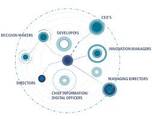
Developers are an integral part of digital transformation. They design the modular systems that replace legacy architecture and build the applications that allow organizations to deliver products and services in new, innovative ways. Yet, when it comes to business strategy, many organizations overlook their developer talent entirely.
Most developers come from backgrounds in computer science, engineering, or mathematics. These disciplines train people to decompose complex problems, reason about systems, and iterate toward solutions—precisely the skills organizations need when navigating transformational change. Giving developers a meaningful voice in business decisions is not just good people management; it is a competitive advantage.
To unlock the full value of developer talent during a digital transformation, organizations should focus on four key areas.
1. Encourage Personal Development
A growing number of developers are actively investing in communication and leadership skills, recognizing that technical ability alone no longer defines a successful career. Soft skills are essential for building internal relationships, advocating for the engineering team’s work, and engaging empathetically with end users and customers.
Consider two common scenarios: a stakeholder who needs to understand how a product team operates, and a client who needs hands-on guidance when adopting a new solution. In the first case, a developer must be able to translate technical decisions into business language. In the second, they must apply empathy and patience—skills that go well beyond writing code.
Organizations that offer structured learning and development programs—covering new programming languages, emerging tooling, and interpersonal skills—are more likely to attract developers who are motivated to contribute across the business, not just within their immediate team.
2. Keep Things Agile
Working within an Agile framework provides developers with a built-in mechanism for developing soft skills through regular ceremonies such as sprint planning, retrospectives, and daily standups. Each meeting gives team members a structured opportunity to communicate blockers, offer solutions, and take ownership of outcomes.
This open, iterative approach stands in sharp contrast to the traditional Waterfall model, where siloed teams hand off deliverables with minimal communication and feedback arrives too late to be actionable. In Agile teams, shared responsibility is the norm: a developer may need to understand a UX decision, a tester may flag an architectural risk, and a business analyst translates all of this into stakeholder updates.
Agile also surfaces natural leaders. Developers with an inclination for leadership can demonstrate it organically through cross-functional collaboration, rather than waiting for a formal promotion. The relatively small size of most Agile teams means individual voices are heard and feedback loops are short—making learning on the job practical and continuous.
3. Be Clear on Requirements and Standards
Attracting strong developer talent is only part of the equation. Organizations must also be transparent about daily expectations—both technical and behavioral. Clear requirements reduce ambiguity, minimize rework, and allow developers to focus energy on work that genuinely moves the business forward.
On the technical side, efficient and well-tested code should be the goal. Workarounds and technical debt may resolve immediate problems, but they introduce systemic risk—particularly when defects surface in production or a client encounters unexpected behavior. Fewer bugs in a sprint naturally shifts scrum meeting focus from firefighting to strategy and innovation.
Organizations should establish documented coding standards, code review processes, and definition-of-done criteria to reduce the temptation of quick fixes and ensure releases are production-ready. Developers must also be comfortable working from design specifications and incorporating client feedback quickly—especially in teams operating continuous integration and continuous delivery (CI/CD) pipelines.
An interest in emerging technologies is valuable, but so is the pragmatic ability to leverage existing solutions rather than rebuild them from scratch. Reuse reduces cost and protects return on investment in established platforms.
4. Keep an Eye on the Future
An organization’s long-term competitive position increasingly depends on how quickly it can respond to technology advances. This means developers need the freedom—and the time—to explore new tools, experiment with emerging technologies, and bring innovation back into the product roadmap.
Technologies such as IoT and connected devices, AI and machine learning, augmented and virtual reality, blockchain, and 5G networks are already opening new business models and user experiences. Developers who build hands-on expertise in these areas become more than implementers—they become advisors who can identify viable use cases, flag risks early, and propose solutions that business stakeholders may not yet know are possible.
This creates a virtuous cycle: developers who grow their skills make themselves more valuable to employers, and employers who invest in that growth gain advocates who can connect technical decisions to strategic outcomes. In a digital transformation, that connection is everything.
Conclusion
Developers are not just executors of a digital transformation strategy—they are among its most capable architects. Organizations that create the conditions for developers to grow personally, work collaboratively, operate to clear standards, and stay ahead of technology trends will find that their engineering teams become a genuine driver of business change, not just a cost center delivering features.
This article is based on original reporting from devops.com.