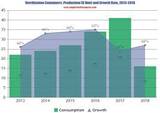
This article summarises a 2019 market research report on the global application container industry, originally sourced from newsdescription.com and attributed to Orbis Research. Statistics and forecasts reflect the state of the market as of the report’s publication date and should not be treated as current figures.
Market Overview
According to a 2019 market research report, the global application container market was projected to grow at a compound annual growth rate (CAGR) of approximately 29% between 2019 and 2024. Two of the primary catalysts behind this growth were the broad shift toward cloud computing and the mainstream adoption of DevOps practices. Containerisation makes cloud-hosted applications both portable and horizontally scalable, while containers integrate naturally into DevOps toolchains — meaning that organisations moving to DevOps often adopt containers simultaneously.
What Is an Application Container?
An application container is a self-contained, executable software package that bundles application code together with everything it needs to run: runtime, system libraries, configuration files, and dependencies. Because containers share the host operating system kernel rather than each running a full guest OS, they are significantly lighter than traditional virtual machines (VMs). Typical container images measure in tens of megabytes, whereas VM images can run to several gigabytes. This density advantage means a single server can host many more container workloads than equivalent VM workloads.
Key Growth Drivers
- Portability: A container packages an application with all its dependencies, enabling it to run consistently across development laptops, on-premises servers, testing environments, and public or private clouds without modification.
- Resource efficiency: Because containers share the host kernel, a single server can run far more containerised workloads than equivalent VM-based deployments, improving hardware utilisation.
- Cost reduction: Denser workload packing reduces the number of servers required. Combined with faster, more automated deployment pipelines, containers can lower both infrastructure operating costs and development overhead.
- DevOps alignment: Containers complement CI/CD pipelines, immutable infrastructure patterns, and microservices architectures — all central to modern DevOps practice.
Key Challenges
Despite strong adoption momentum, container security remained a notable concern at the time of the report. Because containers share the host OS kernel rather than running fully isolated guest operating systems, the isolation boundary is thinner than with traditional VMs. A kernel vulnerability can potentially expose all containers on a host, and the broad default availability of root access within containers increases the blast radius of a compromise. These concerns were driving investment in runtime security tooling, image scanning, and hardened container platforms.
Key Market Trends
Retail and E-Commerce Adoption
Retail and e-commerce organisations were identified as a significant growth segment. Businesses in this vertical were turning to container platforms to modernise software supply chains, accelerate release cycles, and support high-availability transaction processing at scale. The report cited Visa as a notable example: after migrating two critical payment processing applications to Docker’s enterprise container platform, the company reportedly achieved a ten-fold improvement in scalability within six months of going to production, while continuing to support millions of transactions per day. Swedish lock manufacturer Assa Abloy was also cited as an example of a traditional manufacturer using containers as part of a broader digital transformation strategy spanning public cloud and microservices.
North America Leading Market Share
North America held the largest regional market share according to the report. Contributing factors included strong enterprise investment in microservices architecture, a mature cloud ecosystem anchored by major hyperscale providers, active financial investment in container technology companies, and high demand for DevOps capabilities across industries. The region’s established cloud infrastructure and concentration of both large enterprises and specialist container vendors positioned it as the primary market for container platform adoption.
Competitive Landscape
The application container market was characterised as highly competitive and moderately fragmented, with a mix of large technology companies and specialist vendors competing across product innovation, partnerships, and mergers and acquisitions. Key players named in the report included:
- Amazon Web Services (AWS)
- Cisco Systems
- Docker Inc.
- Google LLC
- IBM Corporation
- Microsoft Corporation
- Rancher Labs
- Oracle Corporation
- Joyent Inc.
- D2iQ Inc.
Notable 2019 Announcements
- Docker Enterprise 3.0 (April 2019): Docker announced Docker Enterprise 3.0 at its user conference, positioning it as an end-to-end container platform designed to support both legacy and cloud-native application types, deployable across hybrid cloud and edge environments.
- K3OS by Rancher Labs (April 2019): Rancher Labs announced K3OS, an operating system purpose-built to run k3s — a lightweight Kubernetes distribution designed for resource-constrained environments such as edge nodes and IoT devices. k3s itself had been announced in February 2019.
Why Containers Matter for DevOps Teams
For DevOps practitioners, the container market context translates into concrete operational realities. Widespread enterprise adoption means that container orchestration skills — particularly around Kubernetes — have become foundational. The security concerns highlighted in 2019 led to a now-mature ecosystem of tools covering image vulnerability scanning, runtime threat detection, network policy enforcement, and secrets management. Teams evaluating container strategies today benefit from a significantly more mature tooling landscape than existed at the time this report was published, but the fundamental architectural trade-offs between container isolation and VM isolation described here remain relevant.
Source: Orbis Research market report summary, originally published via newsdescription.com, December 2019.