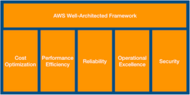
It is a common misconception that the most reliable systems never experience failures. In reality, disruptions, misconfigurations, and network issues are inevitable. Truly reliable systems are those architected to be self-healing, resilient, and capable of rapid recovery. The AWS Well-Architected Framework’s Reliability Pillar provides actionable best practices for building such systems—covering strong architectural foundations, consistent change management, and proven failure-recovery processes.
AWS organises the work of achieving reliability into three areas: understanding your availability needs, designing applications for availability, and operational considerations. This article walks through each area in detail.
1. Understanding Availability Requirements
Not every application needs the same level of availability, and accurately gauging your requirements is the essential first step. Getting this wrong in either direction is costly: over-engineering availability drives up development and operational costs, while under-engineering it risks unacceptable downtime.
To illustrate the range, consider two-nines availability (99%) versus five-nines (99.999%). Two-nines permits roughly three and a half days of downtime per year—acceptable for a batch ETL job or internal reporting tool. Five-nines permits only around five minutes of downtime annually—a threshold appropriate for critical financial or transaction processing systems.
In practice, most applications are not monolithic: they are composed of multiple components with different availability requirements. An e-commerce platform, for example, might demand very high availability for its customer-facing order submission flow, while its fulfilment and reporting components can tolerate longer recovery windows. AWS recommends evaluating each component individually and setting differentiated availability targets accordingly.
Data Plane vs. Control Plane
AWS distinguishes between two planes of operation, each with different availability characteristics:
- Data plane: Handles real-time service delivery. Examples include DynamoDB read/write operations, RDS connectivity, and EC2 instance-to-instance communication. These paths must be highly available.
- Control plane: Handles configuration and provisioning activity. Examples include launching EC2 instances, creating S3 buckets, and provisioning RDS databases. These operations are less latency-sensitive and can tolerate brief interruptions.
By understanding this separation, teams can prioritise their resilience investment where it matters most—on the data plane paths that directly affect end users.
2. Application Design for Availability
Once availability requirements are defined, architectural patterns must be applied to meet them. AWS identifies five key practices:
2.1 Fault Isolation Zones
AWS provides multiple levels of physical and logical isolation to contain the blast radius of failures:
- Availability Zones (AZs): Multiple, physically separated data centres within a single AWS Region. Deploying across AZs delivers resilience with low inter-AZ latency—the right choice for most production workloads.
- Regions: Geographically separate AWS deployments offering maximum isolation. Appropriate for disaster recovery or data sovereignty requirements, but the higher latency makes them unsuitable for synchronous replication in latency-sensitive applications.
2.2 Redundant Components
Physical infrastructure must be designed without single points of failure. Redundant components—deployed across multiple AZs and, where appropriate, across multiple compute nodes and storage volumes—operate in parallel to absorb individual failures without degrading the overall service. The goal is that the failure of any single component is handled gracefully and transparently.
2.3 Microservice Architecture
Decomposing an application into microservices allows teams to apply appropriate availability targets and resilience patterns to each service independently. AWS identifies three core organisational and technical benefits of microservices:
- A small, focused team owns a single business capability, enabling cleaner organisational scaling.
- Each service can be deployed independently, as long as its API contract and other interface requirements are met.
- Each team can choose the technology stack best suited to their service’s requirements.
The trade-off is increased operational complexity and harder distributed debugging. AWS recommends each microservice explicitly publish its availability target, and suggests using AWS X-Ray for distributed tracing and debugging across service boundaries.
2.4 Recovery-Oriented Computing (ROC)
Recovery-Oriented Computing is a systematic design philosophy that prioritises rapid, automated recovery over attempting to prevent all failures. ROC encompasses:
- Isolation and redundancy to contain failure scope
- System-wide rollback capability
- Comprehensive monitoring and automated health checks
- Diagnostics tooling and modular design
- The ability to restart individual components cleanly
A key ROC principle is avoiding rarely-tested recovery paths. Every recovery mechanism should be exercised regularly in production or in realistic simulation environments so it is proven to work when genuinely needed.
2.5 Distributed Systems Best Practices
Distributed systems introduce a class of failure modes—network partitions, partial failures, retry storms—that require deliberate design patterns. AWS recommends the following techniques:
- Throttling: Once you understand each microservice’s request-handling capacity, implement throttling to keep services responsive under high load. Rather than crashing, a throttled service returns a rate-limit response or fails over to a redundant component. AWS API Gateway has built-in throttling support.
- Retry with exponential backoff: When retrying failed requests, introduce progressively longer pauses between attempts. This prevents retry storms from overwhelming an already-stressed dependency.
- Fail fast: Rather than queuing up requests indefinitely during a disruption—which delays recovery and exhausts resources—return errors immediately when a dependency is known to be unavailable.
- Idempotency tokens: Because retries are common in distributed systems, API requests should carry idempotency tokens. This allows the receiving service to detect duplicate requests and return an identical response without re-executing side effects (such as double-charging a payment).
- Constant work: Systems that experience dramatic swings between idle and peak load are harder to keep stable. Using filler or background work to keep compute resources uniformly occupied improves predictability and resilience.
- Circuit breaker: Avoid hard dependencies that can take down the entire system. A circuit breaker monitors calls to a downstream dependency and, when failures exceed a threshold, stops sending requests to it. The circuit can then fall back to cached data or degrade gracefully until the dependency recovers.
- Bi-modal behaviour and static stability: Components that behave differently under failure than under normal conditions create unpredictable cascading failures. Design components to operate in a degraded-but-stable mode in isolation, so that a partial outage does not propagate through the entire system.
3. Operational Considerations for Availability
Architectural patterns alone are not sufficient. Operational practices must reinforce them.
3.1 Automate Deployments
Manual deployments are a leading cause of reliability incidents. Automation reduces human error and enables safer, faster rollouts. Two deployment strategies are particularly relevant:
- Canary deployment: Route a small percentage of traffic to the new version first. Monitor error rates and key metrics, and only promote the release to full traffic once confidence is established.
- Blue-green deployment: Maintain two full production environments. Route production traffic to the blue environment while deploying and validating the new version in green. Shift traffic to green when ready; roll back instantly by switching back to blue.
Both strategies should be implemented through fully automated continuous integration and continuous delivery (CI/CD) pipelines. Changes should never be applied manually to production systems.
3.2 Testing
Understanding your true availability requires testing under realistic conditions. A well-rounded testing strategy should include:
- Unit and integration tests to verify correctness of individual components and their interactions
- Load and performance tests to verify behaviour under expected and peak traffic volumes
- Failure simulations (chaos engineering) to validate that recovery mechanisms work as designed in practice
3.3 Monitoring and Alarming
You cannot improve what you cannot measure. AWS outlines a layered monitoring approach:
- Instrument every application layer to emit metrics, logs, and traces for key components.
- Aggregate and store observability data using Amazon CloudWatch and Amazon S3.
- Configure CloudWatch alarms to trigger automated responses or page on-call engineers when thresholds are breached.
- Perform deeper analytics with services such as Amazon Athena, Amazon Redshift Spectrum, and Amazon QuickSight.
3.4 Operational Readiness Reviews (ORRs)
Before launching a new service or making a significant change to an existing one, AWS recommends conducting an Operational Readiness Review. An ORR validates that the system meets its defined operational requirements—covering monitoring, alerting, runbooks, capacity planning, and on-call processes. Learnings from incidents should feed back into the ORR checklist, and the review should be repeated at least annually as systems evolve.
3.5 Regular Auditing
Monitoring and alarming systems themselves can drift, become stale, or accumulate coverage gaps over time. Regularly audit your observability tooling to confirm that dashboards reflect current architecture, alarms cover critical paths, and runbooks are up to date.
Conclusion
Building for reliability on AWS is not about eliminating failure—it is about designing systems that expect failure and recover gracefully. By systematically applying the practices of the AWS Well-Architected Framework’s Reliability Pillar—from setting differentiated availability targets and leveraging fault isolation zones, to implementing circuit breakers, automated deployments, and rigorous operational reviews—engineering teams can build applications that remain available and trustworthy even under adverse conditions.
These are not theoretical guidelines: they represent patterns distilled from the operational experience of running large-scale distributed systems. Applying them consistently, and re-evaluating them as your architecture evolves, is the most dependable path to production reliability on AWS.