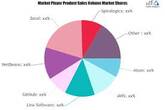
The software development tools market continues to expand as organizations of all sizes invest in platforms and technologies that accelerate delivery, improve collaboration, and reduce operational overhead. From cloud-based IDEs to project management suites, the ecosystem spans a broad range of products serving large enterprises and small-to-medium businesses alike.
What Are Software Development Tools?
Software development tools are applications, platforms, and services used throughout the software development lifecycle (SDLC). They cover source code editing, version control, continuous integration and delivery (CI/CD), project tracking, API design, testing, deployment, and collaboration. The market is generally segmented by deployment model and by the size of the organization using the tools.
Deployment Models
- Cloud-Based: Hosted and managed by the vendor; accessed via browser or API. Reduces infrastructure overhead and supports distributed teams.
- On-Premise: Installed and operated within an organization’s own data center. Preferred in regulated industries where data residency and security controls are mandatory.
Primary End-User Segments
- Large Enterprises: Require scalable, integrated toolchains with enterprise support, audit trails, and compliance features.
- SMEs (Small and Medium Enterprises): Prioritize low cost of entry, ease of setup, and managed-service options that reduce the need for dedicated DevOps staff.
Notable Players in the Market
The competitive landscape includes a mix of large cloud providers, open-source projects, and specialist vendors. The following companies are frequently cited as significant participants across various analyst reports covering this space:
- GitHub (Microsoft): The dominant platform for source control, code review, and—via GitHub Actions—CI/CD automation.
- AWS (Amazon Web Services): Offers a broad developer toolchain including CodeCommit, CodeBuild, CodeDeploy, and CodePipeline, tightly integrated with the broader AWS ecosystem.
- Microsoft: Azure DevOps, Visual Studio, and VS Code cover planning, coding, testing, and deployment across cloud and on-premise environments.
- Atlassian: Jira, Confluence, and Bitbucket are widely used for agile project management, documentation, and code hosting.
- NetBeans: An open-source IDE, now under the Apache Software Foundation, supporting Java and other languages.
- Atom: A hackable, open-source text editor developed by GitHub (now archived; VS Code has largely superseded it).
- Bootstrap: The widely adopted open-source front-end framework for responsive web development.
- Axure: A prototyping and wireframing tool used in UX and product design phases of the SDLC.
- Zend (Perforce): PHP development tools and the Zend Framework, focused on enterprise PHP applications.
- Linx Software: A low-code platform for building and automating back-end applications and integrations.
- CodeLobster: A PHP-focused IDE supporting popular frameworks such as Laravel, Symfony, and Drupal.
- Kwatee: An open-source software deployment tool focused on automating releases to multiple servers.
- Spiralogics: A software services company offering custom development and project management solutions.
- CloudForge: A cloud-based application lifecycle management (ALM) platform supporting Subversion and Git repositories.
- Codenvy (Red Hat/Eclipse Che): A cloud-based IDE and workspace platform, now integrated into the Eclipse Che open-source project under Red Hat.
Key Market Drivers
Several structural trends are pushing organizations to invest more heavily in developer tooling:
- Shift to cloud-native development: Microservices, containers, and serverless architectures require new tooling for local development, CI/CD, and observability.
- DevOps and DevSecOps adoption: Teams are consolidating fragmented toolchains into integrated platforms to reduce context switching and improve pipeline visibility.
- Remote and distributed teams: Cloud-based IDEs and collaborative review tools have become essential infrastructure rather than optional add-ons.
- AI-assisted development: Copilot-style code completion and automated code review features are becoming differentiating factors in IDE and platform selection.
- Open-source consolidation: Enterprise buyers increasingly standardize on tools with strong open-source communities (Git, VS Code, Kubernetes) while paying for enterprise support tiers.
Regional Market Overview
Demand for software development tools is global, but adoption rates and preferred deployment models vary by region:
- North America (U.S., Canada, Mexico): The largest market by revenue, driven by a high density of technology companies, large enterprise software budgets, and early adoption of DevOps practices.
- Europe (U.K., Germany, France, Spain, Italy): Strong demand in financial services, automotive, and manufacturing sectors; GDPR compliance requirements elevate interest in on-premise and private-cloud deployments.
- Asia Pacific (China, Japan, South Korea, India, ASEAN): Rapidly growing developer population, especially in India and Southeast Asia; domestic cloud providers compete with global hyperscalers.
- Latin America (Brazil, Argentina, Colombia): Growing outsourcing hub; SME-oriented SaaS tools gaining traction as broadband infrastructure improves.
- Middle East and Africa (UAE, Saudi Arabia, South Africa): Government-led digital transformation initiatives are accelerating enterprise software investment.
Competitive Dynamics and Strategic Considerations
The software development tools market is characterized by rapid consolidation. Large platform players—Microsoft, AWS, Google, and Atlassian—are acquiring or building adjacent capabilities to offer end-to-end developer platforms. Smaller specialist vendors compete on depth of feature set, open-source credibility, or vertical focus.
For engineering teams evaluating tooling, the most important strategic considerations typically include:
- Integration breadth: How well does the tool connect with the rest of your existing stack?
- Total cost of ownership: License costs plus the engineering time required to operate and maintain the tool itself.
- Vendor lock-in risk: Proprietary data formats, APIs, or workflow automation that make migration costly.
- Security and compliance posture: SOC 2, ISO 27001, FedRAMP, and similar certifications matter for regulated industries.
- Community and ecosystem: Plugin ecosystems, documentation quality, and community support directly affect long-term maintainability.
Summary
The global software development tools market is large, competitive, and evolving quickly. Cloud-based deployment is becoming the default for most teams, while on-premise options retain importance in security-sensitive environments. The key players span from hyperscale cloud providers to focused open-source projects, and the decision of which tools to adopt has direct implications for developer productivity, security posture, and operational costs. Engineering leaders should evaluate tools not just on features but on ecosystem health, total cost, and strategic alignment with their organization’s long-term architecture direction.