
Source: InfoWorld, based on RightScale’s 2017 State of the Cloud report (survey of 1,000+ IT professionals worldwide).
Overview
RightScale’s annual State of the Cloud report has become one of the most widely cited snapshots of enterprise cloud and DevOps adoption. The 2017 edition, derived from a survey of more than 1,000 IT professionals worldwide, highlighted three dominant trends: Docker’s commanding lead among DevOps tools, the continued normalization of hybrid and multi-cloud strategies, and Microsoft Azure’s rapid growth in enterprise public cloud adoption—all while AWS retained its position as the clear market leader.
Docker Leads DevOps Tooling—and Kubernetes Is Climbing Fast
Among all the DevOps tools tracked in the survey, Docker stood out as the clear front-runner. Thirty-five percent of respondents were already running Docker in production, and an additional 32 percent had plans to adopt it. Those adoption figures surpassed every competing tool in the category, including Chef, Puppet, Ansible, Salt, Mesosphere, and Rancher.
Enterprise adoption was even stronger: 40 percent of enterprise respondents were already using Docker, with 30 percent planning to do so. Notably, nearly 35 percent of all Docker users were running some form of container-as-a-service offering, with AWS ECS being the most common choice.
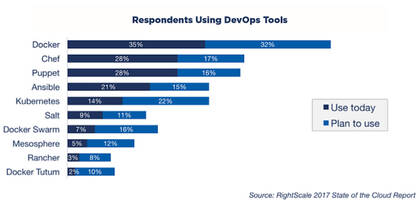
Kubernetes, the container orchestration platform originally developed at Google, registered roughly half of Docker’s adoption numbers—14 percent actively using it and 22 percent planning to. However, RightScale noted that Kubernetes showed the strongest year-over-year growth of any tool in the category. The platform’s emergence as a de facto standard for managing clustered container infrastructure is a likely driver of that acceleration.
What This Means for DevOps Teams
- Docker adoption is broad and accelerating, not limited to startups or cloud-native shops. Enterprise adoption is above average.
- Container orchestration is becoming a requirement, not a nice-to-have. Kubernetes’ trajectory in 2017 foreshadowed its eventual dominance in the orchestration space.
- Container-as-a-service (CaaS) is gaining traction, with AWS ECS being the leading managed option at the time of the survey.
Private Cloud Adoption Edging Down; Hybrid and Multi-Cloud Now the Norm
RightScale has tracked private cloud adoption longitudinally since 2014, and the 2017 data shows a mild but meaningful decline. The percentage of respondents running a private cloud dropped from 77 percent in 2016 to 72 percent in 2017, following a rise from 63 percent the year prior. Hybrid cloud followed a similar trajectory: 58 percent in 2015, 71 percent in 2016, and 67 percent in 2017.
The more telling figures are around multi-cloud usage. Eighty-five percent of enterprises reported using multiple clouds, and 58 percent of those described their strategy as hybrid—combining private and public infrastructure. Organizations relying exclusively on private cloud are now a shrinking minority, while those using multiple public clouds represent the second-largest segment at 20 percent.
The practical takeaway: private cloud isn’t disappearing, but it is increasingly being used in conjunction with public cloud services rather than as a standalone strategy. Pure private-cloud deployments are giving way to architectures that leverage the flexibility of public cloud for variable workloads while keeping sensitive or regulated data on-premises or in dedicated infrastructure.
AWS Remains the Cloud Leader, but Azure Is Closing Ground
AWS continued to dominate public cloud in 2017 by a significant margin, and RightScale observed that its share remained stable year over year. While the percentage of organizations running at least one application on AWS held roughly flat, the report noted that the number of applications and virtual machines per customer was increasing—driving continued revenue growth for Amazon even without net-new customer acquisition at scale.
Microsoft Azure, however, made the most notable gains in the survey. In 2016, 20 percent of respondents reported running applications on Azure; by 2017, that figure had risen to 34 percent—a 14-point jump in a single year. Among enterprise respondents, the growth was even more dramatic: from 26 percent to 43 percent.
Importantly, Azure’s growth does not appear to have come at the direct expense of other established providers. Oracle Cloud and DigitalOcean both saw slight declines—from 4 percent to 3 percent and from 5 percent to 2 percent respectively—but their baseline shares were too small to account for Azure’s surge. The more plausible explanation is that Azure is winning net-new cloud workloads, particularly from enterprises already invested in the Microsoft ecosystem.
Public Cloud Adoption at a Glance (2017 Survey Data)
| Provider | 2016 Adoption | 2017 Adoption | Change |
|---|---|---|---|
| AWS | Stable (largest share) | Stable (largest share) | Flat |
| Microsoft Azure | 20% | 34% | +14 pp |
| Azure (Enterprise) | 26% | 43% | +17 pp |
| Oracle Cloud | 4% | 3% | -1 pp |
| DigitalOcean | 5% | 2% | -3 pp |
Note: Exact AWS percentage figures were not provided in the original source excerpt. The table reflects figures as reported in the InfoWorld summary of RightScale’s data.
Key Takeaways for DevOps and Cloud Engineers
- Docker is the default containerization choice. If your organization hasn’t evaluated Docker yet, you are behind the majority of your peers—especially in enterprise environments.
- Plan for Kubernetes now. Even in 2017, its growth trajectory was pointing toward dominance in container orchestration. That trajectory has since been confirmed.
- Multi-cloud and hybrid are the baseline expectation. Designing systems that can operate across cloud boundaries is no longer an advanced capability—it is table stakes.
- AWS remains the safe default for public cloud, but Azure deserves serious evaluation, particularly for organizations with existing Microsoft licensing agreements or Windows-centric workloads.
- CaaS adoption is growing. Managed container services reduce operational overhead and are being adopted by a meaningful portion of container users.