This article summarises publicly available information about the global DevOps platform market landscape, drawing on a market research teaser originally published by HTF Market Intelligence / indiancolumnist.com (August 2019). Specific revenue figures and CAGR projections cited in the underlying paid report have not been independently verified.
Overview of the Global DevOps Platform Market
The DevOps platform market encompasses the tools, services, and integrated suites that enable organisations to automate, monitor, and continuously deliver software. As enterprises across industries accelerate digital transformation, demand for cohesive DevOps toolchains has grown substantially. Market research published around 2019 highlighted the period from 2019 to 2026 as a key growth window, driven by cloud adoption, microservices architectures, and increasing pressure on engineering teams to shorten release cycles.
Competition in the space spans large platform vendors, specialist tooling companies, and open-source projects backed by commercial entities. The result is a fragmented but rapidly consolidating market, shaped by mergers, acquisitions, and strategic partnerships.
Major Vendors in the DevOps Platform Space
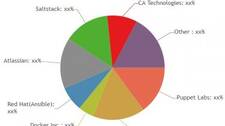
The following companies were identified as significant players in the global DevOps platform market as of the report’s base year. Their positions have continued to evolve through acquisitions and product expansions since then.
- Puppet Labs – Infrastructure automation and configuration management, known for its declarative Puppet DSL and enterprise compliance features.
- Chef (now Progress Chef) – Ruby-based infrastructure-as-code tooling covering configuration management, compliance scanning (InSpec), and application delivery (Habitat).
- Docker Inc. – Pioneer of Linux container packaging and the Docker Engine runtime; also offers Docker Hub as a public image registry.
- Red Hat (Ansible) – Agentless automation platform using YAML-based playbooks; tightly integrated with the Red Hat OpenShift container platform following Red Hat’s acquisition of Ansible in 2015.
- Atlassian – Collaboration and DevOps toolchain vendor behind Jira, Confluence, Bitbucket, and the Bamboo CI/CD server.
- SaltStack – Event-driven automation and remote execution engine; acquired by VMware in 2020.
- CA Technologies (Broadcom) – Enterprise DevOps portfolio including Rally (agile planning) and Automic (release automation); acquired by Broadcom in 2018.
- Rackspace – Managed cloud services provider offering DevOps-as-a-service and multi-cloud expertise.
- XebiaLabs (now Digital.ai) – Enterprise release orchestration and deployment automation platform.
- VersionOne (now Digital.ai) – Agile and SAFe project management tooling, merged with XebiaLabs under the Digital.ai brand.
- Cisco – Network automation, AppDynamics APM, and DevSecOps integrations.
- CollabNet (now Digital.ai) – ALM and value stream management platform.
- HP (Micro Focus) – ALM, performance testing, and application security tooling for enterprise DevOps workflows.
- IBM – DevOps capabilities via IBM Cloud, UrbanCode Deploy/Release, and AI-assisted testing through Watson.
- Microsoft – Azure DevOps Services (formerly VSTS), GitHub (acquired 2018), and deep IDE integration through Visual Studio and VS Code.
- Spirent Communications – Network and application testing, increasingly relevant for DevOps pipelines in telco and SD-WAN environments.
- VMware – Tanzu portfolio for Kubernetes-based application delivery; also acquired SaltStack and Carbon Black post-report.
- DBmaestro – Database DevOps and release automation, bringing CI/CD practices to schema and stored-procedure change management.
Market Segmentation by Maturity Type
The market research segments organisations by their level of DevOps adoption maturity. This tiering is a common framework used by analysts to differentiate product positioning and organisational readiness:
- DevOps Ready – Organisations that have established the cultural and process foundations for DevOps but have not yet fully automated their pipelines.
- DevOps Enabled – Teams that have adopted core automation tooling across CI/CD and configuration management, with measurable improvements in deployment frequency.
- DevOps Capable – Mature practitioners running fully automated, metrics-driven pipelines with advanced practices such as chaos engineering, GitOps, and continuous security scanning.
Market Segmentation by Industry Vertical
DevOps platform adoption cuts across sectors, though the pace and tooling choices vary significantly by vertical:
- Information Technology – The largest adopter segment; software companies and SaaS providers have driven much of the early toolchain innovation.
- Banking, Financial Services, and Insurance (BFSI) – High compliance and audit requirements make automated policy enforcement (e.g., OPA, Chef InSpec) especially important.
- Retail – Omnichannel demand drives rapid release cycles for e-commerce platforms and inventory systems.
- Telecommunications – Network function virtualisation (NFV) and 5G rollouts are pushing telcos toward infrastructure automation and CI/CD for network software.
- Education – Growing adoption of cloud-hosted learning platforms has brought DevOps practices into edtech development teams.
- Other sectors – Healthcare, manufacturing, and government are increasingly moving workloads to cloud environments with associated DevOps toolchain requirements.
Regional Breakdown
DevOps platform adoption and market revenue are distributed unevenly across geographies, reflecting differences in cloud infrastructure maturity, enterprise IT spending, and developer community size.
- North America (United States, Canada, Mexico) – The dominant market, home to most of the major platform vendors and the highest concentration of cloud-native enterprises.
- Europe (Germany, France, UK, Russia, Italy) – Strong adoption in financial services and automotive sectors; GDPR compliance requirements create demand for auditable, policy-driven pipelines.
- Asia-Pacific (China, Japan, South Korea, India, Southeast Asia) – The fastest-growing region, fuelled by a large developer population in India, rapid cloud expansion in China, and digital transformation programmes across Southeast Asia.
- South America (Brazil, Argentina, Colombia) – Emerging adoption driven by fintech growth and increasing public cloud availability from AWS, Azure, and GCP.
- Middle East and Africa (Saudi Arabia, UAE, Egypt, Nigeria, South Africa) – Government-led digital transformation initiatives and smart-city projects are primary adoption drivers.
Key Market Dynamics
Drivers
- Growing enterprise pressure to reduce time-to-market for software releases.
- Widespread adoption of public cloud platforms, which lower the barrier to self-service infrastructure provisioning.
- Kubernetes and container orchestration normalising portable, reproducible deployment targets.
- Cultural shift toward cross-functional product teams blurring the developer/operator boundary.
Restraints
- Skills shortages — qualified DevOps engineers and SREs remain in high demand globally.
- Tool sprawl and integration complexity as organisations accumulate point solutions rather than cohesive platforms.
- Resistance to cultural change within traditional IT organisations operating waterfall or ITIL-only processes.
- Security and compliance concerns, particularly in regulated industries, can slow pipeline automation adoption.
Opportunities
- Value stream management (VSM) tooling to give executives visibility from idea to production.
- AI/ML-assisted pipeline optimisation and anomaly detection in monitoring stacks.
- DevSecOps integration — shifting security left into CI pipelines rather than treating it as a post-deployment gate.
- Platform engineering teams building internal developer portals (IDPs) to standardise and abstract toolchain complexity.
Competitive Landscape Observations
The DevOps platform market has seen significant consolidation since 2019. Notable developments include:
- Microsoft’s GitHub acquisition (2018) and subsequent investments in GitHub Actions have made the platform a full CI/CD competitor, not just a source control host.
- VMware acquired SaltStack (2020) and Pivotal, integrating automation capabilities into the Tanzu portfolio.
- XebiaLabs, VersionOne, and CollabNet merged under the Digital.ai brand, creating a value stream management platform targeting enterprise-scale DevOps.
- Chef was acquired by Progress Software (2020), repositioning the product within a broader application experience portfolio.
- Broadcom’s acquisition of CA Technologies (2018) and subsequent VMware acquisition (2023) continue to reshape the enterprise end of the market.
New entrants — including GitLab, Harness, Argo (CNCF), and Tekton — have also gained significant traction since the original report period, particularly in cloud-native and Kubernetes-native pipeline scenarios.
Summary
The global DevOps platform market remains one of the most active and competitive segments in enterprise software. The convergence of cloud infrastructure, container orchestration, and AI-assisted operations continues to raise the baseline expectation for what a DevOps platform must deliver. Organisations evaluating toolchains should assess not just current feature parity, but vendor roadmap stability, ecosystem integration breadth, and total cost of platform ownership — including the human cost of training and adoption.
Source reference: HTF Market Intelligence / indiancolumnist.com market research teaser, originally published August 2019. The underlying paid report covers the forecast period 2018–2023 with historical data from 2013–2017.