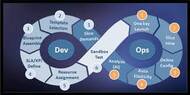
The global DevOps platform market has expanded rapidly as organizations across industries adopt continuous integration, continuous delivery, infrastructure automation, and collaborative development practices. This article summarizes the market landscape, key vendors, segmentation dimensions, and the competitive factors analysts typically examine when evaluating this space.
What Is the DevOps Platform Market?
A DevOps platform is an integrated suite of tools—or a unified product—that supports the full software delivery lifecycle: planning, coding, building, testing, releasing, deploying, operating, and monitoring. The market encompasses standalone toolchains assembled from best-of-breed products as well as all-in-one platforms offered by major vendors.
Demand is driven by enterprise pressure to shorten release cycles, improve reliability, and reduce manual toil across development and operations teams. Cloud-native adoption, container orchestration, and infrastructure-as-code practices all contribute to sustained market growth.
Leading Vendors in the DevOps Platform Space
The vendor landscape is broad and covers specialists in configuration management, container orchestration, CI/CD, release automation, and collaborative project management. Frequently cited players include:
- Puppet Labs – Infrastructure automation and configuration management
- Chef (Progress) – Policy-based infrastructure automation
- Docker Inc. – Containerization platform and developer tooling
- Red Hat (Ansible) – Agentless automation and OpenShift container platform
- Atlassian – Jira, Confluence, Bitbucket, and Bamboo for planning and CI/CD
- SaltStack (VMware) – Event-driven automation and remote execution
- Broadcom (formerly CA Technologies) – Enterprise release automation and value stream management
- Rackspace Technology – Managed cloud and DevOps professional services
- XebiaLabs (Digital.ai) – Release orchestration and value stream management
- VersionOne (Digital.ai) – Agile planning and DevOps value stream
- Cisco – Network automation and DevSecOps integrations
- CollabNet (Digital.ai) – SCM and Agile ALM tooling
- HPE (Micro Focus) – ALM, testing, and DevOps toolchain
- IBM – IBM DevOps and hybrid cloud delivery solutions
- Microsoft – Azure DevOps and GitHub
- VMware – Tanzu platform for modern application delivery
- DBmaestro – Database DevOps and release automation
Note that several of the companies listed above have undergone significant acquisitions, rebranding, or product consolidation since 2019. Readers should verify current product names and parent organizations before making purchasing or competitive decisions.
Market Segmentation
By Type
DevOps platforms are commonly segmented by deployment model and functional category:
- On-premises – Self-hosted tools managed within the organization’s own infrastructure
- Cloud-hosted (SaaS) – Vendor-managed platforms delivered as a service
- Hybrid – Combinations that span on-premises and cloud environments
Functional categories include source code management, CI/CD pipelines, configuration management, container platforms, monitoring and observability, and value stream management.
By Application
Adoption spans multiple verticals and use cases:
- Financial services and banking (regulatory compliance, rapid feature delivery)
- Healthcare IT (secure, auditable release pipelines)
- Retail and e-commerce (high-frequency deployment, A/B testing)
- Telecommunications (network function automation)
- Government and public sector (digital transformation programs)
- Software and technology companies (core delivery workflows)
Regional Market Breakdown
Market adoption and growth rates vary by region, reflecting differences in cloud maturity, enterprise IT spending, and regulatory environment:
- North America – United States, Canada, Mexico (historically the largest market by revenue)
- Europe – UK, Germany, France, Italy, Spain, Russia
- Asia-Pacific – China, India, Japan, South Korea, Singapore, Indonesia, Australia
- Middle East & Africa – Saudi Arabia, UAE, Turkey, Egypt, South Africa
- South & Central America – Brazil, Argentina, Chile
Asia-Pacific, and India in particular, is frequently cited as a high-growth region owing to the expansion of software services exports and cloud infrastructure investment.
Key Competitive Dynamics
Mergers, Acquisitions, and Consolidation
The DevOps toolchain market has seen significant consolidation. Notable examples include Digital.ai’s roll-up of XebiaLabs, CollabNet, VersionOne, and Arxan; Broadcom’s acquisition of CA Technologies; and VMware’s acquisition of SaltStack. This trend toward platform consolidation reflects enterprise appetite for integrated value stream management rather than point solutions.
R&D and Patent Activity
Vendors compete heavily on automation intelligence, AI-assisted testing, and security integration (DevSecOps). R&D investment in areas such as AI-driven anomaly detection, automated remediation, and policy-as-code continues to accelerate patent filings across the category.
Financial Metrics Analysts Track
When evaluating vendor health and market positioning, analysts typically examine:
- Revenue growth rate (year-over-year)
- Gross margin and EBITDA margin
- Net Revenue Retention (NRR) for SaaS vendors
- Market share within specific functional segments (CI/CD, monitoring, etc.)
- Partner ecosystem breadth and marketplace presence
Development Strategies Shaping the Market
Several strategic themes are consistently influencing how vendors position and develop their DevOps platforms:
- Platform unification – Moving from toolchain integrations to native, end-to-end platforms that reduce integration overhead (e.g., GitLab’s single-application approach, GitHub’s expansion from SCM to Actions and Packages)
- AI/ML-assisted workflows – Embedding AI copilots, predictive analytics for pipeline failures, and intelligent test selection
- Security-first delivery (DevSecOps) – Shifting security scanning left into the pipeline and providing policy-as-code guardrails
- Value stream management (VSM) – Giving engineering and business leadership end-to-end visibility from idea to production
- Open-source community investment – Maintaining open-core models to drive adoption and ecosystem growth
Summary
The global DevOps platform market remains highly competitive, with a mix of large enterprise vendors (Microsoft, IBM, Red Hat) and specialist players competing on integration depth, ease of use, and AI-enhanced automation. Consolidation is ongoing, and the lines between CI/CD, security, and observability tooling continue to blur as vendors race to offer comprehensive platforms. Organizations evaluating this market should assess vendors not only on current feature parity but on roadmap alignment with platform unification and DevSecOps maturity.
Note: The original market data cited in the source article was attributed to a 2019 report by Market Intellica via portnews24.com. Vendor names, product portfolios, and market share figures have changed materially since that publication date. Always refer to current analyst reports (Gartner, Forrester, IDC) for up-to-date market sizing.