This article summarises findings from the “Continuous Delivery Market – Growth, Trends, and Forecast (2019–2024)” report, as reported by GlobeNewsWire on June 24, 2019. All figures and projections originate from that report unless otherwise noted.
Market Overview
The global continuous delivery (CD) market was forecast to grow at a compound annual growth rate (CAGR) of 19.75% between 2019 and 2024, according to a report published by Research and Markets. The primary growth drivers identified were the accelerating adoption of cloud infrastructure, the integration of AI and machine learning into software pipelines, and a broader enterprise push toward end-to-end automation of software delivery processes.
Supporting this trajectory, a survey by Perforce cited in the report found that 65% of managers, software developers, and executives reported their organisations had already begun adopting continuous delivery practices at the time of the report.
Key Market Drivers
- Cloud infrastructure expansion: The proliferation of cloud-native tooling has lowered the barrier to entry for continuous delivery, allowing organisations of all sizes to implement scalable, on-demand delivery pipelines without heavy upfront infrastructure investment.
- AI and machine learning integration: Embedding AI into CI/CD pipelines enables smarter test selection, anomaly detection in deployments, and predictive analytics for release quality — reducing human intervention and accelerating feedback loops.
- Connected device proliferation: The growth of IoT and connected infrastructure increases the volume and frequency of software updates required, making automated, continuous delivery pipelines a practical necessity rather than an optional improvement.
- Demand for automation across business processes: Organisations across verticals — from banking to healthcare — are seeking to replace manual, error-prone release processes with repeatable, auditable automated pipelines.
Key Market Restraints
- Skills shortage: A lack of engineers with hands-on CD and DevOps expertise was identified as a significant barrier to adoption, particularly in mid-market organisations.
- Organisational resistance to change: Many enterprises remain hesitant to re-engineer existing toolchains and processes, especially when legacy systems are deeply embedded in operations.
- Open source vs. commercial tension: The dominance of open source CD tools (such as Jenkins, Argo CD, and Tekton) puts competitive pressure on commercial vendors, compressing margins and making it harder for commercial solutions to justify licensing costs.
- Data security and privacy concerns: Moving delivery pipelines to the cloud introduces questions around secrets management, supply chain integrity, and compliance — particularly in regulated industries.
Major Market Trends
Cloud Deployment Gaining Strong Traction
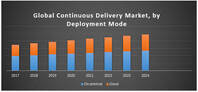
Cloud-hosted continuous delivery tooling offers significant advantages over on-premise deployments: elastic scalability, reduced operational overhead, and faster onboarding. Public cloud platforms, which distribute infrastructure costs across multiple tenants, offer a lower-cost entry point compared to private cloud — making them attractive to SMBs and startups.
The report noted that cloud service providers were actively addressing earlier enterprise concerns around security by introducing end-to-end encryption, fine-grained access controls, and real-time monitoring services. In March 2018, IBM launched a private cloud platform targeted at enterprise workloads — a move the report suggested would pressure other vendors to follow suit with comparable offerings.
North America Projected to Hold the Largest Market Share
North America — led by the United States — was projected to account for the largest share of the global CD market, driven by early enterprise adoption of cloud and IoT technologies. The report estimated that approximately 35% of SMBs in the United States had already deployed cloud solutions at the time of publication.
Strategic activity in the region was also notable: the report cited a partnership between Steltix and Autodeploy to bring a continuous deployment and delivery software suite to European markets as an example of North American vendors expanding internationally. Key verticals expected to drive regional demand included retail, healthcare, telecommunications, and manufacturing.
Market Segmentation
The report segmented the continuous delivery market across four primary dimensions:
By Deployment Type
- Cloud
- On-premise
By Organisation Size
- Large enterprises
- Small and medium-sized enterprises (SMBs)
By End-User Industry
- Banking, Financial Services, and Insurance (BFSI)
- Telecom and IT
- Retail and Consumer Goods
- Healthcare and Life Sciences
- Manufacturing
- Government and Defence
- Other industries
By Geography
- North America
- Europe
- Asia-Pacific
- Latin America
- Middle East & Africa
Competitive Landscape
The report described the continuous delivery market as fragmented, with a mix of large enterprise software vendors and specialist DevOps tooling companies competing across different segments. Key players profiled in the report included:
- XebiaLabs
- IBM Corporation
- Microsoft Corporation
- Accenture PLC
- Wipro Limited
- Salesforce
- CA Technologies (now part of Broadcom)
- Electric Cloud Inc. (acquired by CloudBees)
- Red Hat Inc. (acquired by IBM)
- Atlassian Corporation PLC
- Flexagon LLC
- Clarive Software Inc.
The landscape has shifted considerably since the report was published in 2019. Several acquisitions have consolidated the market: notably, Electric Cloud was acquired by CloudBees, and Red Hat was acquired by IBM — both developments the report had already begun to reflect in company profiles.
Notable Industry Developments (at Time of Publication)
- June 2019: Microsoft launched AI Digital Labs in India, partnering with ten higher education institutions to deliver cloud and AI infrastructure, training curricula, and developer tooling — with the stated aim of skilling approximately 150,000 students for technology roles.
- May 2019: Salesforce and Dell Technologies announced a strategic technology agreement to expand deployment of Salesforce’s CRM and Einstein AI platform across thousands of Dell employees globally.
Context for DevOps Practitioners
While market research reports provide useful directional signals, DevOps teams evaluating continuous delivery tooling should weigh vendor-neutral criteria alongside market positioning. The core capabilities to assess include pipeline-as-code support, native cloud and Kubernetes integration, secrets management, artifact traceability, and the breadth of integration with existing SCM, testing, and monitoring tooling.
The open source ecosystem — including Jenkins X, Argo CD, Tekton, and Flux — continues to mature rapidly and offers enterprise-grade capabilities without commercial licensing costs, which aligns with the report’s observation that open source tooling exerts significant competitive pressure on commercial CD platforms.
Source: GlobeNewsWire / Research and Markets, June 24, 2019. Original report: “Continuous Delivery Market – Growth, Trends, and Forecast (2019–2024).”