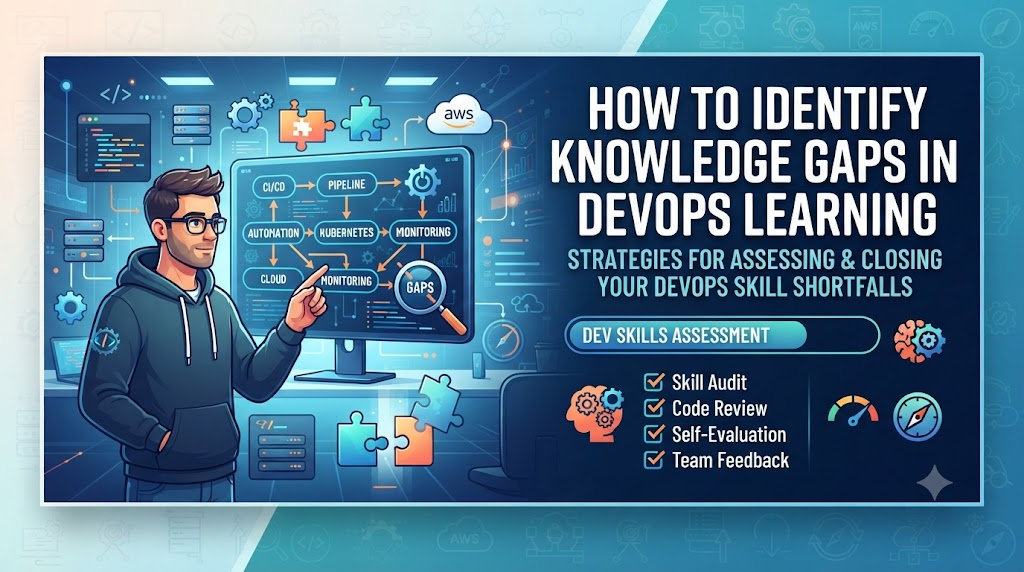
Introduction
Have you ever completed a video course on Docker, Jenkins, and Kubernetes, built a project following a step-by-step YouTube tutorial, but felt completely lost the moment you opened a blank terminal screen on a real job? You are not alone. Many learners face a startling reality: they know the names of dozens of tools, yet they struggle when a deployment fails in a production-like environment.
This friction points directly to the difference between theoretical knowledge, tool familiarity, and practical capability. DevOps learning is rarely a straight line. Without a clear method to how to identify knowledge gaps in DevOps learning, learners waste months collecting certificate badges while remaining vulnerable to real-world operational challenges. Recognizing your missing links is the single most effective catalyst for growth, transforming you from a passive tutorial-follower into a confident, capable DevOps engineer skills practitioner.
What Are Knowledge Gaps in DevOps?
DevOps knowledge gaps represent the disconnect between what you think you know and what you can successfully execute under pressure. In the multi-disciplinary world of DevOps, these gaps can manifest across a sprawling toolchain:
- Linux & Operating Systems: Inability to inspect systemd logs, manage file permissions, or diagnose kernel panic traces.
- Networking: Confusion over DNS propagation, TCP/IP handshakes, subnet masks, or reverse proxy routing.
- Git & Version Control: Struggling with merge conflicts, rebasing, or structuring multi-branch GitOps workflows.
- Scripting: Relying completely on copy-pasted Bash or Python snippets without understanding error handling (
set -e) or idempotency. - CI/CD: Hardcoding credentials inside pipeline files or failing to design rollback mechanisms.
- Cloud & Containers: Treating Docker containers like virtual machines or ignoring cloud IAM security boundaries.
- Kubernetes: Blindly applying YAML manifests without understanding liveness probes, resource quotas, or Ingress controllers.
- Infrastructure as Code (IaC): Writing unmodularized Terraform code that breaks during state file locks or drift corrections.
- Monitoring, Security & Troubleshooting: Waiting for users to report errors because alerts were never configured for application latency spikes.
Why DevOps Learners Develop Knowledge Gaps
Understanding why these gaps form helps you prevent them in the future. Common culprits include:
- Learning tools without understanding fundamentals: Memorizing a Terraform command without grasping how HTTP APIs communicate with cloud providers.
- Following tutorials without independent practice: Relying on guided walkthroughs where every error has already been solved for you.
- Focusing only on certification preparation: Passing multiple-choice exams that test multiple guesses rather than real-world debugging.
- Skipping troubleshooting exercises: Quitting the moment a container crashes instead of reading stack traces.
- Learning too many tools at once: Trying to master ArgoCD, Istio, and Kafka before understanding basic Linux process management.
- Not working on end-to-end projects: Building isolated components (a standalone script here, a local container there) rather than a complete delivery pipeline.
- Avoiding unfamiliar technologies: Sticking to Docker Compose because Kubernetes or serverless environments feel intimidating.
- Not reviewing mistakes or failed deployments: Treating a broken build as an annoyance rather than a deep diagnostic lesson.
Signs That You Have a DevOps Knowledge Gap
How can you tell if your skills are built on solid ground or quicksand? Watch out for these warning signs:
- Difficulty explaining basic concepts: You can run
kubectl apply, but you cannot explain what happens inside the Kubernetes control plane when you do. - Copying commands without understanding them: Your terminal history is full of long commands pasted straight from Stack Overflow without checking flags.
- Unable to troubleshoot pipeline failures: A GitHub Actions or Jenkins build turns red, and your first instinct is to delete the repository and start over.
- Difficulty reading logs: You stare at a 500-line stack trace and cannot isolate the root error message.
- Struggling to design a deployment workflow: Given a simple Node.js app, you don’t know where to start regarding containerization, artifact storage, and deployment targets.
- Knowing tools individually but not knowing how they integrate: You know Docker and AWS, but you don’t know how to securely push an image from a private registry to an ECS cluster using IAM roles.
- Depending heavily on tutorials: The moment a tutorial version updates and the UI changes, your learning process stalls completely.
- Difficulty solving scenario-based interview questions: You freeze when an interviewer asks, “What would you do if a database migration locks up a production release?”
Assess Your DevOps Fundamentals
Before blaming advanced technologies like service meshes or GitOps controllers, evaluate your foundation. DevOps learning gaps almost always originate from shaky core competencies.
- Linux: Can you navigate filesystems, check disk usage (
df -h,du), track processes (top,ps), and manipulate text streams (awk,sed,grep)? - Networking: Do you understand how packets travel across subnets, how load balancers route traffic (Layer 4 vs. Layer 7), and how TLS certificates work?
- Git: Do you understand branching strategies, tag management, and how pull requests integrate code safely?
- Shell Scripting: Can you write a clean Bash script that checks for exit codes and handles exceptions?
- APIs & Databases: Do you know how REST APIs function, how JSON/YAML payloads are structured, and how to execute basic queries in a relational database?
Strong fundamentals make advanced DevOps skills assessment much easier, shortening your learning curve across every modern tool.
Create a DevOps Skills Assessment Checklist
To map out your current standing, review this matrix covering major competencies required for a well-rounded DevOps career skills profile:
| Competency Area | Beginner (Can follow guide) | Intermediate (Can build with docs) | Advanced (Can troubleshoot & design) | Identified Gap / Action Plan |
| Linux Administration | [ ] | [ ] | [ ] | |
| Git & Version Control | [ ] | [ ] | [ ] | |
| Shell Scripting | [ ] | [ ] | [ ] | |
| CI/CD Pipelines | [ ] | [ ] | [ ] | |
| Docker & Containers | [ ] | [ ] | [ ] | |
| Kubernetes | [ ] | [ ] | [ ] | |
| Cloud Platforms (AWS/GCP/Azure) | [ ] | [ ] | [ ] | |
| Infrastructure as Code (Terraform) | [ ] | [ ] | [ ] | |
| Monitoring & Observability | [ ] | [ ] | [ ] | |
| DevSecOps & Secrets Management | [ ] | [ ] | [ ] | |
| Networking & DNS | [ ] | [ ] | [ ] | |
| Troubleshooting & SRE Mindset | [ ] | [ ] | [ ] |
Use Hands-On Projects to Discover Your Gaps
Passive reading creates an illusion of competence. DevOps hands-on practice is the ultimate truth-teller. When you build something end-to-end, your blind spots reveal themselves immediately. Try executing these projects without tutorials:
- Build an end-to-end CI/CD pipeline: Take a simple web app, containerize it, push it to a private registry, and automate testing and deployment using GitHub Actions.
- Deploy to a multi-node Kubernetes cluster: Set up a local cluster using Minikube or Kind, write your own Deployment, Service, and Ingress manifests, and expose the app securely.
- Provision cloud infrastructure with Terraform: Create a modular Terraform script that provisions a VPC, subnets, internet gateway, security groups, and an EC2 instance running a web server.
- Implement monitoring: Integrate Prometheus and Grafana to track CPU utilization and memory leaks on your deployed application.
When your build fails—and it will—pay close attention to why. Is it a misconfigured security group? A bad volume mount? A YAML indentation error? These friction points are precise indicators of your DevOps learning gaps.
Test Yourself Without Tutorials
A powerful way to conduct a DevOps assessment is the “Blank Slate Test.”
Pick a technology you claim to know—say, Docker multi-stage builds or Terraform modules. Open a fresh code editor with zero browser tabs open. Try to write a complete configuration from memory.
When you get stuck—and you cannot remember the syntax for a specific block or flag—stop. That exact moment of hesitation marks the boundary of your functional knowledge. Instead of instantly searching for the answer, try to reason through the documentation or help flags (--help). This builds genuine engineering resilience rather than rote memorization.
Identify the Difference Between Tool Knowledge and Conceptual Knowledge
Many learners fall into the trap of tool accumulation. They learn Jenkins syntax, then GitLab CI syntax, then CircleCI syntax, viewing them as completely separate universes.
True DevOps engineer skills rely on conceptual knowledge.
- Tools change every few years; concepts remain constant.
- Knowing how to write a Dockerfile is tool knowledge; understanding container namespaces, cgroups, and image layering is conceptual knowledge.
- Knowing a specific AWS CLI command is tool knowledge; understanding cloud IAM trust relationships, regional availability zones, and state locks is conceptual knowledge.
When evaluating your skills, ask yourself: If this tool disappeared tomorrow, could I apply the underlying principle using a different technology? If the answer is no, you have a conceptual gap.
Use Troubleshooting as a Knowledge-Gap Detector
Troubleshooting is a mirror reflecting your technical depth. Every time you encounter a bug, it exposes a gap in your mental model. Consider these common diagnostic hurdles:
- Failed CI/CD pipelines: Can you read pipeline console logs to identify whether the failure happened during dependency installation, unit testing, or artifact publishing?
- Docker container failures: Does your container exit immediately with code 137 (OOMKilled)? Do you know how to inspect resource consumption?
- Kubernetes pod crashes: Can you distinguish between an
ImagePullBackOff,CrashLoopBackOff, and aPendingstate caused by insufficient cluster resources? - Networking problems: Can you use
curl,nslookup, ortracerouteto verify whether a container can reach an internal database service? - Authentication errors: Can you troubleshoot expired tokens, incorrect SSH keys, or misconfigured cloud provider credentials?
Use Mock Interviews and Scenario-Based Questions
Technical interviews are often feared, but scenario-based questions are fantastic diagnostics for DevOps skill gaps. Traditional multiple-choice quizzes test memory, but scenarios test situational competence.
Test yourself or a study partner with questions like:
- “An application deployment completed successfully, but users are receiving 504 Gateway Timeout errors. Walk me through your troubleshooting steps.”
- “A Kubernetes pod is stuck in a
Terminatingstate. How do you force-delete it and investigate why it hung?” - “Your Terraform plan shows unexpected changes to resources you didn’t touch. What happened, and how do you fix state drift?”
- “How would you design a secure secret-management workflow so that database passwords are never exposed in plain text inside Git repositories?”
If you struggle to articulate a structured, logical troubleshooting methodology, you have identified an area requiring deeper study.
Ask From Experienced Engineers
It is difficult to spot your own blind spots because your brain naturally glosses over what you don’t know. Seeking feedback from experienced engineers, mentors, or technical communities provides an objective mirror.
- Share your GitHub repository structures or Terraform modules for code reviews.
- Participate in technical forums or local DevOps meetups and explain your architectures.
- Ask senior engineers: “What looks fragile or insecure in this deployment pipeline?”
Constructive feedback cuts through self-deception and highlights hidden weaknesses in security, scalability, and operational hygiene.
Track Knowledge Gaps With a Learning Matrix
To turn insights into action, maintain a personal learning matrix. This simple tracking table helps you prioritize what to fix first:
| Skill / Concept | Current Knowledge Level | Practical Experience | Confidence Level (1–5) | Identified Gap | Learning Resource | Practice Project | Target Completion Date |
| Kubernetes Ingress & TLS | Beginner | None | 2 | Don’t know how cert-manager issues Let’s Encrypt certificates. | Official Docs / Labs | Deploy secure app with custom domain. | 2026-05-15 |
| Terraform Modules | Intermediate | Basic scripts | 3 | Struggling with input/output variable nesting across modules. | Advanced IaC course | Refactor monolith Terraform into reusable modules. | 2026-05-30 |
Prioritize Knowledge Gaps
You cannot learn everything at once. Trying to master service meshes, security scanning, GitOps, multi-cloud networking, and platform engineering simultaneously leads to cognitive overload and burnout. Categorize your identified gaps into three tiers:
- Critical Gaps: Skills blocking your current job performance or immediate interview goals (e.g., core CI/CD troubleshooting, Linux basics).
- Important Gaps: Skills required for career progression over the next 3 to 6 months (e.g., Kubernetes administration, Terraform modularization).
- Nice-to-Have Skills: Cutting-edge or niche tools that aren’t immediately necessary (e.g., experimental WebAssembly runtimes or niche serverless frameworks).
Focus your energy strictly on critical and important gaps.
Build a Personalized DevOps Learning Roadmap
Once your gaps are prioritized, convert them into a structured DevOps learning roadmap:
- Phase 1: Foundations: Solidify Linux administration, networking fundamentals, and Git version control.
- Phase 2: Scripting & Automation: Master Bash/Python scripting and basic task automation.
- Phase 3: Containers & CI/CD: Build proficiency in Docker and design automated pipelines from scratch.
- Phase 4: Cloud & IaC: Provision and manage infrastructure using Terraform and cloud platforms.
- Phase 5: Orchestration & Observability: Deploy workloads on Kubernetes and implement robust monitoring and logging stacks.
- Phase 6: DevSecOps & SRE: Integrate security scanning into pipelines and practice incident response management.
How to Measure Improvement
How do you know your learning plan is working? Measure your progress through tangible milestones:
- You complete end-to-end projects without opening tutorial videos.
- You solve unexpected pipeline errors by reading stack traces rather than guessing.
- You can explain complex concepts simply to a junior peer.
- Your deployment scripts run idempotently without throwing manual errors.
- You pass practical, lab-based assessments instead of memorized multiple-choice tests.
Common Mistakes When Assessing DevOps Skills
Avoid these common traps during your self-evaluation:
- Measuring progress only through certifications: Collecting certificates without building real labs creates a false sense of security.
- Counting tools instead of capabilities: Knowing 20 different monitoring tools poorly is worth far less than mastering one observability stack deeply.
- Avoiding difficult topics: Skipping networking or security because they feel dry or math-heavy.
- Comparing yourself with others: Social media can make it seem like everyone masters Kubernetes over a weekend. Focus on your personal baseline.
- Ignoring fundamentals: Trying to learn advanced service meshes before understanding basic TCP/IP routing.
- Never revisiting old knowledge: Skills atrophy quickly if not reinforced through regular practice.
How DevOps Training Can Help Identify Knowledge Gaps
Self-guided learning is powerful, but structured programs accelerate the discovery and closure of blind spots. Comprehensive DevOps training programs offer structured labs, peer reviews, instructor feedback, and real-world scenarios that force learners out of their comfort zones.
Platforms like DevOpsSchool provide practical, hands-on training environments where engineers encounter real-world operational failures, architectural reviews, and guided troubleshooting sessions. Engaging with structured training helps learners uncover hidden gaps they might miss on their own, ensuring a well-rounded transition into professional DevOps engineering.
Real-World Example: Finding and Closing DevOps Knowledge Gaps
Consider Alex, a junior system administrator who knows basic Git and Docker. Alex can build a local container image, but whenever a pipeline breaks or an application crashes in the cloud, Alex freezes.
- Identifying the Gap: Alex runs through the skills checklist and realizes critical gaps in CI/CD pipeline error handling, Kubernetes troubleshooting, and cloud networking (VPC routing).
- Prioritizing: Alex ranks CI/CD troubleshooting as priority number one because it affects day-to-day work tasks.
- Targeted Practice: Instead of watching another generic video, Alex builds a broken GitHub Actions workflow intentionally, injects a bad environment variable, and practices reading the logs to debug it. Next, Alex provisions a small AWS environment using Terraform and configures a secure security group.
- Measuring Improvement: After two weeks of targeted project work, Alex can successfully diagnose pipeline failures and deploy containerized apps to Kubernetes without referring to tutorial walkthroughs.
DevOps Knowledge Gap Assessment Checklist
Use this quick, actionable summary checklist to evaluate your status right now:
- Can I troubleshoot a failing Linux service (
systemctl)? - Do I understand how DNS records resolve in cloud environments?
- Can I resolve Git merge conflicts smoothly from the command line?
- Can I write an idempotent Bash script?
- Can I design a CI/CD pipeline that includes automated testing and secure artifact storage?
- Do I understand Docker image layers and multi-stage builds?
- Can I deploy and debug a multi-pod application on Kubernetes?
- Can I manage cloud infrastructure state files safely using Terraform?
- Do I know how to set up application metrics and log aggregation?
- Can I explain core DevSecOps principles like secret management and vulnerability scanning?
FAQs
1. How do I know if I have a DevOps knowledge gap?
If you understand the theory of a tool or process but freeze when asked to build or troubleshoot it independently without a step-by-step tutorial, you have a knowledge gap.
2. What are the most common DevOps skill gaps?
The most common gaps involve Linux troubleshooting, networking fundamentals, CI/CD pipeline error handling, Kubernetes pod debugging, and Infrastructure as Code state management.
3. How can I test my DevOps knowledge?
The best way to test your knowledge is the “Blank Slate Test”—attempting to build an end-to-end project or configure a tool from scratch without relying on tutorials or guides.
4. Can hands-on projects reveal DevOps knowledge gaps?
Yes. Real-world projects expose hidden weaknesses in configuration, security, and integration that theoretical quizzes and multiple-choice exams cannot detect.
5. Should I learn every DevOps tool?
No. Tool fatigue is real. Focus on foundational concepts (networking, Linux, automation principles, and system design) rather than trying to memorize every new tool released in the ecosystem.
6. How long does it take to close a DevOps knowledge gap?
It depends on the complexity of the skill. Simple scripting gaps may take a few days of focused practice, while mastering Kubernetes or cloud architecture can take several months of hands-on project work.
7. Are certifications enough to prove DevOps knowledge?
No. Certifications test theoretical understanding and multiple-choice recall, whereas real-world DevOps roles require practical troubleshooting, automation design, and operational resilience.
8. How can beginners assess their DevOps skills?
Beginners can use competency checklists, attempt building small local projects, participate in mock scenarios, and seek code reviews from experienced mentors or structured training programs.
Conclusion
Mastering DevOps is not about collecting badges, memorizing CLI commands, or watching endless tutorials. True capability comes from understanding foundational principles, embracing hands-on practice, and systematically tracking your blind spots. Identifying a knowledge gap is never a sign of failure—it is the essential first step toward becoming a more capable, resilient, and confident DevOps engineer. By assessing your skills honestly, tackling real-world projects, and engaging with structured learning environments when needed, you can bridge your skill gaps and build a lasting, successful career in modern tech.