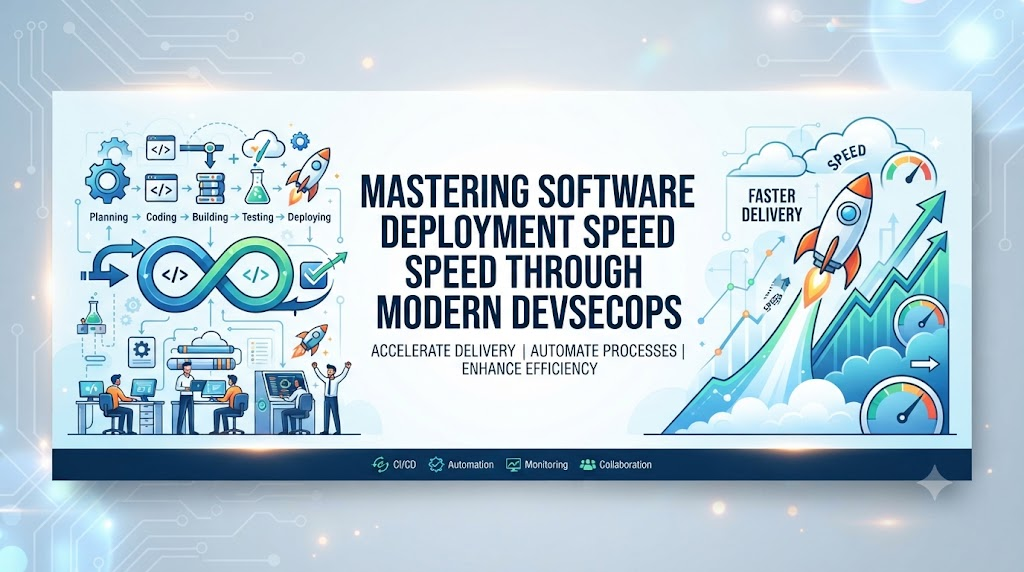
In today’s fast-paced digital economy, software is the core engine driving business success. Whether you are building financial platforms, e-commerce applications, or enterprise SaaS tools, the ability to release new features, fix bugs, and push updates rapidly is a major competitive advantage. However, many organizations struggle with sluggish development cycles, manual release bottlenecks, and unpredictable deployment failures.
Traditional software development and operations processes often create delays, keeping teams stuck in a cycle of infrequent, high-risk releases. This is where modern engineering methodologies step in. By shifting how teams build, test, and deploy applications, organizations can achieve how DevOps improves software delivery speed without sacrificing quality, security, or stability.
What Is DevOps?
DevOps is a cultural and engineering movement that bridges the gap between software development (Dev) and IT operations (Ops). Traditionally, developers wrote code and handed it over a metaphorical wall to operations teams responsible for running it in production, resulting in friction, miscommunication, and delays.
DevOps unifies these workflows through core principles, including:
- Collaboration: Breaking down organizational silos so teams share ownership.
- Automation: Eliminating repetitive manual toil across building, testing, and deployment.
- Continuous Integration (CI) and Continuous Delivery (CD): Ensuring code is integrated and ready for release continuously.
- Monitoring and Continuous Improvement: Gathering real-time insights to refine applications and processes constantly.
What Causes Delays in Traditional Software Delivery?
Before looking at how solutions work, it is vital to understand the root causes of friction in traditional software delivery:
- Manual Deployments: Relying on human intervention to execute deployment scripts or move files around creates human error and massive scheduling delays.
- Disconnected Teams: When developers, testers, and operations work in isolation, bug fixes and handoffs stall momentum.
- Lengthy Testing Cycles: Manual QA testing phases that happen only at the very end of a project lead to massive debugging bottlenecks.
- Environment Inconsistencies: The classic “it works on my machine” problem occurs when development, staging, and production environments do not match.
- Approval Delays: Heavy change-management boards and bureaucratic handoffs slow down momentum.
How DevOps Improves Software Delivery Speed
DevOps transforms the software delivery lifecycle (SDLC) by introducing continuous workflows, automation, and shared responsibility. Instead of treating software delivery as a rare, high-stress event, DevOps treats it as an automated, predictable, and frequent pipeline.
By removing manual hurdles, standardizing environments, and shifting testing and security left, organizations can cut delivery times from months down to hours or even minutes.
Continuous Integration and Faster Development
Continuous Integration (CI) is the practice where developers merge their code changes into a central repository frequently—often multiple times a day.
- Early Problem Detection: Every merge triggers automated builds and tests, allowing teams to catch syntax errors, broken logic, and merge conflicts immediately.
- Reduced Integration Conflicts: Instead of waiting weeks to merge massive codebases—which leads to nightmarish conflict resolution—CI keeps changes small and manageable, drastically accelerating daily development velocity.
CI/CD Pipelines and Automated Delivery
A Continuous Integration and Continuous Delivery (CI/CD) pipeline is the automated backbone of modern software engineering. It takes code from a developer’s commit all the way to production deployment through an automated sequence of stages: building, testing, packaging, and releasing.
[Code Commit] ➔ [Automated Build] ➔ [Automated Testing] ➔ [Artifact Packaging] ➔ [Staging Deployment] ➔ [Production Release]
Code language: CSS (css)
By automating this journey, teams eliminate human bottlenecks, reduce cycle time, and ensure that software is always in a deployable state.
Automation: The Foundation of Faster Software Delivery
Automation is the true engine behind DevOps automation and speed. In a DevOps culture, if something needs to be done more than once, it should be automated.
Automation applies across the board:
- Build Automation: Compiling source code instantly upon commit.
- Test Automation: Executing thousands of test cases in parallel.
- Deployment Automation: Pushing code across servers seamlessly without manual Secure Shell (SSH) sessions.
This eliminates repetitive manual work, prevents human configuration errors, and guarantees absolute consistency across releases.
Automated Testing and Faster Quality Validation
Speeding up delivery without automated testing is a recipe for disaster. DevOps integrates automated testing directly into the development workflow:
- Unit and Integration Tests: Verify individual components and their interactions immediately after code changes.
- API and Functional Tests: Ensure system behavior meets requirements without manual QA intervention.
- Security Scanners: Automatically check code for vulnerabilities during the build phase.
Catching defects in minutes rather than weeks prevents bugs from reaching production, saving valuable engineering hours.
Infrastructure as Code and Faster Environment Provisioning
In the past, setting up servers, networks, and databases required manual requests to infrastructure teams, often taking days or weeks. Infrastructure as Code (IaC) changes this by treating infrastructure configuration as code files stored in version control.
Using tools like Terraform or AWS CloudFormation, teams can spin up entire multi-tier production environments with a single command. This ensures environment consistency between development, testing, and production, completely eliminating environment drift and provisioning delays.
Containers and Kubernetes for Efficient Application Delivery
Containerization technologies like Docker have revolutionized how applications are packaged. A container bundles an application together with its runtime, system tools, and libraries, ensuring it behaves identically regardless of where it runs.
- Portability: Code runs smoothly on a developer’s laptop, a staging server, or a cloud provider.
- Kubernetes Orchestration: Kubernetes automates the deployment, scaling, and management of these containers. It handles traffic routing, self-healing, and dynamic scaling, allowing engineering teams to release application updates seamlessly at scale.
Cloud Computing and DevOps Delivery Speed
Cloud computing and DevOps go hand in hand. Cloud platforms provide elastic, on-demand infrastructure that eliminates hardware procurement delays.
Using cloud-native services, organizations can scale compute power up or down instantly, provision databases in seconds, and leverage managed services that reduce operational overhead. This synergy allows teams to focus entirely on writing application features rather than managing physical hardware.
DevOps Collaboration Between Development and Operations
Technology alone cannot deliver speed; culture is equally critical. DevOps bridges the traditional divide between developers and operations engineers.
When developers understand production constraints, and operations teams understand code architecture, friction disappears. Shared tooling, shared metrics, and joint incident post-mortems create a collaborative environment where everyone is aligned toward a single goal: delivering value to users safely and quickly.
Continuous Monitoring and Faster Problem Detection
Speed without visibility leads to blind spots. Continuous monitoring, logging, and observability tools provide real-time visibility into application health, performance metrics, and user behavior.
When an issue does occur in production, automated alerts notify engineers immediately. Rich logging and application performance monitoring (APM) trace tools help developers pinpoint the exact line of code or infrastructure component causing the failure, slashing Mean Time to Recovery (MTTR).
Continuous Feedback and Continuous Improvement
A fast delivery pipeline relies heavily on continuous feedback loops. Feedback flows from multiple channels:
- Automated test results informing developers of code quality.
- Monitoring tools reporting runtime performance issues.
- User telemetry tracking feature adoption and pain points.
Teams review these insights regularly to optimize their workflows, refine automation scripts, and continuously improve both the software and the delivery process itself.
DevSecOps: Improving Speed Without Ignoring Security
A common misconception is that speeding up delivery compromises security. DevSecOps disproves this by integrating security into every phase of the CI/CD pipeline—a practice known as “shifting left.”
Instead of treating security as a final gatekeeper audit right before launch, automated security checks scan code repositories, container images, and open-source dependencies early. Catching vulnerabilities during development avoids expensive last-minute release delays.
How DevOps Reduces Deployment Risk
Counterintuitively, releasing software more frequently actually reduces risk.
- Smaller Releases: Pushing small, incremental updates makes it much easier to isolate bugs than deploying massive, monolithic quarterly updates.
- Deployment Strategies: Techniques like blue-green deployments and canary releases allow teams to roll out updates to a small subset of users first.
- Feature Flags and Rollbacks: Feature flags let teams toggle features on or off remotely without redeploying code, while automated rollback mechanisms instantly revert faulty changes.
Measuring Software Delivery Speed
To optimize your delivery pipeline, you must measure it. Engineering leaders track key performance indicators (often aligned with DORA metrics) to evaluate efficiency:
| Metric | Description |
| Deployment Frequency | How often code is successfully deployed to production. |
| Lead Time for Changes | How long it takes for a commit to reach production. |
| Change Failure Rate | The percentage of deployments causing a failure in production. |
| Mean Time to Recovery (MTTR) | How long it takes to restore service after an incident. |
| Build and Deployment Duration | The time consumed by the CI/CD pipeline. |
Tracking these metrics helps teams identify bottlenecks rather than blindly pushing for higher deployment volume.
Real-World Example: How DevOps Speeds Up Software Delivery
Traditional Workflow
An e-commerce company plans to release a new checkout feature. Developers spend three weeks writing code in isolation. They hand it to the QA team, who spend two weeks finding bugs manually. Operations takes another week to manually configure staging servers, leading to configuration mismatches. After a stressful change-management review, the deployment fails in production because staging didn’t match production, requiring a full rollback. Total cycle time: 6 weeks.
DevOps-Enabled Workflow
The same feature is broken down into small user stories. Developers commit code daily into a continuous integration pipeline that runs automated unit and integration tests instantly. Once passed, CI/CD pipelines automatically package the application into Docker containers and provision ephemeral staging environments using Infrastructure as Code. Automated security scans pass, and the code is deployed using canary releases. Total cycle time: 2 days, with zero downtime.
Common Challenges When Implementing DevOps for Faster Delivery
Transitioning to a high-speed delivery model comes with hurdles:
- Legacy Systems: Monolithic architectures that are difficult to automate or containerize.
- Cultural Resistance: Team members comfortable with old habits resisting new tools and shared responsibilities.
- Skill Gaps: Lack of hands-on expertise in automation, CI/CD tooling, and cloud infrastructure.
- Tooling Fatigue: Adopting too many disconnected tools without a cohesive strategy.
Best Practices for Improving Software Delivery Speed With DevOps
- Start with Automation: Automate repetitive build and test processes first.
- Build a Reliable CI/CD Pipeline: Establish a robust pipeline that provides fast feedback to developers.
- Automate Testing: Shift automated testing as early into the development phase as possible.
- Use Infrastructure as Code: Manage cloud resources programmatically to guarantee consistency.
- Adopt Version Control Everywhere: Track code, infrastructure scripts, and configuration files in version control.
- Monitor Production Continuously: Implement strong observability to detect and resolve errors proactively.
- Improve Developer Experience: Streamline local development setups and reduce pipeline wait times.
- Release Smaller Changes: Break large features into small, incremental updates.
- Integrate Security Early: Embed security checks directly into your CI/CD workflows.
- Measure Delivery Performance: Track metrics regularly to locate and eliminate workflow bottlenecks.
How DevOps Training Helps Professionals Improve Delivery Practices
Mastering modern delivery speed requires practical, hands-on knowledge across a vast toolchain—including CI/CD servers, container engines, orchestration platforms, cloud infrastructure, and security automation. Structured professional learning programs help engineers and technology leaders bridge the gap between theoretical concepts and real-world implementation.
For professionals seeking to build deep expertise in these areas, structured initiatives from platforms like DevOpsSchool offer comprehensive guidance, practical lab sessions, and industry-aligned training designed to accelerate career growth and organizational transformation.
Future of Faster Software Delivery With DevOps
The landscape of software delivery continues to evolve rapidly. Emerging trends are pushing speed and efficiency to new heights:
- Platform Engineering: Building internal developer platforms to provide self-service infrastructure capabilities.
- GitOps: Using Git repositories as the single source of truth for declarative infrastructure and application deployments.
- AI-Assisted Development and AIOps: Leveraging artificial intelligence to write code, auto-correct pipeline failures, and predict production anomalies.
- Intelligent Observability: Moving beyond basic monitoring into AI-driven predictive insights that prevent failures before they impact users.
Frequently Asked Questions
How does DevOps improve software delivery speed?
DevOps removes manual bottlenecks by automating building, testing, provisioning, and deployment processes while fostering collaboration between development and operations teams.
Does DevOps make software development faster?
Yes, by breaking monolithic tasks into smaller increments, automating repetitive work, and providing continuous feedback, teams can ship features to users much faster.
How does CI/CD improve delivery time?
Continuous Integration and Continuous Delivery automate the journey from code commit to production release, eliminating manual handoffs and reducing integration delays.
Why is automation important in DevOps?
Automation ensures consistency, eliminates human error, and speeds up repetitive tasks across testing, infrastructure provisioning, and deployments.
How does Infrastructure as Code speed up deployment?
IaC allows teams to spin up complete, identical environments programmatically in minutes, avoiding manual server configuration delays.
Does DevOps reduce software delivery risks?
Yes, by encouraging smaller, frequent releases, automated testing, and robust monitoring, DevOps minimizes the blast radius of potential failures.
How do containers improve application delivery?
Containers bundle applications with all dependencies, ensuring they run reliably and consistently across development, testing, and production environments.
What metrics measure DevOps delivery performance?
Key metrics include deployment frequency, lead time for changes, change failure rate, mean time to recovery, and pipeline duration.
Can DevOps improve software quality as well as speed?
Absolutely. Automated testing, continuous monitoring, and early security checks ensure that higher speed does not come at the cost of stability or quality.
Conclusion: Deliver Software Faster With DevOps
In the modern competitive landscape, organizations cannot afford to rely on slow, manual, and disconnected software delivery processes. By combining automation, CI/CD pipelines, Infrastructure as Code, containerization, cloud platforms, and continuous feedback, engineering teams can achieve exceptional speed without compromising stability or security. Embracing these practices—supported by continuous learning through platforms like DevOpsSchool—empowers organizations to innovate rapidly, delight users, and stay ahead in a digital-first world.