Introduction
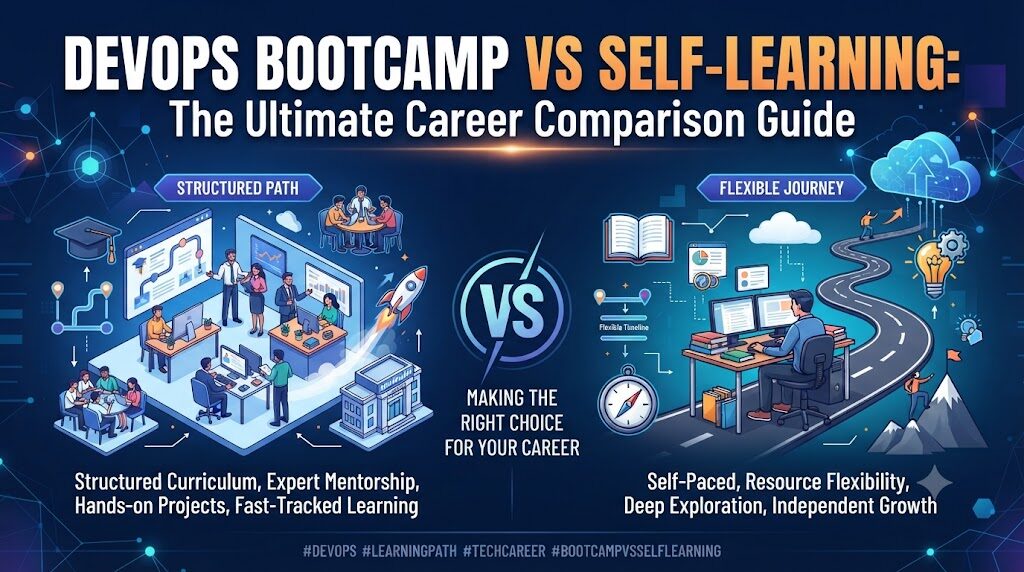
Choosing between an intensive DevOps bootcamp and self-directed learning is a pivotal decision that directly shapes your career trajectory, financial investment, and learning speed. In an industry rapidly shifting toward cloud-native architectures, mastering container orchestration, infrastructure automation, and automated delivery pipelines is essential for career advancement, yet navigating disconnected tutorials without guidance often leads to burnout and slow progress. Whether you are a system administrator, software developer, fresh graduate, or career changer looking to build production-grade skills under expert mentorship through established programs like DevOpsSchool or prefer to curate your own path using open-source resources, this comprehensive guide provides an objective, experience-driven comparison of costs, mentorship, hands-on projects, and career outcomes to help you make an informed decision.
What Is a DevOps Bootcamp?
A DevOps bootcamp is an intensive, immersive, and highly structured educational program designed to transform beginners and experienced IT professionals into job-ready engineers within a compressed timeframe. Unlike traditional university degree programs that focus heavily on theoretical computer science, a bootcamp focuses almost exclusively on industry-aligned practical skills, real-world toolchains, and enterprise workflows.
+-----------------------------------------------------------------------+
|                       DEVOPS BOOTCAMP STRUCTURE                       |
+-----------------------------------------------------------------------+
|  [Structured Curriculum]  -->  [Live Mentor-Led Sessions]               |
|                                       |                               |
|                                       v                               |
|  [Career & Interview Prep] <-- [Hands-On Enterprise Labs & Projects]  |
+-----------------------------------------------------------------------+
Core Characteristics of a DevOps Bootcamp
- Structured and Sequential Curriculum: Bootcamps eliminate guesswork by providing a step-by-step learning path. You move systematically from core fundamentals like Linux, networking, and Git to advanced concepts such as Infrastructure as Code (IaC), container orchestration, and continuous integration/continuous delivery (CI/CD).
- Instructor-Led Training and Live Mentorship: Lessons are delivered by veteran industry practitioners who bring real-world enterprise experience into the classroom. Instead of struggling with abstract concepts, students receive immediate feedback and live architectural explanations.
- Hands-On Guided Labs: Theoretical lectures are immediately accompanied by hands-on lab environments. Students configure real cloud infrastructure, build deployment pipelines, and troubleshoot actual system failures under supervision.
- Production-Grade Enterprise Projects: Participants work on simulated real-world scenarios, such as migrating a monolithic web application to a Kubernetes cluster running on AWS or Azure using Terraform and Jenkins.
- Certification Preparation and Career Support: Reputable bootcamps provide dedicated modules to prepare students for industry certifications, resume optimization, portfolio reviews, mock technical interviews, and job placement assistance.
A Real-World Example
Imagine enrolling in a program where, in week one, you configure secure Linux environments and write Shell automation scripts. By week four, you are provisioning AWS cloud resources using Terraform. By week eight, you have built a fully automated GitOps pipeline using GitHub, Jenkins, Docker, Kubernetes, and Prometheus. You do not spend weeks wondering what tool to learn next; every module directly builds upon the previous one.
What Is Self-Learning in DevOps?
Self-learning in DevOps is an independent, self-directed educational journey where a learner designs their own curriculum, curates learning materials, builds independent lab environments, and solves technical challenges without formal institutional supervision.
+-----------------------------------------------------------------------+
|                        SELF-LEARNING FRAMEWORK                        |
+-----------------------------------------------------------------------+
|  [Curate Free/Paid Resources] --> [Build Custom Home Labs]           |
|                                         |                             |
|                                         v                             |
|  [Community & Forum Support]  <-- [Independent Debugging & Projects]  |
+-----------------------------------------------------------------------+
Code language: PHP (php)
How Self-Learning Works in Practice
Self-directed learners rely on a combination of free and paid resources scattered across the internet:
- Official Product Documentation: Reading technical docs for tools like Docker, Kubernetes, Ansible, Terraform, and AWS.
- On-Demand Video Platforms: Enrolling in individual online courses on platforms like Udemy, Coursera, or Pluralsight.
- Community Resources and Tutorials: Learning from technical blogs, GitHub repositories, YouTube tutorials, and open-source projects.
- Home Labs and Personal Sandbox Environments: Setting up local virtual machines using Vagrant/VirtualBox or creating personal cloud free-tier accounts on AWS, Google Cloud, or Azure to practice configurations.
- Independent Problem Solving: Utilizing online communities such as Stack Overflow, Reddit, Discord channels, and DevOps forums to troubleshoot error messages and architectural bottlenecks.
A Real-World Example
A self-directed learner decides to learn Docker. They search for YouTube tutorials, read the official Docker documentation, and install Docker Desktop on their local laptop. When encountering a container networking error, they copy the error stack trace into Google, read through GitHub issue threads, test different configurations, and eventually resolve the issue independently. This process builds strong problem-solving skills, though it requires significant time, patience, and self-discipline.
DevOps Bootcamp vs Self-Learning: Detailed Comparison
To help you evaluate both learning paths objectively, the table below highlights the core differences across key technical and operational parameters:
| Comparison Feature | DevOps Bootcamp | Self-Learning |
| Financial Cost | Moderate to high upfront investment | Low to zero direct financial cost |
| Learning Speed & Timeframe | Fast-tracked (typically 3 to 6 months) | Variable (typically 9 to 18+ months) |
| Schedule Flexibility | Fixed schedule with scheduled live sessions | Fully flexible; learn anytime at your own pace |
| Mentorship & Guidance | Direct access to senior industry experts | Self-guided; relies on public forums and docs |
| Hands-On Projects | Production-grade, structured enterprise labs | Self-designed, personal sandbox projects |
| Structure & Accountability | High; strict deadlines, attendance, and reviews | Low; requires complete personal discipline |
| Community & Networking | Built-in peer group, alumni, and instructors | Self-built via forums, meetups, and open source |
| Certifications | Guided preparation included in curriculum | Self-prepared using independent study guides |
| Interview Preparation | Structured mock interviews and resume building | Self-researched interview questions and practice |
| Career & Job Support | Dedicated placement assistance and referrals | Independent job searching and networking |
Detailed In-Depth Breakdown of Key Parameters
1. Cost and Financial Investment
Bootcamps require a clear financial commitment, reflecting the cost of hiring senior engineers as instructors, providing cloud lab infrastructure, and maintaining career services. However, this investment often translates into a faster career transition and quicker return on investment (ROI). Self-learning costs almost nothing upfront, but it carries an implicit cost: the extended time required to become job-ready, which delays your transition into a higher-paying DevOps role.
2. Learning Speed and Time to Market
A structured bootcamp compresses years of practical industry experience into a streamlined 12-to-24-week curriculum. You avoid spending weeks studying outdated tools or irrelevant concepts. In contrast, self-learning often involves trial and error, dead ends, and distraction by shiny new tools, extending the timeline to 12 months or longer.
3. Mentorship and Error Resolution
When an deployment pipeline breaks or a Kubernetes pod enters a CrashLoopBackOff state, a bootcamp instructor can pinpoint the underlying misconfiguration in minutes, turning a frustrating block into a clear learning moment. A self-learner may spend hours or days parsing log files and forum posts to resolve the exact same issue.
4. Project Quality and Realism
Self-learners often build simple, isolated projects—such as running a single Nginx container locally. Bootcamp projects mirror multi-tier enterprise environments involving high availability, infrastructure automation, secret management, centralized logging, and production monitoring.
Benefits of Joining a DevOps Bootcamp
+-----------------------------------------------------------------------+
|                    BENEFITS OF A DEVOPS BOOTCAMP                      |
+-----------------------------------------------------------------------+
|  1. Accelerated Career Readiness                                       |
|  2. Structured Enterprise-Grade Curriculum                             |
|  3. Real-Time Expert Mentorship & Code Reviews                         |
|  4. Production-Simulated Multi-Cloud Projects                          |
|  5. Built-in Career Services & Industry Networking                     |
+-----------------------------------------------------------------------+
1. Structured, Industry-Aligned Curriculum
Technology evolves rapidly. A major advantage of an established bootcamp is that its curriculum is designed and updated by active industry architects. You learn modern tools (Terraform, Kubernetes, GitOps, Helm, Prometheus) in the exact sequence required by enterprise hiring managers, ensuring zero wasted effort.
2. Immediate Mentor Feedback and Code Reviews
Learning infrastructure automation requires writing clean, maintainable code—whether HCL for Terraform, YAML for Kubernetes, or Groovy/YAML for Jenkins pipelines. Bootcamp instructors review your code, point out security vulnerabilities, enforce best practices, and teach you how to write production-grade automation scripts.
3. High Accountability and Motivation
Self-learning failure rates are high primarily due to a lack of accountability. Bootcamps provide a structured schedule, weekly project assignments, quizzes, and peer collaboration that keep you motivated and accountable throughout the program.
4. Comprehensive Career and Placement Ecosystem
Technical skills alone do not guarantee a job. Bootcamps help bridge the employment gap by providing:
- Personalized resume and LinkedIn optimization
- Portfolio reviews highlighting real-world GitHub projects
- Realistic technical mock interviews covering system design and scenario-based troubleshooting
- Direct hiring networks and partner employer referrals
Benefits of Self-Learning
+-----------------------------------------------------------------------+
|                     BENEFITS OF SELF-LEARNING                         |
+-----------------------------------------------------------------------+
|  1. Complete Financial Autonomy & Low Overhead                        |
|  2. Maximum Schedule Flexibility & Personal Pace                       |
|  3. Deep, Unassisted Debugging & Problem Solving                       |
|  4. Ability to Tailor Curriculum to Niche Interests                    |
|  5. Development of Lifelong Self-Education Habits                      |
+-----------------------------------------------------------------------+
Code language: PHP (php)
1. Complete Financial Freedom and Low Risk
Self-learning allows you to start your career transition without financial pressure. You can leverage high-quality free documentation, open-source repositories, YouTube video series, and affordable platform subscriptions, paying only for the cloud resources you consume in your personal sandbox.
2. Total Pace and Schedule Flexibility
If you work demanding shifts, have family commitments, or travel frequently, a rigid bootcamp schedule can be difficult to maintain. Self-learning lets you study at your own pace—whether that means putting in two hours every night or studying dedicated blocks on weekends.
3. Cultivation of Deep Problem-Solving Skills
When you do not have an instructor to rescue you from a build error, you are forced to read official documentation, analyze logs, trace network packets, and debug line-by-line. This independent troubleshooting process builds resilience, self-reliance, and deep technical problem-solving capabilities.
4. Customization of Learning Focus
In a self-directed model, you are not bound by a fixed syllabus. If you want to spend extra time mastering eBPF, deep-diving into Linux kernel tuning, or specializing exclusively in AWS serverless infrastructure, you have the complete freedom to customize your study path.
Challenges of Both Learning Approaches
Neither path is without obstacles. Understanding the common pitfalls of both options allows you to mitigate risks effectively.
Challenges of a DevOps Bootcamp
- Significant Upfront Financial Investment: The tuition fees for high-quality bootcamps can present a financial barrier for some students or career changers.
- Intense Time Commitment: Bootcamps require dedicated effort. Balancing an intensive 20-hour-per-week bootcamp alongside a full-time job and family responsibilities requires strict time management.
- Fast-Paced Information Delivery: Because bootcamps cover extensive technical ground quickly, students who fall behind on foundational concepts like Linux networking or Git branching may struggle during advanced modules like Kubernetes or Terraform.
Challenges of Self-Learning
- Information Overload and “Tutorial Hell”: The internet is filled with thousands of tutorials, many of which are outdated, incorrect, or contradictory. Beginners often get caught in “tutorial hell”—watching endless videos without building independent projects.
- Lack of Direction and Outdated Learning Paths: Without expert guidance, self-learners may spend months learning deprecated tools (such as older configuration management patterns) while missing essential modern practices like GitOps or cloud-native security.
- Isolation and High Burnout Rates: Learning complex engineering practices alone can lead to frustration when technical issues stall progress for days, often resulting in high drop-out rates.
Which Learning Style Fits You?
To determine whether a bootcamp or self-learning aligns best with your background, evaluate the decision framework below:
| Learner Profile | Recommended Path | Primary Reason |
| Complete Beginner / Career Changer | DevOps Bootcamp | Requires strong foundational structure, live mentorship, and clear guidance. |
| Working System Administrator / SysAdmin | Hybrid / Bootcamp | Already understands Linux/networking; benefits from fast-tracked automation training. |
| Experienced Software Developer | Self-Learning / Targeted Bootcamp | Already understands code and Git; can easily self-learn containers and CI/CD pipelines. |
| University Student / Recent Graduate | DevOps Bootcamp | Needs practical, production-level project experience to supplement theoretical degrees. |
| Self-Motivated Hobbyist with Low Budget | Self-Learning | Low financial risk; has the discipline to study documentation independently. |
| Busy Working Professional with Limited Time | Flexible Self-Learning | Needs total control over study hours due to irregular work/family commitments. |
In-Depth Learner Profile Analysis
Scenario A: The Career Changer (Non-IT Background)
If you are transitioning from non-technical fields like sales, marketing, or operations, the sheer volume of technical terminology can be overwhelming. A DevOps Bootcamp provides the step-by-step guidance, structured feedback, and supportive environment required to build technical skills from scratch.
Scenario B: The Experienced Software Engineer
If you are already comfortable writing Python, Go, or Java code, understand version control, and interact daily with Linux environments, Self-Learning or a short targeted advanced course is highly viable. You can quickly pick up Docker, Terraform, and CI/CD tools by building upon your existing software engineering background.
Skills You Should Learn Regardless of Your Learning Method
Regardless of whether you choose a structured bootcamp or self-learning, modern cloud infrastructure engineering requires mastering a core set of competencies. Below is the essential learning order recommended for all aspiring engineers:
+-----------------------------------------------------------------------+
|                    DEVOPS SKILLS LEARNING ORDER                       |
+-----------------------------------------------------------------------+
|  Stage 1: Linux Fundamentals, Shell Scripting, & Networking           |
|                               |                                       |
|                               v                                       |
|  Stage 2: Version Control (Git) & Cloud Platforms (AWS/Azure)         |
|                               |                                       |
|                               v                                       |
|  Stage 3: Infrastructure as Code (Terraform) & Configuration Mgmt     |
|                               |                                       |
|                               v                                       |
|  Stage 4: Containerization (Docker) & Orchestration (Kubernetes)      |
|                               |                                       |
|                               v                                       |
|  Stage 5: CI/CD Pipelines (Jenkins, GitHub Actions) & Monitoring      |
|                               |                                       |
|                               v                                       |
|  Stage 6: DevSecOps, Policy as Code, & Site Reliability Engineering   |
+-----------------------------------------------------------------------+
Code language: JavaScript (javascript)
Stage 1: Operating System & Networking Fundamentals
- Linux Administration: File system hierarchy, process management, user permissions, SSH, storage, and systemd services.
- Networking Core: TCP/IP, subnets, CIDR notation, DNS, HTTP/HTTPS, load balancing, firewalls, and VPNs.
- Scripting Languages: Bash shell scripting and Python for automation tasks.
Stage 2: Source Code Management & Cloud Computing
- Git & Version Control: Branching strategies (GitFlow, trunk-based development), pull requests, merge conflict resolution, and rebasing.
- Cloud Architecture: Core services across major cloud platforms (AWS, Azure, or GCP)—compute instances, object storage, virtual private clouds (VPCs), IAM roles, and security groups.
Stage 3: Infrastructure as Code (IaC) & Configuration Management
- Terraform: Writing declarative infrastructure code, managing state files, modularizing code, and executing multi-cloud deployments.
- Ansible: Authoring playbooks, managing server configurations, and automating application deployments across remote instances via SSH.
Stage 4: Containerization & Cloud-Native Orchestration
- Docker: Creating optimized multi-stage Dockerfiles, managing container networking, storage volumes, and Docker Compose configurations.
- Kubernetes (K8s): Deploying clusters, managing Pods, Deployments, Services, Ingress controllers, ConfigMaps, Secrets, Persistent Volumes, and Helm charts.
Stage 5: Continuous Integration & Continuous Delivery (CI/CD)
- Pipeline Automation: Building robust CI/CD pipelines using Jenkins, GitHub Actions, GitLab CI, or Azure DevOps.
- Deployment Strategies: Implementing Blue/Green, Canary, and Rolling updates to minimize downtime.
Stage 6: Observability, Monitoring & Security (DevSecOps)
- Observability Tools: Prometheus for metrics collection, Grafana for dashboard visualization, and the ELK Stack (Elasticsearch, Logstash, Kibana) or Loki for log aggregation.
- DevSecOps Integration: Automated vulnerability scanning (Trivy, SonarQube), secret management (HashiCorp Vault), and compliance monitoring.
Hands-On Practice: The Key to Success
Theory alone will not get you hired as a DevOps engineer. Hiring managers look for proven hands-on capability, practical problem-solving skills, and a strong public portfolio of working code.
1. Build a Personal Home Lab
Set up a personal lab environment using local virtualization tools or cloud free-tier accounts. Use vagrant or local K3s/Minikube clusters to experiment with deployments without incurring cloud costs.
2. Implement End-to-End Cloud Projects
Avoid simple “Hello World” exercises. Instead, design end-to-end multi-tier application deployments that reflect real enterprise architectures.
+-----------------------------------------------------------------------+
|                    ENTERPRISE SIMULATION PROJECT                      |
+-----------------------------------------------------------------------+
|  [Developer Commit] --> [GitHub Repository]                          |
|                               |                                       |
|                               v                                       |
|  [Automated CI Build] --> [SonarQube / Trivy Vulnerability Scan]      |
|                               |                                       |
|                               v                                       |
|  [Docker Container Image Created] --> [Pushed to ECR / Docker Hub]    |
|                               |                                       |
|                               v                                       |
|  [Terraform Provisions AWS EKS Cluster]                               |
|                               |                                       |
|                               v                                       |
|  [ArgoCD / Helm Deploys Application to Kubernetes Cluster]            |
|                               |                                       |
|                               v                                       |
|  [Prometheus & Grafana Monitor Metrics & Send Alerts]                |
+-----------------------------------------------------------------------+
3. Maintain an Active GitHub Portfolio
Document your project deployments thoroughly. A well-organized GitHub repository should contain cleanly structured Terraform code, well-commented Dockerfiles, parameterized Kubernetes manifests, and a comprehensive README.md file complete with architecture diagrams and setup instructions.
Certifications and Career Growth
While certifications do not replace practical experience, they offer validation of your cloud and infrastructure skills, help clear automated resume screeners, and demonstrate your commitment to continuous professional development.
| Certification Name | Target Audience / Level | Key Skills Validated | Impact on Career Growth |
| AWS Certified Solutions Architect – Associate | Intermediate | AWS cloud design, VPC, IAM, EC2, S3, high availability | Strong foundational validation for cloud engineer roles. |
| Certified Kubernetes Administrator (CKA) | Advanced | Kubernetes cluster setup, networking, storage, troubleshooting | High industry value for cloud-native infrastructure roles. |
| HashiCorp Certified: Terraform Associate | Intermediate | Infrastructure as Code, state management, modules, HCL syntax | Excellent validation for automation and platform roles. |
| AWS Certified DevOps Engineer – Professional | Expert | Advanced CI/CD, deployment strategies, monitoring, governance | Top-tier credential for senior cloud and lead engineering roles. |
| Certified Kubernetes Application Developer (CKAD) | Intermediate | Designing, building, and configuring cloud-native apps on K8s | High value for software developers transitioning to DevOps. |
Integrating Certifications with Training
Enrolling in structured programs at DevOpsSchool gives learners access to dedicated exam preparation modules, practice mock exams, and hands-on lab environments specifically tailored to help professionals clear top-tier industry certifications like CKA, AWS DevOps Professional, and Terraform Associate on their first attempt.
Real-World Case Studies
To illustrate how these learning strategies work in real life, consider three representative learner profiles:
Case Study 1: The Fresh Graduate Transitioning via a Bootcamp
- Background: Rahul, a recent computer science graduate with theoretical coding knowledge but no hands-on enterprise infrastructure experience.
- Approach: Enrolled in an intensive 16-week live online DevOps bootcamp.
- Process: Participated in live lectures, completed daily hands-on labs, and built a multi-service GitOps deployment project on AWS using Kubernetes and Terraform. Received direct resume guidance and mock technical interview training.
- Outcome: Secured an entry-level DevOps Engineer position within three months of completing the bootcamp, saving roughly a year of trial-and-error learning.
Case Study 2: The Experienced Developer Using Self-Learning
- Background: Sarah, a senior Java developer with six years of experience looking to shift toward cloud infrastructure and platform engineering.
- Approach: Independent self-directed learning using documentation, cloud sandbox environments, and advanced specialized courses.
- Process: Built custom deployment pipelines for her existing Java applications using GitHub Actions, Dockerized microservices, and provisioned personal AWS resources via Terraform.
- Outcome: Successfully transitioned internally to a Lead Platform Engineer role within her existing company after demonstrating automated deployment pipelines to engineering leadership.
Case Study 3: The System Administrator Combining Both Methods
- Background: Marcus, a traditional Linux System Administrator managing on-premises physical servers.
- Approach: A hybrid approach—using self-learning for Linux/Bash refresher topics while enrolling in a structured bootcamp specifically for advanced topics like Kubernetes, Cloud Security, and GitOps.
- Process: Used self-learning to master Docker and AWS basics, then leveraged the bootcamp’s live mentorship to master complex Kubernetes network policies and CI/CD automation.
- Outcome: Successfully transitioned to a Senior Site Reliability Engineer (SRE) role, doubling his salary while maintaining full confidence in managing cloud infrastructure.
Common Mistakes Learners Make
Avoiding critical mistakes can save you hundreds of hours of wasted effort regardless of your chosen learning path:
- 1. Tool Hopping Without Master Fundamentals: Trying to learn 20 different DevOps tools simultaneously without first mastering core Linux administration, networking fundamentals, and Git workflows.
- 2. Relying Exclusively on Passive Video Watching: Watching hours of video tutorials without typing out code, building configurations, or encountering and fixing errors in a terminal.
- 3. Ignoring Infrastructure Security (DevSecOps): Treating security as an afterthought. Modern teams expect automation code to incorporate hard-coded secret scanning, IAM role restrictions, and vulnerability checks.
- 4. Neglecting Documentation and Communication Skills: Focusing purely on technical configuration while ignoring soft skills, technical documentation, clear diagramming, and cross-team collaboration.
- 5. Building Simple “Hello World” Projects: Expecting to impress hiring managers with simple container builds instead of building realistic end-to-end deployment systems.
Learner Improvement Checklist
 Have I mastered core Linux file management, user permissions, and SSH troubleshooting?
 Can I write a custom Bash script to automate daily operational tasks?
 Have I built and configured a multi-stage Dockerfile optimized for small image sizes?
 Can I write Terraform code to provision a VPC, subnets, and EC2/EKS instances from scratch?
 Have I built an automated CI/CD pipeline that runs security tests before deploying code?
 Is my GitHub portfolio populated with clean code, architecture diagrams, and clear README files?
Code language: JavaScript (javascript)
Best Practices for Learning DevOps
To maximize learning efficiency and achieve career success, implement the following best practices:
- Follow a Goal-Oriented Roadmap: Define a clear learning path focused on a single major cloud provider (AWS or Azure) alongside standard tools (Git, Terraform, Docker, Kubernetes, Jenkins/GitHub Actions).
- Practice the 70/30 Rule: Spend 30% of your time studying theoretical concepts and documentation, and 70% of your time writing code, deploying infrastructure, breaking configurations, and debugging errors in your terminal.
- Implement Version Control for Everything: Never configure infrastructure manually in a cloud console. Write Infrastructure as Code, commit your configurations to Git, and practice writing clear commit messages.
- Engage with Tech Communities: Join local tech meetups, DevOps Discord channels, Reddit communities (
r/devops), and open-source project discussions to stay updated on industry trends and network with practicing professionals. - Simulate Real-World Failure Scenarios: Intentionally misconfigure security groups, kill running Kubernetes pods, or simulate network latency to practice troubleshooting under pressure.
Combining Bootcamp and Self-Learning: The Hybrid Approach
You do not have to view this decision as a rigid binary choice. In fact, many successful professionals adopt a Hybrid Learning Model that combines the strengths of both approaches.
+-----------------------------------------------------------------------+
|                    THE HYBRID DEVOPS LEARNING MODEL                   |
+-----------------------------------------------------------------------+
|  Phase 1: Pre-Bootcamp Self-Study (Linux, Git, Scripting Basics)      |
|                                   |                                   |
|                                   v                                   |
|  Phase 2: Structured Bootcamp (Advanced Cloud, K8s, Terraform, CI/CD) |
|                                   |                                   |
|                                   v                                   |
|  Phase 3: Independent Portfolio Expansion & Open Source Contribution   |
|                                   |                                   |
|                                   v                                   |
|  Phase 4: Lifelong Self-Directed Specialization & Learning            |
+-----------------------------------------------------------------------+
Code language: PHP (php)
How the Hybrid Framework Works
- Phase 1: Pre-Bootcamp Self-Study: Before investing in a structured training program, spend 4 to 6 weeks teaching yourself Linux navigation, basic Git commands, and Python or Shell scripting fundamentals using free resources.
- Phase 2: Intensive Bootcamp Training: Join a structured bootcamp to master complex, interconnected topics like Infrastructure as Code, Kubernetes cluster management, CI/CD security pipelines, and cloud architecture under expert mentorship.
- Phase 3: Independent Project Customization: After finishing the structured program, take your capstone projects and customize them independently. Add specialized logging, test multi-region disaster recovery, or rewrite deployment scripts in another tool to build deep autonomy.
- Phase 4: Continuous Lifelong Learning: Maintain an ongoing habit of reading official release notes, testing new open-source infrastructure tools, and preparing for advanced industry certifications on your own.
Career Opportunities After Learning DevOps
Mastering automated infrastructure opens up diverse career paths across global technology companies, enterprise corporations, and high-growth startups:
+-----------------------------------------------------------------------+
|                       DEVOPS CAREER PATHWAYS                          |
+-----------------------------------------------------------------------+
|  [DevOps Engineer]      --> CI/CD, Infrastructure Automation, Cloud   |
|  [Site Reliability Eng] --> System Availability, Performance, Scaling |
|  [Platform Engineer]    --> Internal Developer Platforms (IDP)        |
|  [DevSecOps Engineer]   --> Security Automation, Compliance as Code   |
|  [Cloud Architect]      --> Multi-Cloud Infrastructure & System Design|
+-----------------------------------------------------------------------+
Code language: JavaScript (javascript)
Primary Career Roles & Core Responsibilities
1. DevOps Engineer
- Core Focus: Automating software delivery pipelines, managing cloud resources, supporting development teams, and maintaining operational efficiency.
- Key Tools: Git, Docker, Terraform, Jenkins, AWS, Kubernetes.
2. Site Reliability Engineer (SRE)
- Core Focus: Applying software engineering principles to operations to ensure system reliability, high availability, performance, disaster recovery, and capacity planning.
- Key Tools: Python, Go, Prometheus, Grafana, Kubernetes, Distributed Tracing.
3. Platform Engineer
- Core Focus: Building Internal Developer Platforms (IDPs) that enable software developers to self-serve infrastructure and deploy applications securely without manual ops ticket delays.
- Key Tools: Kubernetes, Crossplane, ArgoCD, Terraform, Backstage.
4. DevSecOps Engineer
- Core Focus: Embedding automated security controls, code analysis, container scanning, secret management, and compliance checks directly into automated deployment pipelines.
- Key Tools: Vault, SonarQube, Trivy, OPA (Open Policy Agent), Falco.
Future of DevOps Learning
As infrastructure engineering evolves, how professionals learn and adapt is changing rapidly. Staying ahead requires understanding emerging trends in technical education:
- AI-Assisted Learning and Automation: Generative AI tools and code assistants are transforming how engineers write Terraform manifests, debug pipeline scripts, and parse complex log files. Modern learning environments now focus on teaching engineers how to validate, refine, and secure AI-generated infrastructure code.
- Shift Toward Platform Engineering and Developer Portals: As cloud-native environments grow more complex, organizations are focusing heavily on Platform Engineering. Training programs are expanding beyond simple pipeline setup to cover building developer-friendly internal platforms.
- Interactive Cloud-Native Sandbox Labs: Educational models are moving away from passive video consumption toward instant, browser-based cloud labs where environments are provisioned on demand and graded by automated test scripts.
- GitOps and Declarative Everything: Continuous delivery is shifting standard push-based pipelines to pull-based GitOps models using tools like ArgoCD and Flux. Learning environments now prioritize declarative state management over manual scripting.
Frequently Asked Questions (FAQs)
1. Is a DevOps bootcamp worth the financial investment?
Yes, a bootcamp is worth the investment if you value structured learning, live mentorship, accelerated career entry, and dedicated job search support. It significantly reduces the time required to become job-ready compared to independent self-study.
2. Can I learn DevOps completely on my own without formal training?
Yes, it is entirely possible to learn DevOps independently using documentation, online courses, personal lab projects, and tech forums. However, it requires strong self-discipline, time management, and patience to resolve complex technical challenges without mentor support.
3. Which learning path is faster to complete?
A bootcamp is substantially faster, usually taking between 3 to 6 months of structured study. Self-learning typically takes 9 to 18 months due to the time spent selecting resources, curating a custom syllabus, and debugging issues independently.
4. Do top employers value bootcamp graduates?
Employers value practical skills, hands-on project experience, and problem-solving ability over training format alone. A bootcamp graduate with a strong GitHub portfolio demonstrating production-grade Kubernetes, Terraform, and CI/CD projects is highly competitive in the job market.
5. Are certifications necessary to secure a entry-level job?
Certifications are not strictly mandatory, but they provide valuable validation of your cloud knowledge, help clear automated resume screening software, and demonstrate dedication to prospective hiring managers.
6. How much hands-on practice do I need daily?
Aim for at least 1 to 2 hours of hands-on terminal practice daily. Consistent, daily interaction with command-line tools, cloud consoles, and automation code builds muscle memory far more effectively than long weekend study sessions.
7. Which learning path is better suited for working professionals?
If a working professional can commit to scheduled evening or weekend live classes, a bootcamp offers a fast-track route. However, if their work schedule is unpredictable, a self-paced learning plan provides maximum flexibility.
8. Can complete beginners with zero IT background learn DevOps?
Yes, beginners can learn DevOps, but they must first master IT fundamentals—including Linux administration, operating system concepts, networking, and basic programming—before jumping into advanced automation tools like Kubernetes or Terraform.
9. How long does it take to become job-ready?
With a structured bootcamp, dedicated learners can become job-ready in 4 to 6 months. Through self-directed learning, reaching a job-ready standard generally takes between 9 and 12 months of consistent study and project building.
10. What tools should an aspiring engineer learn first?
Start with Linux administration, command-line usage, and Shell scripting. Next, master version control with Git, followed by a major cloud platform (AWS or Azure), containerization with Docker, Infrastructure as Code with Terraform, and CI/CD pipeline building.
11. How important is mentor guidance when learning cloud infrastructure?
Mentorship is extremely valuable when navigating complex topics like microservice networking, IAM security policies, and distributed system debugging. A mentor saves hours of frustration by identifying configuration errors and teaching enterprise best practices.
12. Can I successfully combine a bootcamp with self-learning?
Yes, combining both approaches—often called the Hybrid Method—is recommended. Use self-learning to master fundamental concepts like Linux and Git, use a bootcamp for advanced cloud infrastructure automation, and continue self-learning to stay updated throughout your career.
13. How do tech recruiters evaluate candidates?
Recruiters and engineering managers evaluate candidates based on their GitHub code repositories, practical portfolio projects, hands-on lab performance, ability to explain system design decisions, and real-world troubleshooting skills.
14. What is the biggest challenge self-directed learners face?
The biggest challenge is information overload, combined with getting stuck in “tutorial hell” without building real, independent projects. Without a structured curriculum, it is easy to spend weeks on outdated tools or miss key enterprise practices.
15. What is the best long-term career strategy for continuous growth?
The best strategy is to develop strong self-learning habits early on while taking advantage of structured bootcamps or advanced training when transitioning into new, complex domains like DevSecOps, Platform Engineering, or Site Reliability Engineering.
Final Thoughts
There is no single “correct” learning path that suits every aspiring engineer. The decision between joining a DevOps bootcamp and self-learning depends entirely on your current technical background, learning style, available budget, weekly schedule, and career timeline goals.
Self-learning offers complete financial autonomy and flexibility, making it ideal for self-motivated individuals, experienced developers, or those on a tight budget. Conversely, a structured bootcamp provides an accelerated, guided environment complete with live expert mentorship, production-grade projects, peer accountability, and dedicated placement support.
Ultimately, your long-term success as an engineer will not be measured by the learning format you chose, but by your consistency, curiosity, and ability to solve real-world infrastructure challenges. Tools and methodologies will continue to evolve, but a strong foundation in problem-solving, continuous automation, and continuous learning will keep your career thriving for decades to come.