Introduction
The technology landscape is shifting rapidly, and at the heart of this transformation is the methodology known as DevOps. As organizations strive to deliver software faster and more reliably, the demand for professionals who can bridge the gap between development and operations has skyrocketed. A DevOps Career Path is no longer just a niche choice; it is one of the most rewarding and stable career trajectories in the modern IT sector. For those starting out, the sheer number of tools and technologies can feel overwhelming. However, by prioritizing continuous learning, mastering automation, and adopting an engineering mindset, you can navigate this complexity successfully. Through structured training and resources provided by DevOpsSchool, beginners can build the foundational knowledge required to thrive in this high-demand field. Whether you are a system administrator looking to modernize your skillset or a fresh graduate eager to dive into cloud-native engineering, this guide will provide the clarity and roadmap you need.
What Is DevOps?
DevOps is not a single tool or a specific software; it is a cultural and professional practice that emphasizes collaboration between software developers and IT operations teams.
- Collaboration: Breaking down silos so teams work toward shared objectives.
- Automation: Using code to eliminate manual processes and human error.
- CI/CD: Implementing Continuous Integration and Continuous Delivery to ship code updates safely and rapidly.
- Cloud-Native Development: Leveraging cloud platforms to create scalable and resilient applications.
- Continuous Improvement: A cycle of monitoring, feedback, and refinement to enhance system performance constantly.
In essence, DevOps aims to shorten the systems development life cycle while delivering high-quality software consistently.
Why Choose a Career in DevOps?
The professional landscape for DevOps is exceptionally bright for several reasons:
- High Market Demand: Every company, from startups to enterprises, needs DevOps engineers to maintain their cloud infrastructure.
- Diverse Opportunities: You can work as a Site Reliability Engineer, Platform Engineer, Cloud Architect, or DevSecOps Specialist.
- Competitive Salaries: Due to the specialized nature of the skills involved, DevOps roles are among the highest-paid in the IT industry.
- Global Reach: The infrastructure-as-code nature of the job makes remote work highly feasible and common.
- Constant Innovation: You will always be working with cutting-edge tools like Kubernetes, AI-driven monitoring, and advanced cloud services.
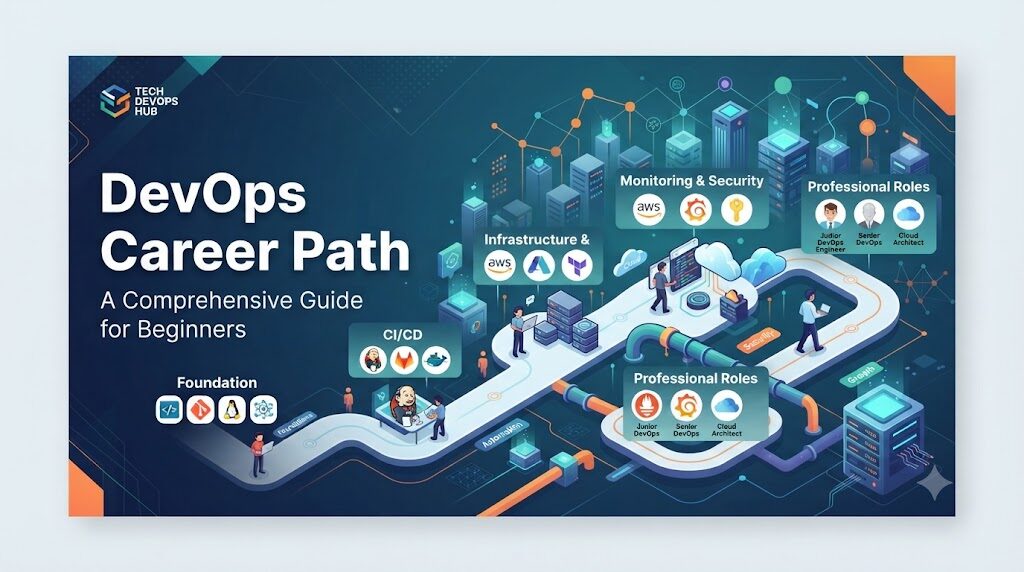
DevOps Career Roadmap
To become a proficient engineer, follow this structured path:
- IT Fundamentals: Understand basic computer architecture, OS concepts, and how the internet works.
- Linux: Mastery of the command line is non-negotiable.
- Networking: Learn HTTP, DNS, IP addressing, and firewalls.
- Scripting: Learn Bash or Python to automate repetitive tasks.
- Git: Become fluent in version control (branching, merging, pull requests).
- CI/CD: Understand how to automate build and deployment processes.
- Containers: Learn how to package applications using Docker.
- Kubernetes: The industry standard for container orchestration.
- Cloud Platforms: Focus on one major provider (AWS, Azure, or GCP).
- Infrastructure as Code (IaC): Use tools like Terraform or CloudFormation.
- Monitoring: Learn observability tools like Prometheus and Grafana.
- DevSecOps Basics: Integrate security into the deployment pipeline.
- Build Projects: Apply your skills to real-world scenarios.
- Apply for Jobs: Build your resume and start interviewing.
Essential Technical Skills
| Skill | Why It Matters | Beginner Priority |
| Linux | Operating system for 90% of servers | Critical |
| Networking | Understanding how data moves | Critical |
| Git | Collaboration and version history | Critical |
| Shell Scripting | Automating mundane tasks | High |
| Python | Advanced automation and tooling | Medium |
| CI/CD | Shipping code reliably | High |
| Docker | Consistent application environments | High |
| Kubernetes | Large-scale container management | Medium |
| Terraform | Managing infrastructure as code | Medium |
| Cloud Platforms | Hosting and scalability | High |
| Monitoring | Ensuring system health | Medium |
| DevSecOps | Secure software delivery | Medium |
Soft Skills Every DevOps Professional Needs
Technical prowess is only half the battle. To succeed, you must cultivate:
- Communication: Clearly explaining technical problems to non-technical stakeholders.
- Collaboration: Working effectively across different departments.
- Problem-solving: Troubleshooting complex system failures under pressure.
- Adaptability: The tech stack changes monthly; you must be willing to unlearn and relearn.
- Time Management: Balancing project deadlines with routine maintenance.
- Leadership: Taking ownership of incidents and driving resolutions.
Hands-On Practice
Theory is meaningless without implementation. To truly master the craft:
- Home Labs: Set up a virtual machine (using VirtualBox or Vagrant) and build a web server.
- Cloud Free Tiers: Use the free tiers of AWS or Azure to host a small application.
- GitHub Projects: Host your scripts, configurations, and documentation publicly.
- Build Pipelines: Create a GitHub Action that deploys a simple static website automatically.
- Kubernetes Clusters: Set up a local cluster using Minikube and deploy a sample application.
Building a Strong DevOps Portfolio
Your portfolio is your evidence of competency. Include:
- GitHub Repositories: Keep them clean, documented, and professional.
- Documentation: Every project should have a well-written README explaining what it does and how to deploy it.
- Automation Projects: Show how you used Terraform to spin up infrastructure.
- Technical Blogs: Write about what you learned—this proves you understand the “why” and not just the “how.”
Certifications That Help Beginners
| Certification | Best For | Skill Level | Focus Area |
| Linux+ | Foundational OS knowledge | Entry | Linux |
| AWS Solutions Architect | Cloud proficiency | Mid | Cloud |
| Certified Kubernetes Admin | Container orchestration | Mid | Kubernetes |
| Terraform Associate | Infrastructure as Code | Mid | IaC |
| DevOpsSchool Programs | Comprehensive training | Beginner/Mid | Industry Tools |
The DevOpsSchool learning ecosystem provides specialized programs designed to move students from theoretical understanding to job-ready execution.
Entry-Level DevOps Job Roles
- Junior DevOps Engineer: Assisting in CI/CD pipeline management and server maintenance.
- Cloud Support Engineer: Solving infrastructure issues for cloud clients.
- Linux Administrator: Managing server OS and basic system hardening.
- Build & Release Engineer: Managing the software release cycle.
- Site Reliability Engineer (Junior): Focusing on system uptime and error budget management.
- Platform Support Engineer: Maintaining the internal tools developers use.
Career Growth Path
- Junior Engineer: Learning the ropes, assisting with tasks.
- DevOps Engineer: Managing pipelines, cloud resources, and automation.
- Senior DevOps Engineer: Architectural decision-making, mentoring, and complex troubleshooting.
- Lead DevOps Engineer: Managing team workflows and high-level strategy.
- Platform Engineer: Building internal developer platforms.
- DevOps Architect: Designing global, scalable, and secure infrastructures.
- Engineering Manager / Consultant: Leading business strategy and organizational change.
Common Challenges for Beginners
| Challenge | Impact | Recommended Solution |
| Too many tools | Analysis paralysis | Focus on one tool per category first |
| Lack of practice | Forgetting theory | Build one small project per week |
| Weak Linux skills | Struggles with servers | Spend 30 minutes daily in the CLI |
| Poor networking | Security/Connection issues | Study OSI model fundamentals |
| Fear of cloud | Cost concerns | Use free tiers and set billing alerts |
Best Practices for Career Growth
- Learn fundamentals first: Don’t skip Linux to learn Kubernetes.
- Practice daily: Consistency beats intensity.
- Build projects: Projects translate to “experience” on a resume.
- Contribute to open source: It teaches you how to work on large, collaborative codebases.
- Network with professionals: Join communities and attend tech meetups.
- Keep learning continuously: The field evolves; so must you.
Measuring Career Progress
| Metric | Why It Matters | Career Benefit |
| Labs completed | Validates hands-on ability | Builds technical confidence |
| Projects built | Demonstrates real skills | Strengthens portfolio |
| Certifications earned | Validates standard knowledge | Improves resume ranking |
| GitHub activity | Proof of consistent work | Attracts recruiters |
| Interview performance | Turning knowledge into roles | Career advancement |
Real-World Example: Beginner to DevOps Engineer
- Starting Point: A system administrator with 3 years of Windows experience.
- Learning Roadmap: Transitioned to Linux, learned Bash, then Python.
- Projects Completed: Automated server backups with Python, migrated a legacy app to AWS.
- First Job: Junior Cloud Support Engineer.
- Career Growth: Promoted to DevOps Engineer within 18 months by taking on CI/CD tasks.
- Lessons Learned: Focus on the “why” of automation, not just the tools. Document everything.
Common Beginner Mistakes
- Learning tools without fundamentals: You cannot automate what you don’t understand manually.
- Ignoring Linux: Everything in the cloud runs on Linux.
- Skipping networking: Debugging application communication requires networking knowledge.
- Not documenting projects: An undocumented project is a wasted project.
- Chasing certifications without practice: Hiring managers value what you can build over how many certificates you hold.
Future of DevOps Careers
- AI-assisted DevOps: Using AI to predict system failures and automate incident responses.
- Platform Engineering: Focusing on building internal products for developers.
- GitOps: Managing infrastructure entirely through Git workflows.
- DevSecOps: Security is shifting “left,” meaning developers must understand security from day one.
- Cloud-native ecosystems: Increased reliance on serverless and microservices.
Practical Weekly Learning Plan
- Monday: Linux command line practice (Permissions, File Management).
- Tuesday: Git exercises (Branching, Merging, Rebasing).
- Wednesday: Build one automation task (Bash script).
- Thursday: Cloud project (Spin up an EC2 instance, deploy a simple app).
- Friday: Read official documentation (AWS or Kubernetes docs).
- Weekend: Review previous topics and update your GitHub portfolio.
FAQs (15 Questions)
- Is DevOps a good career for beginners? Yes, the high demand for automation makes it a stable, high-growth career.
- Do I need coding skills? Yes, you need scripting (Bash/Python) to automate processes.
- Which cloud platform should I learn first? AWS is generally recommended due to its large market share.
- How long does it take to become job-ready? Typically 6 to 12 months of consistent study and practice.
- Which certifications are most valuable? Cloud certs (AWS/Azure) and K8s certs (CKA).
- Can non-programmers learn DevOps? Absolutely, if you are willing to learn scripting and logic.
- How important are GitHub projects? They are crucial evidence of your skills.
- What salary can beginners expect? It varies by region, but generally higher than standard IT support roles.
- Is Linux mandatory? Yes, nearly every server you interact with will be Linux-based.
- Does DevOps involve coding? It involves scripting and IaC (Infrastructure as Code) rather than complex application software development.
- What is the difference between SRE and DevOps? SRE is a specific implementation of DevOps focused on reliability.
- Should I learn Kubernetes early? Learn Docker first; Kubernetes is complex and best approached after mastering containers.
- How do I keep up with new tools? Follow technical blogs, attend conferences, and keep experimenting.
- Is a degree required? No, practical skills and certifications often carry more weight in the DevOps world.
- What is the hardest part for beginners? The sheer volume of tools to learn; stay focused and patient.
Final Thoughts
Entering the world of DevOps is a marathon, not a sprint. The most successful engineers are those who possess a deep curiosity, a love for solving problems, and an unwavering commitment to the fundamentals. Do not be intimidated by the list of tools. Focus on understanding the concepts—automation, reliability, and security—and the tools will follow. Build your projects, document your learning, and stay grounded. The industry is always changing, and your ability to adapt will be your greatest asset.