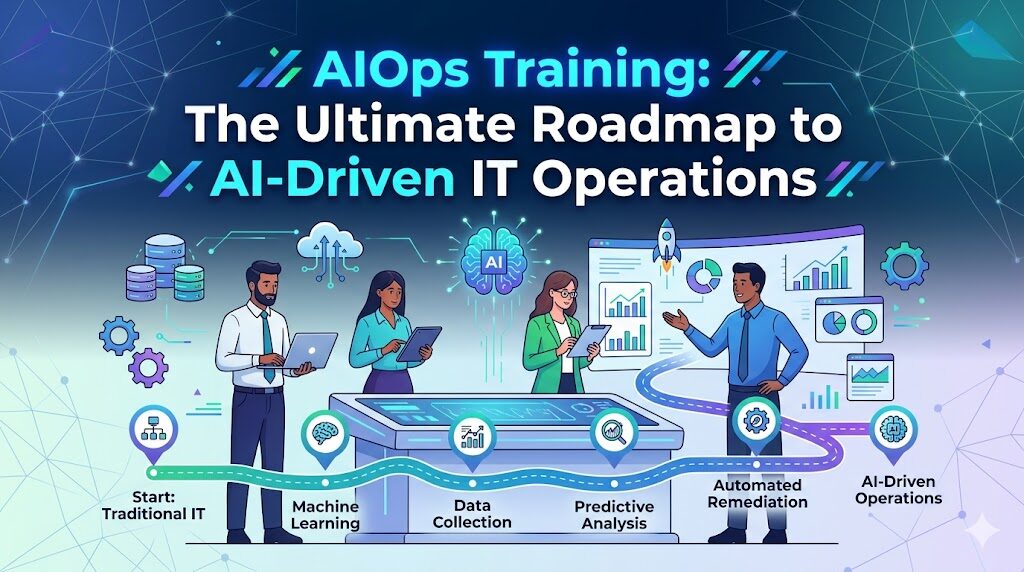
Modern enterprise infrastructure has outgrown human capacity. Cloud-native ecosystems generate an overwhelming amount of telemetry data—millions of logs, metrics, and traces pass through your monitoring pipelines every single second. When an outage occurs, it rarely triggers a single, clear alert. Instead, it sparks a catastrophic alert storm, drowning your on-call engineers in noise while systems crumble.
Traditional monitoring frameworks operate on static, hard-coded thresholds. They tell you when an event crosses a specific limit, but they cannot tell you why a multi-tier microservice architecture failed dynamically. This gap leads directly to alert fatigue, soaring Mean Time to Resolution (MTTR), and severe financial liabilities.
To break this cycle, organizations are rapidly transitioning from reactive monitoring to proactive intelligence using Artificial Intelligence for IT Operations. Structured AIOps Training has evolved from an optional skill development path into an absolute requirement for tech professionals. Let’s unpack the precise operational framework, architecture, toolchains, and educational roadmaps necessary to master AI-driven operations.
What is AIOps?
AIOps, a term originally coined by Gartner, stands for Artificial Intelligence for IT Operations. At its core, it represents the strategic convergence of Big Data, Machine Learning (ML), and advanced analytics with daily IT operations workflows.
The Evolution of Operational Models
- Manual Monitoring (Pre-2000s): System administrators manually inspected physical server resource consumption and written logs.
- Siloed APM & Infrastructure Monitoring (2000s–2010s): The rise of specialized software to track application performance, though data remained isolated within discrete platforms.
- Cloud-Scale Observability (Mid-2010s): Unified gathering of structural system outputs (Metrics, Logs, Traces) across ephemeral, highly distributed container platforms.
- Intelligent AI Operations (Present): Eliminating the human bottleneck by applying automated data pipelines and machine learning algorithms to real-time observability data streams.
Traditional monitoring platforms rely heavily on human configuration to define what constitutes an error condition (e.g., CPU usage greater than 85%). AIOps flips this equation entirely. By ingestively processing raw telemetry, an AIOps platform automatically derives baseline behavior, isolates statistical anomalies, correlates independent events across system layers, and triggers targeted automated responses.
Data Inputs and Platform Framework
An effective enterprise operational environment maps telemetry inputs directly through an analytical pipeline to execute clean automation:
[ Raw Telemetry Data Inputs ]
  ├── Metrics (Time-series metrics from Prometheus)
  ├── Logs (Unstructured text streams from Fluentd / Elastic)
  ├── Traces (Distributed spans from OpenTelemetry)
  └── Topology (Orchestration context from Kubernetes)
             │
             ▼
[ Unified Big Data Ingestion Layer ]
             │
             ▼
[ Machine Learning Analytics Engine ]
  ├── Base Behavioral Profiling
  ├── Dynamic Anomaly Detection
  └── Topology-Aware Event Correlation
             │
             ▼
[ Actionable Output & Automation Layer ]
  ├── Root Cause Analysis (RCA) Dashboards
  └── Auto-Remediation Playbooks (Ansible / Runbooks)
Code language: JavaScript (javascript)
Why AIOps Matters in Modern IT Operations
When software infrastructure migrates to dynamic, multi-cloud platforms, the underlying operational dependencies multiply exponentially. AIOps platforms resolve these complexities across several key functional layers:
1. Advanced Incident Intelligence & Noise Reduction
A minor configuration drift in an API gateway can cause thousands of downstream microservices to throw connection timeouts. In a standard setup, this results in an immediate cascade of redundant pages. AIOps systems utilize topology-aware event correlation to analyze the systemic layout and collapse those thousands of chaotic alerts into a single, comprehensive incident context. This cuts out the background noise and exposes the actual root cause instantly.
2. Predictive Analytics & Adaptive Capacity Planning
Rather than waiting for a storage volume or memory allocation pool to hit empty, machine learning models run continuous time-series forecasting. By examining historical trends alongside concurrent usage patterns, the platform can forecast resource exhaustion days in advance. This shifts capacity planning from speculative guesswork to precise mathematical calculation.
3. Accelerated MTTR via Automated Remediation
The true value of an AIOps Course lies in learning how to configure closed-loop automation systems. When an anomaly is discovered, the AIOps platform identifies the root cause and directly triggers targeted auto-remediation playbooks.
For instance, if a memory leak is verified on an isolated microservice container, the engine can autonomously run a rolling restart script or safely adjust the allocation boundaries. This preserves application availability and effectively drops the Mean Time to Resolution to zero—all without needing to page an engineer in the middle of the night.
Who Should Take an AIOps Training Program?
Transitioning to intelligent infrastructure management requires a modern operational skill set. This training program is specifically tailored for key roles across tech organizations:
- DevOps Engineers: Learn to embed algorithmic testing, policy compliance, and automated feedback loops directly into continuous integration and delivery (CI/CD) pipelines.
- Site Reliability Engineers (SREs): Move past writing static alerting parameters. Harness data science to manage complex Service Level Objectives (SLOs) and build truly self-healing runtime systems.
- Platform & Cloud Engineers: Discover how to build and support centralized, highly scalable observability platforms that process telemetry across diverse multi-cloud environments.
- Monitoring Specialists & NOC Teams: Upgrade traditional infrastructure dashboard management skills to act as specialized incident triage and automation workflow architects.
- IT Managers & Directors: Gain the tactical insight needed to measure enterprise AIOps platform ROI, evaluate vendors objectively, and successfully guide teams through cultural shifts.
What Will You Learn in an AIOps Course?
The specialized curriculum at AIOps School takes you from basic telemetry fundamentals all the way to complex enterprise architecture design.
Module 1: AIOps Fundamentals
Establish a strong foundation in AI-driven operations. Study the architectural shift from traditional monitoring metrics to big data analytics platforms, and learn how to map out a clear business case for AI adoption within enterprise systems.
Module 2: Observability Architecture
Master the structural mechanics of modern system data gathering. Learn to implement and organize unified observability frameworks capable of managing high-cardinality telemetry across highly distributed services.
Module 3: Metrics Collection & Analysis
Deep dive into structured time-series metrics. Understand aggregation methods, counter and gauge behaviors, and how to effectively leverage metrics to spot overarching performance shifts.
Module 4: Structured & Unstructured Log Ingestion
Learn to ingest, parse, and analyze massive volumes of unstructured log messages. Build highly efficient pipeline processing rules to normalize textual log data for down-stream machine learning consumption.
Module 5: Distributed Tracing & Span Analysis
Trace transactional paths as they move through complex microservice architectures. Master context propagation, analyze parent-child span connections, and isolate latency anomalies inside distributed call chains.
Module 6: Topology-Aware Event Correlation
Study how to use infrastructure topology mapping to group related system alerts. Learn to cut through operational noise by matching events directly against your infrastructure’s physical and logical dependency charts.
Module 7: Dynamic Anomaly Detection
Move past basic, static alert limits. Implement machine learning models that evaluate historic baselines and adaptively identify true performance deviations in real time.
Module 8: Machine Learning for Operations (MLOps Foundations)
Explore the foundational data science techniques behind modern operations tools. Learn how supervised, unsupervised, and reinforcement learning models are trained and deployed on active infrastructure data.
Module 9: Algorithmic Incident Intelligence
Master the mechanics of automated incident triage. Learn how AIOps platforms prioritize infrastructure issues, track down root causes, and present clear, actionable data to on-call response teams.
Module 10: Closed-Loop Auto-Remediation
Design and run self-healing operational playbooks. Build secure automation loops that execute targeted, program-driven fixes the moment an anomaly is confirmed.
Module 11: OpenTelemetry Standards
Implement vendor-neutral telemetry standards across your applications. Master the deployment and tuning of OpenTelemetry APIs, SDKs, and collection agents to build robust data pipelines.
Module 12: Enterprise AIOps Architecture & Strategy
Bring your skills together to architect highly reliable, large-scale enterprise AIOps hubs. Focus on core architectural design patterns, multi-region scalability, strict data compliance, and robust security practices.
Top AIOps Tools You Should Know
To build an efficient operations strategy, you need to understand how the industry’s primary toolchains stack up across capabilities, automation, and adoption styles.
| Tool Platform | AI & ML Capabilities | Event Correlation Strengths | Automation & Remediation | Native Integrations | Ease of Corporate Adoption |
| Splunk Enterprise Security | Advanced log analytics powered by custom ML modules. | Robust log-based signature matching. | Direct execution via Splunk SOAR playbooks. | Deep reach via extensive application marketplace. | Steep learning curve; demands specialized expertise. |
| Dynatrace | Davis® AI engine provides deterministic root-cause analysis. | Exceptional topology-aware relationship mapping. | Automated problem discovery and orchestration hooks. | Native agents auto-inject across major cloud environments. | Smooth, automated rollouts across platform layers. |
| Datadog | Watchdog AI uncovers hidden anomalies and trends. | Straightforward tag-based alert grouping. | Webhook integrations trigger external remediation tools. | Broad out-of-the-box cloud platform coverage. | Fast SaaS setup; intuitive dashboard construction. |
| Prometheus | Basic mathematical trend profiling via PromQL. | Manual alert clustering via config files. | Relies on Alertmanager to route alerts upstream. | Deeply rooted in the Kubernetes ecosystem. | Requires solid engineering design for large scale. |
| Grafana Enterprise | Visual anomaly identification across diverse data backends. | Grouping handled via Grafana Alerting engines. | Triggers webhooks and coordinates with automation tooling. | Connects seamlessly to nearly any database plugin. | Highly accessible; the industry standard for visualization. |
| Elastic Stack (ELK) | Built-in unsupervised machine learning for log analysis. | Log analysis using cluster grouping models. | Watcher alerts trigger external API endpoints. | Rich data ingest via Logstash and Beats agents. | Moderate; requires intentional data layout management. |
| Moogsoft | Advanced mathematical noise reduction and event grouping. | Exceptional correlation independent of topology charts. | Integrates smoothly with external ticket triage workflows. | Extensive integrations with common monitoring tools. | Straightforward integration with existing monitoring pipelines. |
| BigPanda | Open Integration Engine driven by clear operational logic. | Excellent alert grouping across diverse telemetry streams. | Drives ticketing systems and incident response platforms. | Aggregates alerts from major monitoring tools. | Smooth integration with existing operational stacks. |
| New Relic | Applied Intelligence automates anomaly detection out of the box. | Clean correlation using text pattern analysis. | Webhooks integrate directly with configuration workflows. | Comprehensive agents cover multiple programming languages. | Standard SaaS setup; intuitive workspace organization. |
Benefits of Earning an AIOps Certification
Validating your practical skills through a structured certification program offers clear advantages for both your daily engineering work and your broader career trajectory:
- Accelerated Career Mobility: An AIOps Certification signals to engineering leaders that you can move past traditional monitoring maintenance and actively architect modern, self-healing platforms.
- Command Higher Compensation: Tech professionals with proven AI-driven operations and infrastructure management skills regularly see substantial market premiums and salary increases over traditional operations positions.
- Bridge the Data Science Gap: True certification programs prove you understand how data science models are practically implemented inside daily operations pipelines—without requiring you to become a full-time data scientist.
- Future-Proof Your Technical Portfolio: As organizations retire legacy, threshold-based infrastructure dashboards, certified professionals are uniquely positioned to design and scale the next generation of intelligent operational platforms.
Why Choose AIOps School for AIOps Training?
AIOps School is a highly specialized educational institution focused entirely on the intersection of machine learning analytics and modern infrastructure operations. The programs are carefully built to translate theoretical data science concepts into practical, day-one engineering skills.
Rather than just watching lecture slides, you spend your time in cloud-hosted sandboxes running production-grade telemetry toolchains. You will build actual log analysis engines, train real anomaly detection pipelines, and configure live auto-remediation playbooks against realistic system failures.
[ Traditional Training Platforms ]  ──► Focus on watching static slides
[ AIOps School Learning Method  ]  ──► 40% Conceptual + 40% Live Labs + 20% Capstone Project
Code language: CSS (css)
The school offers clear learning journeys that scale naturally from foundational concepts to advanced architecture tracks. Every course is taught by experienced industry practitioners who have spent years designing and running large-scale automated operations platforms for Fortune 500 enterprises.
Career Opportunities After Completing an AIOps Certification
Completing your certification opens up specialized engineering and architecture opportunities across the modern technology landscape:
AIOps Engineer
Design, deploy, and maintain the underlying infrastructure analytics engines. You will build and optimize telemetry collection pipelines, tune ML anomaly models, and ensure your operations platforms scale reliably.
Site Reliability Engineer (SRE)
Leverage advanced incident intelligence tools to safeguard application availability. Your focus shifts to driving down system MTTR, eliminating alert noise, and building robust, automated self-healing playbooks.
Observability Architect
Own the end-to-end data strategy across your organization’s entire multi-cloud ecosystem. You will define telemetry ingestion standards, design high-cardinality data storage, and ensure smooth data flow to upstream AI engines.
Automated Incident Response Specialist
Bridge the gap between incident discovery and structural remediation. You will build intelligent event correlation rules and write the code that orchestrates automated, program-driven fixes during system incidents.
Frequently Asked Questions (FAQ)
What exactly is AIOps Training?
It is a specialized educational program focused on applying machine learning, big data analytics, and automated workflows to modern IT operations. The training teaches you how to collect deep system telemetry, detect anomalies automatically, reduce alert noise, and build self-healing infrastructure.
Is AIOps difficult to learn for traditional IT professionals?
It is a structured learning path but entirely achievable. You do not need to be a data scientist. Having a baseline familiarity with IT operations, basic scripting, or DevOps practices makes the transition smooth.
Which AIOps tools are covered in depth during the training?
The curriculum emphasizes core, vendor-neutral principles alongside widely adopted industry platforms like Dynatrace, Datadog, Splunk, Prometheus, Grafana, and the Elastic Stack.
Is an AIOps Certification worth the investment?
Yes. As enterprise environments become more complex, organizations are actively prioritizing engineers who can run intelligent, automated operations. Certification provides clear verification of these in-demand skills.
How long does it take to complete a course at AIOps School?
Program timelines scale based on the specific depth of the track:
- Foundation Level: 30–45 days (allocating 10–12 hours per week)
- Engineer Level: 45–60 days (allocating 12–15 hours per week)
- Professional Level: 60–90 days (allocating 15–20 hours per week)
- Architect Level: 90+ days (allocating 20+ hours per week)
Can traditional DevOps Engineers easily transition into AIOps?
Absolutely. DevOps engineers already understand CI/CD pipelines and basic automation. AIOps training simply expands that skill set by adding algorithmic intelligence and data science analytics to their existing workflows.
Are there any strict prerequisites for the courses?
The Foundation and Engineer tracks require only a basic understanding of IT operations or DevOps concepts. The advanced Professional and Architect tracks are built for professionals with 2–3 years of active engineering experience.
How important are the hands-on labs in the curriculum?
The labs are essential to the program. The official certification exam splits its evaluation directly across conceptual knowledge (40%), hands-on lab scenarios (40%), and a comprehensive real-world capstone project (20%).
What specific industries are adopting AIOps platforms fastest?
Adoption is scaling rapidly across sectors managing complex, high-scale digital platforms. This includes Financial Services, Cloud & SaaS Providers, E-commerce, Telecom, and Healthcare IT ecosystems.
What does the future look like for the AIOps market?
The industry is moving toward fully autonomous, self-healing platforms. Mastering these data-driven operational patterns early ensures you remain highly competitive as automation transforms traditional infrastructure roles.
Conclusion
As modern software systems grow in scale and complexity, traditional, threshold-based monitoring frameworks can no longer keep pace. Relying on human configuration to manage massive streams of enterprise telemetry leads directly to operational blind spots, systemic alert fatigue, and extended system outages. True operational reliability requires a shift toward automated, algorithmic infrastructure intelligence. Enrolling in a comprehensive AIOps Course and earning an industry-recognized AIOps Certification gives you the precise technical foundation needed to deploy robust telemetry pipelines, run advanced anomaly detection models, and build dependable self-healing systems.
Take the next step in your professional development. Explore the specialized training programs at AIOps School and build the skills required to lead the future of AI-driven IT operations.