Introduction
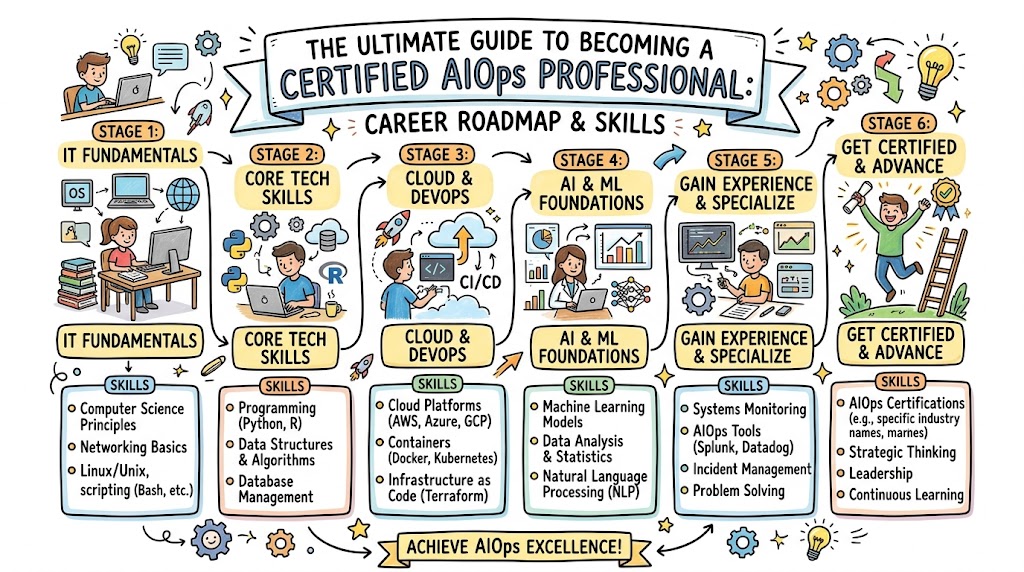
Modern IT infrastructure has reached a level of complexity where manual intervention is no longer enough to maintain uptime. As environments scale, the volume of logs, metrics, and traces becomes overwhelming for human operators. This is where the Certified AIOps Professional program becomes essential for your career growth. This guide is designed for engineers and managers who want to move beyond traditional monitoring into the world of intelligent automation. By following the roadmap provided by AIOps School, professionals can learn how to apply machine learning and data science to IT operations. This guide will help you understand the certification landscape, evaluate the curriculum, and decide which path aligns with your long-term career goals in the global market.
What is the Certified AIOps Professional?
The Certified AIOps Professional is a practitioner-focused program designed to bridge the gap between traditional operations and artificial intelligence. It represents a shift from reactive troubleshooting to proactive, data-driven management of digital services. Unlike theoretical courses, this certification focuses on how to implement AI models within production-grade DevOps and SRE workflows.
It exists because modern enterprises require systems that can self-heal and predict failures before they impact customers. The program focuses on the practical application of algorithms to reduce “noise” in monitoring systems. It aligns with modern engineering practices by teaching professionals how to integrate automated insights directly into CI/CD pipelines and incident management platforms.
Who Should Pursue Certified AIOps Professional?
This certification is highly beneficial for DevOps engineers, Site Reliability Engineers (SREs), and Cloud Architects who are managing large-scale distributed systems. If you find yourself overwhelmed by alert fatigue or spending too much time on repetitive manual tasks, this track is specifically designed for your needs.
Security professionals and Data Engineers also benefit from this program, as it provides a framework for analyzing system behavior through a lens of anomaly detection. For engineering managers in India and across the globe, this certification provides the strategic knowledge needed to build and lead high-performing automation teams. Even beginners with a solid foundation in Linux and cloud can use this to future-proof their skills.
Why Certified AIOps Professional is Valuable and Beyond
The demand for AIOps skills is growing rapidly as companies realize that hiring more people is not a scalable solution for managing cloud-native complexity. Obtaining this certification ensures your longevity in the field by moving you from a “tool operator” to an “automation architect.” It helps you stay relevant even as specific tools like Jenkins or Ansible evolve or get replaced.
Enterprises are adopting AIOps to reduce Mean Time to Repair (MTTR) and improve service availability. By mastering these concepts, you become a high-value asset capable of delivering a significant return on investment for your organization. The career investment you make now will pay off as AI becomes a standard component of every enterprise IT stack.
Certified AIOps Professional Certification Overview
The program is delivered via the official portal at aiopsschool.com and is hosted on the AIOps School website. It features a tiered approach to learning, moving from foundational concepts to advanced architectural patterns. The assessment approach is designed to test your ability to solve real-world problems rather than just memorizing definitions.
The certification is structured to accommodate working professionals, offering flexible learning paths that include video tutorials, hands-on labs, and comprehensive documentation. Ownership of the certification resides with the hosting site, ensuring that the content is regularly updated to reflect the latest trends in the AIOps and MLOps ecosystems.
Certified AIOps Professional Certification Tracks & Levels
The certification is organized into three distinct levels: Foundation, Professional, and Advanced. The Foundation level introduces you to data collection and basic statistical analysis for IT operations. It is the starting point for anyone new to the integration of AI in infrastructure management.
The Professional level dives deeper into specific specialization tracks such as SRE-focused AIOps or FinOps-driven automation. Finally, the Advanced level is for those looking to design enterprise-wide AIOps strategies. These levels align with your career progression, moving from individual contributor roles to senior engineering and leadership positions.
Complete Certified AIOps Professional Certification Table
| Track | Level | Who it’s for | Prerequisites | Skills Covered | Recommended Order |
| Operations | Foundation | Junior DevOps/SRE | Basic Linux & Monitoring | Data Ingestion, Pattern Matching | 1 |
| Engineering | Professional | Experienced Engineers | Foundation Cert | ML Model Deployment, Root Cause Analysis | 2 |
| Strategy | Advanced | Architects/Managers | Professional Cert | Enterprise AI Governance, Predictive Scaling | 3 |
| Specialized | Specialist | Data Engineers | Python Basics | Anomaly Detection, Log Clustering | 2 (Optional) |
| Optimization | Specialist | FinOps Practitioners | Cloud Billing Knowledge | Cost Prediction, Automated Right-sizing | 2 (Optional) |
Detailed Guide for Each Certified AIOps Professional Certification
Certified AIOps Professional – Foundation Level
What it is
This level validates your understanding of the core building blocks of AIOps, including data types and monitoring basics. It proves you can distinguish between traditional monitoring and AI-enhanced observability.
Who should take it
This is suitable for junior engineers, helpdesk professionals, or developers who want to understand how their applications behave in production. No prior AI experience is required.
Skills you’ll gain
- Understanding the four stages of AIOps: Collection, Analysis, Action, and Reporting.
- Identifying different types of telemetry data: Logs, Metrics, Traces, and Events.
- Basic understanding of how machine learning differs from rule-based automation.
Real-world projects you should be able to do
- Set up a unified data dashboard that aggregates logs from multiple sources.
- Create a basic threshold-based alerting system that reduces redundant notifications.
Preparation plan
- 7-14 Days: Focus on the official documentation and understanding the terminology.
- 30 Days: Complete the hands-on labs related to data ingestion and dashboarding.
- 60 Days: Review case studies of companies that successfully transitioned to AIOps.
Common mistakes
- Ignoring the importance of data quality before applying AI models.
- Confusing standard automation scripts with actual AIOps patterns.
Best next certification after this
- Same-track option: Certified AIOps Professional – Professional Level
- Cross-track option: SRE Practitioner Certification
- Leadership option: Technical Team Lead Workshop
Certified AIOps Professional – Professional Level
What it is
This certification validates your ability to deploy and manage machine learning models specifically for IT operations. It focuses on solving complex problems like automated root cause analysis.
Who should take it
Experienced SREs, DevOps engineers, and Cloud Architects who have at least two years of experience in production environments.
Skills you’ll gain
- Implementing supervised and unsupervised learning models for infrastructure.
- Automating the incident lifecycle using AI-driven insights.
- Configuring anomaly detection engines to find “silent” failures.
Real-world projects you should be able to do
- Build a predictive scaling system that adjusts resources based on traffic forecasts.
- Implement an automated incident correlation engine that groups related alerts.
Preparation plan
- 7-14 Days: Deep dive into specific AIOps algorithms and their use cases.
- 30 Days: Work on model tuning and understanding precision vs. recall in IT data.
- 60 Days: Build a full-scale project demonstrating automated remediation.
Common mistakes
- Over-complicating models for simple problems that only need basic scripts.
- Failing to account for “model drift” in changing infrastructure environments.
Best next certification after this
- Same-track option: Certified AIOps Professional – Advanced Level
- Cross-track option: Certified MLOps Engineer
- Leadership option: Certified Engineering Manager
Choose Your Learning Path
DevOps Path
The DevOps path focuses on integrating AI into the software development lifecycle. You will learn how to use AIOps to analyze build logs, predict deployment failures, and optimize CI/CD pipelines. This path is ideal for those who want to improve the velocity and reliability of software delivery through intelligent automation.
DevSecOps Path
In this path, the focus shifts to security-related automation. You will use AIOps concepts to identify unusual patterns that might indicate a security breach. It covers the use of AI for real-time threat detection and automated response to vulnerabilities within the infrastructure.
SRE Path
The SRE path is dedicated to maintaining high availability and performance. You will learn how to use AI to manage service level objectives (SLOs) and error budgets. This path emphasizes automated root cause analysis and the reduction of manual toil through smart incident management.
AIOps Path
This dedicated path focuses on the pure architecture of AI-driven operations. You will explore the deep technical layers of data pipelines and machine learning operations. It is designed for those who want to become specialists in building the actual platforms that power automated IT environments.
MLOps Path
The MLOps path bridges the gap between data science and production engineering. You will learn how to manage the lifecycle of machine learning models just like you manage code. This includes versioning models, monitoring their performance, and ensuring they are deployed reliably in cloud environments.
DataOps Path
DataOps focuses on the reliability and quality of the data that fuels AI models. You will learn how to build robust data pipelines that ensure information is accurate and available in real-time. This path is crucial for organizations that rely on large-scale data processing for their operational decisions.
FinOps Path
The FinOps path uses AI to solve the complex problem of cloud cost management. You will learn how to use predictive models to forecast cloud spending and identify waste. This path teaches you how to automate the right-sizing of resources to ensure maximum financial efficiency.
Role → Recommended Certified AIOps Professional Certifications
| Role | Recommended Certifications |
| DevOps Engineer | Certified AIOps Professional – Foundation & Professional |
| SRE | Certified AIOps Professional – Professional & Advanced |
| Platform Engineer | Certified AIOps Professional – Specialist (Anomaly Detection) |
| Cloud Engineer | Certified AIOps Professional – Foundation |
| Security Engineer | Certified AIOps Professional – Specialist (SecOps Focus) |
| Data Engineer | Certified AIOps Professional – DataOps Specialist |
| FinOps Practitioner | Certified AIOps Professional – FinOps Specialist |
| Engineering Manager | Certified AIOps Professional – Advanced (Strategy) |
Next Certifications to Take After Certified AIOps Professional
Same Track Progression
Once you have mastered the professional level, you should look toward deep specialization. This involves taking advanced courses in specific areas like deep learning for log analysis or natural language processing for incident tickets. Staying within the same track allows you to become a recognized subject matter expert in the AIOps community.
Cross-Track Expansion
If you want to broaden your skill set, consider moving into related fields like MLOps or DevSecOps. Understanding how AI applies to security or how to manage ML models in production will make you a more versatile engineer. This cross-pollination of skills is highly valued in modern enterprise environments.
Leadership & Management Track
For those looking to transition away from hands-on coding, the leadership track is the logical next step. You can pursue certifications focused on engineering management and AI governance. This allows you to lead teams in implementing the complex strategies you learned during your technical certification journey.
Training & Certification Support Providers for Certified AIOps Professional
DevOpsSchool
DevOpsSchool is a leading platform that has established a strong reputation for providing high-quality technical training. They offer a comprehensive suite of resources for those looking to master AIOps and other modern engineering practices. Their approach combines theoretical knowledge with intense practical labs, ensuring that students can apply what they learn in real-world scenarios. With a large community of mentors and alumni, DevOpsSchool provides an environment where professionals can network and share experiences. Their curriculum is updated frequently to match the changing landscape of the IT industry, making them a reliable choice for long-term career development and certification support.
Cotocus
Cotocus specializes in delivering specialized training and consulting services for enterprise-level technologies. They focus on providing hands-on experience through industry-standard projects and real-world simulations. For the Certified AIOps Professional track, Cotocus offers tailored learning paths that help engineers understand the nuances of data-driven operations. Their trainers are experienced practitioners who bring insights from the trenches of software engineering and cloud management. Cotocus emphasizes the importance of mastering tools and methodologies that are currently in high demand. This makes them an excellent partner for both individual learners and corporate teams looking to upgrade their technical capabilities in the automation space.
Scmgalaxy
Scmgalaxy is a well-known resource hub and training provider that focuses on configuration management, DevOps, and automation. They provide a vast library of tutorials, guides, and certification prep materials that are highly beneficial for AIOps candidates. Scmgalaxy’s training programs are designed to be accessible yet deeply technical, covering everything from basic scripting to complex AI integrations. They have a strong presence in the Indian technical community and offer support for a wide range of certifications. Their focus on the practical aspects of software configuration and delivery makes them a go-to source for engineers looking to strengthen their foundational knowledge before moving into advanced AI topics.
BestDevOps
BestDevOps focuses on delivering premium training experiences that are centered on quality and career outcomes. They offer curated bootcamps and certification courses that are specifically designed to help professionals transition into senior roles. Their AIOps training modules are structured to be concise and impactful, focusing on the most relevant skills required by modern employers. BestDevOps prides itself on its hands-on approach, ensuring that every student completes significant project work during their course. By maintaining high standards for their instructors and course materials, they help ensure that their graduates are well-prepared for the challenges of managing production-grade AI-driven infrastructure.
devsecopsschool.com
This provider focuses specifically on the intersection of security and automation. They offer deep-dive training into how AI and machine learning can be used to secure modern cloud-native environments. For professionals taking the Certified AIOps Professional path, this site provides valuable context on anomaly detection and automated threat response. Their courses are designed for security engineers who want to adopt DevOps practices and for DevOps engineers who need to integrate security into their workflows. With a focus on practical security implementation, devsecopsschool.com is a vital resource for anyone looking to specialize in the security aspects of AIOps and intelligent automation.
sreschool.com
Sreschool.com is dedicated to the discipline of Site Reliability Engineering. They provide targeted training on maintaining system reliability, scalability, and performance using modern tools and techniques. Their AIOps-related content focuses on reducing toil and improving incident management through automated insights. Students can learn how to apply AI models to monitor service levels and manage error budgets effectively. The platform offers a variety of learning formats, including self-paced courses and instructor-led sessions. For SREs looking to add AIOps to their toolkit, sreschool.com provides the specific context and practical examples needed to succeed in a production environment.
aiopsschool.com
As the primary host for the Certified AIOps Professional program, aiopsschool.com is the most direct source of information and training for this certification. The site offers a comprehensive learning management system that tracks your progress through various levels of certification. They provide official study guides, practice exams, and access to specialized lab environments. The curriculum is developed by industry experts who are actively working in the AIOps field. Because they own the certification standards, their training materials are always perfectly aligned with the latest exam objectives. This makes aiopsschool.com the essential starting point for any professional pursuing this career path.
dataopsschool.com
Dataopsschool.com focuses on the management and orchestration of data pipelines, which is the foundation of any successful AIOps strategy. They teach professionals how to ensure data quality, accessibility, and security across the entire organization. For AIOps candidates, this provider offers crucial training on how to feed reliable data into machine learning models. Their courses cover data engineering, data governance, and the automation of data workflows. By mastering these skills at dataopsschool.com, engineers can ensure that their AIOps implementations are based on accurate and timely information, which is critical for making correct automated decisions in production.
finopsschool.com
Finopsschool.com addresses the financial management aspect of cloud operations. They provide training on how to use AI and data analysis to optimize cloud spending and improve financial accountability. For professionals in the Certified AIOps Professional program, this site offers specialized knowledge on cost-related anomaly detection and predictive billing. Their curriculum helps bridge the gap between finance and engineering teams, allowing for better collaboration on cloud efficiency. By learning the principles of FinOps through this provider, engineers can show tangible business value by automating the process of reducing waste and optimizing resource utilization in large-scale environments.
Frequently Asked Questions (General)
- How difficult is the Certified AIOps Professional exam?
The exam is moderately challenging as it tests both theoretical concepts and practical application. If you have a solid background in operations and follow the recommended preparation plan, you will be well-positioned to pass. - How long does it take to get certified?
Most professionals complete the training and pass the exam within 30 to 60 days. This depends on your prior experience with automation and the amount of time you can dedicate to studying each week. - Are there any mandatory prerequisites for the Foundation level?
There are no mandatory prerequisites for the Foundation level, but a basic understanding of Linux, networking, and standard monitoring tools is highly recommended for a better learning experience. - What is the return on investment for this certification?
The ROI is high, as AIOps specialists often command higher salaries compared to traditional DevOps engineers. It also opens doors to senior architect and leadership roles in top-tier technology companies. - Do I need to be a data scientist to pass this?
No, you do not need to be a data scientist. The certification focuses on the application of AI models in an operational context, not on the deep mathematical creation of the models themselves. - In what order should I take the certifications?
We recommend starting with the Foundation level, followed by the Professional level. Once those are secured, you can choose a specialist track or move to the Advanced level based on your career goals. - Is the certification recognized globally?
Yes, the certification is recognized by enterprises and technology firms worldwide, including major markets in India, North America, and Europe. - How often do I need to renew my certification?
The certification is typically valid for two to three years. Renewal usually involves taking an updated exam or completing continuing education credits through the platform. - Does the program include hands-on labs?
Yes, the program emphasizes practical learning and includes various lab environments where you can practice data ingestion, model deployment, and incident automation. - Can I take the exam online?
Yes, the exam is hosted online through the official website, allowing you to take it from the comfort of your home or office at a scheduled time. - Are there community forums for students?
The program provides access to exclusive community forums where you can interact with other students, mentors, and industry experts to ask questions and share insights. - What kind of support is available if I get stuck?
Students have access to technical support and mentorship through the training providers, ensuring that you can get help with complex topics or lab exercises.
FAQs on Certified AIOps Professional
- What specific AI models are covered in the curriculum?
The course covers a range of models including K-Means for log clustering, Random Forests for incident classification, and various time-series forecasting models for capacity planning and predictive scaling. - How does this certification differ from a general AI course?
This program is strictly focused on IT operations. While a general AI course might focus on image recognition or natural language processing, this certification focuses on system telemetry, log patterns, and infrastructure health. - Will this certification help me reduce manual work in my current job?
Absolutely. The core goal is to teach you how to automate repetitive tasks like alert sorting and root cause identification, allowing you to focus on more strategic engineering work. - Do I need to know Python to succeed in this program?
While not strictly required for the Foundation level, a basic understanding of Python is very helpful for the Professional and Advanced levels, especially when working with data pipelines. - Is AIOps relevant for small companies or only large enterprises?
While large enterprises benefit most due to their scale, small companies can use AIOps to manage complex cloud setups with a very small team, making it relevant for organizations of all sizes. - Does the course cover tool-specific training like Splunk or Datadog?
The certification is designed to be vendor-neutral, focusing on the underlying principles and architectural patterns that can be applied to any modern monitoring or AIOps tool. - Can this certification help me move into an SRE role?
Yes, AIOps is a core component of modern Site Reliability Engineering. This certification provides the automation skills that are essential for successful SRE practitioners. - What is the focus of the Advanced level exam?
The Advanced level focuses on strategy, governance, and designing the overall AIOps architecture for an entire organization, including data privacy and model lifecycle management.
Final Thoughts: Is Certified AIOps Professional Worth It?
As someone who has seen the evolution of IT from physical servers to complex cloud-native architectures, I can tell you that the era of manual monitoring is ending. The volume of data we generate today is simply too much for any human team to process effectively. Moving into AIOps is not just a career “upgrade”—it is a necessity for anyone who wants to remain competitive in the infrastructure space.
The Certified AIOps Professional program provides a structured, practical, and experience-driven way to gain these skills. It doesn’t just teach you how to use a tool; it teaches you how to think like an automation architect. If you are willing to put in the time to master these data-driven methodologies, you will find yourself at the forefront of the next major wave in enterprise technology. My advice is to start with the foundation and build your expertise steadily. The transition to intelligent operations is a journey, and this certification is the best roadmap you can have.