Introduction
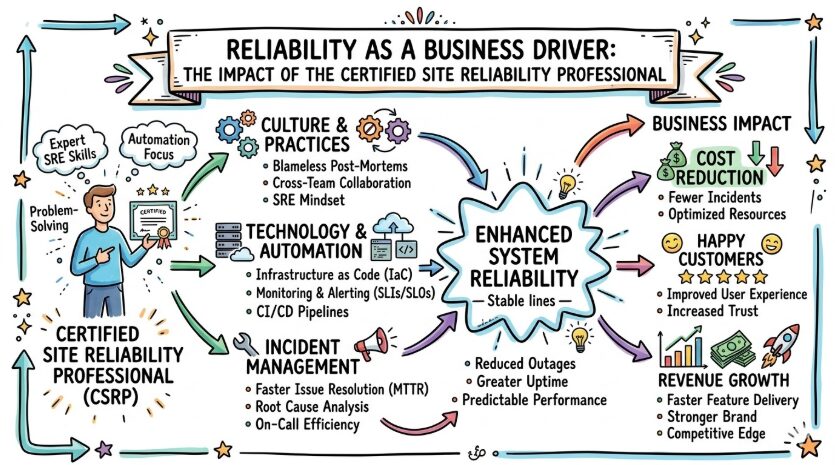
The Certified Site Reliability Professional program is a comprehensive validation framework designed for engineers who want to master the art of balancing system reliability with the speed of software delivery. This guide is written for software engineers, systems administrators, and technical leads who are navigating the complex transition from traditional operations to modern reliability engineering. In an era where downtime costs millions, understanding the principles of error budgets, toil reduction, and automated incident response is no longer optional.
Navigating the landscape of technical certifications can be overwhelming, especially with the overlap between DevOps and SRE roles. This guide provides a clear roadmap to help you understand where the Certified Site Reliability Professional fits into your career trajectory. Whether you are based in India or working in a global distributed team, this program bridges the gap between theoretical cloud-native concepts and the gritty reality of managing production systems at scale.
By reading this guide, professionals will gain clarity on which learning paths align with their current skills and future aspirations. We move beyond the buzzwords to examine the practical utility of this certification. Our goal is to empower you with the information needed to make a strategic decision about your professional development, ensuring that your investment in learning translates into tangible career growth and improved system stability for your organization through SREschool.
What is the Certified Site Reliability Professional?
The Certified Site Reliability Professional represents a standardized benchmark for excellence in the field of reliability engineering. It is not merely a test of theoretical knowledge but a validation of an engineer’s ability to apply SRE principles to real-world production environments. The program exists to formalize the diverse skill set required to keep modern, distributed systems running smoothly, moving away from “firefighting” toward proactive system design.
The curriculum is built around the core pillars of SRE as defined by industry leaders, emphasizing measurable reliability. It focuses on how to define Service Level Objectives (SLOs) that actually matter to the business and how to implement Service Level Indicators (SLIs) that provide true visibility into system health. This certification ensures that practitioners understand how to manage the lifecycle of an application from code commit through to long-term production maintenance.
In the modern enterprise, this certification acts as a signal that an engineer can handle the pressure of high-availability requirements. It aligns with cloud-native workflows, Kubernetes-driven orchestration, and the shift toward infrastructure as code. By completing this program, professionals demonstrate that they are capable of reducing operational load through automation and building resilient systems that can self-heal during failures.
Who Should Pursue Certified Site Reliability Professional?
Software engineers who find themselves spending more time managing infrastructure than writing features will find immense value in this program. It is particularly beneficial for DevOps practitioners who want to specialize specifically in the reliability and observability aspects of the delivery pipeline. As organizations move toward platform engineering models, having a certified SRE on the team becomes a critical requirement for maintaining service integrity.
Cloud professionals and systems administrators who are transitioning from manual server management to automated cloud operations should consider this path. For these individuals, the certification provides the structured methodology needed to scale their impact across hundreds or thousands of microservices. It moves the needle from “running a server” to “architecting a resilient ecosystem,” which is a vital shift for career longevity.
Engineering managers and technical leaders also benefit from this certification, even if they are not coding daily. Understanding the SRE framework allows managers to set realistic expectations for their teams and communicate effectively with stakeholders about system risks. In the Indian market and globally, there is a massive talent gap for professionals who understand the financial and operational implications of system reliability, making this an ideal choice for ambitious technical leads.
Why Certified Site Reliability Professional is Valuable and Beyond
The demand for reliability expertise is skyrocketing as every company becomes a software company. As systems grow in complexity due to microservices and multi-cloud strategies, the risk of catastrophic failure increases. The Certified Site Reliability Professional helps engineers stay relevant by focusing on evergreen principles like observability, automation, and risk management rather than just chasing the latest ephemeral tool or framework.
Enterprise adoption of SRE practices is no longer limited to “Big Tech” firms; it is now a standard requirement in banking, healthcare, and retail. This certification provides a return on investment by making you a high-value asset in any organization that prioritizes uptime and customer experience. It provides the language and frameworks needed to advocate for reliability-focused projects, which are often the most technically challenging and rewarding tasks in an organization.
Furthermore, the focus on toil reduction ensures that your career remains sustainable. By learning how to automate away repetitive tasks, you free yourself to work on high-impact engineering problems. This shift not only increases your professional satisfaction but also makes you indispensable to your employer. The certification proves that you are committed to the long-term health of both the systems you manage and the engineering culture you work within.
Certified Site Reliability Professional Certification Overview
The Certified Site Reliability Professional program is a multi-tiered educational journey delivered through Certified Site Reliability Professional and hosted on the SREschool.com platform. The program is designed to cater to different stages of professional maturity, from those just entering the field to seasoned veterans looking to lead SRE departments. Each level is built to challenge the candidate’s practical understanding of reliability concepts.
Assessment in this program is rigorous and performance-based. Unlike traditional certifications that rely heavily on multiple-choice questions, this program emphasizes practical scenarios and case studies that reflect actual production incidents. This approach ensures that a certified professional can hit the ground running when faced with a real-world outage or a scaling bottleneck. The ownership of the program lies with industry practitioners who update the curriculum to reflect current enterprise practices.
The structure is modular, allowing engineers to pick tracks that align with their specific day-to-day responsibilities. This flexibility is essential in a field as broad as SRE, where one engineer might focus on infrastructure automation while another focuses on deep-dive observability and distributed tracing. The program provides a clear path of progression, ensuring that as you grow in your career, there is a corresponding certification level to validate your advanced expertise.
Certified Site Reliability Professional Certification Tracks & Levels
The certification is divided into three primary levels: Foundation, Professional, and Advanced. The Foundation level introduces the core vocabulary and concepts, ensuring a baseline of understanding across the organization. The Professional level dives into implementation, focusing on the tools and techniques required to manage production systems. The Advanced level is for architects and leaders who design reliability strategies for entire organizations.
Specialization tracks are a key feature of the program. While the core focuses on SRE, there are pathways that branch into DevOps, FinOps, and DevSecOps. These tracks allow professionals to cross-pollinate their reliability skills with other critical domains. For instance, a FinOps-focused SRE learns how to optimize for both reliability and cost, a skill set that is highly sought after in current economic climates.
These levels align perfectly with career progression from Junior SRE to Senior SRE and eventually to Principal Engineer or SRE Manager. By following the structured tracks, an engineer can build a holistic portfolio of skills that covers every aspect of the modern technology stack. This tiered approach prevents “knowledge gaps” and ensures that the professional has a solid foundation before moving into complex, high-stakes reliability engineering tasks.
Complete Certified Site Reliability Professional Certification Table
| Track | Level | Who it’s for | Prerequisites | Skills Covered | Recommended Order |
| Core SRE | Foundation | Beginners & Managers | Basic IT Knowledge | SLIs/SLOs, Toil, Incident Mgmt | 1 |
| Core SRE | Professional | SREs & DevOps Engineers | Foundation Level | Automation, Observability, CI/CD | 2 |
| Core SRE | Advanced | Lead Engineers & Architects | Professional Level | Error Budgets, Capacity Planning | 3 |
| FinOps | Specialist | Cloud Financial Analysts | Professional Level | Cost Modeling, Unit Economics | 4 (Optional) |
| DevSecOps | Specialist | Security Engineers | Professional Level | Chaos Security, Policy as Code | 4 (Optional) |
| Platform | Expert | Platform Engineers | Advanced Level | IDPs, Self-Service Infrastructure | 5 |
Detailed Guide for Each Certified Site Reliability Professional Certification
Certified Site Reliability Professional – Foundation
What it is
This certification validates a candidate’s understanding of the fundamental principles of Site Reliability Engineering. It ensures the individual can communicate using SRE terminology and understands the cultural shift required for reliability.
Who should take it
This is suitable for junior engineers, product managers, and traditional IT operations staff who are new to the SRE philosophy. It is also ideal for stakeholders who need to understand why reliability is a shared responsibility.
Skills you’ll gain
- Defining Service Level Indicators (SLIs) and Service Level Objectives (SLOs).
- Understanding the concept of Error Budgets and how they govern releases.
- Identifying “Toil” and understanding its impact on engineering productivity.
- Basic incident response workflows and post-mortem culture.
Real-world projects you should be able to do
- Drafting an initial SLO document for a simple web service.
- Conducting a blameless post-mortem for a minor system disruption.
- Mapping manual tasks to identify candidates for automation.
Preparation plan
- 7-14 days: Focus on reading core SRE books and understanding the vocabulary.
- 30 days: Engage with online modules and attend foundational webinars.
- 60 days: Apply concepts to a small internal project and review case studies.
Common mistakes
- Treating SLOs as rigid targets rather than negotiation tools.
- Confusing SRE with traditional “Ops” with a new title.
Best next certification after this
- Same-track option: Professional Level SRE
- Cross-track option: DevOps Foundation
- Leadership option: Technical Lead Essentials
Certified Site Reliability Professional – Professional
What it is
This level validates the ability to implement SRE practices using modern tooling and automation. It proves that the engineer can actively improve the reliability of a production system through technical intervention.
Who should take it
This is designed for practicing SREs and DevOps engineers with 2-4 years of experience who are responsible for the uptime and performance of live environments.
Skills you’ll gain
- Implementing advanced observability with Prometheus and Grafana.
- Building automated CI/CD pipelines with integrated reliability checks.
- Configuring automated incident alerting and escalation paths.
- Managing infrastructure as code using Terraform or Ansible.
Real-world projects you should be able to do
- Designing a dashboard that visualizes error budget consumption in real-time.
- Automating the recovery of a failed microservice using Kubernetes probes.
- Building a canary deployment pipeline that rolls back based on SLI degradation.
Preparation plan
- 7-14 days: Review documentation for monitoring and automation tools.
- 30 days: Complete hands-on labs focusing on incident response and IaC.
- 60 days: Conduct an end-to-end reliability audit of a staging environment.
Common mistakes
- Over-automating before understanding the manual process.
- Creating too many alerts, leading to alert fatigue.
Best next certification after this
- Same-track option: Advanced Level SRE
- Cross-track option: DevSecOps Specialist
- Leadership option: SRE Management
Certified Site Reliability Professional – Advanced
What it is
The Advanced certification validates an engineer’s ability to design complex, multi-region reliability strategies. It focuses on high-level architecture, capacity planning, and organizational SRE culture.
Who should take it
This is intended for Principal Engineers, Architects, and SRE Leads who are responsible for the reliability of entire platforms or business units.
Skills you’ll gain
- Designing multi-cloud and multi-region failover strategies.
- Advanced capacity planning and performance tuning at scale.
- Implementing Chaos Engineering to proactively find system weaknesses.
- Developing SRE team structures and hiring frameworks.
Real-world projects you should be able to do
- Creating a global traffic management strategy for 99.99% availability.
- Running a “Game Day” to simulate a total region outage and recovery.
- Developing a custom observability platform for high-cardinality data.
Preparation plan
- 7-14 days: Deep dive into distributed systems papers and architecture.
- 30 days: Design and document a complex failure scenario recovery plan.
- 60 days: Implement a Chaos Engineering experiment on a non-critical system.
Common mistakes
- Ignoring the cost implications of high-availability designs.
- Focusing only on technical solutions while ignoring team culture.
Best next certification after this
- Same-track option: Platform Engineering Expert
- Cross-track option: FinOps Specialist
- Leadership option: Director of Engineering / VP of Reliability
Choose Your Learning Path
DevOps Path
The DevOps path focuses on the seamless integration of development and operations. For the Certified Site Reliability Professional, this means emphasizing the automation of the delivery pipeline and ensuring that reliability is baked into the code from the start. Practitioners on this path will learn how to bridge the gap between “building it” and “running it” using shared metrics.
DevSecOps Path
In this path, security is treated as a core component of reliability. A system cannot be reliable if it is not secure. Candidates will learn how to integrate automated security scanning into their CI/CD pipelines and how to apply SRE principles to security incident response. This path is essential for those working in highly regulated industries.
SRE Path
This is the “pure” reliability path, focusing deeply on the mechanics of production systems. It prioritizes observability, incident management, and the mathematical rigor of SLOs. This path is for the specialist who wants to be the ultimate authority on system uptime and performance, moving toward high-level reliability architecture.
AIOps Path
The AIOps path explores the intersection of artificial intelligence and operations. Candidates learn how to use machine learning models to predict system failures before they occur and how to automate the analysis of vast amounts of log data. This is a forward-looking path for engineers who want to manage systems at a scale that exceeds human manual capacity.
MLOps Path
Focusing on the reliability of machine learning pipelines, this path addresses the unique challenges of model drift and data integrity. An SRE in this path ensures that ML models are served reliably and that the underlying infrastructure can handle the intensive compute requirements of modern AI applications. It is a critical role for data-driven organizations.
DataOps Path
The DataOps path applies SRE principles to data engineering and data pipelines. It focuses on the reliability of data delivery, ensuring that data warehouses and real-time streams are consistent and performant. This path is vital for companies where data is the primary product or where business decisions depend on real-time analytics.
FinOps Path
Reliability at any cost is not a sustainable business strategy. The FinOps path teaches SREs how to balance performance with cloud spending. Candidates learn about unit economics, cost allocation, and how to optimize infrastructure to provide the highest reliability for the lowest possible price.
Role → Recommended Certified Site Reliability Professional Certifications
| Role | Recommended Certifications |
| DevOps Engineer | Foundation, Professional, DevSecOps Specialist |
| SRE | Foundation, Professional, Advanced |
| Platform Engineer | Professional, Advanced, Platform Expert |
| Cloud Engineer | Foundation, Professional, FinOps Specialist |
| Security Engineer | Foundation, DevSecOps Specialist |
| Data Engineer | Foundation, DataOps Specialist |
| FinOps Practitioner | Foundation, FinOps Specialist |
| Engineering Manager | Foundation, SRE Management Track |
Next Certifications to Take After Certified Site Reliability Professional
Same Track Progression
Once you have mastered the Advanced level of SRE, the natural progression is to look toward Platform Engineering. This involves building the internal developer platforms (IDP) that allow other teams to be self-sufficient while maintaining reliability standards. Deepening your expertise in specific tools like Kubernetes or cloud-native networking also complements this track perfectly.
Cross-Track Expansion
An SRE professional can significantly increase their value by expanding into FinOps or DevSecOps. Understanding the financial implications of reliability or the security vulnerabilities of a distributed system makes you a much more versatile engineer. This cross-training allows you to participate in high-level business discussions that go beyond technical implementation.
Leadership & Management Track
For those looking to move away from the keyboard, the management track focuses on building and scaling SRE organizations. This involves learning how to hire the right talent, how to advocate for SRE budgets at the executive level, and how to foster a culture of blamelessness and continuous improvement across the entire engineering department.
Training & Certification Support Providers for Certified Site Reliability Professional
DevOpsSchool
DevOpsSchool provides comprehensive training programs tailored for professionals looking to transition into SRE and DevOps roles. Their curriculum is highly practical, focusing on the tools and methodologies used in modern tech environments. With a strong presence in India, they offer both online and classroom-based sessions led by experienced industry practitioners. They emphasize hands-on labs, ensuring that students do not just learn the theory but can actually implement the solutions. Their support extends to career guidance and placement assistance, making them a popular choice for engineers at various stages of their careers.
Cotocus
Cotocus is known for its high-end technical consulting and specialized training programs in the cloud-native space. They focus on delivering in-depth knowledge of SRE, Kubernetes, and automated infrastructure. Their trainers are often active consultants who bring real-world problems and solutions into the classroom. Cotocus is particularly effective for corporate training, helping entire teams align on reliability standards. Their approach is focused on architectural depth, ensuring that candidates understand the “why” behind every technical decision. They provide a robust environment for learning the complexities of distributed systems at scale.
Scmgalaxy
Scmgalaxy serves as a massive knowledge hub and community for software configuration management and DevOps professionals. They offer a wide array of resources, including tutorials, certifications, and technical blogs that cover every aspect of the delivery lifecycle. Their training programs for SRE are designed to be accessible yet thorough, making them a great starting point for those new to the field. Scmgalaxy’s strength lies in its community-driven approach, providing a platform where engineers can share experiences and solve problems together. They are a reliable source for staying updated on the latest trends in reliability engineering.
BestDevOps
BestDevOps focuses on quality-driven education for the modern engineering professional. Their courses are structured to provide a clear path from beginner to expert level, with a strong emphasis on SRE and platform engineering. They pride themselves on keeping their content updated with the latest industry shifts, ensuring that students are learning current practices. BestDevOps provides a supportive learning environment with dedicated mentors who help candidates navigate the certification process. Their training modules are designed to be concise and impactful, catering to busy working professionals who need to maximize their learning time.
devsecopsschool.com
devsecopsschool.com is the go-to destination for engineers who want to master the integration of security into the reliability framework. Their courses focus on the DevSecOps track, teaching how to automate security checks and build resilient systems that can withstand cyber threats. They provide specialized training that is essential for SREs working in security-sensitive environments. The curriculum includes practical exercises on chaos security and policy as code. By focusing on this niche, they help professionals develop a rare and highly valuable skill set that bridges the gap between operations, security, and reliability.
sreschool.com
sreschool.com is the primary platform for the Certified Site Reliability Professional program, offering dedicated tracks for every level of SRE expertise. The platform is built by SREs for SREs, ensuring that the content is technically accurate and practically relevant. They provide a comprehensive suite of learning tools, including sandboxed environments where engineers can practice incident response in real-time. Their focus is entirely on reliability, making them the most specialized provider for this specific certification. The platform’s modular approach allows for a personalized learning journey that fits the specific needs of the individual.
aiopsschool.com
aiopsschool.com focuses on the future of operations, where artificial intelligence and machine learning are used to manage system reliability. Their training programs cover the AIOps track, teaching engineers how to implement predictive maintenance and automated root cause analysis. This is an essential resource for those looking to work with large-scale, complex systems that require automated oversight. They provide insight into the latest AI tools and how they can be integrated into traditional SRE workflows. Their courses are designed for forward-thinking engineers who want to be at the forefront of the next operational revolution.
dataopsschool.com
dataopsschool.com addresses the growing need for reliability in data engineering through its DataOps-focused curriculum. They teach how to apply SRE principles to data pipelines, ensuring that data is delivered accurately and on time. Their courses are vital for data engineers and SREs who are responsible for the health of data platforms. They cover topics such as data observability, pipeline automation, and managing the reliability of distributed data stores. By focusing on the intersection of data and operations, they help professionals ensure that the business can always rely on its data-driven insights.
finopsschool.com
finopsschool.com provides specialized training in cloud financial management, a critical skill for the modern SRE. Their courses teach how to align technical reliability with financial efficiency, ensuring that cloud infrastructure is optimized for both performance and cost. They provide a structured approach to FinOps, covering everything from cost allocation to unit economics. This training is essential for SREs who need to justify their infrastructure spending to stakeholders. Their curriculum helps professionals become “cloud-economists,” capable of driving significant cost savings for their organizations while maintaining high service levels.
Frequently Asked Questions (General)
- How difficult is the Certified Site Reliability Professional exam?
The difficulty depends on the level, but the Professional and Advanced levels are considered challenging due to their focus on practical application and real-world scenarios rather than rote memorization. - How long does it take to prepare for the certification?
Most professionals spend between 30 to 60 days preparing, depending on their existing experience with SRE concepts and the specific level of certification they are pursuing. - Are there any prerequisites for the Foundation level?
There are no formal prerequisites, though a basic understanding of software development and IT operations is highly recommended to grasp the concepts effectively. - Does this certification help in getting a job in India?
Yes, the demand for SREs in India’s tech hubs is massive, and this certification serves as a strong validator for recruiters looking for specialized reliability talent. - Can I skip the Foundation level and go straight to Professional?
While possible for very experienced engineers, it is generally recommended to follow the sequence to ensure no gaps exist in your understanding of the core SRE philosophy. - What is the ROI of getting certified as an SRE?
Certified SREs often command higher salaries and have access to more senior roles, as they are capable of managing the high-stakes production environments of major enterprises. - How often is the certification content updated?
The curriculum is reviewed annually to ensure it reflects current industry trends, tool updates, and evolving best practices in reliability engineering. - Is the exam conducted online or at a center?
The certification is primarily delivered online through a proctored environment, allowing professionals from around the globe to take the exam at their convenience. - What tools should I be familiar with before taking the Professional exam?
Familiarity with Kubernetes, Prometheus, Grafana, and at least one major cloud provider (AWS, Azure, or GCP) is highly beneficial for the practical sections. - Is there a community or alumni network I can join?
Yes, successful candidates gain access to a global community of certified professionals where they can network, share knowledge, and find career opportunities. - Do I need to know how to code to become a Certified Site Reliability Professional?
Yes, a basic to intermediate level of coding (usually Python or Go) and shell scripting is necessary, as SRE is essentially an engineering approach to operations. - How does this certification compare to a DevOps certification?
While DevOps is broad, this certification is specialized, focusing specifically on the “Run” phase and the technical reliability of systems in production.
FAQs on Certified Site Reliability Professional
- What makes the Certified Site Reliability Professional unique compared to other SRE programs?
It focuses heavily on the practical “day-two” operations and the alignment of technical metrics with business goals like customer satisfaction and cost. - Can this certification be used to transition from a manual QA role?
Yes, but it requires a significant upskilling in automation and infrastructure, making the Foundation level an excellent starting point for that transition. - How does the program handle multi-cloud reliability?
The Advanced level specifically covers strategies for maintaining availability across different cloud providers, reflecting the reality of modern enterprise environments. - Is incident management a major part of the exam?
Yes, understanding the lifecycle of an incident, from detection to resolution and post – mortem analysis, is a core component of the certification. - Are the labs included in the training program?
Most training providers for this certification include hands-on labs that simulate real production environments to help you practice your skills. - Does the certification cover Chaos Engineering?
Yes, specifically at the Professional and Advanced levels, where proactive failure testing is introduced as a key reliability practice. - How does this program address the “human” side of SRE?
It emphasizes blameless culture and psychological safety, recognizing that human factors are just as important as technical ones in incident response. - Can I renew my certification?
Certifications are typically valid for two to three years, after which you can renew by passing an updated exam or progressing to the next level.
Final Thoughts: Is Certified Site Reliability Professional Worth It?
From the perspective of a mentor who has seen the industry evolve over decades, the Certified Site Reliability Professional is a high-value investment for any engineer committed to the production side of software. We are moving past the era where “knowing how to code” is enough. Today’s market demands engineers who understand how that code behaves under pressure, how it fails, and how to make it resilient.
This certification provides the structured path needed to move from a reactive role to a proactive engineering role. It isn’t just about adding a badge to your profile; it’s about internalizing a mindset that prioritizes long-term system health over short-term fixes. If you are looking to future-proof your career and take on the most challenging and rewarding roles in modern technology, this certification is an excellent step forward.