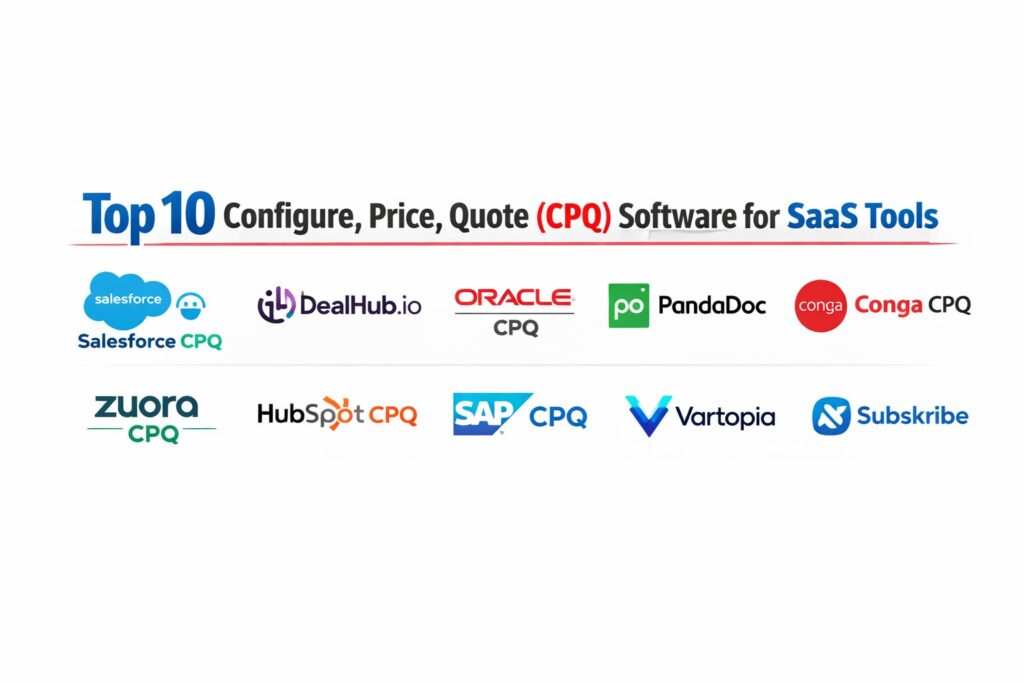
Introduction
Configure, Price, Quote (CPQ) software for SaaS represents a specialized layer of the revenue operations stack designed to handle the complexities of subscription-based economies. Unlike traditional manufacturing CPQ, which focuses on physical parts and dimensions, SaaS CPQ must manage multi-dimensional variables such as seat-based pricing, usage-based consumption, ramp deals, and automated renewals. These platforms serve as the bridge between the initial sales conversation and the downstream financial systems, ensuring that every contract is technically valid, accurately priced, and structured for long-term revenue recognition. For high-growth software companies, this technology is the primary engine for eliminating manual quoting errors and accelerating the “quote-to-cash” cycle.
The necessity for a dedicated SaaS CPQ is driven by the shift toward hybrid pricing models where organizations combine flat fees with tiered usage and modular add-ons. Manual spreadsheets and fragmented legacy systems struggle to maintain data integrity when deals involve mid-term upgrades, downgrades, or complex discounting logic. A robust CPQ environment enables sales teams to generate sophisticated proposals in minutes while providing finance teams with the structured data required for automated billing and revenue forecasting. When selecting a platform, organizations must evaluate the depth of the subscription management engine, the seamlessness of the CRM integration, the flexibility of the approval workflows, and the scalability of the system to handle thousands of unique contract configurations.
Best for: SaaS and subscription-based enterprises, B2B software companies with complex pricing structures, and revenue operations teams looking to automate the contract lifecycle and renewal process.
Not ideal for: Simple e-commerce businesses with fixed pricing, professional service firms with unique one-off project bids, or very early-stage startups with a single, non-negotiable pricing tier.
Key Trends in CPQ for SaaS
The integration of Artificial Intelligence has moved into the core of the quoting process, with systems now offering “Guided Selling” that suggests the optimal product mix and discount levels based on historical win rates. We are seeing a significant move toward “Product-Led Growth” (PLG) integrations, where CPQ systems can automatically trigger quotes based on in-app usage triggers or trial conversions. Real-time revenue impact visualization is also becoming a standard requirement, allowing sales reps to see the immediate effect of a discount on the Total Contract Value (TCV) and Annual Recurring Revenue (ARR) before submitting for approval.
Unified billing and CPQ architectures are replacing fragmented stacks, ensuring that the data captured during the quoting stage flows perfectly into the invoice without manual intervention. There is a heightened focus on “Ramp Deals,” where software platforms allow for phased rollouts of seats or features over a multi-year contract to align with the customer’s implementation schedule. Furthermore, the “Self-Service Quoting” shift is gaining traction, allowing existing customers to perform their own upgrades or add-on purchases through a secure portal that remains governed by the master service agreement’s pricing logic.
How We Selected These Tools
Our selection process involved a rigorous assessment of functional depth specifically within the subscription management and SaaS revenue recognition sectors. We prioritized platforms that have demonstrated high reliability in managing complex, multi-year contract lifecycles and “evergreen” renewal models. A key criterion was the “CRM Native” experience, evaluating how well each CPQ tool integrates with major sales platforms to ensure a single source of truth for the sales team. We looked for a balance between highly customizable enterprise powerhouses and nimble, modern solutions designed for rapid deployment.
Scalability was a major factor; we selected tools that can manage everything from simple seat-based subscriptions to complex, global contracts with localized currencies and tax rules. Security and compliance signals were scrutinized to ensure alignment with international financial standards such as ASC 606 and IFRS 15, which are critical for SaaS revenue reporting. Finally, we assessed the total cost of ownership, including the time required for implementation and the ongoing administrative overhead needed to update price books as product catalogs evolve.
1. Salesforce CPQ
Salesforce CPQ is a market-leading platform built natively on the Salesforce Lightning architecture. It offers an exhaustive suite of tools for configuring complex product bundles, managing discount schedules, and generating professional quotes directly within the world’s most used CRM. It is the standard for enterprise SaaS companies that require a deep, unified data model for their entire revenue operation.
Key Features
The platform features a robust “Product Bundling” engine that enforces configuration rules to prevent incompatible feature selections. It includes a sophisticated “Discount Schedule” module that allows for volume-based or tiered pricing logic to be applied automatically. The “Guided Selling” prompt helps reps select the right products by asking a series of qualifying questions. It features advanced “Renewal and Amendment” automation that handles mid-term contract changes with precision. Additionally, its deep integration with Salesforce Billing ensures a seamless transition from a signed quote to a recognized invoice.
Pros
Being native to Salesforce means no data synchronization issues and a consistent UI for sales teams already familiar with the CRM. The ecosystem of third-party administrators and consultants is the largest in the world.
Cons
The implementation process is notoriously complex and usually requires a significant investment in professional services. The licensing cost can be prohibitive for smaller organizations.
Platforms and Deployment
Web-based (SaaS) and mobile access via the Salesforce app. It is a cloud-native deployment.
Security and Compliance
Maintains the highest enterprise security standards including SOC 2, HIPAA, and GDPR. It supports granular field-level security and audit logs.
Integrations and Ecosystem
Integrates perfectly with the entire Salesforce ecosystem and thousands of AppExchange partners for billing and e-signature.
Support and Community
Offers the “Trailhead” learning platform and a massive global community of certified CPQ specialists.
2. DealHub.io
DealHub is a modern, high-velocity CPQ and “DealRoom” platform designed to simplify the sales process for both the rep and the buyer. It is known for its “no-code” configuration and its focus on creating a collaborative, digital environment for contract negotiation.
Key Features
The standout feature is the “Digital DealRoom,” a personalized microsite where buyers can view quotes, collateral, and contracts in one place. It includes a “Playbook-Driven” configuration that guides reps through the quoting process without needing to memorize complex rules. The system features integrated e-signature and contract lifecycle management (CLM) in a single platform. It offers real-time notifications when a buyer interacts with the deal room or views a quote. The platform also provides deep insights into deal progress and buyer engagement metrics.
Pros
The implementation time is significantly faster than traditional enterprise CPQ tools. The collaborative deal room experience helps differentiate the sales process and speed up buyer consensus.
Cons
The platform may lack some of the extreme “edge-case” custom coding capabilities found in older, developer-centric CPQ engines. It is heavily focused on the sales experience over back-end financial complexity.
Platforms and Deployment
Web-based SaaS with deep integrations for Salesforce, Microsoft Dynamics, and HubSpot.
Security and Compliance
SOC 2 Type II compliant and maintains strict data privacy standards for all contract and quote data.
Integrations and Ecosystem
Offers native integrations with major CRMs and various subscription billing tools like Chargebee and Zuora.
Support and Community
Known for highly responsive customer success and a streamlined onboarding process for new teams.
3. Oracle CPQ
Oracle CPQ is a powerful, enterprise-grade solution that excels in handling massive product catalogs and highly complex pricing models. It is built for global organizations that require a scalable engine to manage thousands of users across multiple channels and geographies.
Key Features
The platform features a “Configuration Engine” that can handle millions of possible product combinations without performance degradation. It includes a comprehensive “Global Pricing” module that supports multi-currency and localized tax calculations. The “Bulk Upload” feature allows for the rapid updating of large price books and product lists. It features advanced “Margin Analysis” tools that help sales leaders ensure every deal meets profitability requirements. The system also offers a specialized “Partner Portal” for managing indirect sales channels.
Pros
It is one of the most stable and scalable platforms on the market, capable of supporting the world’s largest enterprises. Its ability to handle complex, multi-layered discounting is unmatched.
Cons
The user interface can feel more technical and less “modern” compared to newer SaaS-first tools. It requires a dedicated technical resource for ongoing maintenance and updates.
Platforms and Deployment
Cloud-based SaaS accessible via web browser.
Security and Compliance
Adheres to rigorous global standards including ISO 27001 and maintains top-tier data residency controls.
Integrations and Ecosystem
Integrates with Oracle ERP, Salesforce, and Microsoft Dynamics, as well as various third-party financial systems.
Support and Community
Provides professional enterprise support and a wide network of global implementation partners.
4. PandaDoc
PandaDoc is a versatile document automation platform that has expanded its CPQ capabilities to serve small to mid-market SaaS companies. It is favored for its ease of use and its ability to create visually stunning, interactive proposals that include integrated payment options.
Key Features
The platform features a “Drag-and-Drop” document editor that makes it easy to build professional quotes without design skills. It includes a “Product Catalog” with automated pricing calculations and optional item selection for buyers. The system features integrated e-signature and real-time document tracking to see when a lead opens a quote. It offers “Smart Content” blocks that automatically pull in case studies or testimonials based on the product being quoted. The platform also supports “Payment Collection” directly through the signed document.
Pros
The setup process is extremely fast, often taking only a few days to fully deploy. It offers excellent value for companies that prioritize document aesthetics and simplicity.
Cons
The configuration logic for complex “rules-based” bundling is not as deep as specialized CPQ engines. It may struggle with the most advanced multi-year subscription amendment scenarios.
Platforms and Deployment
Web-based SaaS and mobile app.
Security and Compliance
SOC 2 Type II compliant and utilizes 256-bit encryption for all stored documents and signatures.
Integrations and Ecosystem
Strong native integrations with HubSpot, Pipedrive, and Salesforce, as well as various payment gateways like Stripe.
Support and Community
Offers an extensive help center, video tutorials, and a very active customer support team.
5. Conga CPQ (formerly Apttus)
Conga CPQ is a robust, enterprise-focused solution that emphasizes the “Quote-to-Cash” lifecycle. It is designed for organizations that want to unify their CPQ, CLM, and billing processes into a single, cohesive workflow.
Key Features
The platform features a highly sophisticated “Constraint Rule” engine that ensures even the most complex SaaS bundles are valid. It includes advanced “Price Waterfall” visualization to show exactly how a final price was calculated. The system features a native “Contract Lifecycle Management” tool that handles redlining and legal approvals seamlessly. It offers specialized modules for “Incentives and Rebates” management. The platform also provides deep analytics on quoting cycles and sales rep performance.
Pros
The unification of CPQ and CLM reduces friction between sales and legal teams. It is a very powerful tool for organizations with extremely complex, high-stakes contract requirements.
Cons
The administrative complexity is high, necessitating specialized staff to manage the system. It can be slower to deploy compared to more lightweight SaaS alternatives.
Platforms and Deployment
Cloud-based SaaS with a strong presence on the Salesforce platform.
Security and Compliance
Maintains enterprise-grade security certifications and is designed to handle sensitive legal and financial data.
Integrations and Ecosystem
Integrates deeply with Salesforce and various ERP systems for downstream financial processing.
Support and Community
Offers professional training programs and a dedicated success model for large-scale enterprise deployments.
6. Zuora CPQ
Zuora CPQ is uniquely designed for the “Subscription Economy,” focusing specifically on the recurring revenue lifecycle. It is the ideal choice for SaaS companies that use Zuora’s billing engine and need a quoting tool that understands the nuances of subscription changes.
Key Features
The platform features a “Subscription-First” data model that natively understands terms, renewals, and evergreen contracts. It includes an “Amendment Engine” that makes it easy to handle mid-term upgrades and pro-rated charges. The system features a “Product Catalog” that is shared between CPQ and Billing to ensure data consistency. It offers “Ramp Pricing” tools for phased subscription rollouts. The platform also provides real-time “Metrics Preview” so reps can see the impact on ARR and MRR during the quote.
Pros
It eliminates the “sync errors” between sales quotes and billing invoices by using a single source of truth for product data. It is the most specialized tool for complex subscription logic.
Cons
It is most effective when used as part of the broader Zuora ecosystem; it may be less attractive to those using a different billing engine. The UI for reps is functional but less “flashy” than some competitors.
Platforms and Deployment
Web-based SaaS.
Security and Compliance
Fully compliant with ASC 606 and IFRS 15 standards for revenue recognition and maintains top-tier data security.
Integrations and Ecosystem
Designed to sit between Salesforce and the Zuora Billing platform, creating a seamless revenue pipeline.
Support and Community
Provides extensive resources on subscription business models and a dedicated support team for revenue operations.
7. HubSpot CPQ (Quotes)
HubSpot’s CPQ capabilities are built directly into its Sales Hub, offering a streamlined experience for teams already using the HubSpot CRM. It focuses on removing friction from the quoting process for SMB and mid-market SaaS companies.
Key Features
The platform features “Customizable Quote Templates” that can be branded and sent in seconds. It includes “Product Library” management with support for recurring line items and billing frequencies. The system features integrated “e-Signature and Payments” through HubSpot’s native tools. It offers “Quote Approval” workflows that ensure discounts stay within authorized limits. The platform also provides real-time “Deal Tracking” that updates the CRM stage automatically when a quote is signed.
Pros
The “All-on-One” nature of HubSpot means there is no integration to maintain between CRM and CPQ. It is one of the most user-friendly tools for sales reps.
Cons
The advanced configuration and bundling rules are not as deep as enterprise-level tools like Salesforce CPQ. It is less suited for extremely complex “technical” configurations.
Platforms and Deployment
Cloud-based SaaS.
Security and Compliance
Maintains high standards for data privacy and is GDPR and SOC 2 compliant as part of the HubSpot platform.
Integrations and Ecosystem
Integrates seamlessly with everything in the HubSpot ecosystem and hundreds of third-party apps via the App Marketplace.
Support and Community
Known for world-class 24/7 support and a massive “HubSpot Academy” for user training.
8. SAP CPQ
SAP CPQ is an enterprise solution that focuses on high-volume, multi-channel sales. It is particularly strong for large SaaS organizations that have complex global operations and require tight integration with their back-office ERP.
Key Features
The platform features an “AI-Driven Pricing” engine that suggests the best price to win a deal while protecting margins. It includes a “Rule-Based Configurator” that can manage massive product variations across global regions. The system features “Multi-Channel Support,” allowing the same pricing logic to be used by direct sales and partners. It offers advanced “Margin Calculation” and commissions tracking. The platform also provides a specialized “UI for Mobile Sales” to ensure reps can quote on the go.
Pros
The integration with SAP ERP provides unparalleled visibility from the initial quote to final delivery and payment. It is extremely reliable for high-volume enterprise environments.
Cons
The setup and customization require specialized SAP consultants, making it a high-cost endeavor. It may feel “over-engineered” for smaller, purely digital SaaS firms.
Platforms and Deployment
Cloud-based SaaS.
Security and Compliance
Adheres to the highest global enterprise standards and is designed to meet strict regulatory requirements.
Integrations and Ecosystem
Deeply integrated with SAP S/4HANA and Salesforce, as well as various global payment and tax engines.
Support and Community
Provides professional SAP support services and a vast network of global implementation partners.
9. Vartopia
Vartopia is a specialized CPQ platform designed specifically for “Partner-Led” SaaS companies. It focuses on the unique challenges of managing deal registration and quoting through an indirect sales channel of resellers and distributors.
Key Features
The platform features a unified “Partner Portal” where resellers can register deals and generate quotes according to their specific margins. It includes a “Collaboration Engine” that allows vendor and partner to work on a quote together. The system features “Lead Distribution” and deal protection rules to prevent channel conflict. It offers “Custom Price Books” tailored to specific partner tiers. The platform also provides deep analytics on channel performance and partner engagement.
Pros
It solves the specific pain point of channel conflict and partner quoting which many generalist CPQs ignore. It helps vendors scale their indirect sales force without increasing administrative overhead.
Cons
It is highly specialized; if you don’t have a partner-led sales model, it is not the right tool. The UI is focused on the partner experience over internal sales.
Platforms and Deployment
Web-based SaaS.
Security and Compliance
Standard enterprise data security and secure access controls for third-party partners.
Integrations and Ecosystem
Integrates with major CRMs to ensure that partner quotes are reflected in the master sales pipeline.
Support and Community
Offers dedicated support for channel managers and a streamlined onboarding process for new partners.
10. Subskribe
Subskribe is a modern, “Adaptive CPQ” built specifically for the unique needs of mid-market and enterprise SaaS companies. It aims to eliminate the gap between the quote and the invoice by using a unified data model for the entire revenue lifecycle.
Key Features
The platform features an “Adaptive Configuration” engine that handles ramp deals, multi-year contracts, and usage-based pricing natively. It includes “Real-Time Revenue Preview” so reps can see exactly how a deal will impact ARR. The system features a “Unified Catalog” that ensures the product data quoted is the same data used for billing. It offers “Automated Approvals” and document generation in a single flow. The platform also provides a “Customer Portal” for self-service upgrades and renewals.
Pros
It is built specifically for the modern SaaS model, avoiding the “legacy baggage” of older CPQ engines. The unified quote-to-invoice model reduces financial reconciliation work significantly.
Cons
As a newer entrant in the market, its third-party app ecosystem is still growing compared to giants like Salesforce. It is primarily focused on the SaaS vertical.
Platforms and Deployment
Web-based SaaS.
Security and Compliance
SOC 2 Type II compliant and designed to meet ASC 606 revenue recognition standards.
Integrations and Ecosystem
Strong native integrations with Salesforce and various modern accounting and billing systems.
Support and Community
Offers a high-touch customer success model and a dedicated focus on revenue operations excellence.
Comparison Table
| Tool Name | Best For | Platform(s) Supported | Deployment | Standout Feature | Public Rating |
| 1. Salesforce CPQ | Enterprise Ecosystem | Web, iOS, Android | Cloud-Native | Native CRM Data Model | 4.7/5 |
| 2. DealHub.io | Sales Velocity | Web-Based | Cloud SaaS | Collaborative DealRoom | 4.8/5 |
| 3. Oracle CPQ | Global Complexity | Web-Based | Cloud SaaS | Scalable Config Engine | 4.4/5 |
| 4. PandaDoc | SMB / Proposals | Web, iOS, Android | Cloud SaaS | Interactive Document Editor | 4.7/5 |
| 5. Conga CPQ | Quote-to-Cash | Web-Based | Cloud SaaS | Unified CPQ & CLM | 4.3/5 |
| 6. Zuora CPQ | Subscription Experts | Web-Based | Cloud SaaS | Native Subscription Logic | 4.2/5 |
| 7. HubSpot CPQ | SMB / Ease of Use | Web-Based | Cloud SaaS | Integrated CRM Quoting | 4.5/5 |
| 8. SAP CPQ | Multi-Channel / ERP | Web, iOS, Android | Cloud SaaS | ERP-Driven Pricing | 4.2/5 |
| 9. Vartopia | Channel Management | Web-Based | Cloud SaaS | Partner Collaboration | 4.6/5 |
| 10. Subskribe | Modern SaaS Operations | Web-Based | Cloud SaaS | Unified Quote-to-Invoice | 4.8/5 |
Evaluation & Scoring of CPQ for SaaS
The scoring below is a comparative model intended to help shortlisting. Each criterion is scored from 1–10, then a weighted total from 0–10 is calculated using the weights listed. These are analyst estimates based on typical fit and common workflow requirements, not public ratings.
Weights:
- Core features – 25%
- Ease of use – 15%
- Integrations & ecosystem – 15%
- Security & compliance – 10%
- Performance & reliability – 10%
- Support & community – 10%
- Price / value – 15%
| Tool Name | Core (25%) | Ease (15%) | Integrations (15%) | Security (10%) | Performance (10%) | Support (10%) | Value (15%) | Weighted Total |
| 1. Salesforce CPQ | 10 | 3 | 10 | 10 | 9 | 9 | 6 | 8.20 |
| 2. DealHub.io | 8 | 9 | 8 | 9 | 9 | 9 | 8 | 8.55 |
| 3. Oracle CPQ | 10 | 4 | 9 | 9 | 10 | 8 | 6 | 8.05 |
| 4. PandaDoc | 6 | 10 | 8 | 8 | 8 | 9 | 10 | 8.00 |
| 5. Conga CPQ | 9 | 4 | 9 | 10 | 9 | 8 | 7 | 8.00 |
| 6. Zuora CPQ | 9 | 5 | 8 | 9 | 9 | 8 | 7 | 7.75 |
| 7. HubSpot CPQ | 7 | 10 | 8 | 9 | 8 | 10 | 9 | 8.40 |
| 8. SAP CPQ | 9 | 4 | 9 | 10 | 10 | 8 | 6 | 7.90 |
| 9. Vartopia | 8 | 7 | 8 | 8 | 8 | 8 | 8 | 7.90 |
| 10. Subskribe | 9 | 8 | 8 | 9 | 9 | 9 | 8 | 8.55 |
How to interpret the scores:
- Use the weighted total to shortlist candidates, then validate with a pilot.
- A lower score can mean specialization, not weakness.
- Security and compliance scores reflect controllability and governance fit, because certifications are often not publicly stated.
- Actual outcomes vary with assembly size, team skills, templates, and process maturity.
Which CPQ for SaaS Tool Is Right for You?
Solo /Freelancer
For early-stage SaaS founders, speed and cost are the primary drivers. You need a tool that integrates instantly with your CRM and allows you to send clean, professional quotes without a technical implementation. A platform that combines quoting with e-signature and simple payment collection will help you close your first fifty deals with minimal administrative friction.
SMB
Organizations with limited administrative staff should prioritize ease of use and automated renewal reminders. Your goal is to ensure that your recurring software donations or service contracts are managed without manual oversight. A tool that provides clear, simple templates and integrates with your existing accounting software is the most efficient choice here.
Mid-Market
Growing SaaS companies need to move beyond simple seat-based pricing and toward more complex bundles and discount rules. You should look for a CPQ that offers guided selling to help new reps stay consistent and an amendment engine that makes mid-term upgrades easy for your customer success team to handle.
Enterprise
Large, global software firms require a system that acts as a financial gatekeeper. Security, multi-currency support, and the ability to integrate with high-end ERP systems for automated revenue recognition are the top priorities. You need a tool that can handle thousands of global users and ensure that every contract complies with international accounting standards.
Budget vs Premium
If budget is the primary concern, looking for CPQ features already built into your CRM is the most cost-effective path. Premium platforms, however, offer specialized logic for ramp deals and usage-based pricing that can provide a much higher return on investment by reducing the time your finance team spends on manual billing corrections.
Feature Depth vs Ease of Use
Highly technical tools offer infinite flexibility but can stall a sales team if the quoting process becomes too slow. Often, a “good enough” tool that allows a rep to get a valid quote to a customer in ten minutes is more valuable than a “perfect” system that takes forty minutes of configuration.
Integrations & Scalability
Your CPQ must be the “glue” between your sales and finance teams. As you scale, the ability to pass structured contract data directly into your billing and revenue recognition engines without human intervention is a vital consideration for long-term operational health.
Security & Compliance Needs
If you handle global enterprise contracts or operate in regulated sectors, your CPQ is a compliance tool. Ensure the provider has the specific certifications required for ASC 606 revenue recognition and maintains a secure, encrypted environment for all signed legal agreements.
Frequently Asked Questions (FAQs)
1. What is the difference between CPQ and a standard quote tool?
A standard quote tool simply generates a document. A CPQ (Configure, Price, Quote) uses a rules engine to ensure that only valid product combinations are selected, calculates complex tiered pricing automatically, and enforces approval workflows for discounts.
2. Why is CPQ critical for SaaS companies specifically?
SaaS deals often involve recurring revenue, pro-rated mid-term upgrades, and automatic renewals. A standard quoting tool cannot handle the math of a customer adding 50 seats six months into a 12-month contract, whereas a SaaS-focused CPQ handles it instantly.
3. Does CPQ software help with revenue recognition?
Yes, by providing structured data about when a subscription starts, how much was paid, and what the terms are, a CPQ helps finance teams comply with ASC 606 and IFRS 15 standards for recognizing revenue over the life of a contract.
4. How long does a typical CPQ implementation take?
For SMB-focused tools, it can take 2-4 weeks. For enterprise-grade systems like Salesforce or Oracle, implementations often take 3-6 months and require a dedicated project team to map out all pricing and configuration rules.
5. Can CPQ help with sales rep onboarding?
Absolutely. Through “Guided Selling,” a CPQ can prompt new reps with the right questions to ask a customer and automatically suggest the correct product bundles, significantly reducing the time it takes for a new hire to become productive.
6. What is “Quote-to-Cash”?
Quote-to-Cash is the end-to-end process that starts with a sales rep configuring a quote and ends with the finance team collecting the final payment. CPQ is the critical first step in this chain that ensures the rest of the process is accurate.
7. Do CPQ systems support usage-based pricing?
Modern SaaS-focused CPQs are increasingly supporting usage-based models, allowing reps to quote a base fee plus a “price-per-unit” for consumption, which then integrates with the billing system to track actual usage.
8. Is e-signature usually included in CPQ software?
Many modern CPQ tools include native e-signature or have very deep integrations with providers like DocuSign or HelloSign, ensuring the contract moves directly from “quoted” to “signed” without leaving the platform.
9. Can CPQ manage channel partners?
Yes, many enterprise CPQ systems offer “Partner Portals” where resellers can generate their own quotes using their specific discounted price books, ensuring that all channel deals are still governed by the vendor’s configuration rules.
10. How does a CPQ handle renewals?
A SaaS CPQ can automatically generate a “renewal quote” months before a contract expires, pulling in the original pricing and applying any pre-negotiated uplifts, allowing the customer success team to close renewals with a single click.
Conclusion
In the modern SaaS ecosystem, a CPQ platform is the essential digital infrastructure that transforms complex pricing strategies into scalable revenue. As companies move beyond simple monthly subscriptions toward hybrid, usage-based, and multi-year ramp deals, the ability to automate the “quote-to-contract” flow becomes a non-negotiable requirement for growth. By centralizing pricing logic and configuration rules, an organization can empower its sales team to move faster while ensuring the finance team receives perfectly structured data for billing and compliance. The ideal CPQ is one that not only secures the initial deal but also provides the scalable foundation for the entire recurring customer relationship.