Introduction
A contract repository is the technical foundation of modern legal operations, serving as a centralized, secure database where an organization’s executed agreements are stored, indexed, and managed. Unlike a simple cloud storage folder, a dedicated repository transforms unstructured documents—often trapped in PDF or image formats—into structured, actionable data through Optical Character Recognition (OCR) and metadata tagging. For businesses managing hundreds or thousands of agreements, these tools provide a “single source of truth” that mitigates the risk of missed renewal windows, regulatory non-compliance, and lost revenue. By centralizing visibility, repositories enable legal, procurement, and finance teams to instantly retrieve key terms without manual document review.
The strategic deployment of a contract repository is a critical step in a company’s digital transformation journey. It moves the organization from a reactive state—where contracts are only examined during disputes or audits—to a proactive state where obligations are tracked in real-time. The best repository tools utilize artificial intelligence to automatically extract critical data points such as termination notice periods, governing law, and payment terms. This technical layer ensures that the repository is not just a digital filing cabinet, but a dynamic intelligence engine that supports executive decision-making and protects the enterprise from operational “blind spots.”
Best for: Legal operations teams, procurement managers, and C-level executives who require instant visibility into contract obligations, renewal timelines, and risk exposure across the entire organization.
Not ideal for: Micro-businesses or freelancers with only a handful of recurring agreements that can be effectively managed through a basic calendar and standard cloud storage solution.
Key Trends in Contract Repository Tools
The most significant trend is the transition from static storage to “Agentic AI” repositories. These systems don’t just store files; they employ autonomous agents that monitor the repository for specific risks, such as a change in privacy laws, and automatically flag all affected contracts. Another major shift is the integration of “Spend Intelligence,” where the repository is linked directly to the company’s ERP system to verify that the terms stored in the contract (like tiered pricing) are actually being reflected in the invoices received.
Furthermore, there is a growing emphasis on “Zero-Touch” ingestion. Using advanced machine learning, new tools can now ingest legacy contracts from disparate sources—email, local drives, and legacy databases—and automatically categorize them with over 95% accuracy without human intervention. Security trends have also evolved, with “Self-Sovereign Identity” and blockchain-based audit trails becoming standard features to ensure that once a contract is executed and stored, its integrity is cryptographically guaranteed and immutable throughout its lifecycle.
How We Selected These Tools
Our selection process focused on tools that excel specifically in the “Store and Manage” phase of the contract lifecycle. While many are full Contract Lifecycle Management (CLM) suites, we prioritized those with the most robust repository backends, focusing on searchability, metadata extraction, and reporting. We evaluated each tool based on its “Time-to-Value,” looking for platforms that allow organizations to upload and index their existing contract portfolios in days rather than months.
Technical robustness was measured by the accuracy of the OCR engine and the flexibility of the data schema—specifically, how easily a user can create custom fields for unique industry-specific obligations. We also heavily weighted the quality of the “Alerting Engine,” as a repository is only as good as its ability to notify stakeholders of upcoming deadlines. Finally, we ensured a mix of tools suitable for different market segments, from lightweight, user-friendly options for mid-market firms to high-governance, enterprise-grade systems for global corporations.
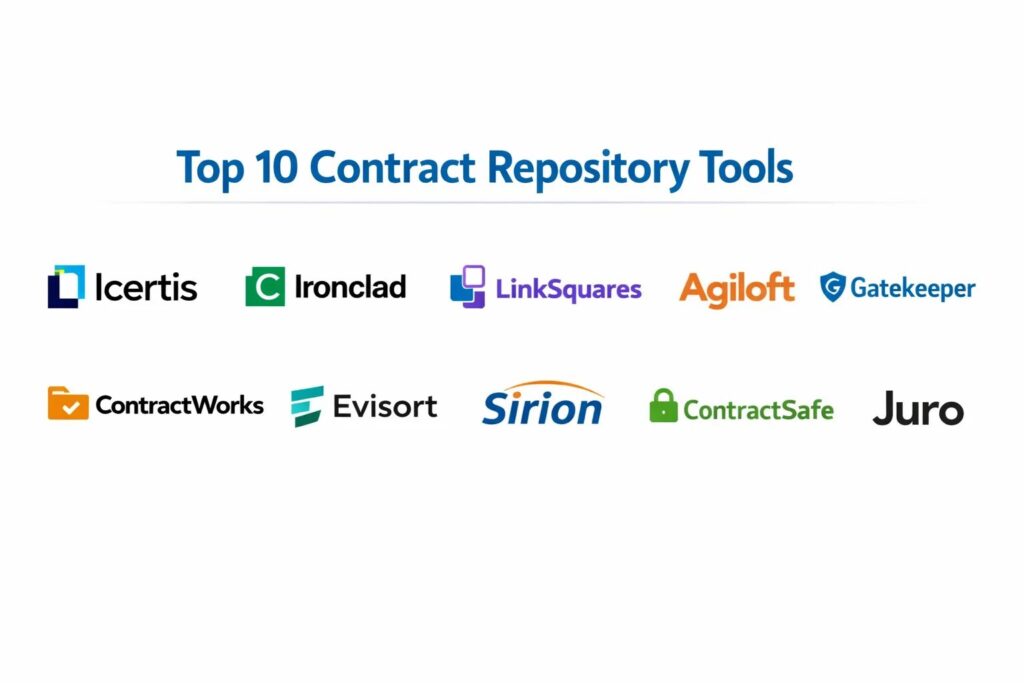
1. Icertis
Icertis is widely recognized as the gold standard for enterprise-grade contract intelligence. It is built for complex, global organizations that require high levels of governance and the ability to turn contractual language into structured data that flows across the entire enterprise.
Key Features
The platform features an AI-driven “Contract Intelligence” engine that provides deep visibility into risk and performance. It offers multi-language and multi-currency support, making it ideal for multinational corporations. The system includes a sophisticated obligation management module that tracks non-financial commitments. It provides advanced analytics and heatmaps to visualize risk across the entire contract portfolio. Additionally, it offers specialized “Industry Vertical” solutions tailored to the unique regulatory requirements of sectors like healthcare, retail, and manufacturing.
Pros
Unmatched scalability and governance for large-scale enterprise deployments. The AI capabilities for metadata extraction and risk analysis are among the most advanced in the market.
Cons
The implementation process is highly complex and typically requires significant time and professional services. The pricing is at the highest end of the market, making it inaccessible for smaller firms.
Platforms and Deployment
Cloud-based web platform with dedicated mobile access for executives.
Security and Compliance
Holds top-tier certifications including SOC 2 Type II, ISO 27001, and HIPAA compliance for sensitive data.
Integrations and Ecosystem
Deep native integrations with SAP, Oracle, Microsoft Dynamics 365, and Salesforce.
Support and Community
Offers global 24/7 enterprise support and a robust community of certified implementation partners.
2. Ironclad
Ironclad is a favorite among modern legal teams for its intuitive user interface and powerful workflow automation. While it handles the entire lifecycle, its “Data Repository” (called the Dynamic Repository) is exceptional for its ease of search and automated data capture.
Key Features
The Dynamic Repository automatically tags contracts using “Ironclad AI,” which identifies key terms as soon as a document is uploaded. It features a “Clickwrap” solution for managing high-volume, standardized agreements like Terms of Service. The platform includes a robust “Workflow Designer” that allows non-technical users to build complex approval routes. It provides real-time collaboration tools that allow teams to negotiate directly within the browser. The system also offers a specialized “Salesforce Integration” that is widely considered one of the most stable in the industry.
Pros
Excellent user experience leads to high adoption rates across non-legal departments like Sales and HR. The speed of deployment is significantly faster than traditional enterprise CLMs.
Cons
Advanced features like AI redlining can be expensive as add-ons. It may lack some of the deepest post-signature obligation tracking found in buy-side specific tools.
Platforms and Deployment
Cloud-native web application.
Security and Compliance
SOC 2 Type II compliant with enterprise-grade encryption and granular role-based access controls.
Integrations and Ecosystem
Seamless connections with Salesforce, Google Drive, Dropbox, and various e-signature providers.
Support and Community
Highly active user community and extensive digital training resources through the “Ironclad Academy.”
3. LinkSquares
LinkSquares is a data-first platform designed specifically to help legal teams understand what is inside their existing contracts. Its repository is optimized for “Full-Text Search” and rapid reporting, making it a powerful tool for M&A due diligence and audit preparation.
Key Features
The platform utilizes a proprietary OCR and AI engine that can process thousands of legacy PDFs with high accuracy. It features “LinkSquares Finalize” for drafting and “LinkSquares Analyze” for deep repository insights. The system includes an automated “Renewal Dashboard” that provides a bird’s-eye view of all upcoming expirations. It offers custom report builders that allow users to drag and drop data fields to create executive summaries. The AI also assigns “Risk Scores” to contracts to help prioritize legal review efforts.
Pros
Exceptional at extracting data from “messy” legacy documents and scanned images. The search functionality is incredibly fast, even with portfolios containing tens of thousands of contracts.
Cons
The platform is primarily focused on the legal department and may have fewer features for procurement-specific spend management.
Platforms and Deployment
Web-based dashboard.
Security and Compliance
Maintains SOC 2 and HIPAA compliance with a focus on secure data isolation.
Integrations and Ecosystem
Integrates with Salesforce, HubSpot, and common document storage platforms like SharePoint.
Support and Community
Known for high-quality, high-touch customer success and technical support.
4. Agiloft
Agiloft is a “No-Code” platform that offers extreme flexibility for organizations with unique or highly specialized contract processes. Its repository is essentially a highly customizable database that can be tailored to any data model.
Key Features
The system is built on a no-code configuration engine, allowing users to create custom tables, fields, and workflows without writing software. It features “AI on the Inside” for automated clause extraction and risk analysis. The platform includes a robust “Vendor Portal” where third parties can upload documents directly into the repository. It offers a powerful “Audit Trail” that tracks every change made to a record over its entire history. The reporting engine is highly sophisticated, capable of generating complex graphical dashboards.
Pros
Deep configurability makes it possible to solve almost any contract management use case. It offers a “Satisfaction Guarantee” which is unique in the enterprise software space.
Cons
The interface can feel “database-heavy” and less modern than competitors like Ironclad. The high degree of flexibility can lead to over-complication during setup.
Platforms and Deployment
Available as a cloud service or as an on-premise self-hosted installation.
Security and Compliance
Highly secure with support for SSO, multi-factor authentication, and SOC 2 compliance.
Integrations and Ecosystem
Broad integration capabilities via a flexible API and pre-built connectors for Microsoft 365 and Salesforce.
Support and Community
Extensive documentation and a strong network of implementation consultants.
5. Gatekeeper
Gatekeeper is a unified platform for contract and vendor management. It is designed to bridge the gap between legal agreements and the actual performance of the vendors those agreements govern.
Key Features
The platform features an “AI Extract” tool that pulls data from legacy contracts automatically. It includes a “Kanban” style workflow view for tracking the progress of contracts through different stages. The system provides a dedicated “Employee Portal” for self-service contract requests. It features “LuminIQ,” an AI assistant that helps summarize complex clauses for non-legal users. A standout feature is its integrated “Credit Risk Monitoring,” which tracks the financial health of the vendors stored in the repository.
Pros
Excellent for vendor-heavy organizations that need to manage both the contract and the supplier relationship in one place. The visual workflow engine is very easy to manage.
Cons
The pricing model is based on the number of vendors/contracts, which can scale quickly for large portfolios.
Platforms and Deployment
Cloud-based web platform.
Security and Compliance
Fully GDPR compliant with SOC 2 Type II certification and secure data hosting.
Integrations and Ecosystem
Strongest in the NetSuite ecosystem, but also integrates with Salesforce and various e-sign tools.
Support and Community
Offers 24/7 support and a comprehensive knowledge base for administrators.
6. ContractWorks
ContractWorks focuses on “Functional Simplicity.” It is designed for teams that need to get a repository up and running in minutes rather than weeks, offering the essential features of a repository without the overhead of a full CLM.
Key Features
The platform provides a secure, centralized repository with advanced OCR search that makes every word in every PDF findable. it includes an automated “Alerting System” for expirations and key dates. It features a “Tagging” system that allows for quick categorization of contracts by department, region, or type. The tool includes built-in e-signature capabilities at no extra cost. It also offers “Unlimited User” plans, which encourages wide adoption across the company without increasing the bill.
Pros
One of the easiest tools to deploy, often taking less than 24 hours to set up. Transparent, flat-fee pricing makes it very budget-friendly for mid-market companies.
Cons
Lacks advanced workflow automation and complex redlining tools found in high-end CLM platforms. Not ideal for companies with highly complex approval requirements.
Platforms and Deployment
Web-based application.
Security and Compliance
Uses 256-bit encryption and maintains SOC 2 compliance to ensure data integrity.
Integrations and Ecosystem
Basic integrations with major e-signature providers and cloud storage tools.
Support and Community
Provides award-winning 24/7 customer support based in the USA.
7. Evisort
Evisort is an AI-native platform that excels in “Contract Intelligence.” It was built from the ground up to use machine learning to read and understand contracts, making it a powerhouse for large-scale data extraction.
Key Features
The “Intelligence Engine” can track over 50 different types of clauses and metadata fields out of the box. It features a “Searchable Dashboard” that allows users to query their repository using natural language (e.g., “Show me all contracts with a 60-day notice period”). The system automatically creates a “Summary Page” for every contract, highlighting key risks and dates. It provides a “Legacy Ingestion” service that uses AI to clean and organize old contract data. It also includes tools for “Post-Execution Compliance” to ensure parties are meeting their obligations.
Pros
The AI is highly accurate and requires very little training to start extracting meaningful data. It is excellent for “Triage,” helping legal teams find high-risk agreements instantly.
Cons
The focus on AI analysis means it may be less optimized for the early-stage “Drafting” phase than some other tools.
Platforms and Deployment
Cloud-based web platform.
Security and Compliance
SOC 2 Type II and HIPAA compliant, with a focus on high-security enterprise environments.
Integrations and Ecosystem
Integrates with AWS, Box, SharePoint, and most major CRM systems.
Support and Community
Offers dedicated technical account managers for enterprise clients.
8. Sirion
Sirion (formerly SirionLabs) is an AI-powered platform that focuses on “Post-Signature Value.” It is designed for large enterprises that want to ensure that the value negotiated in the contract is actually delivered during the life of the agreement.
Key Features
The platform uses “Agentic AI” (AskSirion) which allows users to interact with their contract repository via a conversational interface. It features “Automated Invoice Auditing” which compares vendor invoices against the contract terms stored in the repository. The system includes a “Clause Library” that suggests the best language during negotiations based on historical data. It provides “Performance Dashboards” that track vendor KPIs alongside the contract obligations. It also offers automated “Risk Assessment” for every agreement in the portfolio.
Pros
The best tool for managing complex service agreements and high-value vendor relationships. The AI-driven invoice reconciliation can provide immediate ROI by finding overcharges.
Cons
The platform is very “feature-dense,” which can lead to a steeper learning curve for occasional users.
Platforms and Deployment
Cloud-based enterprise platform.
Security and Compliance
Enterprise-grade security with ISO and SOC certifications.
Integrations and Ecosystem
Broad connectivity with ERP systems (SAP, Oracle) and CRM platforms.
Support and Community
Strong global support presence and a leading voice in AI-driven legal tech.
9. ContractSafe
ContractSafe is a streamlined repository tool that prioritizes “Ease of Search” and “Security.” It is aimed at mid-market companies that want a professional repository without the complexity of a full lifecycle tool.
Key Features
The platform features “Google-like” search capabilities that work across all documents, including scanned images. it includes an “AI Assistant” (powered by [AI]ssistant) that helps extract key dates and parties during the upload process. The system provides “Email Alerts” for renewals that can be sent to any stakeholder, even those without a login. It features a “Virtual Data Room” mode for securely sharing groups of contracts during audits or deals. It also offers “Unlimited Users” on most plans to facilitate company-wide access.
Pros
Extremely user-friendly interface that requires almost zero training. Very fast implementation with a high focus on data security and “clean” repository management.
Cons
Does not include advanced drafting or internal redlining tools. It is a “Repository First” tool rather than a “Workflow First” tool.
Platforms and Deployment
Cloud-based web application.
Security and Compliance
SOC 2 Type II certified with a focus on secure, isolated data environments.
Integrations and Ecosystem
Integrates with Zapier, allowing it to connect to thousands of other business apps.
Support and Community
Highly rated for its responsive and helpful customer success team.
10. Juro
Juro is a “Flexible” contract platform that is designed to be used by both legal and business teams. It stands out for its unique “Browser-Native” editor, which makes every contract a searchable digital document from the moment it is created.
Key Features
The platform features a “Data-First” repository where every contract is stored as JSON data rather than just a flat PDF. It includes a “Visual Timeline” for every contract, showing its history from draft to signature to expiration. The system provides a “Table View” that allows users to create custom dashboards of their contract data. It features “AI Summaries” that give a quick overview of any document in the repository. The tool also includes integrated e-signatures and automated approval workflows.
Pros
The “Browser-Native” approach makes the data much more accessible and searchable than PDF-based systems. It is exceptionally fast for creating and signing standard business agreements.
Cons
May not be as effective for managing a massive library of “legacy” PDFs as specialized AI tools like Evisort or LinkSquares.
Platforms and Deployment
Cloud-based web platform.
Security and Compliance
GDPR compliant and SOC 2 certified with strong data encryption.
Integrations and Ecosystem
Excellent integrations with Slack, Salesforce, and HubSpot to keep teams aligned.
Support and Community
Known for a modern, tech-forward approach to customer support and product updates.
Comparison Table
| Tool Name | Best For | Platform(s) Supported | Deployment | Standout Feature | Public Rating |
| 1. Icertis | Global Enterprise | Web, Mobile | Cloud | Industry-specific AI | 4.8/5 |
| 2. Ironclad | Modern Legal Ops | Web | Cloud | Dynamic Repository | 4.7/5 |
| 3. LinkSquares | Legacy Analysis | Web | Cloud | High-speed OCR/Search | 4.6/5 |
| 4. Agiloft | High Customization | Web | Hybrid | No-code Configuration | 4.8/5 |
| 5. Gatekeeper | Vendor Governance | Web | Cloud | Credit Risk Monitoring | 4.7/5 |
| 6. ContractWorks | Mid-Market Speed | Web | Cloud | Unlimited User Model | 4.5/5 |
| 7. Evisort | Contract Intel | Web | Cloud | Natural Language Query | 4.6/5 |
| 8. Sirion | Post-Sign Value | Web | Cloud | Invoice Reconciliation | 4.9/5 |
| 9. ContractSafe | Simple Security | Web | Cloud | [AI]ssistant Extraction | 4.4/5 |
| 10. Juro | Data-First Teams | Web | Cloud | Browser-Native Editor | 4.7/5 |
Evaluation & Scoring of Contract Repository Tools
The scoring below is a comparative model intended to help shortlisting. Each criterion is scored from 1–10, then a weighted total from 0–10 is calculated using the weights listed. These are analyst estimates based on typical fit and common workflow requirements, not public ratings.
Weights:
- Core features – 25%
- Ease of use – 15%
- Integrations & ecosystem – 15%
- Security & compliance – 10%
- Performance & reliability – 10%
- Support & community – 10%
- Price / value – 15%
| Tool Name | Core (25%) | Ease (15%) | Integrations (15%) | Security (10%) | Performance (10%) | Support (10%) | Value (15%) | Weighted Total |
| 1. Icertis | 10 | 6 | 10 | 10 | 9 | 9 | 6 | 8.65 |
| 2. Ironclad | 9 | 9 | 9 | 9 | 9 | 9 | 8 | 8.85 |
| 3. LinkSquares | 9 | 8 | 8 | 9 | 10 | 9 | 8 | 8.65 |
| 4. Agiloft | 9 | 7 | 9 | 9 | 9 | 8 | 9 | 8.50 |
| 5. Gatekeeper | 8 | 9 | 8 | 9 | 8 | 9 | 9 | 8.50 |
| 6. ContractWorks | 7 | 10 | 7 | 9 | 8 | 10 | 10 | 8.55 |
| 7. Evisort | 10 | 8 | 8 | 9 | 9 | 8 | 8 | 8.75 |
| 8. Sirion | 10 | 7 | 9 | 9 | 9 | 9 | 7 | 8.60 |
| 9. ContractSafe | 7 | 10 | 7 | 9 | 9 | 9 | 9 | 8.40 |
| 10. Juro | 8 | 9 | 9 | 9 | 9 | 8 | 8 | 8.55 |
How to interpret the scores:
- Use the weighted total to shortlist candidates, then validate with a pilot.
- A lower score can mean specialization, not weakness.
- Security and compliance scores reflect controllability and governance fit, because certifications are often not publicly stated.
- Actual outcomes vary with assembly size, team skills, templates, and process maturity.
Which Contract Repository Tool Is Right for You?
Solo / Freelancer
For individuals, a full-scale repository is often overkill. However, if you are scaling, a tool like ContractSafe provides the simplest entry point for keeping your agreements organized and secure without a complex setup.
SMB
Small to medium-sized businesses should look at ContractWorks or Juro. These tools offer a balanced mix of speed, ease of use, and essential features like e-signatures and renewal alerts that solve the most immediate pains of manual management.
Mid-Market
Organizations with a high volume of sales or vendor contracts will benefit most from Ironclad or Gatekeeper. These platforms provide the workflow automation and vendor-specific intelligence needed to manage growth without scaling the legal headcount.
Enterprise
Large-scale enterprises with complex governance needs should choose Icertis or Sirion. These platforms are designed for the “system of record” approach, ensuring that contract data is integrated into the broader corporate infrastructure and financial systems.
Budget vs Premium
If budget is the primary concern, ContractWorks offers a flat-rate model that is highly predictable. If you are looking for a premium, AI-driven experience that provides deep business intelligence, Evisort or LinkSquares are the top-tier investments.
Feature Depth vs Ease of Use
Agiloft offers the most depth and customizability but requires more effort to maintain. Conversely, ContractSafe and Ironclad prioritize an intuitive user interface that ensures high adoption across all business departments.
Integrations & Scalability
For companies deeply embedded in the Salesforce ecosystem, Ironclad and Icertis offer the most robust connectors. For those looking for a stand-alone intelligence layer to sit on top of multiple storage locations, LinkSquares is the optimal choice.
Security & Compliance Needs
All listed tools meet high security standards, but Icertis and Agiloft are particularly well-suited for highly regulated industries (like Pharma or Defense) that require on-premise options or specific federal-grade compliance certifications.
Frequently Asked Questions (FAQs)
1. What is the difference between a repository and a CLM?
A repository is a storage and management system for finalized, executed contracts. A Contract Lifecycle Management (CLM) system covers the entire process, including the drafting, negotiation, and approval phases before a contract is signed.
2. Can these tools handle scanned PDF documents?
Yes, all the tools in this list use Optical Character Recognition (OCR) technology to read the text inside scanned PDFs and images, making them fully searchable and allowing for data extraction.
3. How long does it take to migrate existing contracts?
Migration time depends on the volume and the tool. AI-native tools like LinkSquares or Evisort can process thousands of documents in hours, while setting up the custom fields and folder structures might take a few days.
4. Is my contract data secure in a cloud repository?
Modern repositories use 256-bit encryption for data at rest and in transit. Most are SOC 2 Type II compliant, which is the industry standard for ensuring that a service provider securely manages your data.
5. Do these tools help with M&A due diligence?
Yes, AI-powered repositories are essential for M&A. They allow legal teams to instantly find “Change of Control” clauses or “Non-Compete” agreements across a target company’s entire contract portfolio.
6. Can I set alerts for non-date related obligations?
Advanced tools like Sirion and Icertis allow you to track “behavioral” obligations, such as service level agreements (SLAs) or insurance requirements, rather than just simple expiration dates.
7. Do I need a legal background to use these tools?
No. While legal teams often “own” the repository, these tools are designed for business users in Sales, HR, and Procurement to easily find the information they need without asking a lawyer.
8. What happens if I want to switch platforms later?
Most repositories allow you to export your contracts and the associated metadata (as a CSV or Excel file). It is important to check the “data portability” terms of your contract before signing up.
9. Can these tools detect if a contract is missing a standard clause?
Yes, many AI-driven repositories can compare a contract against your company’s “Standard Playbook” and flag if required clauses—like an Indemnification or Force Majeure clause—are missing or deviate from the approved language.
10. How does a repository help with cost savings?
A repository saves money by preventing unwanted auto-renewals of software or services, identifying duplicated vendor services, and ensuring that you are receiving the tiered discounts negotiated in your master agreements.
Conclusion
Implementing a robust contract repository is no longer a luxury but a fundamental operational requirement for the modern enterprise. As we navigate the complexities of the 2026 business environment, the ability to instantly access and analyze contractual obligations is a key differentiator for successful legal and procurement teams. By moving away from fragmented filing systems and embracing AI-driven centralization, organizations can protect themselves from financial leakage and regulatory risk while simultaneously increasing deal velocity. The choice of tool should be guided by your specific scale, the complexity of your agreements, and the degree of integration required with your existing tech stack. Ultimately, the right repository turns your contracts from passive legal documents into strategic assets that drive business value and ensure long-term corporate resilience.