Introduction
Product feed management tools have become the essential connective tissue of the global digital economy, serving as the bridge between an organization’s internal inventory data and a fragmented landscape of external sales channels. These platforms function as a sophisticated translation layer, taking raw product information from an ERP or eCommerce backend and reformatting it to meet the strict technical specifications of marketplaces like Amazon, search engines like Google, and social platforms like TikTok. For modern retailers, these systems are not merely data transporters; they are performance optimization engines that ensure product visibility and price accuracy across thousands of digital touchpoints.
The strategic importance of dedicated feed management is amplified by the rise of omnichannel commerce, where a single pricing error or out-of-stock listing can lead to immediate account suspensions and lost revenue. A robust feed tool allows marketing teams to apply complex logic—such as “if margin is less than 10%, exclude from Google Ads”—without requiring a single line of code from the IT department. By centralizing the management of product titles, descriptions, and media assets, organizations can maintain a unified brand voice while tailoring specific attributes to the unique algorithms of each individual channel. As the complexity of digital shelf management grows, these tools represent a primary driver for operational efficiency and sustainable growth in the competitive e-commerce landscape.
Best for: High-volume retailers, digital marketing agencies, and enterprise brands managing extensive product catalogs across multiple international marketplaces and advertising platforms.
Not ideal for: Single-channel boutique stores with limited inventory or small local businesses that do not participate in multi-channel advertising or marketplace selling.
Key Trends in Product Feed Management Tools
The integration of Artificial Intelligence (AI) has fundamentally transformed feed management from a manual task to an automated intelligence function. Modern platforms now use Large Language Models to automatically rewrite product titles for better search relevance and to fill in missing attributes based on image recognition technology. We are also seeing a significant move toward “real-time synchronization,” where inventory updates are pushed to channels every few minutes rather than once a day. This trend is critical for preventing overselling and maintaining high seller ratings on strict marketplaces like Amazon and eBay.
Another dominant trend is the fusion of feed management with performance analytics, where tools now suggest optimizations based on actual return on ad spend (ROAS) data. Instead of just pushing data, these systems are becoming “decision-ready,” automatically pausing low-performing products or shifting budget to high-velocity items. Furthermore, the rise of “social commerce” and “visual search” has forced feed tools to prioritize image transformation modules, allowing brands to add dynamic overlays, such as discount badges or logos, directly onto product images at scale. Finally, as data privacy regulations tighten, there is a heightened focus on secure, encrypted data pipelines that ensure constituent product data remains protected throughout the syndication process.
How We Selected These Tools
Our selection process involved a rigorous assessment of technical stability and channel depth specifically within the global e-commerce sector. We prioritized platforms that have demonstrated the ability to handle massive data loads—often millions of SKUs—without performance degradation during peak shopping periods like Black Friday. A key criterion was the “integration velocity,” evaluating how quickly each tool adopts new channel APIs and formatting requirements as platforms like Google or Meta update their standards. We looked for a balance between advanced rule-based logic and a user interface that allows non-technical marketing managers to execute complex data transformations.
Scalability was a non-negotiable factor; we selected tools that cater to various market segments, from growing mid-market brands to multi-national enterprise corporations. Security certifications were scrutinized to ensure alignment with international standards like GDPR and SOC 2, which are essential for protecting sensitive business intelligence and pricing strategies. Finally, we assessed the quality of customer support and the availability of managed services, as the complexity of feed management often requires expert guidance to navigate channel-specific errors and approval processes.
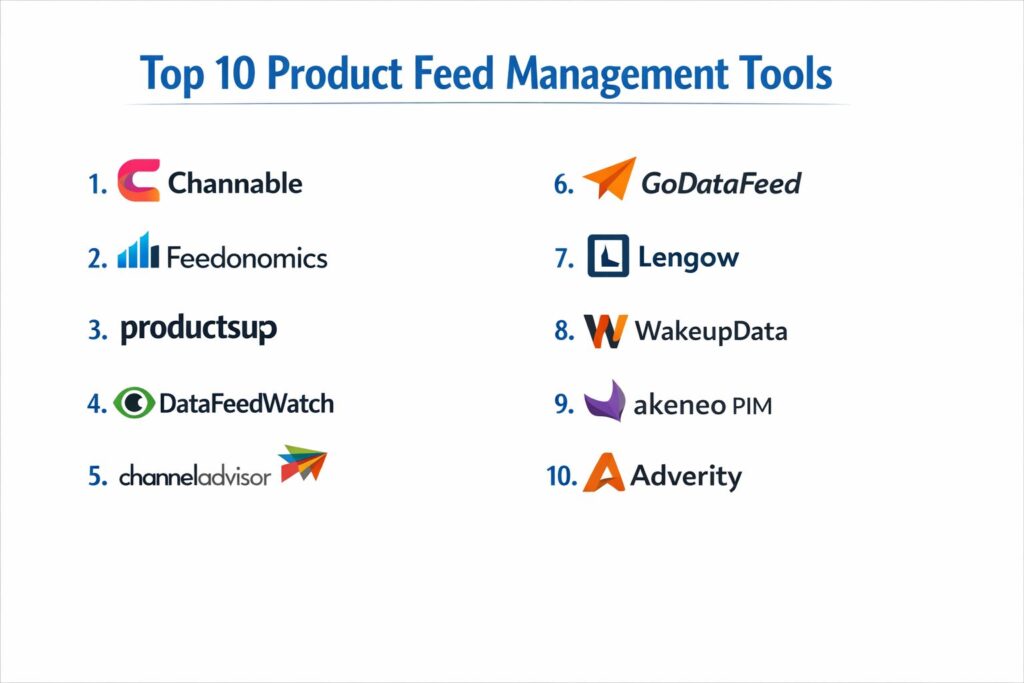
1. Channable
Channable is a versatile, all-in-one platform known for its intuitive rule-based engine and broad channel coverage. It serves mid-sized to large retailers by simplifying the process of creating, optimizing, and syndicating product feeds to over 2,500 different price comparison sites, marketplaces, and affiliate networks.
Key Features
The platform features a visual “if-then” rule builder that allows users to filter products and modify attributes without technical help. It includes an integrated PPC tool that can automatically generate Google Ads and Microsoft Advertising campaigns directly from product feed data. The system offers real-time API connections for many major marketplaces to ensure stock levels are always current. It also features a built-in quality check that identifies missing information before the feed is sent to a channel. Advanced analytics allow users to track the performance of individual items across different platforms.
Pros
The user interface is exceptionally clean and easy to navigate for non-developers. Its integrated PPC automation provides a unique advantage for performance marketers.
Cons
The pricing structure can become expensive as you add more channels and products. Some users find the advanced scripting options more limited than enterprise-heavy competitors.
Platforms and Deployment
Cloud-based SaaS accessible via any modern web browser.
Security and Compliance
Full GDPR compliance with secure data encryption and role-based access controls for team members.
Integrations and Ecosystem
Offers native plugins for major platforms like Shopify, Magento, and BigCommerce, plus thousands of pre-configured channel templates.
Support and Community
Provides extensive documentation, a dedicated help center, and localized support in multiple languages.
2. Feedonomics
Feedonomics is a premium, full-service feed management solution that combines a powerful technical platform with a dedicated team of experts. It is specifically designed for large-scale enterprises and high-growth brands that require white-glove service for complex data challenges.
Key Features
The platform features an advanced “Transformer” engine capable of cleaning and enriching massive datasets from multiple disparate sources. It offers 24/7 managed support where dedicated feed specialists handle the setup and troubleshooting of your feeds. The system includes “Feed Protection” alerts that notify users of sudden changes in product counts or data quality issues. It supports ultra-frequent sync intervals, making it ideal for high-velocity merchants on Amazon. It also features sophisticated order management capabilities that sync marketplace orders directly back to the merchant’s backend.
Pros
The combination of technology and human expertise is world-class, making it the safest choice for enterprise-level operations. It excels at handling highly complex, non-standard data.
Cons
It is a high-cost solution that may be out of reach for smaller businesses. The setup process is more involved than self-service tools.
Platforms and Deployment
Cloud-based SaaS.
Security and Compliance
Maintains rigorous security standards including SOC 2 Type II compliance and enterprise-grade data handling protocols.
Integrations and Ecosystem
Strong integrations with all major global marketplaces and a wide array of enterprise ERP systems.
Support and Community
Renowned for its “Full-Service” model, providing a dedicated account manager and 24/7 technical monitoring.
3. Productsup
Productsup is a high-performance “Product-to-Consumer” (P2C) platform designed for global brands and large retailers. It focuses on mastering the complexity of modern commerce by providing a highly scalable environment for data syndication and optimization.
Key Features
The platform features a drag-and-drop interface that can manage millions of products with ease. It includes a “Dynamic Image Editor” that allows brands to create channel-specific product images with automated overlays. The system offers a specialized module for “Product Content Syndication” that helps maintain brand consistency across various retailer sites. It features advanced AI tools for automated categorization and attribute mapping. The platform also provides sophisticated data health dashboards that visualize errors and opportunities across the entire product catalog.
Pros
The performance on extremely large datasets is industry-leading. The visual workflow makes complex data pipelines much easier to manage and audit.
Cons
The complexity and price point are geared specifically toward the enterprise market. There is a notable learning curve for users new to high-level data management.
Platforms and Deployment
Cloud-based SaaS.
Security and Compliance
Adheres to strict international security standards, including GDPR and SOC 2, ensuring total data sovereignty.
Integrations and Ecosystem
Features an extensive library of integrations for international marketplaces and sophisticated marketing platforms.
Support and Community
Offers a professional academy for certification and high-tier support for enterprise clients.
4. DataFeedWatch
DataFeedWatch is a popular, user-friendly feed management tool that strikes a perfect balance between power and affordability. It is widely used by both merchants and agencies who need a reliable way to optimize feeds for shopping channels.
Key Features
The software features a straightforward mapping system that allows users to align their internal data with the requirements of hundreds of channels. It includes an “Analytics” module that tracks the performance of every product, enabling users to remove unprofitable items from feeds automatically. The system offers a “Price Watch” tool to monitor competitor pricing on various platforms. It features automated attribute enrichment using AI to improve search visibility. The platform also provides a specialized tool for creating local inventory feeds to drive foot traffic to physical stores.
Pros
It is one of the most cost-effective professional tools on the market. The customer support team is highly praised for being fast and responsive.
Cons
The interface, while functional, is less modern than some newer competitors. Some advanced enterprise workflows may require manual workarounds.
Platforms and Deployment
Web-based SaaS.
Security and Compliance
Standard data encryption and GDPR compliance are built-in, providing a secure environment for merchant data.
Integrations and Ecosystem
Direct integrations with Shopify, WooCommerce, Magento, and several hundred advertising channels.
Support and Community
Offers a wealth of educational webinars and a very helpful live-chat support service.
5. ChannelAdvisor
ChannelAdvisor, now part of Rithum, is one of the oldest and most established platforms in the multi-channel commerce space. It offers a comprehensive suite that goes beyond feed management to include deep marketplace integration and fulfillment services.
Key Features
The platform features a centralized dashboard that manages everything from product listings to inventory levels and order fulfillment. It includes a sophisticated “Demand Forecaster” that uses historical data to predict future inventory needs. The “Velocity Repricer” automatically adjusts prices on marketplaces like Amazon based on competition and sales goals. It offers deep insights into “Buy Box” performance and competitive landscape analytics. The system also supports “Where to Buy” solutions that bridge the gap between digital media and retailer checkout pages.
Pros
It is a truly comprehensive solution for businesses that want to manage their entire e-commerce operation in one place. The depth of marketplace expertise is unparalleled.
Cons
The software is notoriously complex and usually requires significant training or a dedicated administrator. Pricing is generally high and can include revenue-sharing components.
Platforms and Deployment
Enterprise cloud-based SaaS.
Security and Compliance
Industry-leading security protocols including PCI compliance for payment-related data and SOC 2 certifications.
Integrations and Ecosystem
Vast ecosystem with hundreds of pre-built integrations for global marketplaces and logistics providers.
Support and Community
Provides extensive professional services and a large network of certified implementation partners.
6. GoDataFeed
GoDataFeed is a performance-focused feed platform designed to help e-commerce businesses automate their product data workflows. It acts as a content management system for product data, making it easy to syndication information to hundreds of channels.
Key Features
The platform features an automated sync engine that pulls data from almost any e-commerce source and keeps it updated across channels. It includes a “Preview” tool that shows exactly how a product will look on a specific channel before the feed is live. Users can build dynamic rules to clean up messy data and apply custom transformations at scale. The software offers specialized templates for Google, Amazon, Meta, and TikTok. It also includes tools for injecting custom UTM tags and tracking codes into product URLs for better attribution.
Pros
It offers a very low barrier to entry and is remarkably easy to set up for smaller teams. The customer support is consistently rated as being fast and helpful.
Cons
It lacks some of the deep enterprise features like advanced PIM functionality or complex order routing found in more expensive suites.
Platforms and Deployment
Web-based SaaS.
Security and Compliance
Maintains secure data pipelines with standard encryption and privacy compliance for all user data.
Integrations and Ecosystem
Compatible with over 200 e-commerce channels and all major website platforms like BigCommerce and Shopify.
Support and Community
Known for providing a high-quality knowledge base and responsive chat support.
7. Lengow
Lengow is an international “e-commerce automation” platform that helps brands and retailers centralize their digital distribution. It is particularly strong in the European market, offering deep integrations with hundreds of local and global marketplaces.
Key Features
The platform features an intuitive “Success Center” that guides users through the process of optimizing feeds for specific channels. It includes an “App Store” where users can add specialized modules for things like translation and dynamic pricing. The system offers advanced tools for managing “Soft Credits” and complex attribute relationships between products. It features a “Matching” tool that helps align your catalog with the specific taxonomies of different marketplaces. The reporting module provides a high-level view of sales performance across all connected channels.
Pros
The user interface is very modern and visually appealing. It is an excellent choice for businesses looking to expand their presence across Europe and beyond.
Cons
Performance can occasionally be slow when processing very large catalogs. The advanced settings can be technical and require time to master.
Platforms and Deployment
Web-based SaaS.
Security and Compliance
Strictly adheres to European data privacy laws and maintains high standards for server security.
Integrations and Ecosystem
Features a massive library of marketplace integrations, particularly in the European region.
Support and Community
Offers a dedicated customer success model and a variety of training resources for new users.
8. WakeupData
WakeupData is a flexible feed management and optimization platform designed for brands, retailers, and agencies. It focuses on providing a high degree of control over product data to drive better ROI from digital advertising.
Key Features
The platform features a powerful data transformation engine that allows for complex filtering and enrichment. it includes a “Competitor Price Monitoring” tool that allows users to adjust their feed data based on what others are charging. The software offers an “Image Transformation” module to add logos, prices, or promotion details directly to product photos. It features “Dynamic Text Ads” generation to maximize the effectiveness of search campaigns. The system also supports “Local Inventory Ads” to connect online browsing with offline store availability.
Pros
It offers unique features like web crawling and scraping for data enrichment that many competitors lack. The flexibility for creating custom templates is very high.
Cons
The user base is smaller than some global leaders, resulting in a less extensive community forum. The interface may require some time to navigate efficiently.
Platforms and Deployment
Cloud-based SaaS.
Security and Compliance
Standard encryption and data protection protocols ensure that merchant feeds remain secure.
Integrations and Ecosystem
Integrates well with popular platforms like Shopify and WooCommerce and all major social and search ad channels.
Support and Community
Provides personalized onboarding and a range of training packages to ensure user success.
9. Akeneo PIM
Akeneo is primarily a Product Information Management (PIM) system, but it serves as a critical foundation for feed management in enterprise environments. It is designed to be the “single source of truth” for all product data before it is syndicated to other platforms.
Key Features
The platform features a robust “Product Cloud” that centralizes technical, marketing, and media assets in one place. It includes advanced “Data Quality” tools that provide scores for product completeness per channel. The system offers an AI-augmented assistant for writing product descriptions and translating content into multiple languages. It features a sophisticated “Activation” portal that connects directly to marketplaces and syndication networks. The open-source heritage allows for deep technical customization via a powerful REST API.
Pros
It provides much deeper data enrichment capabilities than a standard feed tool. It is the best choice for organizations with complex, multi-layered product hierarchies.
Cons
It is not a pure feed management tool and usually requires an additional connector or activation module to send data to channels. Implementation is a significant technical undertaking.
Platforms and Deployment
Web-based SaaS and self-hosted options.
Security and Compliance
Enterprise-grade security certifications and sophisticated user permission management.
Integrations and Ecosystem
Massive marketplace of connectors for ERPs, DAMs, and all major e-commerce platforms.
Support and Community
Supported by a global network of partners and a large community of open-source developers.
10. Adverity
Adverity is an integrated data platform that specializes in connecting, managing, and automating marketing data at scale. While it is often used for overall analytics, its data transformation capabilities make it a powerful tool for complex feed management.
Key Features
The platform features a massive library of over 600 connectors, allowing it to pull data from almost any digital source. It includes a powerful “Data Transformation” module that uses advanced logic to clean and harmonize disparate datasets. The system features automated data quality control that flags errors in real-time. It offers “Smart Monitoring” that uses AI to detect anomalies in data pipelines. The platform also provides custom dashboarding tools to visualize how product data impacts overall marketing performance.
Pros
The level of data connectivity and automation is unmatched for large organizations. It is an excellent tool for teams that need to blend feed data with other marketing metrics.
Cons
It is a highly technical tool that requires a strong data strategy to implement correctly. The pricing is complex and can be high for smaller businesses.
Platforms and Deployment
Cloud-based SaaS.
Security and Compliance
Top-tier security including ISO 27001 and GDPR compliance, ensuring enterprise data integrity.
Integrations and Ecosystem
Vast array of connectors for both data sources and destinations, including all major BI tools.
Support and Community
Offers dedicated technical support and a partnership-driven approach to client success.
Comparison Table
| Tool Name | Best For | Platform(s) Supported | Deployment | Standout Feature | Public Rating |
| 1. Channable | Mid-Market / PPC | Web-Based | Cloud SaaS | Visual Rule Builder | 4.7/5 |
| 2. Feedonomics | Enterprise / Managed | Web-Based | Cloud SaaS | 24/7 Managed Service | 4.8/5 |
| 3. Productsup | Enterprise P2C | Web-Based | Cloud SaaS | Dynamic Image Editor | 4.7/5 |
| 4. DataFeedWatch | Agencies / Value | Web-Based | Cloud SaaS | Profitability Analytics | 4.8/5 |
| 5. ChannelAdvisor | Marketplaces / All-in-One | Web-Based | Cloud SaaS | Velocity Repricer | 4.1/5 |
| 6. GoDataFeed | SMB / Simple Setup | Web-Based | Cloud SaaS | Rapid Preview Tool | 4.8/5 |
| 7. Lengow | European Market | Web-Based | Cloud SaaS | Success Center Guidance | 4.4/5 |
| 8. WakeupData | Custom Enrichment | Web-Based | Cloud SaaS | Competitor Price Monitor | 4.8/5 |
| 9. Akeneo PIM | Data Governance | Web / On-Prem | Hybrid | Data Quality Scoring | 4.6/5 |
| 10. Adverity | Data Engineers | Web-Based | Cloud SaaS | 600+ Data Connectors | 4.5/5 |
Evaluation & Scoring of Product Feed Management Tools
The scoring below is a comparative model intended to help shortlisting. Each criterion is scored from 1–10, then a weighted total from 0–10 is calculated using the weights listed. These are analyst estimates based on typical fit and common workflow requirements, not public ratings.
Weights:
- Core features – 25%
- Ease of use – 15%
- Integrations & ecosystem – 15%
- Security & compliance – 10%
- Performance & reliability – 10%
- Support & community – 10%
- Price / value – 15%
| Tool Name | Core (25%) | Ease (15%) | Integrations (15%) | Security (10%) | Performance (10%) | Support (10%) | Value (15%) | Weighted Total |
| 1. Channable | 8 | 10 | 9 | 8 | 8 | 9 | 9 | 8.65 |
| 2. Feedonomics | 10 | 6 | 10 | 10 | 10 | 10 | 6 | 8.90 |
| 3. Productsup | 10 | 5 | 9 | 10 | 10 | 9 | 6 | 8.45 |
| 4. DataFeedWatch | 7 | 9 | 8 | 8 | 8 | 10 | 10 | 8.35 |
| 5. ChannelAdvisor | 9 | 4 | 9 | 9 | 8 | 8 | 5 | 7.50 |
| 6. GoDataFeed | 7 | 10 | 8 | 8 | 8 | 9 | 10 | 8.35 |
| 7. Lengow | 8 | 7 | 8 | 8 | 7 | 8 | 7 | 7.60 |
| 8. WakeupData | 8 | 7 | 7 | 8 | 8 | 8 | 8 | 7.70 |
| 9. Akeneo PIM | 9 | 6 | 9 | 9 | 9 | 8 | 7 | 8.15 |
| 10. Adverity | 8 | 4 | 10 | 9 | 9 | 9 | 7 | 8.00 |
How to interpret the scores:
- Use the weighted total to shortlist candidates, then validate with a pilot.
- A lower score can mean specialization, not weakness.
- Security and compliance scores reflect controllability and governance fit, because certifications are often not publicly stated.
- Actual outcomes vary with assembly size, team skills, templates, and process maturity.
Which Product Feed Management Tool Is Right for You?
Solo / Founder-Led
For the individual entrepreneur, a tool that is easy to set up and provides immediate channel connections is vital. You should look for a platform that has a high degree of automation for basic tasks like categorization and attribute mapping so you can spend your time on product development and marketing strategy rather than data entry.
Small Nonprofit
Organizations with limited technical resources should prioritize tools that offer excellent customer support and pre-built templates. Since budget is often a concern, a “pay-per-SKU” or value-oriented platform ensures you only pay for what you use while still maintaining professional-grade feeds for your donors or beneficiaries.
Mid-Market
Growing brands need to focus on performance and cross-channel consistency. A tool that offers rule-based optimization and performance tracking will help you identify which products are driving revenue and which are wasting your ad spend. Ease of use for a small marketing team is a critical factor at this stage.
Enterprise
Large-scale organizations require a system that can handle millions of data points with enterprise-grade security. Managed services or full-service options are often the best choice here, as the complexity of global channel management usually requires dedicated experts to maintain technical compliance and data integrity.
Budget vs Premium
If budget is the primary concern, there are excellent tools that offer professional features for a fraction of the cost of enterprise suites. However, premium solutions often pay for themselves through advanced features like dynamic repricing, superior marketplace support, and the elimination of manual errors that could lead to channel penalties.
Feature Depth vs Ease of Use
A tool that is too complex might never be fully utilized by your team, while a tool that is too simple might lack the power you need to scale. Finding the right balance depends on your team’s technical maturity; sometimes a slightly less powerful tool that everyone actually uses is more valuable than a complex system that requires a developer to operate.
Integrations & Scalability
Your feed tool must be able to grow with you as you add more products and expand into new international markets. Ensure the provider has a robust roadmap for adding new channels and that their infrastructure can support the increased data load without slowing down your update cycles.
Security & Compliance Needs
If you handle sensitive product data or operate in highly regulated regions like the EU, security is a legal requirement. Always check for SOC 2 or GDPR compliance to ensure your business intelligence and pricing data are handled with the highest level of care and professional standards.
Frequently Asked Questions (FAQs)
1. What is a product feed?
A product feed is a digital file—usually in XML, CSV, or via API—that contains all the information about the products you sell, including titles, prices, descriptions, and images, formatted so that external shopping channels can read it.
2. Why can’t I just use my website’s built-in feed?
Standard website feeds are often generic and do not meet the specific, varying requirements of channels like Google, Amazon, or TikTok. A feed management tool allows you to customize and optimize that data for each specific destination.
3. Does feed management help with SEO?
Yes, by optimizing your product titles and descriptions with relevant keywords in your feed, you improve your product’s visibility in search results on platforms like Google Shopping and Amazon.
4. How often should my product feed update?
For high-volume merchants, real-time or near real-time updates are best. At a minimum, your feed should update daily to ensure that pricing and stock levels are accurate and that you are not advertising out-of-stock items.
5. Can these tools handle international currencies and languages?
Most professional feed tools have built-in capabilities for currency conversion and can manage multi-language feeds, making it easier to expand into global markets with localized product data.
6. What is the difference between a PIM and a feed management tool?
A PIM (Product Information Management) is where you create and store your “master” product data. A feed management tool takes that master data and optimizes/distributes it to various sales and marketing channels.
7. Do I need an IT team to set this up?
Most modern feed management tools are designed for marketing teams and use “no-code” visual interfaces. While initial integration with your website might require a developer, daily management is usually handled by non-technical staff.
8. Can a feed tool help me manage my Amazon orders?
Some advanced tools offer “order synchronization,” where orders placed on marketplaces like Amazon or eBay are automatically sent back to your website’s backend for fulfillment, keeping everything centralized.
9. How do these tools help with “out-of-stock” items?
You can set rules in your feed tool to automatically remove products from your advertising feeds when inventory levels drop below a certain threshold, preventing you from paying for clicks on items you can’t sell.
10. What are “dynamic rules” in feed management?
Dynamic rules are “if-this-then-that” statements you create to automate data changes. For example, “If the product title contains ‘Red’, then add the word ‘Crimson’ to the color attribute for the Facebook feed.”
Conclusion
In the modern e-commerce landscape, the ability to effectively manage and optimize product data has moved from a technical luxury to a core operational requirement for sustainable growth. A robust product feed management tool acts as the primary driver for cross-channel visibility, ensuring that your inventory is not only present but also perfectly positioned for discovery by your target audience. Whether you are a mid-market brand aiming for rapid expansion or an enterprise organization seeking to consolidate global data pipelines, the right system will provide the scalable infrastructure and intelligent insights needed to navigate the complexities of digital shelf management. By transforming raw data into high-performance assets, you empower your organization to scale with confidence and maintain a critical competitive edge in an increasingly automated and data-driven marketplace.