Introduction
Affiliate payout platforms are specialized financial technologies designed to automate the complex cycle of rewarding third-party promoters, influencers, and strategic partners. In the modern digital economy, these systems have evolved from simple manual payment tools into sophisticated “Partnership Clouds” that manage the entire lifecycle of a commission—from initial click attribution to final cross-border disbursement. Unlike standard payroll systems, an affiliate payout platform must handle high-volume micro-transactions, diverse global tax regulations, and dynamic commission structures that may vary based on product margins or seasonal promotions. For organizations scaling their performance marketing, this technology is the primary safeguard against administrative bottlenecking and partner churn.
The strategic importance of a dedicated payout infrastructure is driven by the rise of “partner experience” as a competitive differentiator. Affiliates today prioritize transparency, speed of payment, and the flexibility to receive funds in their local currency or via digital wallets. Manual processes or legacy banking tools often result in delayed payments and opaque fee structures that erode trust within a partner network. A professional payout platform solves these issues by offering self-service onboarding portals, automated tax form collection (such as W-9 and W-8 series), and real-time payment status tracking. When evaluating a solution, organizations must prioritize global reach, the strength of fraud prevention algorithms, and the seamlessness of integration with their existing marketing and accounting stacks.
Best for: E-commerce brands, B2B SaaS companies, global ad networks, and digital marketplaces that manage hundreds to thousands of active affiliates and require a scalable, compliant way to distribute commissions.
Not ideal for: Small businesses with fewer than five partners, organizations running purely internal referral programs without monetary rewards, or local service providers that do not operate across multiple regions or currencies.
Key Trends in Affiliate Payout Platforms
The primary shift in the sector is the move toward “Embedded Compliance,” where platforms automatically validate tax IDs and perform real-time “Know Your Customer” (KYC) checks during the partner onboarding process. This trend reduces the legal liability for brands while ensuring that payments are only sent to verified, non-sanctioned entities. We are also seeing the widespread adoption of AI-driven fraud detection that analyzes payment patterns to identify “self-referral” loops or suspicious traffic sources before a payout is even authorized. This proactive approach to security is becoming a non-negotiable requirement for high-volume networks.
Another significant trend is the diversification of payout methods to include “Instant-Pay” options and digital wallet integrations like Venmo and Apple Pay, alongside traditional ACH and Wire transfers. This meets the demands of a younger, global workforce that may not have access to traditional banking infrastructure. Furthermore, unified data architectures are now bridging the gap between affiliate performance data and financial reconciliation. This ensures that every dollar paid out is instantly matched to a specific conversion and reflected in the company’s general ledger, providing finance teams with real-time visibility into the true ROI of their affiliate programs.
How We Selected These Tools
Our selection process involved a comprehensive analysis of global payment reliability and the depth of compliance features specifically for the performance marketing industry. We prioritized platforms that have demonstrated the ability to handle mass payouts—thousands of transactions simultaneously—without system latency or increased error rates. A critical criterion was “Multi-Regional Competence,” evaluating how effectively each platform manages different currency exchange rates and local banking regulations across the US, EU, and emerging markets. We looked for tools that offer a balance between a powerful API for developers and a user-friendly dashboard for marketing managers.
Scalability was a major factor; we chose tools that can support a company as it grows from a dozen influencers to a global network of millions of affiliates. Security certifications were heavily weighted, with a preference for platforms that maintain SOC 2 Type II and PCI DSS compliance, as these are essential for protecting sensitive financial data. Finally, we assessed the “Self-Service” capability of each tool, ensuring that the selected platforms allow affiliates to manage their own payment methods and tax documentation, thereby reducing the administrative burden on the brand’s internal finance and marketing teams.
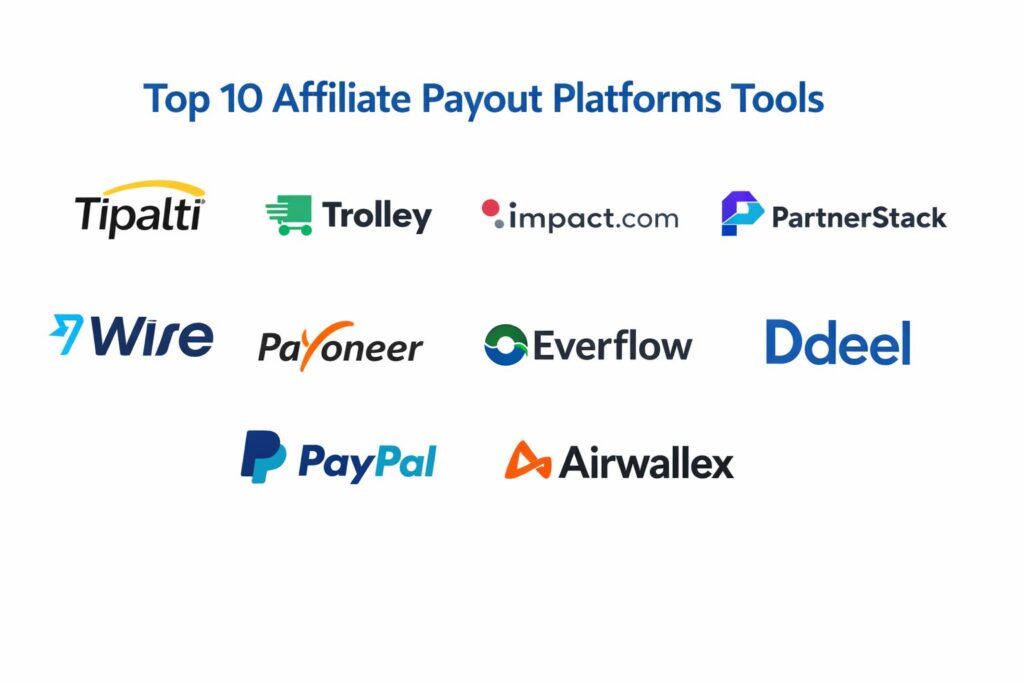
1. Tipalti
Tipalti is an enterprise-grade finance automation platform that excels in managing high-velocity global payouts. It is specifically built to handle the entire “Accounts Payable” lifecycle for affiliate networks, from partner onboarding and tax compliance to automated payment execution and reconciliation.
Key Features
The platform features a white-labeled partner portal where affiliates can choose from over six different payment methods across 190 countries. It includes automated tax form collection and validation, ensuring that W-9 or W-8 forms are correctly filed before any payment is sent. Its “Detect” module uses advanced algorithms to identify potentially fraudulent partners or transactions. The system offers deep, real-time integration with major ERPs and accounting software. It also provides a robust API that allows developers to embed payout functionality directly into their own applications or websites.
Pros
It offers the most comprehensive tax and regulatory compliance engine in the market, making it the safest choice for global brands. Its ability to scale to millions of transactions is unmatched.
Cons
The platform’s complexity and high entry price point may be overwhelming for small businesses. The initial implementation process can take several weeks of dedicated setup.
Platforms and Deployment
Web-based (SaaS) with a focus on enterprise-level cloud deployment.
Security and Compliance
Maintains the highest level of security with SOC 2 Type II, GDPR, and PCI DSS Level 1 compliance. It uses bank-grade encryption for all sensitive data.
Integrations and Ecosystem
Offers native integrations with NetSuite, QuickBooks, Sage, and various performance marketing platforms like Everflow or Impact.
Support and Community
Provides dedicated account managers for enterprise clients and a massive library of educational content for finance professionals.
2. Trolley
Trolley, formerly known as Payment Rails, is a modern payout platform designed specifically for the “Internet Economy.” It is highly favored by marketplaces and ad networks for its clean interface and specialized focus on the needs of creators and affiliates.
Key Features
The platform includes a specialized “Tax” module that automates the collection of tax identities and the generation of year-end 1099 and 1042-S reports. It features a “Trust” engine that performs real-time OFAC and AML screening on every recipient to ensure legal compliance. The dashboard provides clear visibility into payment status, giving both the brand and the affiliate real-time updates on transaction progress. It offers a “Sync” tool that bridges the gap between payment data and accounting systems. The platform also supports mass payouts in over 135 currencies via various methods.
Pros
The interface is exceptionally intuitive and easier for non-financial staff to navigate compared to enterprise-heavy tools. Its pricing model is more accessible for growing mid-market companies.
Cons
It lacks some of the broader “Procurement” or general AP features found in more expensive all-in-one financial suites. Customer support is generally digital-first rather than via phone.
Platforms and Deployment
Cloud-based SaaS accessible via a modern web browser.
Security and Compliance
Full GDPR compliance and SOC 2 certification, with rigorous identity verification protocols integrated into the onboarding flow.
Integrations and Ecosystem
Integrates natively with QuickBooks Online and Xero, and provides a well-documented API for custom connections to marketing stacks.
Support and Community
Known for a responsive support team and detailed technical documentation for developers building custom payout workflows.
3. Impact.com
Impact.com is a leading “Partnership Cloud” that manages the entire lifecycle of affiliate marketing. Unlike standalone payment tools, it integrates tracking, recruitment, and payouts into a single ecosystem, making it a “one-stop shop” for performance marketers.
Key Features
The platform features a robust “Contracting” module where brands can set complex, event-driven commission rules for each partner. It includes a unified “Financing” tab that consolidates all partner earnings into a single invoice for the brand. Its “Fraud” tools analyze traffic at the click level, preventing payout for non-compliant or low-quality conversions. The system offers an integrated marketplace for partner discovery and recruitment. It also provides advanced data visualization to track the “Path to Conversion” and adjust payouts accordingly based on multi-touch attribution.
Pros
Having tracking and payments in one tool eliminates data silos and simplifies the reconciliation process. It is highly effective for teams that want a single source of truth for all affiliate activities.
Cons
Because it is a full-service marketing platform, it can be more expensive than using a standalone payout tool. The learning curve is significant due to the breadth of features.
Platforms and Deployment
Web-based (SaaS) with a mobile companion app for monitoring campaign performance.
Security and Compliance
Enterprise-grade security with full GDPR and CCPA compliance. It uses sophisticated identity management to protect brand-partner relationships.
Integrations and Ecosystem
Maintains a massive ecosystem of integrations with CRM, E-commerce (Shopify/Magento), and various finance applications.
Support and Community
Offers a professional “Impact Academy” for training and a global support network for enterprise-level clients.
4. PartnerStack
PartnerStack is a dedicated partnership management platform built specifically for B2B SaaS companies. It focuses on automating the complex recurring commission models and reseller relationships that are common in the software industry.
Key Features
The platform features an “Automated Payouts” system that handles monthly recurring revenue (MRR) commissions without manual intervention. It includes a custom “Partner Portal” where affiliates can see their projected earnings and historical payouts in real-time. Its “Marketplace” connects SaaS brands with over 800,000 active B2B partners. The system offers built-in tax compliance and handles all 1099/1042-S filing requirements. It also provides specialized tools for managing “Reseller” licenses and tracking the full customer lifecycle from lead to renewal.
Pros
It is the gold standard for software companies that need to manage “recurring” commissions rather than just one-time sales. The partner experience is modern and highly polished.
Cons
Its features are very specialized for SaaS, making it less ideal for general retail or physical goods e-commerce. Pricing is typically on the higher end of the mid-market.
Platforms and Deployment
Cloud-based SaaS.
Security and Compliance
Maintains SOC 2 Type II status and follows strict international data privacy laws, ensuring that B2B partner data is handled securely.
Integrations and Ecosystem
Offers deep, bi-directional integrations with CRM systems like Salesforce and HubSpot, and payment processors like Stripe.
Support and Community
Provides a dedicated customer success model and a vibrant community of SaaS partnership professionals.
5. Wise for Business
Wise for Business is a global payment platform that is highly respected for its transparent exchange rates and low-cost international transfers. It is a preferred choice for companies that want a “no-frills,” high-efficiency tool for sending mass payments to global partners.
Key Features
The platform features “Batch Payments,” allowing users to upload a single CSV or Excel file to pay up to 1,000 people simultaneously in different currencies. It provides “Local Bank Details” in over 10 currencies, making it easier for brands to receive and hold funds without high conversion fees. Its “API” allows for the total automation of payout workflows directly from a brand’s internal systems. The system uses the “Mid-Market Rate” for all currency conversions, which is typically much cheaper than traditional banks. It also offers a multi-user dashboard with role-based access controls.
Pros
It offers some of the lowest and most transparent international transfer fees in the industry. The setup process is remarkably fast, allowing brands to start paying partners in minutes.
Cons
It lacks specialized affiliate “Tax Compliance” features like automated W-9 collection or 1099 generation. It is a general payment tool rather than a specialized marketing platform.
Platforms and Deployment
Web-based and mobile apps for iOS and Android.
Security and Compliance
Regulated as a Money Service Business in multiple jurisdictions and uses two-factor authentication for all sensitive transactions.
Integrations and Ecosystem
Integrates natively with QuickBooks and Xero, and offers a robust open API for custom connections.
Support and Community
Provides a comprehensive online help center and fast, digital-first support for business account holders.
6. Payoneer
Payoneer is a veteran in the global payment space, particularly known for its strength in emerging markets. It provides a reliable bridge for brands to pay affiliates in regions where traditional banking or PayPal might be difficult or expensive to use.
Key Features
The platform features “Global Receiving Accounts,” which allow affiliates to get paid in their local currency as if they had a local bank account. It offers a “Mass Payout” API that enables brands to send funds to thousands of recipients instantly. Partners can choose to receive funds via bank transfer, the Payoneer Prepaid Mastercard, or digital wallet transfers. It includes built-in compliance tools to handle international regulatory requirements. The system also offers a “Billing Service” where affiliates can request payments directly from brands.
Pros
It has one of the widest global footprints, making it ideal for brands with large numbers of partners in Asia, Eastern Europe, or South America. The brand familiarity among affiliates is very high.
Cons
The fee structure can be complex, with various charges for different types of transfers and card usage. Some users find the verification process to be more rigorous and slower than newer competitors.
Platforms and Deployment
Web-based SaaS and a highly-rated mobile app for global partners.
Security and Compliance
Fully regulated as a global financial services provider, adhering to strict AML/KYC standards across all operating regions.
Integrations and Ecosystem
Integrated into major affiliate networks and marketplaces like Amazon, Fiverr, and various specialized ad platforms.
Support and Community
Offers multi-lingual support and has a massive global user base with extensive peer-to-peer community resources.
7. Everflow
Everflow is a “Performance Marketing Platform” that combines advanced affiliate tracking with powerful payout automation. It is designed for mid-to-large scale agencies and brands that need to manage high volumes of clicks and conversions alongside financial distributions.
Key Features
The platform features a “Smart Checkout” integration that links conversions directly to payout rules. It includes an “Auto-Invoice” system that generates professional invoices for affiliates based on their performance data. Its “Fraud Shield” uses machine learning to block low-quality traffic before it converts, ensuring that payouts are only made for high-quality leads. The system offers deep analytics on “Partner Value,” helping brands identify their most profitable affiliates. It also features a built-in integration with Tipalti to handle the actual movement of funds and tax compliance.
Pros
The tracking and attribution engine is one of the most powerful and fastest in the market. The automated invoicing significantly reduces the “back-and-forth” between marketing and finance.
Cons
The platform is technically dense and may require a dedicated operations person to manage effectively. It is best used as a tracking tool that connects to a payment processor.
Platforms and Deployment
Cloud-based SaaS.
Security and Compliance
Maintains high standards for data privacy and security, focusing on protecting the integrity of conversion data and partner identities.
Integrations and Ecosystem
Strong native links to Tipalti, various CRM systems, and a massive array of e-commerce platforms and ad networks.
Support and Community
Known for providing “White-Glove” onboarding and having a very responsive technical support team.
8. Deel
Deel is a global HR and payroll platform that has expanded into the affiliate and contractor payout space. It is particularly strong for organizations that treat their top-tier affiliates like “partners” or “independent contractors” and want to ensure full legal compliance.
Key Features
The platform features legally-vetted “Contract Templates” for over 150 countries, ensuring that affiliate agreements are compliant with local labor laws. It includes a “Global Payouts” engine that allows partners to withdraw their earnings in crypto, local currency, or to a Deel Card. Its “Compliance Dashboard” tracks all tax documentation and legal filings in a central location. The system offers automated “Self-Billing” invoices for affiliates. It also provides a robust API to automate the creation of contracts and the triggering of payments based on performance data.
Pros
It offers the best “Legal and HR” layer for brands that want to maintain long-term, compliant relationships with high-value partners. The withdrawal options for affiliates are some of the most diverse available.
Cons
It is a premium product with a price structure that may be higher than simple payment tools. The focus is more on “people” management than “click” tracking.
Platforms and Deployment
Web-based SaaS.
Security and Compliance
ISO 27001 certified and fully compliant with global labor and tax laws, offering top-tier protection for partner data.
Integrations and Ecosystem
Integrates with major accounting tools like QuickBooks, Xero, and various HRIS systems.
Support and Community
Offers 24/7 global support and a wealth of resources on international hiring and partner management.
9. PayPal Payouts
PayPal Payouts (formerly Mass Pay) is the industry standard for “instant” and “familiar” distributions. It is the most common payment method requested by affiliates and influencers worldwide due to its extreme ease of use and ubiquity.
Key Features
The platform features an “Instant Payout” capability that delivers funds to a recipient’s PayPal account in seconds. It allows for “Mass Payments” to up to 5,000 people simultaneously via a simple file upload or a few clicks in the dashboard. Its “Hyperwallet” service (a PayPal-owned entity) provides even deeper payout capabilities for enterprise-scale marketplaces. The system handles “Currency Conversion” automatically at the time of transfer. It also offers a robust set of “Developer APIs” to integrate PayPal payments into any custom affiliate portal.
Pros
It is the most recognized and requested payment method globally, which can increase partner recruitment and retention. The “instant” nature of the funds is a major advantage for creators.
Cons
The transaction and currency conversion fees can be higher than specialized bank-transfer tools like Wise. Support for high-volume accounts can sometimes be difficult to reach.
Platforms and Deployment
Web-based and mobile apps.
Security and Compliance
World-class fraud protection and encrypted transactions, backed by one of the largest financial services infrastructures in the world.
Integrations and Ecosystem
Integrated into almost every major e-commerce and affiliate platform on the planet.
Support and Community
Massive global community and extensive documentation, though getting personalized human support can be a challenge for smaller accounts.
10. Airwallex
Airwallex is a financial technology platform designed for modern global businesses. It is particularly strong for affiliate programs that need to manage multi-currency “Local Wallets” and want to avoid the high costs of traditional cross-border banking.
Key Features
The platform features “Local Global Accounts,” allowing brands to open bank accounts in minutes across 20+ different currencies. It includes a “Batch Payment” tool for high-volume distributions to global partners with zero or low transaction fees. Its “Market-Leading FX” rates ensure that the brand and the affiliate get the best possible value during currency conversion. The system offers “Corporate Cards” that can be used for marketing spend or partner incentives. It also provides a powerful “Payouts API” to build custom financial workflows.
Pros
It combines a traditional business bank account with a high-end payout engine, reducing the need for multiple financial platforms. The fee structure for international transfers is highly competitive.
Cons
It is not a “Marketing” platform, so it does not offer affiliate tracking or campaign management tools. Access is limited in certain countries compared to veterans like Payoneer.
Platforms and Deployment
Web-based SaaS and mobile app.
Security and Compliance
Regulated in every major country it operates in and uses bank-grade security protocols for all transactions.
Integrations and Ecosystem
Offers a solid integration marketplace with connections to Shopify, NetSuite, and Xero.
Support and Community
Provides fast online support and a very clear technical guide for developers looking to automate their financial stack.
Comparison Table
| Tool Name | Best For | Platform(s) Supported | Deployment | Standout Feature | Public Rating |
| 1. Tipalti | Enterprise / Global AP | Web-Based | Cloud-Native | Tax Compliance Engine | 4.8/5 |
| 2. Trolley | Mid-Market / Marketplaces | Web-Based | Cloud SaaS | Trust & Tax Module | 4.7/5 |
| 3. Impact.com | Full Partner Life Cycle | Web, iOS, Android | Cloud SaaS | Integrated Tracking | 4.6/5 |
| 4. PartnerStack | B2B SaaS / Recurring | Web-Based | Cloud SaaS | Recurring Commission | 4.8/5 |
| 5. Wise | Low-Cost Global Pay | Web, iOS, Android | Cloud SaaS | Mid-Market FX Rates | 4.7/5 |
| 6. Payoneer | Emerging Markets | Web, iOS, Android | Cloud SaaS | Virtual Local Accounts | 4.4/5 |
| 7. Everflow | Performance Agencies | Web-Based | Cloud SaaS | Fraud Shield & Tracking | 4.7/5 |
| 8. Deel | Legal / Compliant Pay | Web-Based | Cloud SaaS | Vetted Global Contracts | 4.8/5 |
| 9. PayPal | Instant Speed / Familiar | Web, iOS, Android | Cloud SaaS | Instant Wallet Delivery | 4.3/5 |
| 10. Airwallex | Multi-Currency Wallets | Web, iOS, Android | Cloud SaaS | Global Local Accounts | 4.6/5 |
Evaluation & Scoring of Affiliate Payout Platforms
The scoring below is a comparative model intended to help shortlisting. Each criterion is scored from 1–10, then a weighted total from 0–10 is calculated using the weights listed. These are analyst estimates based on typical fit and common workflow requirements, not public ratings.
Weights:
- Core features – 25%
- Ease of use – 15%
- Integrations & ecosystem – 15%
- Security & compliance – 10%
- Performance & reliability – 10%
- Support & community – 10%
- Price / value – 15%
| Tool Name | Core (25%) | Ease (15%) | Integrations (15%) | Security (10%) | Performance (10%) | Support (10%) | Value (15%) | Weighted Total |
| 1. Tipalti | 10 | 4 | 10 | 10 | 10 | 9 | 7 | 8.70 |
| 2. Trolley | 8 | 9 | 8 | 9 | 9 | 9 | 8 | 8.45 |
| 3. Impact.com | 9 | 6 | 9 | 9 | 8 | 8 | 7 | 8.00 |
| 4. PartnerStack | 9 | 8 | 9 | 9 | 9 | 9 | 7 | 8.55 |
| 5. Wise | 6 | 10 | 7 | 8 | 10 | 8 | 10 | 8.05 |
| 6. Payoneer | 7 | 7 | 7 | 9 | 8 | 7 | 8 | 7.35 |
| 7. Everflow | 9 | 7 | 8 | 8 | 9 | 8 | 8 | 8.15 |
| 8. Deel | 8 | 8 | 7 | 10 | 9 | 9 | 7 | 8.20 |
| 9. PayPal | 6 | 10 | 9 | 8 | 10 | 6 | 7 | 7.75 |
| 10. Airwallex | 7 | 8 | 7 | 9 | 9 | 8 | 9 | 7.95 |
How to interpret the scores:
- Use the weighted total to shortlist candidates, then validate with a pilot.
- A lower score can mean specialization, not weakness.
- Security and compliance scores reflect controllability and governance fit, because certifications are often not publicly stated.
- Actual outcomes vary with assembly size, team skills, templates, and process maturity.
Which Affiliate Payout Platform Tool Is Right for You?
Solo / Founder-Led
For independent creators or founder-led startups, speed and low entry costs are the primary drivers. You need a platform that doesn’t require complex engineering to launch. Using a tool that everyone already knows—like a basic digital wallet or a transparent transfer service—allows you to focus on growing your first 10-20 partner relationships without a compliance headache.
Small Nonprofit
Organizations with limited budgets should prioritize transparency in exchange rates and “no subscription” models. Your goal is to ensure that the maximum amount of money reaches your partners and advocates. A tool that provides local currency payouts without high bank fees is the most efficient choice for cause-driven organizations.
Mid-Market
Growing businesses must transition from manual spreadsheets to automated “Tax-First” systems. As your partner list reaches the hundreds, the risk of a tax audit or a fraudulent payout increases significantly. You should look for a tool that offers built-in identity verification and automated year-end reporting to protect your company’s financial health.
Enterprise
Large, global organizations require a “Zero-Touch” financial infrastructure. Security, multi-entity management, and deep ERP integration are the top priorities. You need a system that can act as a global sub-ledger, ensuring that every cent paid out to affiliates across different subsidiaries is perfectly accounted for and compliant with international law.
Budget vs Premium
If budget is the concern, look for “pay-as-you-go” models with flat transfer fees. However, premium platforms provide value through “reduced friction”—by automating the hours of work spent collecting tax forms and manually calculating commissions, which often saves more money in labor costs than the software itself.
Feature Depth vs Ease of Use
Highly specialized “Marketing Clouds” offer incredible insights but can be difficult for a finance team to use. Conversely, simple “Payment Tools” are easy to use but may not give the marketing team the data they need to optimize their campaigns. Finding a balance or ensuring a strong integration between the two is vital.
Integrations & Scalability
Your payout tool must be the “glue” between your marketing data and your bank account. As you scale, the ability to add new payment methods or expand into new countries without changing your whole financial stack is a critical consideration for long-term technical health.
Security & Compliance Needs
If you pay partners in highly regulated regions or handle sensitive beneficiary data, your payout choice is a legal mandate. Ensure the provider has the specific KYC and AML certifications required to operate in your target markets, as non-compliance can lead to frozen accounts and massive fines.
Frequently Asked Questions (FAQs)
1. Why can’t I just use my business bank account to pay affiliates?
Traditional banks are not built for mass, micro-transactions. They often charge high flat fees per wire, lack the ability to collect tax forms (like W-9s), and do not provide a self-service portal for affiliates to track their own payment status, leading to high administrative work.
2. How do these platforms handle affiliate taxes?
Professional platforms like Tipalti and Trolley include built-in tax engines. They require affiliates to fill out digital tax forms before their first payment, validate the info against government databases, and automatically generate 1099 or 1042-S reports at the end of the year.
3. What are “Mass Payouts”?
Mass payouts allow a business to send thousands of individual payments to different people in different countries using one single funding transfer. This is done via an API or by uploading a file, saving dozens of hours compared to manual processing.
4. Is it safe to pay affiliates in cryptocurrency?
Some platforms like Deel offer crypto payouts. While it is fast and has lower fees for certain regions, it requires careful consideration of your local tax laws and the volatility of the asset, as the “value” of the commission can change between the time it is earned and the time it is withdrawn.
5. How do I prevent affiliate payout fraud?
Look for platforms with “Fraud Shields” or click-to-payout verification. These tools analyze the traffic and conversion data to ensure the sale was legitimate before the commission is approved for payment, protecting your marketing budget.
6. Do these tools work with Shopify or WooCommerce?
Yes, most top-tier platforms have native integrations or use Zapier to connect your e-commerce store directly to the payment engine, allowing for automated commission calculations based on actual sales data.
7. What is the “Mid-Market” exchange rate?
This is the real exchange rate you see on Google. Many traditional banks add a 3-5% markup to this rate when you send money abroad. Platforms like Wise or Airwallex use the real rate and charge a transparent fee, which is much cheaper.
8. Can I manage multiple affiliate programs in one platform?
Yes, enterprise-level tools allow for “Multi-Entity” or “Multi-Brand” management. This is essential for agencies or large corporations that run different affiliate campaigns for different products or geographical regions.
9. What happens if a payment fails?
Professional payout platforms provide “Failure Alerts” and automated “Return to Sender” logic. If an affiliate’s bank details are wrong, the platform will notify the partner to update their info, rather than just losing the money in the banking system.
10. How long does a global payout usually take?
Digital wallet transfers (like PayPal or Payoneer-to-Payoneer) are often instant. Local bank transfers through tools like Wise usually take 1-2 days, while traditional international SWIFT wires can take 3-5 business days.
Conclusion
In the modern performance marketing landscape, an affiliate payout platform is the essential link between creative success and financial integrity. As organizations shift toward a decentralized, global workforce of influencers and partners, the ability to distribute commissions accurately and compliantly becomes a core operational requirement. By implementing a system that prioritizes partner experience through self-service portals and transparent reporting, brands can build the deep trust necessary for long-term growth. The ideal platform is one that not only automates the manual labor of mass payments but also provides the scalable infrastructure and legal safeguards needed to navigate the complexities of global finance.
I find that this comparison of affiliate payout platforms provides a critical roadmap for any Finance Operations Lead looking to eliminate the administrative headache of global commission distribution. I learned from this blog that modern payout technology has evolved into “Partnership Clouds” that handle everything from real-time tax compliance to multi-currency disbursements. In my professional world, implementing a tool like Tipalti or Trolley means I can finally scale our partner network without increasing our internal headcount, while ensuring we remain fully compliant with global tax regulations (like W-9/W-8 series). For others in the industry, this shift toward automated, transparent payouts is the most effective way to build trust with high-performing affiliates and reduce partner churn. My advice for anyone looking to learn from this blog is to prioritize the automated tax collection and fraud detection features of each tool; a payout platform is only as valuable as its ability to keep your company audit-ready and protected from non-compliant entities.