Introduction
Copyright registration tools are essential digital assets designed to establish a definitive legal record of ownership for creative works. In an era dominated by rapid digital distribution and generative AI, these platforms provide creators and enterprises with the technical means to secure their intellectual property before it enters the public domain. By utilizing advanced timestamping, cryptographic hashing, and integration with national registries, these tools act as a proactive shield against unauthorized use, plagiarism, and commercial infringement. For any organization, the ability to produce a verifiable audit trail of creation is not just a legal precaution; it is a fundamental requirement for asset monetization and risk management.
The necessity of these tools has intensified as the boundaries between human and machine-generated content become increasingly blurred. Protecting software code, literary works, architectural designs, and multimedia assets requires a sophisticated approach that traditional methods can no longer sustain. When evaluating a copyright solution, professionals must prioritize the technical validity of the proof provided, the jurisdictional reach of the service, and the robustness of the platform’s security architecture. A high-quality tool does more than just record a date; it creates an immutable link between the author and the work that can withstand rigorous legal scrutiny in a court of law.
Best for: Independent artists, software development firms, media agencies, and enterprise legal departments that need to automate the protection of high-volume digital assets.
Not ideal for: Generic ideas that have not been fixed in a tangible medium, or titles and slogans which are typically governed by trademark law rather than copyright.
Key Trends in Copyright Registration Tools
The integration of blockchain technology has emerged as a dominant trend, providing an immutable and decentralized ledger for timestamping creative works. This ensures that the proof of creation cannot be altered or tampered with by any single entity. Additionally, the rise of AI-powered monitoring has shifted the focus from passive registration to active enforcement. Modern tools now scan the internet in real-time to identify potential infringements, allowing owners to take immediate action through automated cease-and-desist workflows.
There is also a significant move toward global interoperability. As creative teams become more distributed, tools are evolving to provide multi-jurisdictional support, ensuring that a single registration carries weight across different international legal frameworks. Another emerging trend is the focus on “data provenance,” where platforms record the entire evolutionary history of a project—from the initial sketch to the final product. This granular level of documentation is becoming vital for proving human authorship in projects that utilize AI-assisted tools.
How We Selected These Tools
The selection process for these top 10 tools involved a rigorous evaluation of their legal standing and technical reliability. We prioritized platforms that are recognized by major intellectual property offices or utilize industry-standard cryptographic methods for verification. A primary criterion was the “admissibility of evidence,” ensuring that the certificates generated by these tools provide a strong foundation for legal proceedings. We also examined the user experience, looking for platforms that simplify the often-complex process of filing and managing large portfolios.
Scalability was another critical factor in our assessment. We sought out tools that could serve both individual freelancers and large-scale enterprises with automated API-driven workflows. Security protocols were scrutinized to ensure that sensitive files are encrypted and stored in compliance with global data protection standards. Finally, we considered the additional value-added services provided, such as infringement detection and legal mediation support, to determine which platforms offer the most comprehensive protection for modern creators.
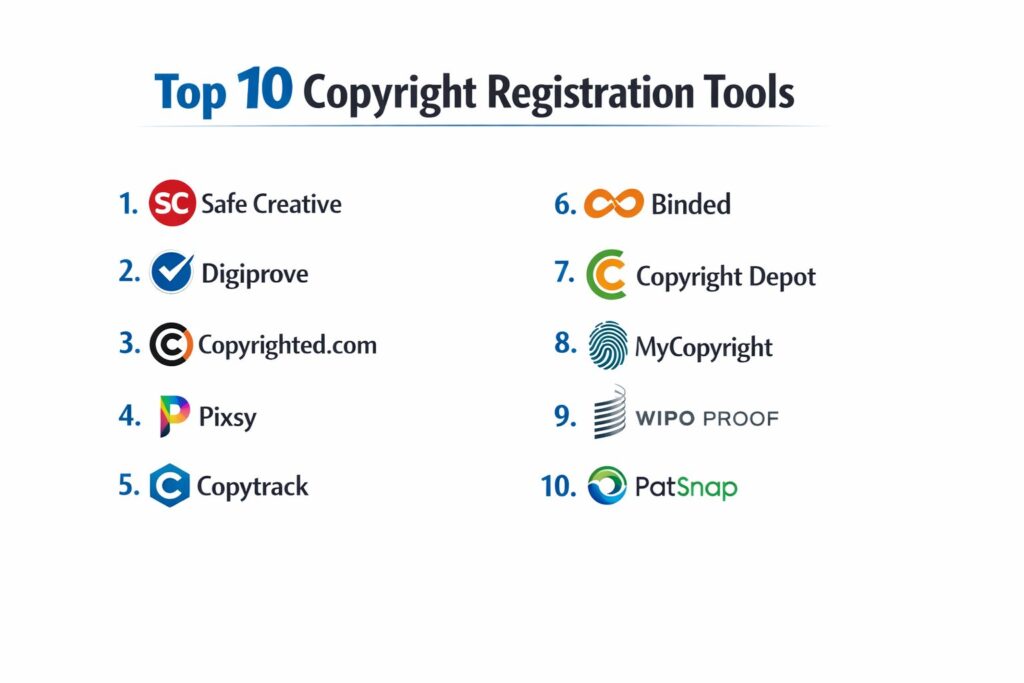
1. Safe Creative
Safe Creative is one of the most established global registries, providing a versatile platform for the digital registration of all types of creative works. It offers a transparent system where creators can choose between public or private registrations, each backed by a triple-hash cryptographic process. This ensures that the integrity of the file and its timestamp are irrefutable.
Key Features
The platform provides internationally valid digital certificates that act as a strong “proof of anteriority.” It supports a wide range of licenses, including Creative Commons and proprietary “all rights reserved” models. A standout feature is its “semantic search” capability, which allows others to verify the ownership of a work by searching the public registry. It also includes an automated monitoring system that tracks the use of registered content across the web. For high-volume users, the platform offers an API for seamless integration into existing content management systems.
Pros
It is widely recognized by legal professionals and offers a very high level of technical transparency. The ability to manage different versions of a work within a single project is excellent for iterative processes.
Cons
The free tier has significant limitations on the number of registrations and the level of protection. The interface can be overwhelming for users who only need simple, one-off registrations.
Platforms and Deployment
Web-based platform accessible via any modern browser, with dedicated API options for enterprise integration.
Security and Compliance
Utilizes advanced encryption and multiple redundant servers. It is fully compliant with international treaties such as the Berne Convention and WIPO standards.
Integrations and Ecosystem
Integrates with various content platforms and offers plugins for CMS environments like WordPress to automate the registration of new blog posts.
Support and Community
Offers a comprehensive knowledge base, legal guides, and professional support for enterprise clients.
2. Digiprove
Digiprove focuses on providing a non-intrusive way to prove the existence and integrity of digital files. Rather than requiring users to upload their entire file to a central server, it creates a unique digital fingerprint (hash) locally on the user’s device. This makes it a preferred choice for organizations handling sensitive or proprietary data that cannot be shared.
Key Features
The software creates a “Proof of Existence” certificate that is timestamped and cryptographically signed. It uses a patented process that ensures the content of the file remains private while still providing absolute proof of its state at a specific time. It includes an automated “Watch” service that can monitor local folders and automatically certify any new or modified files. The platform also provides a “Self-Certify” feature for websites, which adds a visible seal to pages to deter plagiarism.
Pros
The “privacy-first” approach is a major benefit for developers and researchers who need to protect trade secrets. It is incredibly lightweight and does not require large data transfers.
Cons
Because the full file is not stored by Digiprove, the user is responsible for maintaining the original file and its associated certificate for the proof to remain valid.
Platforms and Deployment
Available as a web service, a desktop application for Windows, and an API for server-side integration.
Security and Compliance
High-level security as the original content never leaves the user’s infrastructure. Compliant with digital signature laws in major jurisdictions.
Integrations and Ecosystem
Offers deep integration for developers through its API, allowing for the automated certification of software builds and database logs.
Support and Community
Provides technical documentation for developers and direct email support for business users.
3. Copyrighted.com
Copyrighted.com offers a streamlined and highly accessible service designed to provide digital proof of ownership for a variety of media. It is particularly popular among bloggers, writers, and digital artists who need a simple way to document their work before publishing it online.
Key Features
The platform issues a “Certificate of Registration” that includes a unique ID and a timestamp of the submission. It provides a visible “Copyrighted” badge that can be placed on websites or digital assets to serve as a deterrent to potential infringers. Users can manage their entire portfolio through a centralized dashboard, making it easy to track the status of multiple works. The service also includes a basic monitoring tool that alerts users if their registered text or images appear elsewhere on the web.
Pros
The interface is extremely user-friendly and requires no technical knowledge to operate. It is one of the most affordable professional options for individual creators.
Cons
The legal weight of its certificates may be less robust in some specialized jurisdictions compared to government-backed registrations. The monitoring features are not as deep as those of specialized enforcement tools.
Platforms and Deployment
Web-based service accessible via browser.
Security and Compliance
Standard SSL encryption for data transfers and secure cloud storage for certificates and asset metadata.
Integrations and Ecosystem
Offers basic widgets and badges for web integration but lacks the deep API capabilities of enterprise-focused competitors.
Support and Community
Email-based support and a collection of FAQs and basic copyright education resources.
4. Pixsy
Pixsy is a specialized tool built specifically for photographers and visual artists. It combines copyright registration with a powerful “reverse image search” engine to provide an end-to-end solution for protecting and monetizing visual content.
Key Features
The platform features an automated “batch filing” system that simplifies the process of registering images with the U.S. Copyright Office. Its AI-driven search technology constantly scans the internet to find where your images are being used, categorizing matches into “authorized” and “unauthorized.” If an infringement is found, Pixsy provides a professional legal team to handle the recovery of licensing fees on a contingency basis. It also offers a “takedown” tool that automates the process of sending DMCA notices to hosting providers.
Pros
The integration of registration and active enforcement makes it a complete ecosystem for visual creators. The “no-win, no-fee” legal recovery service is a massive benefit for smaller studios.
Cons
The service is highly specialized for images and is not suitable for text, music, or software. The professional tier can be expensive for those with very large portfolios.
Platforms and Deployment
Web-based platform with integrations for major photo-sharing sites like Flickr and Instagram.
Security and Compliance
Enterprise-grade security for image metadata and a clear focus on GDPR and DMCA compliance.
Integrations and Ecosystem
Connects directly to image hosting services and cloud storage solutions to automatically import and monitor new uploads.
Support and Community
Offers expert legal advice, a dedicated blog on image rights, and professional support for high-volume users.
5. Copytrack
Copytrack is a global leader in image rights management, offering a comprehensive suite of tools for the registration, monitoring, and legal enforcement of visual assets. It is designed to handle the needs of both individual photographers and large-scale photo agencies.
Key Features
The platform uses a high-precision image matching algorithm that can detect unauthorized use even if the image has been cropped or modified. It offers a free “vault” for timestamping and registering images, providing a secure record of ownership. When an infringement is detected, users can choose to pursue a “commercial post-licensing” agreement or initiate legal proceedings through Copytrack’s global network of partner attorneys. The dashboard provides detailed analytics on the geographic spread and potential value of infringed assets.
Pros
Its global legal reach is exceptional, with the ability to pursue claims in over 140 countries. The monitoring tool is highly accurate with very few false positives.
Cons
Like Pixsy, it is strictly focused on images and does not support other forms of intellectual property. The focus is heavily on enforcement rather than the initial registration process.
Platforms and Deployment
Web-based service with an easy-to-use image uploader and automated sync features.
Security and Compliance
Employs robust data protection measures and operates in full compliance with international copyright and privacy laws.
Integrations and Ecosystem
Integrates with popular social media and photography platforms to streamline the monitoring process.
Support and Community
Provides extensive legal resources and a professional support team specialized in intellectual property rights.
6. Binded
Binded (formerly known as Blockai) is a modern, blockchain-based copyright registry that focuses on making copyright protection simple and accessible for the social media age. It is built to be “the world’s most creator-friendly copyright tool,” removing the technical and financial barriers to registration.
Key Features
Every registration on Binded is recorded on the Bitcoin blockchain, creating a permanent, immutable record that cannot be deleted or altered. The platform allows users to create a public “Copyright Page” that showcases their work and its registration details, which can be linked to from social media bios. It features a unique integration with Instagram that automatically registers every image a user posts to their feed. The tool also provides a “Copyright Vault” for organizing and securing your most important creative assets.
Pros
The use of blockchain provides a future-proof and decentralized form of evidence. The Instagram automation is a game-changer for digital influencers and artists.
Cons
While blockchain proof is increasingly accepted, it may not yet carry the same weight as a formal government registration in certain traditional legal contexts.
Platforms and Deployment
Web-based platform with mobile-friendly features and social media integrations.
Security and Compliance
Leverages the inherent security of the blockchain for timestamping and offers secure cloud storage for file backups.
Integrations and Ecosystem
Deeply integrated with Instagram and provides easy-to-share links for various creative portfolios.
Support and Community
Focused on a young, tech-savvy community with active social media channels and straightforward help guides.
7. Copyright Depot
Copyright Depot is a long-standing service that specializes in the archival storage and certification of creative works. It is known for its “guaranteed long-term conservation,” promising to hold and protect registered assets for decades.
Key Features
The platform allows for the registration of an incredibly diverse range of works, including literature, music, scientific research, and architectural plans. Each registration receives an “unalterable” timestamp and an official certificate that is legally recognized in over 170 countries. A key feature is the “30-year storage guarantee,” which ensures that the original file remains accessible for legal comparison for the duration of its copyright protection. It also offers a “Confidentiality” mode where the registered content is encrypted and inaccessible even to the platform’s staff.
Pros
The long-term storage commitment provides peace of mind that other digital tools may not offer. It is one of the few platforms that handles scientific and technical documentation effectively.
Cons
The interface feels dated compared to more modern, AI-driven platforms. It lacks automated monitoring or enforcement features, focusing purely on the registration and storage aspects.
Platforms and Deployment
Web-based service with a focus on high-security file uploads.
Security and Compliance
Strong emphasis on encryption and physical server security. Fully compliant with the Berne Convention for international protection.
Integrations and Ecosystem
Primarily a standalone registry with limited third-party integrations.
Support and Community
Offers direct support and a wealth of information on international copyright law and treaty compliance.
8. MyCopyright
MyCopyright provides a professional-grade registration service that bridges the gap between digital timestamping and formal government filings. It is designed for creators who want the convenience of a web-based tool but require the high-level documentation of a legal registry.
Key Features
The platform issues “Certified Records of Ownership” that include a detailed technical log of the submission. It allows users to group multiple related works into a single registration to save on costs, which is ideal for series of articles or albums. The dashboard includes a “Rights Management” section where users can document transfers of ownership or licensing agreements. It also provides a unique “Copyright Audit” tool that helps organizations identify unprotected assets within their digital infrastructure.
Pros
The “grouped registration” feature is a significant cost-saver for prolific creators. The documentation produced is highly detailed and ready for use in professional legal filings.
Cons
The platform requires more manual input than the “one-click” blockchain alternatives. There is a learning curve associated with properly categorizing different types of work.
Platforms and Deployment
Web-based portal with secure account management.
Security and Compliance
Adheres to strict data security standards and provides a clear audit trail for all user activities.
Integrations and Ecosystem
Works well as a supplementary tool for legal departments and connects with standard document management systems.
Support and Community
Provides high-quality customer service and a library of educational webinars on intellectual property management.
9. WIPO PROOF
WIPO PROOF is a digital business service offered by the World Intellectual Property Organization. It provides a highly credible “digital fingerprint” for any file, serving as a globally recognized piece of evidence for the existence of an asset at a specific point in time.
Key Features
The service generates a “token” for each file that is timestamped using a highly secure, high-precision source. These tokens are designed to be universally accepted in courts and IP offices around the world. Because it is run by a United Nations agency, the credibility of the proof is unmatched. It does not store the original file, instead focusing solely on the generation and storage of the cryptographic token. This makes it a powerful tool for protecting trade secrets, research data, and unfinished creative concepts.
Pros
The level of international legal weight is the highest available for a digital timestamping service. It is an essential tool for cross-border IP protection and enterprise-level research.
Cons
The service is strictly for “proof of existence” and does not provide active monitoring or legal enforcement. Each token must be purchased individually, which can become costly for high-volume users.
Platforms and Deployment
Web-based service with a simple, high-security interface.
Security and Compliance
Meets the highest international standards for digital security and timestamping (RFC 3161 compliant).
Integrations and Ecosystem
Designed to complement existing IP strategies and fits seamlessly into any professional or legal workflow.
Support and Community
Backed by the extensive resources and expertise of the World Intellectual Property Organization.
10. PatSnap
While primarily known as an R&D and patent intelligence platform, PatSnap has expanded into a powerful suite for managing all forms of intellectual property, including complex copyrights for software and industrial designs. It is the go-to tool for large corporations and innovation-heavy organizations.
Key Features
The platform uses AI to analyze and categorize massive portfolios of intellectual property, identifying gaps in protection and potential areas of risk. It includes a dedicated module for managing copyright assets, allowing teams to collaborate on registrations and track licensing revenue. Its “Competitive Intelligence” tool monitors the activities of other companies, alerting users to potential infringements or overlapping IP. It also provides a sophisticated workflow for documenting the development process of a new product, which is vital for proving authorship.
Pros
It provides an unparalleled “big picture” view of an organization’s intellectual property landscape. The integration of market data and legal intelligence is unique in the industry.
Cons
The platform is an enterprise-level solution with a price point that is out of reach for individual creators or small startups. It is highly complex and requires specialized training to fully utilize.
Platforms and Deployment
Cloud-based enterprise platform with deep integration capabilities.
Security and Compliance
Features military-grade encryption and is compliant with all major international enterprise security certifications.
Integrations and Ecosystem
Integrates with PLM (Product Lifecycle Management) and ERP systems to ensure that IP protection is built into the product development cycle.
Support and Community
Offers dedicated account managers, professional training sessions, and a global network of IP experts.
Comparison Table
| Tool Name | Best For | Platform(s) Supported | Deployment | Standout Feature | Public Rating |
| 1. Safe Creative | Global Digital Assets | Web, API | Cloud | Public Verification Registry | 4.7/5 |
| 2. Digiprove | Privacy-Conscious IP | Web, Win, API | Hybrid | Local Hashing (No Uploads) | 4.6/5 |
| 3. Copyrighted.com | Individual Creators | Web | Cloud | Visible Deterrent Badges | 4.2/5 |
| 4. Pixsy | Visual Artists | Web | Cloud | AI Reverse Image Search | 4.8/5 |
| 5. Copytrack | Global Image Rights | Web | Cloud | Global Legal Recovery | 4.7/5 |
| 6. Binded | Social Media Creators | Web | Cloud | Instagram Auto-Sync | 4.5/5 |
| 7. Copyright Depot | Long-term Archiving | Web | Cloud | 30-Year Storage Guarantee | 4.3/5 |
| 8. MyCopyright | Grouped Registrations | Web | Cloud | Certified Record Bundles | 4.4/5 |
| 9. WIPO PROOF | High-Stakes Evidence | Web | Cloud | UN-Backed Credibility | 4.9/5 |
| 10. PatSnap | Enterprise Innovation | Web | Cloud | AI-Driven IP Intelligence | 4.6/5 |
Evaluation & Scoring of Copyright Registration Tools
The scoring below is a comparative model intended to help shortlisting. Each criterion is scored from 1–10, then a weighted total from 0–10 is calculated using the weights listed. These are analyst estimates based on typical fit and common workflow requirements, not public ratings.
Weights:
- Core features – 25%
- Ease of use – 15%
- Integrations & ecosystem – 15%
- Security & compliance – 10%
- Performance & reliability – 10%
- Support & community – 10%
- Price / value – 15%
| Tool Name | Core (25%) | Ease (15%) | Integrations (15%) | Security (10%) | Performance (10%) | Support (10%) | Value (15%) | Weighted Total |
| 1. Safe Creative | 10 | 7 | 9 | 9 | 9 | 9 | 8 | 8.85 |
| 2. Digiprove | 9 | 8 | 10 | 10 | 9 | 8 | 8 | 8.85 |
| 3. Copyrighted.com | 7 | 10 | 6 | 8 | 8 | 7 | 9 | 7.75 |
| 4. Pixsy | 9 | 9 | 10 | 9 | 10 | 10 | 8 | 9.20 |
| 5. Copytrack | 9 | 8 | 9 | 9 | 10 | 9 | 8 | 8.80 |
| 6. Binded | 8 | 10 | 9 | 9 | 9 | 7 | 10 | 8.80 |
| 7. Copyright Depot | 8 | 6 | 5 | 10 | 8 | 8 | 9 | 7.65 |
| 8. MyCopyright | 9 | 8 | 7 | 9 | 8 | 8 | 9 | 8.35 |
| 9. WIPO PROOF | 10 | 9 | 6 | 10 | 10 | 10 | 7 | 8.80 |
| 10. PatSnap | 10 | 5 | 10 | 10 | 10 | 10 | 6 | 8.65 |
How to interpret the scores:
- Use the weighted total to shortlist candidates, then validate with a pilot.
- A lower score can mean specialization, not weakness.
- Security and compliance scores reflect controllability and governance fit, because certifications are often not publicly stated.
- Actual outcomes vary with assembly size, team skills, templates, and process maturity.
Which Copyright Registration Tool Is Right for You?
Solo / Freelancer
For independent creators, tools like Binded or Copyrighted.com offer the perfect balance of ease and affordability. These platforms allow you to protect your work quickly without needing a dedicated legal team, ensuring that your social media posts and digital assets are documented from day one.
SMB
Small businesses and creative agencies should look toward Safe Creative or MyCopyright. These tools provide more robust documentation and the ability to manage a growing portfolio of work, which is essential when collaborating with clients and proving ownership during contract negotiations.
Mid-Market
Organizations with high-value visual assets, such as photography studios or e-commerce brands, will find the most value in Pixsy or Copytrack. The combination of automated registration and active infringement monitoring ensures that your brand’s visual identity is protected across the global web.
Enterprise
Large corporations and R&D-driven firms require the deep intelligence and security of PatSnap or WIPO PROOF. These solutions provide the high-level compliance and “proof of existence” needed for protecting trade secrets and managing massive, multi-national intellectual property portfolios.
Budget vs Premium
If budget is the primary concern, free or low-cost digital registries provide a solid baseline of protection. However, premium services that include active enforcement and legal support are often worth the investment, as they can directly help recover lost revenue from infringers.
Feature Depth vs Ease of Use
Users who need a simple “upload and forget” experience should choose modern, AI-integrated platforms. Those who require absolute technical control and privacy, such as software developers, will benefit more from technical tools like Digiprove that focus on local hashing and data integrity.
Integrations & Scalability
For developers and content publishers, API access is non-negotiable. Choosing a tool that integrates directly into your build pipeline or CMS ensures that protection happens automatically, reducing the risk of human error and ensuring that no asset goes unprotected.
Security & Compliance Needs
In highly regulated industries, the credibility of the service provider is paramount. UN-backed or blockchain-based tools offer the highest level of security and transparency, providing a future-proof record that is designed to withstand the most intense legal scrutiny.
Frequently Asked Questions (FAQs)
1. Is a digital copyright certificate as valid as a government registration?
Digital certificates serve as powerful “proof of existence” and are generally admissible in court. However, in some countries like the U.S., formal registration with the national copyright office is still required to initiate a lawsuit and claim certain types of damages.
2. Can I register a piece of software using these tools?
Yes, software code is protected as a literary work. Tools like Digiprove and Safe Creative are excellent for this, as they can timestamp source code, object code, and even technical documentation to prove the date of creation.
3. Do these tools prevent people from stealing my work?
No tool can physically prevent theft, but they act as a strong deterrent. By displaying a registration badge and having a verifiable record of ownership, you make it much harder and more legally risky for someone to use your work without permission.
4. Is blockchain the best way to protect my copyright?
Blockchain provides an immutable and decentralized timestamp, which is incredibly strong evidence of creation. While not a replacement for government registration, it offers a transparent and future-proof record that is recognized in an increasing number of jurisdictions.
5. How much does professional copyright registration cost?
Costs vary widely, from free community-driven registries to enterprise platforms that cost thousands per year. Many tools offer a “pay-per-file” model, while others provide subscription-based portfolios for higher-volume users.
6. Can I register a work that was created by AI?
In many jurisdictions, pure AI-generated content cannot be copyrighted. However, if there is significant human “creative input” or if the AI was used as a tool (similar to a camera or paintbrush), these platforms can help document the human contribution and development process.
7. Does one registration cover my work internationally?
Under international treaties like the Berne Convention, copyright is often automatic across most countries. Digital tools that provide internationally recognized timestamps and certificates help reinforce this global protection by providing clear evidence of ownership.
8. What happens if the registration tool I use goes out of business?
This is why choosing established providers or blockchain-based tools is critical. Blockchain records exist independently of the company, and tools like Copyright Depot offer 30-year storage guarantees to ensure your records remain accessible.
9. Can I register my work after it has already been published?
Yes, you can register a work at any time. However, it is always best to register as close to the creation date as possible, as this provides the strongest evidence in a dispute over “who created it first.”
10. Do I need to register every version of a project?
For major updates, it is highly recommended to register the new version. This creates a clear trail of the project’s evolution and ensures that the unique elements of each iteration are protected under the law.
Conclusion
Copyright registration tools represent a critical evolution in the management of creative capital. In an environment where digital assets can be duplicated and distributed in seconds, a proactive approach to ownership documentation is no longer optional—it is a strategic necessity. By choosing a tool that aligns with your specific technical and legal requirements, you are not just securing a single file; you are building a defensible foundation for your entire creative career or business enterprise. Whether through the decentralized power of blockchain or the global credibility of an international registry, the ability to prove the “who” and “when” of creation is the ultimate safeguard for the modern creator. As the legal landscape continues to adapt to new technologies, the integration of these tools will remain the most effective way to ensure that the value of human innovation is recognized and protected on a global scale.