Introduction
Anti-piracy monitoring tools represent the critical defensive layer in the modern digital economy, designed to identify, track, and mitigate the unauthorized distribution of intellectual property. These platforms utilize advanced forensic watermarking, digital fingerprinting, and automated web crawling to scan the vast expanses of the surface, deep, and dark web. In a landscape where digital assets can be duplicated and disseminated globally in seconds, these tools provide the necessary visibility to protect revenue streams and brand integrity. For a professional overseeing digital ecosystems, understanding the mechanics of these tools—from automated DMCA notices to real-time IPTV link de-indexing—is essential for maintaining a secure and profitable distribution pipeline.
The necessity of these tools has escalated as piracy evolved from simple file-sharing to sophisticated, organized criminal networks. Today, organizations face threats ranging from “cracked” software and leaked sensitive documents to illegal live-streaming of premium events. Effective anti-piracy is no longer just about issuing takedown notices; it involves comprehensive threat intelligence that maps the “piracy demand” to help businesses adjust their regional pricing or access models. When selecting a solution, enterprise buyers must evaluate the speed of detection, the success rate of automated enforcement, and the ability of the tool to provide court-admissible evidence for potential litigation. A robust monitoring strategy ensures that the value of creative and technical work is preserved against persistent global threats.
Best for: Media conglomerates, software vendors, luxury brands, and live broadcast entities that require automated, large-scale protection of copyrighted assets across global digital platforms.
Not ideal for: Small-scale creators with a limited number of assets who can manage manual takedowns, or organizations that do not have any publicly accessible or distributable digital intellectual property.
Key Trends in Anti-piracy Monitoring Software
The integration of Artificial Intelligence has shifted the industry from reactive monitoring to proactive threat hunting. AI-driven “smart scanners” are now capable of mimicking human browsing behavior to uncover hidden pirate links that traditional crawlers might miss. Real-time enforcement has also become a standard, particularly for live sports and events, where a delay of even a few minutes can result in significant revenue loss. We are seeing a move toward “dynamic blocking,” where ISPs and regulatory bodies cooperate to shut down illegal server infrastructure as soon as a breach is detected.
Another significant trend is the rise of blockchain-backed forensic watermarking, which provides an immutable trail for digital assets. This allows organizations to trace a leak back to its original authorized source with absolute certainty. Furthermore, anti-piracy tools are increasingly offering “demand intelligence,” turning piracy data into a strategic asset. By analyzing where and why content is being pirated, companies can identify underserved markets and optimize their legitimate delivery services. The focus is no longer just on “stopping” piracy, but on converting pirate audiences into paying customers through better access and timing.
How We Selected These Tools
Our selection process for these top-tier platforms involved a rigorous evaluation of technical performance and industry reputation. We prioritized tools that demonstrate high speed in detecting infringements, as the window of opportunity to prevent damage is often very small. We examined the breadth of their monitoring capabilities, ensuring they cover not only traditional websites but also social media, peer-to-peer networks, mobile app stores, and dark web forums. Automation was a key criterion; we looked for platforms that can handle the entire lifecycle of an infringement, from discovery to verified removal, without requiring constant manual intervention.
Reliability and the accuracy of detection—minimizing false positives—were also heavily weighted. We analyzed the robustness of their legal and reporting frameworks, seeking tools that provide detailed audit trails and compliant evidence for enforcement actions. The ability to integrate with existing Digital Rights Management and content delivery systems was essential for ensuring a seamless security posture. Finally, we considered the scalability of each platform, selecting those capable of protecting massive global portfolios while maintaining high success rates in diverse jurisdictions.
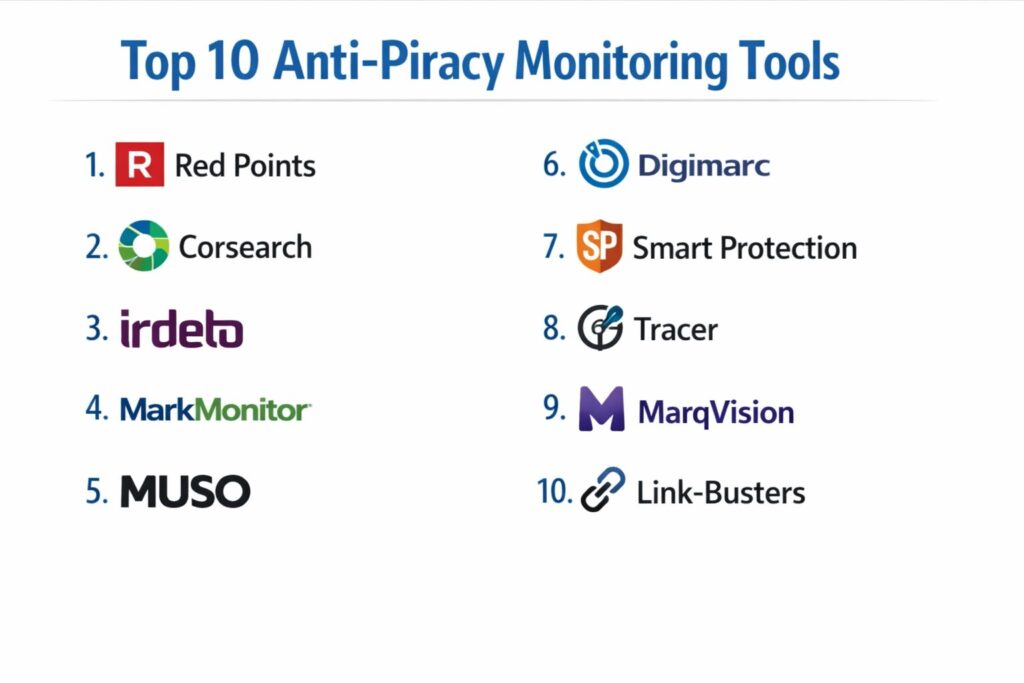
1. Red Points
Red Points is a leader in automated brand protection, specializing in removing illegal content and counterfeit products across social media, marketplaces, and websites. It uses an AI-powered engine to learn a brand’s visual and textual identity, allowing it to spot infringements with high precision. The platform is designed for rapid, high-volume enforcement, making it a favorite for brands with large digital footprints.
Key Features
The software features an automated keyword and image recognition system that continuously crawls thousands of platforms. It provides a centralized dashboard where users can track the status of every detected infringement in real-time. The “one-click” takedown execution streamlines the enforcement process, while the ROI-focused reporting highlights the total revenue recovered through its actions. It also includes specialized modules for protecting mobile apps and identifying typosquatted domains.
Pros
The level of automation is exceptional, significantly reducing the administrative burden on internal legal teams. Its user interface is highly intuitive and provides clear, actionable data.
Cons
The pricing can be high for smaller organizations with limited assets. Some users have reported that the automated system requires fine-tuning to avoid flagging legitimate resellers.
Platforms and Deployment
Web-based SaaS platform accessible from any modern browser.
Security and Compliance
Adheres to enterprise-grade security standards including SOC 2 Type II and is fully GDPR compliant.
Integrations and Ecosystem
Integrates seamlessly with major e-commerce platforms and social media APIs for direct enforcement.
Support and Community
Offers dedicated account management and a comprehensive library of automated onboarding guides.
2. Corsearch
Corsearch provides a holistic approach to IP protection, linking digital anti-piracy with physical brand security. It is widely used by luxury brands and global enterprises to combat a wide range of threats, from counterfeit goods to digital piracy. Its strength lies in its global investigative network and its ability to connect disparate infringements to a single source.
Key Features
It utilizes advanced image and video recognition technology to identify unauthorized use of intellectual property. The platform monitors e-commerce marketplaces, social media, and rogue websites on a global scale. It features a sophisticated risk-scoring system that helps teams prioritize the most damaging infringements. Corsearch also provides dark web scanning to monitor piracy groups and their communication channels. Detailed legal-ready reporting is a core component, supporting large-scale litigation efforts.
Pros
The investigative depth is unmatched, providing a clear picture of the networks behind the piracy. It offers a very high degree of global coverage across multiple languages and jurisdictions.
Cons
The platform is complex and can require specialized training to utilize its full investigative potential. It is one of the more expensive options in the market.
Platforms and Deployment
Cloud-hosted platform with mobile accessibility for field agents.
Security and Compliance
Follows strict data protection protocols and is compliant with international privacy regulations.
Integrations and Ecosystem
Deeply integrated with trademark databases and global enforcement registries.
Support and Community
Provides high-level professional support and a community focused on brand integrity and legal protection.
3. Irdeto
Irdeto is a global powerhouse in digital platform security, particularly for the broadcast and live sports industries. It offers a comprehensive suite of anti-piracy services that combine technical monitoring with forensic watermarking and legal enforcement. It is designed to protect premium video content at every stage of the distribution lifecycle.
Key Features
The platform provides real-time monitoring of illegal live streams and IPTV networks. Its forensic watermarking technology allows broadcasters to identify the exact source of a content leak within minutes. Irdeto features an integrated Digital Rights Management system that works in tandem with its monitoring tools. It can automatically disrupt pirate servers during live events through high-speed enforcement actions. The software also includes detailed analytics on pirate viewer behavior to help drive business strategy.
Pros
It is the gold standard for live event protection, offering the speed and precision required for sports and premium broadcasts. The integration between monitoring and DRM is exceptionally robust.
Cons
The technical nature of the platform means it requires significant expertise to manage effectively. It is largely focused on the media and entertainment sector, making it less versatile for other industries.
Platforms and Deployment
Hybrid deployment including cloud-based monitoring and on-premise hardware for watermarking.
Security and Compliance
Features studio-grade security and is a trusted partner for major Hollywood studios and sports leagues.
Integrations and Ecosystem
Integrates with all major content delivery networks and video playout systems.
Support and Community
Offers 24/7 global support and specialized technical consulting for large-scale deployments.
4. MarkMonitor
MarkMonitor, a part of Clarivate, is a veteran in the brand protection space, focusing on domain name security, search engine de-indexing, and broad anti-piracy monitoring. It is used by some of the largest companies in the world to manage and protect their extensive digital portfolios.
Key Features
The platform features a sophisticated domain management tool that protects against typosquatting and brand impersonation. Its anti-piracy module uses automated crawlers to find and remove illegal content from torrent sites and cyberlockers. MarkMonitor provides an aggressive search engine cleaning service that removes pirate links from top results. It includes a performance dashboard that tracks the success rate of every takedown notice. The software also offers a specialized module for protecting executive and high-profile brand identities.
Pros
The tool offers unparalleled strength in domain strategy and cleanup. It has a long history of successful collaborations with major search engines and ISPs.
Cons
The interface can feel dated compared to newer, more agile competitors. The broad scope of the tool means it can be overkill for companies only needing simple content protection.
Platforms and Deployment
SaaS platform with enterprise-level security.
Security and Compliance
Fully compliant with corporate security standards and international data privacy laws.
Integrations and Ecosystem
Integrates with corporate legal suites and domain registry platforms.
Support and Community
Provides expert account management and a vast wealth of white papers and industry research.
5. MUSO
MUSO is unique for its data-driven approach to anti-piracy, focusing as much on audience intelligence as it does on enforcement. It provides rights-holders with a deep understanding of the global piracy landscape, helping them identify lost revenue and new market opportunities.
Key Features
The platform scans billions of pages daily across all major piracy channels, including P2P and direct download sites. It features a “Demand Discovery” tool that uses piracy data to show where content is trending illegally. The automated notice and takedown system is highly efficient and covers a wide range of industries. MUSO provides market-level reporting that allows users to compare their legal performance against piracy trends. It also includes historical trend analysis to measure the long-term impact of anti-piracy strategies.
Pros
It turns negative piracy data into a strategic business asset. The platform is versatile, serving industries from music and publishing to film and software.
Cons
While its analytics are top-tier, its real-time enforcement for live events is not as specialized as some other competitors.
Platforms and Deployment
Cloud-based SaaS platform.
Security and Compliance
Adheres to standard professional security practices and GDPR requirements.
Integrations and Ecosystem
Supports API connections for custom data analysis and integrates with major content management systems.
Support and Community
Offers responsive technical support and a community focused on data-driven content strategy.
6. Digimarc
Digimarc is renowned for its invisible digital watermarking technology, which provides a fundamental layer of protection for audio, video, images, and documents. Instead of just looking for filenames, it looks for the unique “mark” embedded within the content itself.
Key Features
The software embeds imperceptible watermarks that survive file conversion, compression, and screen-recording. Its relentless web crawlers search for these marks across millions of websites and social platforms. Digimarc provides forensic tracing to identify which authorized user or account was the source of a leak. The platform protects both digital assets and the physical packaging of products. It also features a real-time alerting system that notifies rights-holders as soon as a mark is detected in an unauthorized location.
Pros
The protection is embedded in the content itself, making it much harder for pirates to bypass. It is an excellent tool for identifying the source of “insider” leaks.
Cons
The effectiveness of the monitoring depends on the content being marked before distribution. It requires a more proactive approach than reactive crawlers.
Platforms and Deployment
Cloud-based monitoring with software plugins for content creation tools.
Security and Compliance
Provides high-grade encryption and is used by governments and central banks for document security.
Integrations and Ecosystem
Integrates directly with creative workflows and professional editing software like Adobe Creative Cloud.
Support and Community
Offers extensive technical documentation and specialized training for its watermarking technology.
7. Smart Protection
Smart Protection utilizes high-speed AI to automate the entire lifecycle of finding and removing IP infringements. It is designed to be a “one-stop” solution for brands that want to protect their products, content, and reputation without a heavy administrative overhead.
Key Features
The platform uses specialized AI to detect infringements across e-commerce marketplaces, social media, and search engines. It features a “one-click” enforcement workflow that automates the filing of takedown requests. Smart Protection includes dedicated modules for brand protection, product protection, and digital content protection. Its visual dashboards provide a clear view of the ROI and the total volume of infringements removed. It also offers specific tools for monitoring mobile app stores for clones or modified versions of applications.
Pros
The tool is very fast at executing takedowns, often achieving removals within hours. It offers a very competitive price-to-performance ratio for mid-market companies.
Cons
The focus on high-speed automation can occasionally lead to false positives that require manual review. It is less focused on deep forensic investigation than some enterprise peers.
Platforms and Deployment
Web-accessible SaaS platform.
Security and Compliance
Compliant with standard digital security and privacy regulations.
Integrations and Ecosystem
Integrates with a wide range of marketplace and social platform APIs.
Support and Community
Provides active customer success teams and detailed reporting for stakeholders.
8. Tracer (formerly AppDetex)
Tracer is a high-end brand protection and anti-piracy platform that uses “Tracer AI” to connect disparate infringements to single, organized sources. It is particularly strong in identifying brand impersonation and piracy across app stores and social media.
Key Features
The “Tracer AI” engine analyzes large datasets to identify patterns and link individual pirate listings to larger criminal networks. It provides deep monitoring of mobile app stores for unauthorized or “modded” versions of software. The platform features an automated takedown system that works across hundreds of digital platforms. Tracer also includes specialized tools for domain and paid search monitoring to prevent traffic diversion. It provides comprehensive evidence packages that are ready for legal action or law enforcement referral.
Pros
It is exceptionally good at identifying the “big picture” of a piracy operation. The mobile app protection is among the strongest in the industry.
Cons
The deep analytical capabilities can result in a more complex user experience. It is positioned as a premium solution with a corresponding price point.
Platforms and Deployment
Cloud-hosted enterprise platform.
Security and Compliance
Maintains high-level corporate security and data privacy certifications.
Integrations and Ecosystem
Integrates with corporate security operations centers and legal management platforms.
Support and Community
Offers professional account management and specialized investigative services.
9. MarqVision
MarqVision is an AI-native platform that focuses on the rapid detection and removal of counterfeit goods and pirated content. Its proprietary “MARQ AI” engine is designed to learn and adapt to the visual identity of a brand, making it highly effective at spotting sophisticated fakes.
Key Features
The AI engine automatically scans global marketplaces and social media platforms for infringements. It features a bot-filing system that can execute thousands of takedowns per hour on major platforms. MarqVision provides global monitoring with a particular strength in both Western and Asian marketplaces. The platform includes integrated tools for IP registration and management, helping users protect their assets from the start. It also offers a detailed dashboard showing the financial impact of every enforcement action.
Pros
The speed of its automated filing system is world-class. It is a highly effective tool for companies facing massive volumes of low-level piracy and counterfeiting.
Cons
While excellent for marketplaces, its features for live event and video stream protection are not as deep as specialized media tools.
Platforms and Deployment
SaaS platform with a modern, easy-to-use interface.
Security and Compliance
SOC 2 Type II certified and fully GDPR compliant.
Integrations and Ecosystem
Has strong pre-built connections with the world’s largest e-commerce and social platforms.
Support and Community
Offers a dedicated customer success team and a library of automated onboarding guides.
10. Link-Busters
Link-Busters is a specialized anti-piracy service focused on the high-speed removal of illegal links from search engines, cyberlockers, and torrent sites. It is built for speed, aiming to render pirate links useless before they can reach a wide audience.
Key Features
The “Rapid Enforcement Engine” is capable of sending thousands of takedown notices per hour. It continuously monitors P2P networks, torrent sites, and cyberlockers for unauthorized content. The platform features a specialized tool for de-indexing pirate links from search engines like Google and Bing. Link-Busters provides real-time client dashboards that show the exact status of every link found. It also includes a manual verification step for high-value assets to ensure absolute accuracy in enforcement.
Pros
It is one of the most cost-effective and fastest ways to clean up search results and file-sharing sites. The setup process is very quick and requires minimal technical effort from the user.
Cons
It is primarily focused on link removal and does not offer the deep forensic or brand protection features found in larger suites.
Platforms and Deployment
Web-based SaaS platform.
Security and Compliance
Adheres to standard data encryption and privacy protocols.
Integrations and Ecosystem
Designed to function as a high-speed enforcement layer that can complement other security tools.
Support and Community
Provides responsive email and phone support with a focus on technical reliability.
Comparison Table
| Tool Name | Best For | Platform(s) Supported | Deployment | Standout Feature | Public Rating |
| 1. Red Points | Digital Brands / SMBs | Web, Social, Market | SaaS | AI-Learned Takedowns | 4.8/5 |
| 2. Corsearch | Global Enterprises | Web, App, Market | Cloud | Global Investigative Net | 4.7/5 |
| 3. Irdeto | Live Events / Media | Web, OTT, Mobile | Hybrid | Forensic Watermarking | 4.9/5 |
| 4. MarkMonitor | Large Corp Portfolios | Web, Domain, Search | SaaS | Domain Strategy & Cleanup | 4.5/5 |
| 5. MUSO | Content Strategy | Web, P2P, Social | Cloud | Demand Discovery Analytics | 4.6/5 |
| 6. Digimarc | Asset-level Security | Audio, Video, Image | Cloud | Invisible Digital Marks | 4.7/5 |
| 7. Smart Protection | Rapid AI Enforcement | Web, Social, App | SaaS | One-Click Workflows | 4.5/5 |
| 8. Tracer | Organized Piracy | Web, App, Social | Cloud | Tracer AI Network Linking | 4.6/5 |
| 9. MarqVision | Global Marketplaces | Web, Social, Market | SaaS | High-Volume Bot Filing | 4.7/5 |
| 10. Link-Busters | Search/Link Cleanup | Search, P2P, Cyber | SaaS | Rapid Enforcement Engine | 4.4/5 |
Evaluation & Scoring of Anti-piracy Monitoring Tools
The scoring below is a comparative model intended to help shortlisting. Each criterion is scored from 1–10, then a weighted total from 0–10 is calculated using the weights listed. These are analyst estimates based on typical fit and common workflow requirements, not public ratings.
Weights:
- Core features – 25%
- Ease of use – 15%
- Integrations & ecosystem – 15%
- Security & compliance – 10%
- Performance & reliability – 10%
- Support & community – 10%
- Price / value – 15%
| Tool Name | Core (25%) | Ease (15%) | Integrations (15%) | Security (10%) | Performance (10%) | Support (10%) | Value (15%) | Weighted Total |
| 1. Red Points | 10 | 9 | 9 | 8 | 9 | 9 | 8 | 9.05 |
| 2. Corsearch | 10 | 6 | 8 | 9 | 8 | 10 | 6 | 8.20 |
| 3. Irdeto | 10 | 5 | 10 | 10 | 10 | 10 | 7 | 8.85 |
| 4. MarkMonitor | 9 | 6 | 8 | 9 | 8 | 9 | 7 | 8.10 |
| 5. MUSO | 8 | 8 | 9 | 8 | 9 | 9 | 8 | 8.40 |
| 6. Digimarc | 10 | 7 | 9 | 9 | 9 | 8 | 7 | 8.55 |
| 7. Smart Protection | 9 | 9 | 8 | 8 | 9 | 8 | 9 | 8.70 |
| 8. Tracer | 9 | 6 | 8 | 9 | 8 | 9 | 7 | 8.10 |
| 9. MarqVision | 9 | 9 | 9 | 9 | 10 | 8 | 8 | 8.95 |
| 10. Link-Busters | 7 | 9 | 7 | 7 | 9 | 8 | 10 | 8.00 |
How to interpret the scores:
- Use the weighted total to shortlist candidates, then validate with a pilot.
- A lower score can mean specialization, not weakness.
- Security and compliance scores reflect controllability and governance fit, because certifications are often not publicly stated.
- Actual outcomes vary with assembly size, team skills, templates, and process maturity.
Which Anti-piracy Monitoring Tool Is Right for You?
Solo / Freelancer
For individual creators, a tool that is affordable and requires little maintenance is best. Software that offers a simple interface for monitoring the most common social platforms and search engines can provide significant peace of mind without a large financial investment.
SMB
Small to medium businesses should prioritize automation and “all-in-one” capabilities. Tools that can handle both brand protection and content monitoring from a single dashboard allow smaller teams to effectively fight piracy without hiring a dedicated legal department.
Mid-Market
Mid-market organizations often need tools that offer a balance of price and investigative depth. At this level, the ability to prioritize the most damaging infringements using AI-based risk scoring becomes essential for optimizing limited resources.
Enterprise
Large enterprises require platforms that offer global scalability, deep legal support, and the highest levels of security. These organizations should look for tools that can handle massive volumes of data and integrate with global law enforcement and registry networks.
Budget vs Premium
Budget solutions are often highly focused on specific tasks like link removal or search engine cleaning. Premium solutions, while significantly more expensive, provide the comprehensive forensic tools, real-time live event protection, and dedicated investigative teams necessary for high-value intellectual property.
Feature Depth vs Ease of Use
If you need to understand the underlying criminal networks behind a piracy operation, you will need a tool with deep investigative features. However, if your primary goal is to keep your content off search engines and marketplaces, a tool with a streamlined, user-friendly interface is more efficient.
Integrations & Scalability
The value of an anti-piracy tool is multiplied if it can “talk” to your existing distribution systems. For companies with large, dynamic catalogs, choosing a platform with a robust API and native integrations with content delivery networks is non-negotiable.
Security & Compliance Needs
For organizations in highly regulated sectors or those handling sensitive government and corporate documents, the security of the monitoring platform is as important as its performance. Choosing a tool from a developer with recognized certifications ensures that your intellectual property remains protected within the tool itself.
Frequently Asked Questions (FAQs)
1. How quickly can an anti-piracy tool remove an illegal link?
While detection is often instantaneous, removal depends on the responsiveness of the platform or ISP. Many top-tier tools can achieve de-indexing or removal within 24 to 72 hours, though live events require and often achieve removal in just a few minutes.
2. Can these tools stop piracy on the dark web?
While you cannot “takedown” content on the dark web in the same way as the surface web, professional monitoring tools can track the communication of piracy groups. This intelligence helps organizations anticipate leaks and take preventative measures on more accessible platforms.
3. What is forensic watermarking?
Forensic watermarking is a technique that embeds a unique, invisible code into every copy of a piece of content. If that copy is leaked online, the code can be extracted to identify exactly which authorized user or account was responsible for the breach.
4. Do these tools prevent the initial leak of content?
Most anti-piracy tools are reactive, meaning they find content after it has been leaked. However, they can be paired with preventative measures like Digital Rights Management (DRM) and secure content exchange platforms to create a more complete defense.
5. Are takedown notices legally binding?
A DMCA or similar takedown notice is a formal legal request. Most legitimate platforms and ISPs comply with these notices to avoid being held liable for the infringing content. If they refuse, the evidence gathered by the monitoring tool can be used in court.
6. Can AI-based monitoring tools produce false positives?
Yes, AI systems can occasionally flag legitimate resellers or authorized promotional use. This is why professional tools allow for “whitelisting” authorized partners and often include a manual review step for high-stakes enforcement.
7. How do these tools handle piracy on social media?
Most tools have direct API integrations with major social media platforms. This allows them to automatically report and remove infringing posts, live stream links, and accounts that repeatedly violate copyright.
8. Is anti-piracy only for movies and music?
No, modern anti-piracy tools protect a wide range of assets, including professional software, mobile apps, ebooks, architectural plans, sensitive corporate data, and even physical brand logos and trademarks.
9. Can piracy data be used for marketing?
Yes, tools like MUSO allow companies to see where their content is popular on piracy sites. This “demand data” can help marketing teams identify new geographical regions for expansion where there is a clear interest in their content.
10. What is search engine de-indexing?
De-indexing is the process of removing a link from search engine results. Even if the illegal website remains active, removing it from search results drastically reduces its visibility and the amount of traffic it can attract.
Conclusion
In an increasingly digitized world, the battle against piracy has moved from manual legal threats to an automated technological arms race. For any professional managing high-value assets, an anti-piracy monitoring tool is not merely a defensive utility but a vital component of a modern revenue preservation strategy. By choosing a platform that balances rapid AI detection with robust enforcement and actionable intelligence, organizations can effectively mitigate the impact of digital theft. The key to long-term success lies in selecting a tool that scales with your portfolio and integrates seamlessly into your broader security ecosystem. Ultimately, the goal is to create a digital environment where legitimate content is the easiest and most reliable path for your audience, ensuring that your creative and technical investments continue to yield their full value.