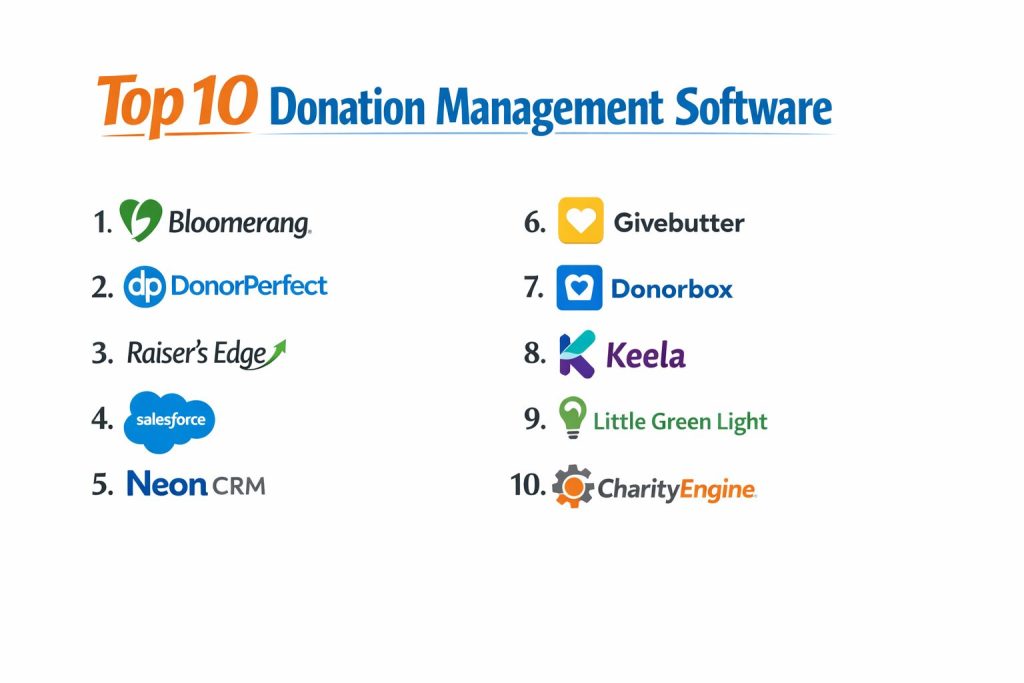
Introduction
Donation management software acts as the operational heartbeat of modern philanthropic organizations, transforming traditional fundraising into a data-driven science. These platforms are engineered to manage the complex lifecycle of a contribution, from the initial digital interaction to automated tax receipting and long-term donor stewardship. For leadership within the nonprofit sector, these tools are no longer a luxury but a fundamental necessity for maintaining transparency and operational speed. By centralizing constituent data, organizations can eliminate the fragmented silos of spreadsheets and manual entry, ensuring that every touchpoint with a supporter is recorded, analyzed, and leveraged for future engagement.
The strategic value of these platforms lies in their ability to optimize donor retention and streamline back-office workflows. As global giving patterns shift toward digital-first interactions, nonprofits require robust systems that can handle recurring multi-channel payments while ensuring stringent data privacy compliance. High-performance donation systems provide real-time visibility into campaign health, allowing development teams to pivot strategies based on live engagement metrics. When selecting a platform, enterprise-grade buyers focus on the depth of the CRM integration, the sophistication of automated communication journeys, and the platform’s capacity to scale alongside growing donor databases.
Best for: Small to large-scale nonprofit organizations, educational institutions, healthcare foundations, and community-driven charitable groups looking for automated fundraising and donor relationship management.
Not ideal for: Private commercial retail businesses, simple personal peer-to-peer transfers without tax-exempt status, or organizations that do not require detailed donor tracking and tax reporting.
Key Trends in Donation Management Software
The integration of artificial intelligence for predictive giving has become a cornerstone of the industry, allowing platforms to suggest optimal “ask” amounts based on a donor’s historical behavior and wealth indicators. There is a decisive move toward frictionless giving experiences, where digital wallets and one-click mobile payments are prioritized to reduce abandonment rates on donation forms. Real-time data synchronization between fundraising tools and accounting software is now an industry standard, significantly reducing the administrative burden on finance teams during audit seasons.
Hyper-personalization is another dominant trend, with automated systems generating customized video thank-you messages and impact reports tailored to a donor’s specific interests. Enhanced cybersecurity measures, such as confidential computing and end-to-end encryption for sensitive financial data, are being implemented to protect against the rising threat of data breaches in the social sector. Furthermore, the rise of “agentic” AI is beginning to automate complex donor research and moves management, freeing up human fundraisers to focus on high-value relationship building.
How We Selected These Tools
Our selection process for the top donation management tools involved a rigorous evaluation of technical architecture and market reliability. We prioritized platforms that demonstrate high uptime and the ability to process large transaction volumes during peak giving periods, such as year-end campaigns. Security certifications were a non-negotiable criterion, with a focus on PCI DSS compliance and robust data protection frameworks like GDPR and SOC 2. We specifically looked for software that offers a “unified source of truth,” where donor records, communication history, and financial transactions are seamlessly linked.
Usability was another critical factor, as nonprofit teams often consist of both technical staff and volunteers. We assessed the intuitiveness of the administrative dashboards and the flexibility of the donor-facing interfaces. Integration ecosystems were heavily weighted, favoring tools that offer native connections to common nonprofit utilities like Mailchimp, QuickBooks, and various social media platforms. Finally, we analyzed the long-term ROI of each tool, considering how features like automated recurring gift management and AI-driven retention scoring contribute to sustainable revenue growth for the organization.
1. Bloomerang
Bloomerang is a specialized donor management system focused heavily on the science of donor retention. It is designed to help mid-market nonprofits reduce churn by providing a clear visual of donor engagement levels. The platform’s philosophy is built around “stewardship,” ensuring that organizations spend as much time thanking and engaging current donors as they do seeking new ones.
Key Features
The software features an interactive dashboard that tracks retention rates in real-time, highlighting “at-risk” donors who haven’t given recently. It includes a built-in “Generosity Score” that identifies high-potential prospects within your existing database. The system automates personalized communication based on donor behavior, such as sending specific emails to first-time givers versus long-term supporters. It also offers a clean, visual timeline for every constituent, showing their entire history of interactions, from event attendance to volunteer hours.
Pros
It excels at providing actionable insights that directly lead to higher retention rates. The interface is modern and requires very little training for new staff.
Cons
The pricing scales upward quickly as the number of records in your database grows. Some of the more advanced marketing features require additional paid add-ons.
Platforms and Deployment
Web-based (Cloud) with mobile-responsive functionality for on-the-go access.
Security and Compliance
PCI DSS compliant and adheres to standard data privacy regulations with secure, encrypted data hosting.
Integrations and Ecosystem
Offers strong native integrations with QuickBooks, Mailchimp, and various peer-to-peer fundraising tools.
Support and Community
Highly rated for its customer success team and provides an extensive library of fundraising education resources.
2. DonorPerfect
DonorPerfect is a comprehensive fundraising platform known for its deep reporting capabilities and flexible database structure. It is built to serve as a robust CRM that can handle the complex needs of growing organizations, from simple online giving to sophisticated grant tracking and major gift management.
Key Features
The platform provides highly customizable data entry screens, allowing organizations to track the specific information most relevant to their mission. It features a powerful automated monthly giving system that manages credit card updates and recurring payments with minimal manual intervention. The reporting suite is exceptionally deep, offering hundreds of pre-built reports alongside a custom report builder. It also includes integrated tools for event management, volunteer tracking, and online auction support within the same environment.
Pros
It is one of the most stable and feature-rich platforms on the market, capable of supporting very large datasets. The customer support is consistently rated as a top industry standard.
Cons
The user interface can feel somewhat dated compared to newer, more “slick” competitors. The sheer number of options can make the initial setup process complex.
Platforms and Deployment
Cloud-based with a dedicated mobile application for field work and event management.
Security and Compliance
SOC 2 Type II compliant and maintains top-tier PCI security for all financial transactions.
Integrations and Ecosystem
Features a wide array of third-party integrations and an open API for custom enterprise connections.
Support and Community
Provides extensive training through “DonorPerfect University” and offers dedicated account management for larger clients.
3. Blackbaud Raiser’s Edge NXT
Raiser’s Edge NXT is the enterprise gold standard for large-scale nonprofit operations, such as universities and global NGOs. It is a sophisticated cloud-based solution that combines deep donor analytics with comprehensive multi-channel fundraising tools.
Key Features
The software utilizes advanced AI and machine learning to provide “propensity to give” ratings for every donor in the system. It features a modern, role-based web interface that allows fundraisers to access critical data from any device. The system includes integrated wealth screening tools that automatically identify major gift prospects. It also offers a unified environment for managing grants, large-scale events, and complex capital campaigns, all while providing automated workflows for donor moves management.
Pros
Unmatched in its ability to handle complex organizational structures and massive donor populations. The predictive analytics provide a significant advantage for major gift officers.
Cons
The cost is significantly higher than most other options, making it inaccessible for many small organizations. The learning curve is steep and often requires dedicated staff to manage.
Platforms and Deployment
Fully cloud-based with modern web-access layers.
Security and Compliance
Meets all global enterprise security standards, including PCI, HIPAA (where applicable), and SOC compliance.
Integrations and Ecosystem
As part of the Blackbaud ecosystem, it integrates perfectly with their financial and education-specific software suites.
Support and Community
Offers premium professional services, global support teams, and a massive network of certified consultants.
4. Salesforce Nonprofit Cloud
Salesforce Nonprofit Cloud is a highly extensible platform built on the world’s leading CRM infrastructure. It is designed for organizations that want a fully customized solution that can manage everything from fundraising to program delivery and impact measurement.
Key Features
The platform provides a 360-degree view of every constituent, linking their donation history to their volunteer work and program participation. Its powerful automation engine, Flow, allows organizations to build complex, custom logic for any business process. The “Nonprofit Success Pack” (NPSP) comes with pre-configured templates for common nonprofit workflows like householding and gift processing. It also features an enormous marketplace of apps, allowing users to add specialized functionality for anything from SMS marketing to international currency management.
Pros
The level of customization is limitless, making it the most flexible tool available. Nonprofits are often eligible for free base licenses through the “Power of Us” program.
Cons
Requires significant technical expertise or expensive external consultants to set up and maintain properly. The platform can be overwhelming for teams looking for a “simple” solution.
Platforms and Deployment
Cloud-based with a highly capable mobile app and browser access.
Security and Compliance
Industry-leading security with granular permissions, multi-factor authentication, and global compliance certifications.
Integrations and Ecosystem
The AppExchange offers thousands of ready-made integrations, making it the most connected platform in the sector.
Support and Community
Supported by a massive global community of “Trailblazers” and a vast network of specialized implementation partners.
5. Neon CRM
Neon CRM is an all-in-one suite designed specifically for small to mid-sized nonprofits that need to manage multiple activities within a single tool. It balances donor management with membership, events, and a full-featured website builder.
Key Features
The software offers a comprehensive membership management module that handles renewals, member-only portals, and tiered benefits. It includes a built-in email marketing tool that supports complex automated drip campaigns based on donor triggers. The event management system allows for customized ticketing, seating charts, and volunteer sign-ups. Neon also features a native website builder that ensures your donation forms and member portals are seamlessly integrated and branded to match your organization.
Pros
Provides excellent value by consolidating multiple tools (CRM, events, membership) into a single subscription. The automated workflow builder is powerful yet accessible for non-technical users.
Cons
While it does many things well, some specialized features (like deep accounting) may not be as robust as stand-alone solutions. Customer support response times can vary.
Platforms and Deployment
Cloud-based with mobile-responsive administrative and donor views.
Security and Compliance
Full PCI compliance for payments and secure SSL encryption for all web-facing portals.
Integrations and Ecosystem
Good selection of native integrations with accounting tools like QuickBooks and specialized marketing platforms.
Support and Community
Offers a helpful knowledge base and active user forums, alongside paid training and consulting options.
6. Givebutter
Givebutter is a modern, community-centric fundraising platform that has gained rapid popularity for its ease of use and unique “zero platform fee” model. It is designed for high-energy campaigns, peer-to-peer fundraising, and social giving.
Key Features
The platform supports a wide range of modern payment methods, including Venmo, Apple Pay, and Google Pay, right out of the box. It features interactive “giving walls” where donors can leave comments, photos, and GIFs, creating a social experience. The peer-to-peer tools are exceptionally user-friendly, allowing supporters to set up their own fundraising pages in minutes. It also includes built-in live streaming and event ticketing with QR-code scanning for check-ins, making it ideal for hybrid events.
Pros
The “tips” model allows nonprofits to use the platform for free, which is perfect for budget-conscious organizations. The donor-facing experience is modern and fun, often leading to higher conversion rates.
Cons
The CRM features are not as deep as specialized donor databases like Bloomerang or DonorPerfect. Transaction fees (from payment processors) still apply even if the platform fee is zero.
Platforms and Deployment
Cloud-based with a focus on mobile optimization for both donors and administrators.
Security and Compliance
Secure payment processing through Stripe and full PCI compliance.
Integrations and Ecosystem
Integrates with Zapier, allowing it to connect to thousands of other apps, as well as native links to common CRMs.
Support and Community
Known for very responsive customer support and a growing community of modern digital fundraisers.
7. Donorbox
Donorbox is a streamlined, high-performance donation engine that specializes in embeddable forms and recurring giving. It is favored by organizations that want a powerful “checkout” experience that plugs directly into their existing website.
Key Features
The platform is optimized for recurring donations, offering a seamless “one-click” monthly giving option for donors. Its forms are highly customizable and can be translated into over 40 languages, supporting multiple currencies. It includes a unique “Ultra-Swift” checkout that utilizes saved donor info for rapid transactions. Donorbox also offers specialized tools for text-to-give, crowdfunding, and donor-advised funds (DAF) giving, along with a simple donor management dashboard for tracking contributions.
Pros
Extremely fast to set up and easy to embed on any website (WordPress, Squarespace, etc.). The pricing is very competitive for smaller organizations with low transaction volumes.
Cons
The core donor management features are basic; organizations with complex CRM needs will likely need to integrate it with another system. Advanced features require additional monthly fees.
Platforms and Deployment
Web-based (Cloud) with a focus on high-performance mobile-web interfaces.
Security and Compliance
Uses Stripe’s secure infrastructure and provides robust fraud detection and PCI compliance.
Integrations and Ecosystem
Strong native integrations with Mailchimp, Salesforce, and Zapier for broader connectivity.
Support and Community
Provides quick digital support and helpful guides for optimizing online donation forms.
8. Keela
Keela is an “intelligence-driven” donor management platform that focuses on making data-driven fundraising accessible to smaller teams. It uses AI to provide actionable advice, helping staff know who to call and when to send an appeal.
Key Features
The “Smart Ask” feature uses AI to calculate the exact amount a specific donor is likely to give, increasing average gift sizes. The platform includes a “Donor Score” that ranks engagement and flags those who might be lapsing. Keela also offers a built-in project management tool that helps teams organize their fundraising tasks and deadlines. Its integrated email marketing and direct mail tools allow for a truly multi-channel approach from a single dashboard, with automated tracking for every message sent.
Pros
The AI insights are very practical and help small teams act with the sophistication of a much larger organization. The interface is intuitive and focused on productivity.
Cons
As a newer player in some markets, it may have fewer localized payment gateway options than more established competitors. The cost can become a factor as the database grows.
Platforms and Deployment
Cloud-based with a modern, responsive web interface.
Security and Compliance
Ensures high-level data encryption and is compliant with standard nonprofit security protocols.
Integrations and Ecosystem
Connects natively with QuickBooks, Eventbrite, and various payment processors like Stripe and PayPal.
Support and Community
Provides dedicated implementation specialists for new clients and has a very friendly, helpful support team.
9. Little Green Light
Little Green Light is an affordable, straightforward donor management solution designed specifically for small nonprofits. It prioritizes simplicity and core administrative efficiency over complex “flashy” features.
Key Features
The platform offers excellent donor and gift tracking, with a focus on making data entry as quick and clean as possible. It features a robust system for managing pledges and tracking progress against specific fundraising goals. The software includes built-in tools for generating automated thank-you letters and year-end tax receipts. Its integration with Zapier allows small teams to build a “best-of-breed” tech stack by connecting Little Green Light to their favorite email or accounting tools without needing a developer.
Pros
Extremely cost-effective for small organizations with under 2,500 records. It is very easy to learn, meaning volunteers can be productive within minutes.
Cons
It lacks built-in advanced marketing automation or sophisticated AI tools. The interface is utilitarian rather than modern or visually engaging.
Platforms and Deployment
Cloud-based with standard web browser access.
Security and Compliance
Provides secure data hosting with standard SSL encryption and PCI-compliant payment integrations.
Integrations and Ecosystem
Relies heavily on Zapier for connectivity, though it does offer some native links to payment and email tools.
Support and Community
Offers a very responsive help desk and a well-organized library of training videos and documentation.
10. CharityEngine
CharityEngine is a native, all-in-one platform built for mid-sized to large nonprofits that want a single database for all their operations. It distinguishes itself by owning the entire technology stack, meaning no data ever has to “sync” between modules.
Key Features
The platform includes an integrated payment processor, CRM, marketing automation, and peer-to-peer tools in one unified database. It features sophisticated AI for predictive giving and fraud detection. The system offers a robust “Advocacy” module that allows supporters to sign petitions or contact their representatives directly from the platform. It also includes deep wealth screening and major gift tracking tools, along with a comprehensive suite for managing complex fundraising events and auctions.
Pros
Eliminates data silos entirely because every feature is native to the system. It offers enterprise-level power with a more streamlined management experience than a custom-built Salesforce setup.
Cons
The initial implementation can be a significant undertaking due to the breadth of the system. Custom pricing means it can be expensive for smaller organizations.
Platforms and Deployment
Cloud-based with specialized views for different staff roles.
Security and Compliance
Highly secure, maintaining PCI Level 1 certification and advanced data privacy controls.
Integrations and Ecosystem
Because it is a native all-in-one, it minimizes the need for external integrations, though it does offer APIs for essential external connections.
Support and Community
Provides high-touch professional support and dedicated account managers for its enterprise clients.
Comparison Table
| Tool Name | Best For | Platform(s) Supported | Deployment | Standout Feature | Public Rating |
| 1. Bloomerang | Retention Focus | Web, Mobile | Cloud | Generosity/Engagement Scores | 4.8/5 |
| 2. DonorPerfect | Growth & Reporting | Web, Mobile | Cloud | Deep Reporting Suite | 4.7/5 |
| 3. Raiser’s Edge NXT | Large Enterprises | Web, Mobile | Cloud | AI Predictive Analytics | 4.5/5 |
| 4. Salesforce Cloud | Total Customization | Web, Mobile | Cloud | Massive App Ecosystem | 4.6/5 |
| 5. Neon CRM | All-in-One (SMB) | Web, Mobile | Cloud | Membership & Web Integration | 4.4/5 |
| 6. Givebutter | Social Fundraising | Web, Mobile | Cloud | Free Social Giving Tools | 4.9/5 |
| 7. Donorbox | Embedded Forms | Web, Mobile | Cloud | Ultra-Swift Recurring Checkout | 4.8/5 |
| 8. Keela | AI-Driven Insights | Web, Mobile | Cloud | “Smart Ask” AI Logic | 4.7/5 |
| 9. Little Green Light | Small Nonprofits | Web, Mobile | Cloud | Simple/Affordable Admin | 4.6/5 |
| 10. CharityEngine | Native All-in-One | Web, Mobile | Cloud | Native Tech Stack (No Sync) | 4.5/5 |
Evaluation & Scoring of Donation Management Software
The scoring below is a comparative model intended to help shortlisting. Each criterion is scored from 1–10, then a weighted total from 0–10 is calculated using the weights listed. These are analyst estimates based on typical fit and common workflow requirements, not public ratings.
Weights:
- Core features – 25%
- Ease of use – 15%
- Integrations & ecosystem – 15%
- Security & compliance – 10%
- Performance & reliability – 10%
- Support & community – 10%
- Price / value – 15%
| Tool Name | Core (25%) | Ease (15%) | Integrations (15%) | Security (10%) | Performance (10%) | Support (10%) | Value (15%) | Weighted Total |
| 1. Bloomerang | 9 | 10 | 8 | 9 | 9 | 10 | 8 | 9.00 |
| 2. DonorPerfect | 10 | 7 | 9 | 10 | 9 | 10 | 8 | 9.05 |
| 3. Raiser’s Edge | 10 | 4 | 9 | 10 | 10 | 9 | 5 | 8.15 |
| 4. Salesforce | 10 | 3 | 10 | 10 | 10 | 9 | 7 | 8.00 |
| 5. Neon CRM | 8 | 8 | 8 | 9 | 8 | 8 | 9 | 8.15 |
| 6. Givebutter | 7 | 10 | 7 | 9 | 10 | 9 | 10 | 8.55 |
| 7. Donorbox | 6 | 10 | 8 | 9 | 10 | 8 | 10 | 8.20 |
| 8. Keela | 9 | 9 | 8 | 9 | 9 | 9 | 8 | 8.75 |
| 9. Little Green Light | 7 | 9 | 6 | 9 | 8 | 10 | 10 | 8.15 |
| 10. CharityEngine | 10 | 6 | 7 | 10 | 10 | 9 | 7 | 8.35 |
How to interpret the scores:
- Use the weighted total to shortlist candidates, then validate with a pilot.
- A lower score can mean specialization, not weakness.
- Security and compliance scores reflect controllability and governance fit, because certifications are often not publicly stated.
- Actual outcomes vary with assembly size, team skills, templates, and process maturity.
Which Donation Management Software Tool Is Right for You?
Solo / Small Team
For very small teams or solo administrators, the priority is a tool that automates as much of the manual work as possible without a high cost. Software that focuses on simplicity and ease of setup allows you to focus on raising funds rather than managing technology.
Mid-Market Growth
As organizations grow, the need for data intelligence becomes paramount. Tools that provide AI-driven insights and retention scoring help growing teams work more strategically, ensuring that their limited staff time is spent on the highest-value opportunities.
Enterprise & Large Scale
Large organizations with multiple departments require a “single source of truth” and highly secure environments. Enterprise solutions must be able to handle complex reporting requirements and offer deep customizability to match existing internal processes.
Budget-First Organizations
For nonprofits operating on thin margins, “zero platform fee” models or highly affordable flat-rate subscriptions are essential. These tools provide professional-grade fundraising features while ensuring that as much money as possible goes directly to the mission.
Feature-Rich vs Simple
The choice between a feature-rich suite and a simple tool often depends on your internal technical capacity. If you have the staff to manage a complex system, the deep insights can be transformative. If not, a simpler tool will likely be more effective in the long run.
Integration Needs
If your organization already relies on specific tools for accounting or email, choosing a donation platform with native integrations for those specific services will prevent data errors and save hours of manual entry every week.
Security & Trust
Donors must feel safe when giving online. Choosing a tool with recognized security certifications and a clean track record of data protection is vital for maintaining the trust that is the foundation of any nonprofit organization.
Frequently Asked Questions (FAQs)
1. What is the difference between a CRM and donation software?
A CRM is a broad database used to manage all constituent relationships (donors, volunteers, partners), while donation software specifically focuses on the transaction and receipting process. Modern platforms usually combine both into a single integrated system.
2. Can these tools handle recurring donations automatically?
Yes, most professional tools offer automated recurring gift management. This includes processing the monthly payment, sending an automated receipt, and often notifying the organization if a donor’s credit card is about to expire.
3. Do I need a separate payment processor like Stripe?
Many donation platforms have built-in payment processing, while others require you to connect an external account like Stripe or PayPal. Integrated processors often offer better data sync, but external ones might have lower transaction rates.
4. How do these tools help with year-end tax receipts?
These platforms can generate individual tax receipts for every gift and also produce a consolidated year-end summary for each donor. This can be sent automatically via email or generated for physical mailing, saving weeks of administrative work.
5. Is AI actually useful for small nonprofits?
AI is incredibly helpful for small teams because it acts as a “digital assistant.” It can automatically segment your donors and tell you which ones are most likely to increase their giving, allowing you to focus your limited time where it matters most.
6. Can I move my data from spreadsheets into these tools?
Yes, all professional platforms provide import tools. Most offer “mapping” features that allow you to upload a CSV file from Excel and tell the software where each piece of information belongs in the new database.
7. How do donation platforms handle peer-to-peer fundraising?
Peer-to-peer tools allow your supporters to create their own branded pages to raise money for you. The software tracks who raised the money and automatically adds the new donors and their contributions to your main database.
8. Are there free options for nonprofits?
Several platforms offer free versions or “no platform fee” models where donors have the option to leave a tip for the software provider. However, you will still usually have to pay standard transaction fees to credit card companies.
9. Can these tools track volunteer hours as well as money?
Many all-in-one CRMs include a volunteer management module where you can track hours, skills, and availability alongside the volunteer’s financial giving history for a complete view of their involvement.
10. What is “wealth screening” in donation software?
Wealth screening is a feature that cross-references your donor list with public records to identify individuals with significant assets. This helps fundraisers identify “major gift” prospects who may have the capacity to give much larger amounts.
Conclusion
Selecting the right donation management software is a strategic investment that directly impacts an organization’s ability to sustain and grow its mission. In a philanthropic landscape that is increasingly defined by digital convenience and AI-driven personalization, the chosen platform must serve as more than just a payment portal; it must be a sophisticated engine for relationship building. The most effective organizations are those that move away from reactive, manual processes and embrace unified systems that provide real-time clarity and automated stewardship. By prioritizing data integrity, security, and ease of use, nonprofit leaders can ensure their technology supports a culture of transparency that honors the donor’s trust while maximizing every dollar raised for their cause.