Introduction
Online course marketplaces have fundamentally restructured the global education and professional training landscape. These digital ecosystems bridge the gap between world-class expertise and learners across every continent, providing access to specialized knowledge that was once locked behind physical campus walls. For professionals, these platforms serve as the primary engine for continuous skill acquisition, allowing for rapid pivots in response to shifting industry demands. By aggregating content from individual experts, top-tier universities, and global technology leaders, these marketplaces offer a breadth of choice that single-institution models cannot match.
The transition to digital-first professional development is driven by the need for measurable skill competency and just-in-time learning. Organizations now prioritize these platforms to address specific technical gaps, such as implementing new cloud architectures or mastering advanced data analytics. When selecting a marketplace, a strategic evaluation must go beyond simple course counts. Decision-makers must analyze the pedagogical quality of the content, the rigor of the assessment mechanisms, and the portability of the resulting credentials. Furthermore, the ability to integrate these platforms into existing talent management systems is crucial for tracking return on investment and ensuring that learning initiatives align with broader business objectives.
Best for: Working professionals seeking career advancement, enterprise teams needing scalable upskilling, lifelong learners pursuing academic rigor, and organizations requiring verifiable compliance training.
Not ideal for: High-stakes medical certifications requiring physical residencies, heavy industrial trades requiring manual equipment mastery, or environments without reliable high-speed internet connectivity.
Key Trends in Online Course Marketplaces
The integration of advanced algorithms is now personalizing the learner journey at an unprecedented scale. Platforms are using data to analyze individual performance and dynamically adjust the difficulty of content, ensuring that learners remain engaged without becoming overwhelmed. There is also a significant move toward “in-the-flow-of-work” learning, where bite-sized modules are delivered exactly when an employee encounters a specific technical challenge.
Micro-credentialing has become a dominant trend, with digital badges and professional certificates gaining widespread acceptance among global recruiters. These compact, verifiable credentials allow professionals to prove their expertise in niche areas without committing to multi-year degree programs. Additionally, the rise of cohort-based learning is reintroducing social interaction and accountability into the digital space, combining the flexibility of online video with the community benefits of a traditional classroom.
How We Selected These Tools
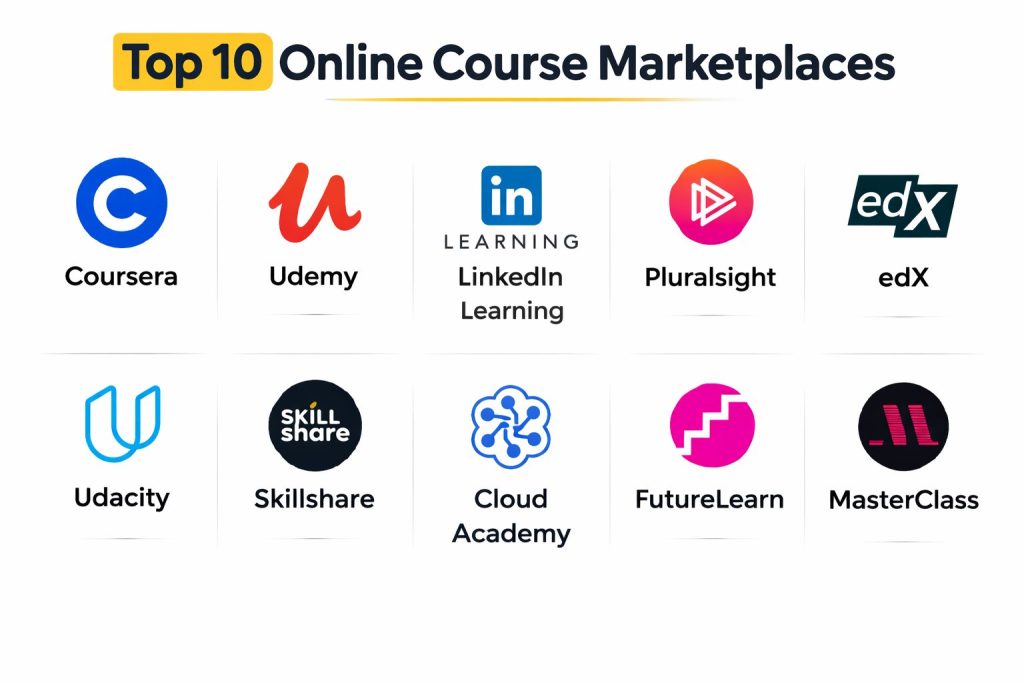
The selection of these top ten marketplaces was based on a multi-dimensional analysis of market authority, content diversity, and technical infrastructure. We focused on platforms that have demonstrated a high level of credibility through partnerships with major universities or industry-leading technology corporations. Global reach was a significant factor, prioritizing platforms that offer localized content and support for multiple languages.
We also scrutinized the quality of the user experience, evaluating the intuitiveness of the learning management interfaces and the robustness of mobile applications. Security and data privacy were paramount, ensuring that both individual and corporate user data are protected under international standards. Finally, we looked for platforms that provide sophisticated analytics for administrators, allowing for the precise measurement of skill progression and program effectiveness.
1. Coursera
Coursera is a premium marketplace known for its deep partnerships with over 300 world-leading universities and industry giants like Google and IBM. It provides a structured hierarchy of learning, ranging from short guided projects to full online master’s degrees. The platform is highly regarded for its academic rigor and the professional weight of its certifications.
Key Features
The platform offers specialized professional certificates designed to make learners job-ready in high-demand fields like data science and project management. Its “Guided Projects” provide interactive, side-by-side workspace environments for hands-on practice. It includes sophisticated plagiarism detection and proctored examinations for its higher-level credentials. The platform also features a robust enterprise dashboard that allows organizations to map learning paths directly to specific job roles and skill competencies.
Pros
Credentials from Coursera carry significant weight with global employers and academic institutions. The peer-review system for assignments fosters a deeper understanding of the material through collaborative feedback.
Cons
The structured nature of many courses means they have set start dates and deadlines, which may not suit all self-paced learners. The cost for full degree programs is a substantial investment compared to individual skill courses.
Platforms and Deployment
Web-based, iOS, and Android. It supports offline viewing for most video content through its mobile applications.
Security and Compliance
Adheres to global data protection standards and provides single sign-on for enterprise users. It is compliant with various international educational privacy regulations.
Integrations and Ecosystem
Integrates seamlessly with major enterprise learning management systems and HR platforms. It also allows for direct certificate sharing to professional networking profiles.
Support and Community
Offers extensive technical support for enterprise partners and a massive global forum for peer-to-peer learner interaction.
2. Udemy
Udemy is the world’s largest marketplace for individual-led courses, boasting a library of over 250,000 titles. It operates on a decentralized model where independent experts create and sell their own content, resulting in a vast array of niche topics that are often updated faster than traditional academic curricula.
Key Features
The platform features a highly flexible pay-per-course model, allowing learners to purchase only what they need with lifetime access. Its search and recommendation engine is highly refined, using millions of student reviews to surface the most effective instructors. For businesses, a curated “Business Pro” collection offers high-quality technical content and hands-on labs. The platform also supports multi-language subtitles and localized pricing in over 60 currencies.
Pros
It is incredibly affordable, with frequent sales making high-quality instruction accessible to a global audience. The sheer variety of topics ensures that even the most specialized technical questions can be answered.
Cons
Because anyone can become an instructor, the quality of production and instruction can vary significantly between courses. Certificates of completion are not accredited and may not be recognized by formal academic institutions.
Platforms and Deployment
Web-based, iOS, Android, and support for smart TVs.
Security and Compliance
Standard encryption for transactions and user data. Enterprise versions offer enhanced security features and administrative controls.
Integrations and Ecosystem
The enterprise version integrates with major corporate tools, while the individual version focuses on ease of use through a standalone interface.
Support and Community
Direct instructor messaging allows for specific questions, supported by a massive library of student-generated Q&A for every course.
3. LinkedIn Learning
LinkedIn Learning leverages the world’s largest professional network to provide highly targeted skill development. It focuses on the most in-demand skills identified by real-time hiring data, making it a powerful tool for career-focused upskilling.
Key Features
The platform is uniquely integrated with professional profiles, allowing certificates to be displayed immediately upon completion. It provides personalized course recommendations based on a user’s current job title, skills, and career goals. Its “Learning Paths” offer curated sequences of courses designed to take a learner from beginner to advanced in specific professional roles. The platform also features a massive library of high-production-value video content led by vetted industry experts.
Pros
The seamless integration with the professional ecosystem makes it an essential tool for job seekers and active professionals. It offers a very high and consistent standard of video production across all its content.
Cons
The subscription-based model means that access to content is lost if the subscription is canceled. It is less focused on deep, multi-month technical specializations compared to some academic competitors.
Platforms and Deployment
Web, iOS, and Android. Optimized for mobile consumption during commutes or breaks.
Security and Compliance
Backed by the enterprise-grade security of its parent organization, including robust data privacy and access management.
Integrations and Ecosystem
Deeply tied to the LinkedIn platform and integrates with common corporate HR and recruiting software.
Support and Community
Strong corporate support and a built-in social layer that allows for discussion within professional groups.
4. Pluralsight
Pluralsight is a specialized marketplace focused strictly on technology and IT skills. It is the preferred choice for software developers, cybersecurity professionals, and cloud architects who need to stay ahead of the rapid pace of technological change.
Key Features
Its proprietary “Skill IQ” and “Role IQ” assessments provide objective measurements of a learner’s proficiency, allowing for the creation of customized learning paths. The platform includes hands-on labs and sandboxed environments where users can practice coding and system administration without risk. It offers deep coverage of cloud platforms, data engineering, and security frameworks. For teams, it provides detailed analytics to help managers identify and close specific technical gaps.
Pros
The content is created by a highly vetted group of technical authors, ensuring extreme accuracy and depth. The focus on technical assessment helps users prove their skills to current or future employers.
Cons
It has a very narrow focus, making it unsuitable for those looking for soft skills or general business education. The cost is higher than many general-purpose marketplaces.
Platforms and Deployment
Web, Desktop App, iOS, and Android. Support for offline video viewing.
Security and Compliance
Highly secure enterprise environment with support for advanced authentication protocols and detailed audit logs.
Integrations and Ecosystem
Integrates with major code repositories and project management tools, as well as enterprise learning platforms.
Support and Community
Highly technical support and a community focused on engineering excellence and certification preparation.
5. edX
Founded by Harvard and MIT, edX is an open-source-based marketplace that provides university-level courses to a global audience. It is distinguished by its commitment to academic research and its focus on making high-quality education accessible as a public good.
Key Features
The platform is the home of “MicroMasters” programs, which provide graduate-level credits that can be applied toward a full master’s degree at participating universities. It offers an “Audit” track that allows users to access course materials for free. Its learning environment is designed to mirror a university classroom, with rigorous assignments and academic discussion forums. It also provides specialized executive education programs for senior leadership in corporate environments.
Pros
Offers the most prestigious academic credentials available in the online marketplace. The open-source nature of the underlying technology allows for high levels of transparency and collaboration.
Cons
The courses are often very demanding and time-consuming, which may be difficult for busy professionals to manage. The interface can feel more academic and less “consumer-friendly” than some modern competitors.
Platforms and Deployment
Web-based, iOS, and Android.
Security and Compliance
Strong adherence to academic and data privacy standards. Its open-source platform is frequently audited for security vulnerabilities.
Integrations and Ecosystem
Supports integration with corporate training systems and provides verifiable digital certificates that are widely recognized globally.
Support and Community
Academic support through teaching assistants and a global community of university students and alumni.
6. Udacity
Udacity is a marketplace focused on “Nanodegree” programs created in collaboration with major tech companies. It is designed to bridge the gap between traditional education and the specific needs of the 21st-century technology workforce.
Key Features
The platform focuses on project-based learning, where students build real-world portfolios that are reviewed by industry professionals. It provides one-on-one technical mentorship and career coaching to help students transition into new roles. Its curriculum is built around the “cutting edge” of technology, including autonomous systems, artificial intelligence, and cloud computing. The platform also includes a robust hiring partner network that connects top graduates directly with employers.
Pros
The focus on building a real-world portfolio is highly effective for proving skills to recruiters. The personalized mentorship provides a level of support that is rare in the online space.
Cons
The cost of Nanodegree programs is significant, and they require a substantial weekly time commitment. The course catalog is much smaller than general marketplaces like Udemy or Coursera.
Platforms and Deployment
Web-based and mobile-optimized.
Security and Compliance
Standard professional data protection and secure handling of student project data.
Integrations and Ecosystem
Works closely with corporate partners to create custom training paths that lead directly to internal roles.
Support and Community
High-touch support including technical mentors, project reviewers, and career services.
7. Skillshare
Skillshare is a creative-focused marketplace that operates on a community-driven model. It is the go-to platform for designers, photographers, writers, and entrepreneurs who learn best through short, project-based classes.
Key Features
The platform encourages a “learning by doing” approach, where every class includes a project that students can share with the community. It offers a subscription-based “Unlimited” plan that provides access to tens of thousands of classes. Its focus is on bite-sized, high-energy content that can be consumed quickly. It also features a “Teacher” program that allows creative professionals to build their own brand and earn revenue from their expertise.
Pros
Excellent for creative inspiration and learning specific, practical tasks in a short amount of time. The community feedback loop provides immediate validation for creative work.
Cons
The platform lacks deep technical or academic courses, making it unsuitable for many professional certifications. The quality of individual classes can be inconsistent.
Platforms and Deployment
Web-based, iOS, and Android.
Security and Compliance
Standard user data protection and secure payment processing.
Integrations and Ecosystem
Integrates with social media platforms for sharing creative work and projects.
Support and Community
Strong social interaction through project galleries and community discussion boards.
8. Cloud Academy
Cloud Academy is a specialized marketplace for enterprise cloud training. It focuses on helping teams master the complex ecosystems of AWS, Azure, and Google Cloud through a combination of content and hands-on testing.
Key Features
It features “Cloud Playgrounds” that provide risk-free, live cloud environments for testing and practice. The platform includes a “Skill Assessment” tool that evaluates an entire team’s technical maturity. Its content is organized into “Training Plans” that guide users through the specific requirements of major cloud certifications. It also offers a “Content Engine” that allows enterprises to customize training with their own internal documentation and specific use cases.
Pros
The live lab environments are an essential tool for mastering cloud infrastructure. The enterprise analytics are among the most detailed in the industry for tracking technical skills.
Cons
The subscription cost is high and is primarily targeted at businesses rather than individual casual learners. The scope is strictly limited to cloud and associated technologies.
Platforms and Deployment
Web-based with a mobile app for video consumption.
Security and Compliance
Enterprise-ready with SSO, MFA, and rigorous data residency options.
Integrations and Ecosystem
Integrates with major enterprise talent and performance management systems.
Support and Community
Dedicated success managers for enterprise clients and technical support for learners.
9. FutureLearn
FutureLearn is a UK-based marketplace that emphasizes social learning. It partners with prestigious universities and cultural institutions to offer a wide range of courses with a focus on interaction and discussion.
Key Features
The platform’s interface is built around conversation, with discussion prompts integrated into every step of the learning process. It offers “Microcredentials” that are developed in partnership with professional bodies and universities. Its content covers everything from healthcare and humanities to business and coding. The platform also supports “Expert-Track” sequences that provide deep dives into professional specialties.
Pros
The social learning model increases engagement and completion rates by making the experience less isolating. It provides access to high-quality content from many institutions outside of the US.
Cons
The “free to audit” period is often limited to the duration of the course plus a few weeks. It may feel less technically intensive for those in high-end engineering fields.
Platforms and Deployment
Web-based and mobile-optimized.
Security and Compliance
Compliant with European data protection regulations (GDPR) and academic privacy standards.
Integrations and Ecosystem
Supports digital certificates that can be shared on professional networks and added to resumes.
Support and Community
A very active and moderated social community that is core to the learning experience.
10. MasterClass
MasterClass is a unique marketplace that focuses on high-production-value courses led by globally recognized celebrities and world-class masters of their craft. It is designed to provide inspiration and high-level perspective rather than granular technical training.
Key Features
The platform features cinematic-quality video lessons from icons in film, cooking, business, and science. Each class includes a downloadable workbook that summarizes key concepts and provides additional resources. It offers a “Sessions” format that involves more hands-on activities over a 30-day period. The interface is exceptionally polished and designed for “edutainment” and lifelong learning.
Pros
Provides access to the mindsets and strategies of the world’s most successful individuals. The production quality is the highest in the industry, making the content very engaging.
Cons
It lacks the technical depth and assessment rigor required for professional certifications. It is more about inspiration and broad knowledge than mastering a specific technical skill.
Platforms and Deployment
Web, iOS, Android, and all major smart TV platforms.
Security and Compliance
Standard consumer data protection and secure subscription management.
Integrations and Ecosystem
A standalone platform focused on the individual consumer experience.
Support and Community
General customer support and a community area for sharing insights from the lessons.
Comparison Table
| Tool Name | Best For | Platform(s) Supported | Deployment | Standout Feature | Public Rating |
|---|---|---|---|---|---|
| 1. Coursera | Academic Credentials | Web, iOS, Android | Cloud | University Partnerships | 4.8/5 |
| 2. Udemy | Niche Skills | Web, iOS, Android, TV | Cloud | 250k+ Course Library | 4.5/5 |
| 3. LinkedIn Learning | Career Advancement | Web, iOS, Android | Cloud | Networking Integration | 4.6/5 |
| 4. Pluralsight | Deep Tech/IT | Web, Desktop, Mobile | Cloud | Skill IQ Assessments | 4.7/5 |
| 5. edX | Higher Education | Web, iOS, Android | Cloud | MicroMasters Credits | 4.5/5 |
| 6. Udacity | Tech Career Pivot | Web, Mobile | Cloud | Industry Mentorship | 4.4/5 |
| 7. Skillshare | Creative Projects | Web, iOS, Android | Cloud | Community Feedback | 4.3/5 |
| 8. Cloud Academy | Enterprise Cloud | Web, iOS, Android | Cloud | Live Cloud Labs | 4.6/5 |
| 9. FutureLearn | Social Learning | Web, Mobile | Cloud | Discussion-led Model | 4.2/5 |
| 10. MasterClass | Expert Perspective | Web, Mobile, TV | Cloud | Celebrity Instructors | 4.7/5 |
Evaluation & Scoring of Online Course Marketplaces
The scoring below is a comparative model intended to help shortlisting. Each criterion is scored from 1–10, then a weighted total from 0–10 is calculated using the weights listed. These are analyst estimates based on typical fit and common workflow requirements, not public ratings.
Weights:
- Core features – 25%
- Ease of use – 15%
- Integrations & ecosystem – 15%
- Security & compliance – 10%
- Performance & reliability – 10%
- Support & community – 10%
- Price / value – 15%
| Tool Name | Core (25%) | Ease (15%) | Integrations (15%) | Security (10%) | Performance (10%) | Support (10%) | Value (15%) | Weighted Total |
|---|---|---|---|---|---|---|---|---|
| 1. Coursera | 10 | 8 | 9 | 9 | 9 | 9 | 8 | 9.05 |
| 2. Udemy | 9 | 10 | 6 | 7 | 9 | 7 | 10 | 8.30 |
| 3. LinkedIn Learning | 8 | 10 | 10 | 9 | 9 | 8 | 8 | 8.85 |
| 4. Pluralsight | 10 | 7 | 8 | 9 | 9 | 9 | 7 | 8.55 |
| 5. edX | 10 | 7 | 8 | 9 | 8 | 8 | 8 | 8.45 |
| 6. Udacity | 9 | 7 | 7 | 8 | 8 | 10 | 6 | 7.90 |
| 7. Skillshare | 7 | 9 | 6 | 7 | 9 | 7 | 9 | 7.60 |
| 8. Cloud Academy | 9 | 7 | 9 | 9 | 9 | 9 | 7 | 8.35 |
| 9. FutureLearn | 8 | 8 | 7 | 8 | 8 | 8 | 8 | 7.85 |
| 10. MasterClass | 7 | 10 | 5 | 8 | 10 | 8 | 7 | 7.80 |
How to interpret the scores:
- Use the weighted total to shortlist candidates, then validate with a pilot.
- A lower score can mean specialization, not weakness.
- Security and compliance scores reflect controllability and governance fit, because certifications are often not publicly stated.
- Actual outcomes vary with assembly size, team skills, templates, and process maturity.
Which Online Course Marketplace Tool Is Right for You?
Solo / Freelancer
For individuals managing their own career, a platform that offers a broad range of practical skills at an affordable price is usually the best entry point. The ability to buy single courses for specific needs allows for high flexibility without a recurring financial commitment.
SMB
Small businesses should look for platforms that offer a curated “business” tier. This ensures that employees have access to high-quality, pre-vetted content without the manager needing to spend time auditing thousands of individual instructors.
Mid-Market
Mid-market organizations often require better reporting and the ability to assign specific learning paths. Platforms that balance a wide content library with administrative analytics provide the best value for growing teams.
Enterprise
For global corporations, integration and compliance are the top priorities. Selecting a marketplace that connects directly to the HRIS and offers robust security and multilingual support is essential for a successful large-scale deployment.
Budget vs Premium
Budget-conscious learners can find immense value in platforms that offer free audit tracks or frequent discounts. Premium platforms are a better investment when the goal is a recognized academic degree or a specific high-level professional certification.
Feature Depth vs Ease of Use
If you need to master complex technical concepts, prioritize platforms that offer labs and deep assessments. For those looking for quick professional tips or creative inspiration, a platform with high-energy, short-form content is more effective.
Integrations & Scalability
A marketplace is only as good as its place in your ecosystem. Ensure the platform you choose can export progress data to your primary tracking tools to ensure that learning is recognized and rewarded within your organization.
Security & Compliance Needs
In regulated industries, the “auditability” of training is non-negotiable. Look for marketplaces that provide detailed completion records, proctored exams, and certificates that meet specific legal or industry standards.
Frequently Asked Questions (FAQs)
1. Can online certificates replace a college degree?
While certificates are increasingly respected for technical skills, they are generally seen as a supplement to, rather than a total replacement for, traditional degrees in most established industries. They are most effective at proving your commitment to current industry trends.
2. What is the average cost of an online course?
Prices vary wildly, from free audit tracks and $10 sales to $2,000 for university-backed certificates. Subscriptions typically range between $20 and $60 per month for unlimited access to a library.
3. Do employers really value these certifications?
Yes, especially in technology, design, and marketing. Employers value the specific, up-to-date knowledge that these platforms provide, as traditional university curricula can sometimes lag behind the current market needs.
4. Can I get a refund if I don’t like a course?
Most major marketplaces offer a 7-day to 30-day money-back guarantee, provided you haven’t completed a significant portion of the course. Always check the specific policy before making a large purchase.
5. How long does it take to complete a typical specialization?
A single course might take 10 hours, while a full specialization or Nanodegree usually requires 3 to 6 months of consistent work, averaging 5 to 10 hours of study per week.
6. Are the “free” courses on these platforms actually good?
Many free courses are excellent and provide the same video content as the paid versions. The main difference is that the free track usually excludes graded assignments and the final certificate.
7. Can I learn offline?
Most platforms with mobile apps allow you to download videos for offline viewing, which is perfect for learning during travel or in areas with poor connectivity.
8. Is there a limit to how many courses I can take?
On subscription-based platforms, you can generally take as many courses as you want. On pay-per-course platforms, you own each course you buy forever and can revisit it at any time.
9. Do I need special software to take these courses?
Most courses run directly in a web browser. However, technical courses in coding or design may require you to install specific tools on your computer to complete the assignments.
10. What is a “MOOC”?
MOOC stands for Massive Open Online Course. It refers to a model where a single course is designed to be taken by thousands of students simultaneously from all over the world, typically at a low cost.
Conclusion
Navigating the vast landscape of online course marketplaces requires a clear understanding of your long-term career goals and immediate skill requirements. The right platform is not necessarily the one with the most content, but the one that aligns its pedagogical approach with your learning style and professional aspirations. As the boundaries between formal education and professional development continue to blur, these marketplaces will play an even more central role in how we define and verify expertise. By choosing strategically—balancing academic prestige with practical, hands-on application—you can build a personalized learning ecosystem that remains resilient in the face of constant industry transformation. The future of work belongs to those who view learning as a continuous process rather than a destination.
As a Senior Learning & Development Specialist, I find that this comparison of online course marketplaces perfectly captures the strategic shift toward data-driven upskilling. I learned from this breakdown that the choice between a massive library like Udemy and a credential-heavy platform like Coursera or edX depends entirely on whether you need immediate, niche technical answers or long-term academic prestige. In my daily work, using platforms like LinkedIn Learning or Pluralsight has been essential for integrating professional development directly into the team’s workflow, allowing us to use Skill IQ assessments to identify and close technical gaps in real-time. For others in the corporate world, these marketplaces offer a scalable way to transform static training into a dynamic “learning in the flow of work” model that keeps the workforce competitive. My best advice for anyone digging into this blog is to prioritize platforms that offer LMS integration and verifiable micro-credentials; being able to track a team’s progress and prove their competency to stakeholders is what turns a simple course into a measurable business asset.