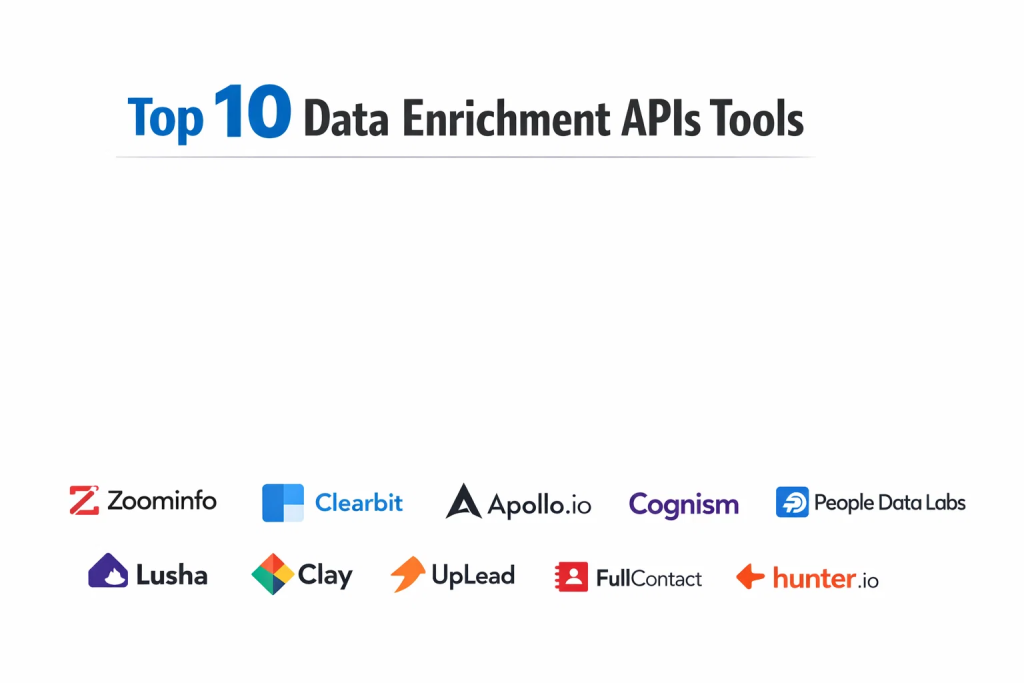
Introduction
Data enrichment APIs represent the critical infrastructure required to transform static, incomplete datasets into dynamic intelligence engines. In an era where information decays at an alarming rate, these interfaces provide a real-time bridge between internal databases and vast external repositories of firmographic, technographic, and personal identity data. By programmatically appending missing attributes—such as verified email addresses, direct-dial phone numbers, corporate hierarchy, and current technology stacks—these tools eliminate the manual research burden that typically hampers operational efficiency. For a modern organization, the ability to resolve identities and context in milliseconds is no longer a luxury; it is a fundamental requirement for maintaining a competitive edge in automated decision-making and personalized engagement.
The strategic value of these APIs extends beyond simple record-filling. They facilitate sophisticated lead scoring, territory management, and risk assessment by providing the granular detail necessary for high-fidelity modeling. When integrated directly into a production pipeline, an enrichment API ensures that every piece of incoming data is instantly validated and expanded, preventing “data rot” from entering the system of record. For technical leaders, the challenge lies in selecting a provider that balances breadth of coverage with high precision and strict adherence to global privacy regulations. A robust API must not only return data but also provide metadata regarding the source and confidence level of that information to ensure enterprise-grade reliability.
Best for: Revenue operations teams, growth engineers, data scientists, and enterprise architects who need to automate the validation and expansion of customer or prospect records at scale.
Not ideal for: One-time manual lookups, basic contact management without automation needs, or organizations without the technical resources to implement RESTful API calls.
Key Trends in Data Enrichment APIs
The industry is rapidly moving toward “Waterfall Enrichment” models, where multiple APIs are queried sequentially to ensure the highest possible match rate and data accuracy. Artificial Intelligence is being integrated directly into the enrichment layer to predict missing values and identify intent signals, such as when a company is actively researching a specific category of software. There is also a significant shift toward “Zero-Party” data verification, where APIs cross-reference multiple social and public signals to ensure a contact’s role is current, reflecting the high frequency of job changes in the modern workforce.
Compliance has become a primary driver of innovation, with top-tier APIs now offering localized data processing to meet strict regional residency requirements. Real-time technographic tracking—identifying the exact moment a company installs or uninstalls a piece of software—is becoming a standard feature for high-end providers. Furthermore, we are seeing the rise of “Identity Resolution Graphs” that can link fragmented digital footprints across different devices and platforms into a single, unified profile, providing a holistic view of the customer journey.
How We Selected These Tools
Our selection process focused on the technical robustness and data integrity of each API provider. We prioritized platforms that offer extensive documentation and SDKs, making them accessible for developers to integrate into custom applications. Data freshness was a non-negotiable criterion; we sought out providers with high-frequency refresh cycles and verified human-in-the-loop validation processes. Market reputation within the DevOps and DataOps communities played a significant role, as did the provider’s ability to handle high-concurrency requests with minimal latency.
We also evaluated the depth of the datasets provided, looking for a mix of firmographic (company-level) and demographic (person-level) attributes. The availability of specialized data, such as intent signals or specific European market compliance, was factored into the ranking to ensure a diverse range of use cases. Finally, we looked at the scalability of the pricing models, favoring those that offer clear credit-based or usage-based tiers that can grow alongside an organization’s data needs.
1. ZoomInfo API
ZoomInfo is the enterprise benchmark for B2B intelligence, offering an unparalleled depth of firmographic and contact data. Its API allows businesses to tap into a massive database that includes detailed organizational charts, department-level insights, and streaming intent data. It is engineered for high-volume environments where accuracy and breadth of coverage are the primary requirements.
Key Features
The API provides access to over 600 million professional profiles and 100 million company records with high-frequency updates. It includes “Scoops,” which are actionable triggers like leadership changes or planned projects. The system offers granular technographic data, identifying thousands of different software and hardware installations. It also supports complex corporate hierarchy mapping, allowing users to understand parent-child relationships between global entities. Its intent engine identifies companies actively searching for specific solutions in real-time.
Pros
It offers the most comprehensive B2B database in the market, particularly for North American accounts. The data is highly structured, making it easy to map directly into enterprise-grade CRMs and data warehouses.
Cons
The cost is among the highest in the industry, often requiring long-term annual commitments. The API’s complexity can be overwhelming for smaller teams with simpler enrichment needs.
Platforms and Deployment
Web-based REST API with native integrations for major CRMs like Salesforce and Microsoft Dynamics.
Security and Compliance
Holds SOC 2 Type II certification and offers robust features for GDPR and CCPA compliance, including automated opt-out processing.
Integrations and Ecosystem
Extensive ecosystem with pre-built connectors for nearly all major sales and marketing automation platforms.
Support and Community
Provides dedicated account management and 24/7 technical support for enterprise-tier customers.
2. Clearbit (HubSpot Breeze Intelligence)
Clearbit, now part of the HubSpot ecosystem, is famous for its “API-first” philosophy and ease of use. It excels at turning a single data point, like an email address or a domain, into a full person or company profile with over 100 different attributes. It is a favorite among developers for its clean documentation and rapid integration capabilities.
Key Features
The platform offers real-time enrichment that triggers the moment a lead enters a system. It includes a “Reveal” feature that identifies anonymous website visitors by matching IP addresses to company profiles. The API supports dynamic form shortening, which reduces the number of fields a user has to fill out by auto-populating known data. It provides deep social profile integration, pulling in LinkedIn, X (Twitter), and other public handles. The system also tracks company growth signals, such as funding rounds and employee headcount changes.
Pros
The integration process is incredibly fast, often taking only a few hours for basic setups. It provides very high-quality data for tech-focused industries and startups.
Cons
Since the acquisition, some features are increasingly tied to the HubSpot ecosystem. The contact-level data in certain international regions can be less comprehensive than specialized competitors.
Platforms and Deployment
Cloud-based REST API with a focus on webhooks for real-time data flow.
Security and Compliance
Fully GDPR and CCPA compliant with a strong focus on data privacy and ethical sourcing.
Integrations and Ecosystem
Deeply integrated with HubSpot, while maintaining strong connections with Salesforce, Slack, and Segment.
Support and Community
Offers excellent developer documentation and a supportive community of growth engineers.
3. Apollo.io API
Apollo.io has emerged as a dominant player by combining a massive contact database with an affordable, usage-based pricing model. Its API is designed for teams that need to run high-volume outbound sequences and require a constant stream of enriched leads. It provides a rare balance of data volume and built-in sales engagement features.
Key Features
The API allows users to search and enrich against a database of over 275 million contacts. It features an AI-powered lead scoring engine that prioritizes prospects based on their likelihood to convert. Users can trigger automated email sequences directly through the platform after enrichment. It includes a Chrome extension for real-time enrichment while browsing LinkedIn or company websites. The system also provides “Job Change” alerts to help users re-engage with champions who have moved to new organizations.
Pros
It offers exceptional value for money, including a very generous free tier for early-stage teams. The all-in-one nature of the platform reduces the need for multiple separate tools.
Cons
Data accuracy for phone numbers can sometimes lag behind specialized premium providers. The interface and API responses can occasionally feel slower during peak usage times.
Platforms and Deployment
REST API with local browser extensions and cloud-based management.
Security and Compliance
Adheres to standard data protection regulations and provides tools for managing suppression lists.
Integrations and Ecosystem
Strong native integrations with HubSpot and Salesforce, plus a flexible API for custom workflows.
Support and Community
Extensive self-service Knowledge Base and a large community of SDRs and sales managers.
4. Cognism API
Cognism is the leading choice for organizations operating in the European market or those requiring high-precision mobile phone data. It differentiates itself through its “Diamond Data” feature—manually verified mobile numbers that provide significantly higher connect rates than automated datasets.
Key Features
The API specializes in GDPR-compliant data for the EMEA region, ensuring that outreach remains legal and ethical. Its Diamond Data feature offers human-verified mobile numbers with a 98% accuracy guarantee. The system includes intent data through a partnership with Bombora, allowing users to see which accounts are in an active buying cycle. It also provides advanced filtering for hiring trends and office locations. The API is built to handle complex batch enrichment for cleaning up large legacy databases.
Pros
It offers the best mobile phone data accuracy for sales teams that rely on cold calling. Its compliance-first approach takes the risk out of European prospecting.
Cons
The North American database, while growing, is not as deep as ZoomInfo’s. Pricing is generally at the premium end of the market.
Platforms and Deployment
Web-based API with a focus on CRM-native workflows.
Security and Compliance
The industry leader in GDPR compliance, holding ISO 27001 and SOC 2 certifications.
Integrations and Ecosystem
Connects seamlessly with Salesforce, HubSpot, and major sales engagement tools like Outreach and Salesloft.
Support and Community
Provides high-touch customer success and technical onboarding to ensure ROI.
5. People Data Labs (PDL) API
People Data Labs positions itself as a data infrastructure company rather than a sales tool. It provides a massive, raw dataset of professional profiles and company records, designed specifically for developers building their own applications, talent platforms, or predictive models.
Key Features
The API provides access to billions of resume-style profiles, including detailed work history and educational backgrounds. It features a sophisticated identity resolution engine that can link disparate data points to a single person. Its “Person Enrichment” endpoint can return data based on a single email, social handle, or phone number. PDL also offers a “Company Enrichment” endpoint for deep firmographic insights. The data is delivered in highly structured JSON format, optimized for machine learning and analytics.
Pros
It is the most developer-friendly option for those building custom software. The scale of the data is massive, covering nearly every professional with a digital footprint.
Cons
It lacks the user-friendly interface or built-in sales engagement tools found in other platforms. The raw nature of the data requires more technical effort to clean and utilize effectively.
Platforms and Deployment
Pure REST API with SDKs for Python, Node.js, and Java.
Security and Compliance
Maintains strict data governance protocols and provides transparency regarding data origins.
Integrations and Ecosystem
Designed to be integrated into custom stacks; also works well with data platforms like Snowflake and BigQuery.
Support and Community
Offers a technical Slack community and high-quality engineering-focused documentation.
6. Lusha API
Lusha is known for its simplicity and the high accuracy of its B2B contact information. Originally popular as a browser extension, its API now allows enterprises to integrate its accurate contact-finding capabilities directly into their own internal tools and workflows.
Key Features
The API focuses on delivering direct dials and verified work emails with high match rates. It includes a “Company API” for quick firmographic lookups and a “Contact API” for person-level data. The system features a simple credit-based consumption model that is easy to track. It provides real-time validation to ensure that contact details are still active before they are delivered. The platform also offers a “Bulk Enrichment” tool for processing large lists via the dashboard or API.
Pros
It is one of the easiest APIs to implement for simple contact enrichment. The accuracy of its direct-dial phone numbers is consistently ranked among the highest in the industry.
Cons
The depth of firmographic and technographic data is more limited compared to full-suite platforms like ZoomInfo. It is primarily focused on contact data rather than account-level intelligence.
Platforms and Deployment
REST API and browser-based platform.
Security and Compliance
ISO 27001 certified and fully compliant with GDPR and CCPA.
Integrations and Ecosystem
Native integrations for major CRMs and a very popular LinkedIn browser extension.
Support and Community
Provides solid documentation and responsive email support for all pricing tiers.
7. Clay API
Clay is a modern data orchestration platform that acts as a “waterfall” for enrichment. Its API allows you to query over 50 different data providers (including many on this list) through a single interface, ensuring you find the data you need by automatically moving to the next provider if the first one fails.
Key Features
The platform creates a unified workspace where users can build complex enrichment workflows without deep coding. Its API allows for the programmatic execution of these “waterfalls.” It includes built-in AI that can scrape websites for custom data points, such as “Does this company mention AI on their homepage?” It features a spreadsheet-style interface for managing and cleaning data before exporting it. The system also supports automated outreach based on the enriched signals it discovers.
Pros
It provides the highest possible match rates by aggregating multiple data sources. It allows for the creation of highly customized, creative enrichment logic that other tools can’t match.
Cons
The cost can add up quickly as you pay for both the Clay platform and the individual provider credits. The learning curve for setting up complex workflows is higher than for single-point APIs.
Platforms and Deployment
Cloud-based platform with a robust REST API for workflow triggers.
Security and Compliance
Adheres to standard enterprise security practices and allows users to control which data providers are used.
Integrations and Ecosystem
Connects to almost every B2B data provider and CRM on the market.
Support and Community
Boasts a very active community of growth hackers and provides excellent tutorial content.
8. UpLead API
UpLead is often cited as the top choice for those who prioritize email deliverability. It features a built-in real-time email verification process that ensures every email returned through the API is valid, significantly reducing bounce rates for outreach campaigns.
Key Features
The API offers a 95% accuracy guarantee on its data. It includes a “Technographics” feature that tracks over 16,000 different technology products across millions of companies. Users can enrich data in bulk by uploading lists or through real-time API calls. It provides over 50 different search filters, including revenue, industry, and social profiles. The platform also features “Intent Data” to help identify companies that are currently in-market for specific services.
Pros
The email verification is a major time-saver, ensuring high deliverability from the start. The pricing is transparent and more accessible for mid-sized companies.
Cons
The total volume of its contact database is smaller than the industry giants. The API documentation, while functional, is not as extensive as some developer-focused competitors.
Platforms and Deployment
REST API with a web-based management dashboard.
Security and Compliance
Full GDPR and CCPA compliance with secure data handling protocols.
Integrations and Ecosystem
Integrates with popular tools like Salesforce, HubSpot, Pipedrive, and various email marketing platforms.
Support and Community
Offers responsive customer support and a library of training resources.
9. FullContact API
FullContact is a specialist in identity resolution and data hygiene. Its API is designed to help companies build a “Whole Customer View” by linking fragmented identities—such as multiple email addresses, social profiles, and device IDs—to a single persistent person ID.
Key Features
The “Identity Map” allows organizations to recognize customers across different touchpoints even when they use different identifiers. It offers a “Person Enrichment” API that provides hundreds of professional and personal attributes. The “Company Enrichment” API provides deep insights into corporate structures and brand data. It features a private “identity cloud” option for enterprises that want to manage their own first-party identity graph. The system is designed to deduplicate and clean massive databases in real-time.
Pros
It is the best tool for organizations that have complex, fragmented customer data across multiple systems. It places a very high emphasis on privacy and ethical data practices.
Cons
It is more of a backend infrastructure tool and lacks the prospecting features of sales-oriented platforms. The focus on identity resolution may be more than what a simple sales team needs.
Platforms and Deployment
Cloud-native REST API with high availability.
Security and Compliance
Extremely strong privacy focus; uses patented technology to ensure data is handled without compromising individual privacy.
Integrations and Ecosystem
Works well with Customer Data Platforms (CDPs) and Master Data Management (MDM) systems.
Support and Community
Provides enterprise-grade support with a focus on technical implementation and data strategy.
10. Hunter.io API
Hunter (or Hunter.io) is the specialist in professional email discovery and verification. Its API is widely used by developers to build “find-and-verify” functionality directly into their applications, focusing purely on the accuracy of the email communication channel.
Key Features
The “Domain Search” API returns all publicly available email addresses associated with a specific company. The “Email Finder” can generate a verified email address based on a person’s name and company domain. The “Email Verifier” provides a detailed check on any email address to ensure it is deliverable. It includes a “Campaigns” feature that allows for automated cold email outreach directly from the platform. The API also provides the source of each piece of data, ensuring transparency.
Pros
It is the most reliable tool for purely email-focused needs. The API is incredibly fast, simple to use, and very affordable for high-volume verification.
Cons
It does not provide deep firmographic or technographic data beyond basic company information. It lacks the broader “people intelligence” features found in full-suite enrichment platforms.
Platforms and Deployment
Simple REST API with official libraries for multiple programming languages.
Security and Compliance
Strictly follows data privacy regulations and only indexes publicly available professional information.
Integrations and Ecosystem
Integrates with almost all CRMs and offers a highly rated browser extension for Chrome and Firefox.
Support and Community
Excellent technical documentation and a massive user base that shares tips and best practices.
Comparison Table
| Tool Name | Best For | Platform(s) Supported | Deployment | Standout Feature | Public Rating |
| 1. ZoomInfo | Enterprise Sales | Web, API | Hybrid | Deepest B2B Intent | 4.4/5 |
| 2. Clearbit | Growth Engineers | Web, API, Webhook | Cloud | IP-to-Company Reveal | 4.5/5 |
| 3. Apollo.io | SMB Outbound | Web, API | Cloud | All-in-One Sales Suite | 4.8/5 |
| 4. Cognism | European Markets | Web, API | Cloud | Diamond Verified Mobiles | 4.7/5 |
| 5. People Data Labs | Developers/ML | API | Cloud | Global Identity Graph | 4.6/5 |
| 6. Lusha | Direct Dials | Web, API | Local/Cloud | High Accuracy Mobile | 4.3/5 |
| 7. Clay | Waterfall Enrichment | Web, API | Cloud | Multi-Source Orchestration | 4.9/5 |
| 8. UpLead | Email Accuracy | Web, API | Cloud | 95% Accuracy Guarantee | 4.6/5 |
| 9. FullContact | Identity Resolution | API | Cloud | Persistent Person ID | 4.2/5 |
| 10. Hunter.io | Email Verification | Web, API | Cloud | Bulk Email Verifier | 4.7/5 |
Evaluation & Scoring of Data Enrichment APIs
The scoring below is a comparative model intended to help shortlisting. Each criterion is scored from 1–10, then a weighted total from 0–10 is calculated using the weights listed. These are analyst estimates based on typical fit and common workflow requirements, not public ratings.
Weights:
- Core features – 25%
- Ease of use – 15%
- Integrations & ecosystem – 15%
- Security & compliance – 10%
- Performance & reliability – 10%
- Support & community – 10%
- Price / value – 15%
| Tool Name | Coverage (25%) | Accuracy (15%) | Integrations (15%) | Compliance (10%) | Latency (10%) | Support (10%) | Value (15%) | Weighted Total |
| 1. ZoomInfo | 10 | 9 | 10 | 9 | 7 | 10 | 5 | 8.45 |
| 2. Clearbit | 8 | 9 | 10 | 9 | 10 | 8 | 7 | 8.60 |
| 3. Apollo.io | 9 | 7 | 9 | 8 | 8 | 8 | 10 | 8.55 |
| 4. Cognism | 8 | 10 | 8 | 10 | 8 | 9 | 7 | 8.50 |
| 5. People Data Labs | 10 | 8 | 7 | 8 | 10 | 8 | 8 | 8.60 |
| 6. Lusha | 7 | 9 | 8 | 9 | 9 | 8 | 8 | 8.10 |
| 7. Clay | 10 | 9 | 10 | 8 | 7 | 9 | 8 | 8.95 |
| 8. UpLead | 7 | 9 | 8 | 9 | 9 | 8 | 8 | 8.10 |
| 9. FullContact | 9 | 8 | 7 | 10 | 9 | 8 | 6 | 8.10 |
| 10. Hunter.io | 5 | 10 | 9 | 9 | 10 | 8 | 10 | 8.10 |
How to interpret the scores:
- Use the weighted total to shortlist candidates, then validate with a pilot.
- A lower score can mean specialization, not weakness.
- Security and compliance scores reflect controllability and governance fit, because certifications are often not publicly stated.
- Actual outcomes vary with assembly size, team skills, templates, and process maturity.
Which Data Enrichment API Tool Is Right for You?
Solo / Freelancer
For individuals or early-stage consultants, a tool that offers immediate value without a complex setup is best. Look for platforms that have a robust free tier and a simple browser extension to help you qualify prospects as you browse.
SMB
Small businesses should prioritize all-in-one platforms that combine enrichment with outreach tools. This reduces the number of subscriptions you need to manage and ensures that your enriched data is immediately actionable for sales and marketing.
Mid-Market
At this stage, the focus shifts toward data hygiene and scalability. You need an API that integrates deeply with your CRM to automate record updates, ensuring that your growing sales team isn’t wasting time on manual data entry or bounced emails.
Enterprise
Enterprise organizations require the highest level of coverage and compliance. The ability to map complex global corporate hierarchies and receive intent signals to prioritize massive account lists is critical. Look for providers with dedicated support and SOC 2 certifications.
Budget vs Premium
Budget-conscious teams will find that usage-based or “pay-as-you-go” models are the most sustainable. Premium tools are an investment in high-fidelity data that can significantly increase the conversion rates of high-value account-based marketing programs.
Feature Depth vs Ease of Use
If you have a dedicated DevOps or DataOps team, you can opt for more complex, developer-focused APIs that provide raw data for custom modeling. If your team is primarily sales-led, choose a tool with a user-friendly interface and pre-built connectors.
Integrations & Scalability
Your enrichment tool must grow with you. Choose an API that supports both real-time individual lookups and massive bulk processing. Interoperability with data warehouses like Snowflake is essential for long-term strategic analysis.
Security & Compliance Needs
If you are operating in highly regulated sectors or the European market, compliance is your number one priority. Ensure your provider has a clear, legal path for how they source their data and offers features to help you automate privacy requests.
Frequently Asked Questions (FAQs)
1. What is the difference between data cleansing and data enrichment?
Cleansing is about removing errors and duplicates from your existing data to ensure it is accurate. Enrichment is the process of adding new, missing information from external sources to make your records more complete and actionable.
2. How often should I enrich my CRM data?
Professional data decays at a rate of roughly 2% to 3% per month as people change jobs or companies move. For high-performing teams, real-time enrichment for new leads combined with a full database refresh every quarter is recommended.
3. Is using a data enrichment API legal under GDPR?
Yes, provided the API provider follows strict compliance protocols. Many top providers focus on publicly available professional information and provide automated tools to handle “Right to be Forgotten” requests and opt-outs.
4. Can these APIs find personal cell phone numbers?
Some premium APIs specialize in finding mobile numbers, often verified through various public signals or manual checks. However, the use of personal numbers for business outreach is subject to strict “Do Not Call” regulations in many regions.
5. What is “Intent Data” in the context of enrichment?
Intent data refers to signals that suggest a company is currently in the market for a product. This can include website visits, content downloads, or specific search patterns identified by the API provider’s partner network.
6. Do I need to be a developer to use an enrichment API?
While the API itself requires some technical setup, many of these tools offer “no-code” integrations for popular platforms like HubSpot and Salesforce. This allows non-technical users to set up automated enrichment workflows easily.
7. How do match rates work?
A match rate is the percentage of your records that the API successfully finds and enriches. Match rates vary depending on the quality of your input data and the depth of the provider’s database in your specific target industry.
8. What are technographics?
Technographics provide information about the hardware and software used by a company. This includes their CRM, hosting provider, marketing tools, and internal productivity suites, allowing you to target prospects based on their tech stack.
9. Can I enrich data from just a LinkedIn URL?
Yes, many modern enrichment APIs can take a social profile URL and return a full contact record, including the person’s current work email, job title, and company firmographics.
10. What is “Waterfall Enrichment”?
This is a technique where you set up a sequence of multiple APIs. If the first API cannot find a record, the system automatically queries the second and third, maximizing the total amount of data you can collect.
Conclusion
Integrating a professional data enrichment API is a transformative step for any data-driven organization. It moves the business away from a reliance on stagnant, siloed information and toward a state of continuous intelligence. By choosing a partner that aligns with your technical requirements, budget, and geographic focus, you ensure that your teams are always operating with a complete and accurate picture of their market. In the current landscape, the difference between a successful campaign and a wasted effort often comes down to the quality of the data underlying the outreach. As APIs become more sophisticated and AI-driven, those who prioritize high-fidelity, real-time enrichment will lead the next generation of efficient, automated growth.