Introduction
Software Asset Management (SAM) tools are sophisticated enterprise platforms designed to manage, control, and protect software assets throughout their entire lifecycle. In the corporate environment, these tools have transitioned from being simple license trackers to “Digital Value Management” hubs. They reconcile what a company has purchased (entitlements) with what is actually installed and used (consumption), ensuring both regulatory compliance and financial optimization. As organizations face the triple threat of SaaS sprawl, complex multi-cloud licensing, and aggressive vendor audits, SAM tools serve as the primary defensive and cost-saving layer for IT and Finance departments.
The modern SAM landscape is now heavily influenced by the convergence of IT Asset Management (ITAM) and FinOps. Professionals no longer just look for “installed software” on local hard drives; they manage a hybrid ecosystem of on-premise legacy apps, containerized microservices, and thousands of “Shadow SaaS” subscriptions. The best SAM tools leverage autonomous agents and machine learning to predict renewal risks, automate license reclamation, and provide a transparent view of the organization’s total software carbon footprint.
Real-world use cases include:
- Audit Defense: Generating “Effective License Positions” (ELPs) to prove compliance during vendor audits from giants like Oracle, Microsoft, and IBM.
- SaaS Spend Optimization: Identifying underutilized “zombie” accounts in platforms like Salesforce or Adobe and automatically reassigning or canceling them.
- Merger & Acquisition (M&A) Due Diligence: Rapidly discovering the software estate of an acquired company to identify security risks and redundant licensing costs.
- Security & Vulnerability Mapping: Linking software versions to known CVEs (Common Vulnerabilities and Exposures) to help security teams prioritize patching.
- Cloud Infrastructure Rightsizing: Analyzing IaaS and PaaS consumption to ensure SQL Server or Windows Server licenses are applied efficiently in the cloud (BYOL).
What buyers should evaluate (Criteria):
- Normalization Engine: The quality of the tool’s library to accurately identify “Microsoft Word” from a cryptic executable string.
- Entitlement Logic: The ability to understand complex licensing rules like “Core-based,” “Concurrent user,” or “Secondary use rights.”
- Discovery Depth: Whether the tool uses agents, agentless scans, or API connectors to see into every corner of the network and cloud.
- SaaS Management (SMP): Capabilities specifically for discovering and managing web-based applications that don’t live on a server.
- Automation Workflow: The ease of creating “if-then” scenarios, such as “If a user hasn’t logged into Zoom in 30 days, revoke the Pro license.”
- FinOps Integration: How well the tool bridges the gap between software licensing and cloud infrastructure spending.
Best for: Large-scale enterprises with complex licensing contracts, organizations undergoing rapid digital transformation, and IT teams facing frequent vendor audits.
Not ideal for: Very small startups with fewer than 50 employees where simple manual tracking or a basic accounting spreadsheet may suffice until scale is reached.
Key Trends in Software Asset Management
The SAM market has undergone a significant evolution, shifting from reactive compliance to proactive optimization.
- FinOps and SAM Convergence: The “wall” between cloud spend and software licensing has collapsed. Tools provide a unified view of “Cloud-Software Value,” calculating the cost of a license plus the infrastructure it runs on.
- Shadow AI Discovery: Tools now specifically hunt for “Shadow AI”—unauthorized Large Language Model (LLM) subscriptions that pose significant data privacy and cost risks.
- Autonomous License Reclamation: AI agents now interact with users via Slack or Teams to ask, “We noticed you haven’t used this app; can we reclaim the license?” and then execute the change automatically.
- Sustainability Reporting: Modern SAM platforms calculate the “Carbon Intensity” of the software estate, helping organizations meet new ESG (Environmental, Social, and Governance) compliance standards.
- Zero-Trust Asset Visibility: SAM tools are integrating with Zero Trust architectures to ensure that only “managed and compliant” assets can access sensitive corporate networks.
- Vendor-Specific AI Optimizers: Specialized “AI modules” for high-risk vendors (Oracle/SAP/IBM) that simulate audit scenarios and suggest the most cost-effective contract structures.
- Predictive Renewal Forecasting: Machine learning models that analyze historical usage trends to tell procurement exactly what to buy 6 months before a major contract renewal.
How We Selected These Tools (Methodology)
Our ranking is the result of an intensive analysis of the global ITAM/SAM marketplace, focusing on “best-of-breed” performance.
- Discovery Precision: We prioritized tools that demonstrate the lowest “false positive” rates when identifying software versions across hybrid environments.
- License Library Depth: We evaluated the sheer volume of “Software Recognition” entries in the vendor’s proprietary databases.
- Enterprise Scalability: Preference was given to platforms capable of managing estates with over 100,000 global endpoints without performance degradation.
- Native SaaS Capabilities: We looked for tools that have successfully integrated “SaaS Management” as a core pillar rather than a superficial add-on.
- Third-Party Validation: We analyzed performance data from industry analysts and verified user reviews from high-traffic software peer-review sites.
- Financial Impact: We focused on tools with a proven track record of delivering at least 15-30% in immediate “low-hanging fruit” cost savings.
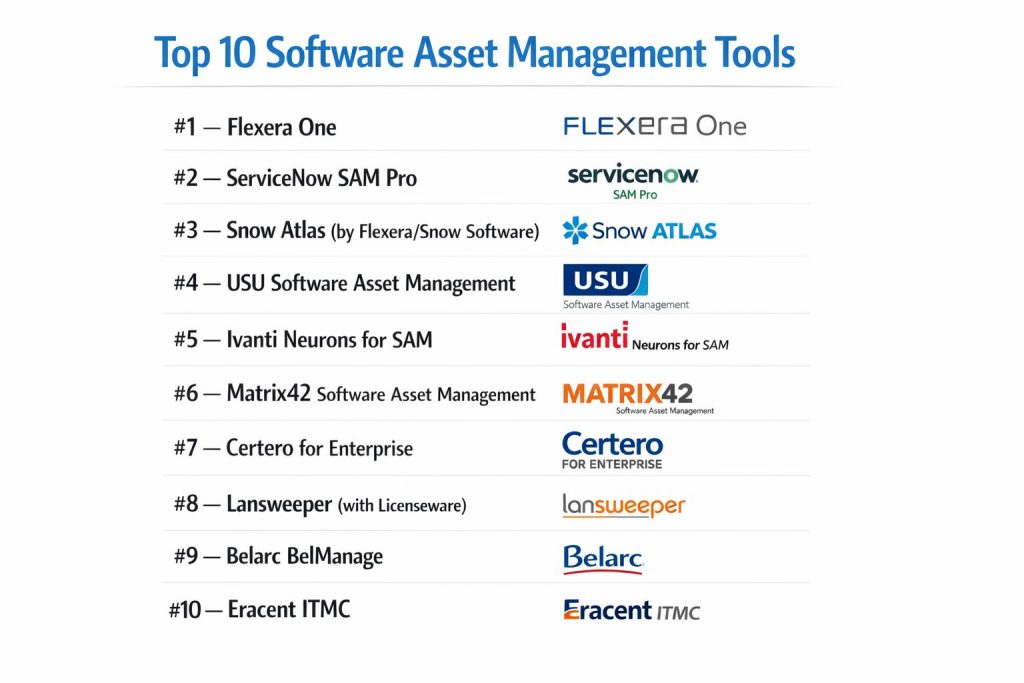
Top 10 Software Asset Management Tools
#1 — Flexera One
Often considered the industry “Gold Standard,” Flexera One is a comprehensive platform that provides deep visibility across on-premise, SaaS, and cloud environments with a focus on spend optimization.
Key Features
- Technopedia Content Library: The world’s largest repository of IT asset data, providing enrichment for millions of software and hardware products.
- Hybrid IT Visibility: Seamlessly tracks software across traditional data centers, public clouds (AWS/Azure/GCP), and containers.
- License Differentiation: High-fidelity engines specifically for complex publishers like Oracle, IBM, and SAP.
- Cloud Cost Optimization: Integrated FinOps capabilities that identify wasted cloud spend alongside software waste.
- SaaS Manager: Advanced API connectors to discover and manage over 30,000 SaaS applications.
- Risk Management: Identifies end-of-life (EOL) and end-of-support (EOS) software to prevent security gaps.
Pros
- Unmatched Recognition: If Flexera’s Technopedia can’t identify the software, it’s likely no other tool can.
- Deep Analytics: Provides highly granular reporting that is ready for executive-level presentations.
Cons
- Cost: One of the most expensive options on the market, usually reserved for large enterprises.
- Complexity: Requires a high level of expertise to configure and manage effectively.
Platforms / Deployment
- Web / Agent / Agentless
- Cloud-native (SaaS)
Security & Compliance
- SOC 2 Type II, ISO 27001, FedRAMP Authorized.
- High-level encryption for data in transit and at rest.
Integrations & Ecosystem
Broad ecosystem including ITSM (ServiceNow), ERP (SAP/Oracle), and public clouds.
- ServiceNow & BMC
- AWS, Azure, Google Cloud
- Okta & Microsoft Entra ID
- Salesforce
Support & Community
Global 24/7 support, dedicated Customer Success Managers (CSMs) for large accounts, and a vast community of certified partners.
#2 — ServiceNow SAM Pro
Built natively on the Now Platform, SAM Pro integrates software management directly into the IT Service Management (ITSM) and CMDB workflow, making it a favorite for organizations already using ServiceNow.
Key Features
- Native CMDB Integration: No data silos; your SAM data lives exactly where your IT service data lives.
- Content Library Normalization: Automatically normalizes software discovery data using a daily-updated global library.
- License Change Management: Triggers software reclamation workflows directly when an employee leaves the company or changes roles.
- SaaS Spend Management: Dedicated dashboards for managing subscriptions and “overlapping” SaaS functionality.
- Publisher Packs: Pre-configured intelligence for high-value vendors like Microsoft, Adobe, and Citrix.
- Predictive Intelligence: AI-powered suggestions for license re-harvesting and rightsizing.
Pros
- Seamless Workflow: Excellent for automating the “Request-to-Retire” lifecycle within a single portal.
- Unified UI: Users don’t have to learn a new interface if they are already familiar with ServiceNow.
Cons
- Platform Lock-in: Only available to ServiceNow customers; cannot be used as a standalone product.
- Resource Intensive: Requires a robust CMDB and consistent data hygiene to be effective.
Platforms / Deployment
- Web / ServiceNow Discovery / Agent Client Collector
- Cloud (PaaS)
Security & Compliance
- NIST, GDPR, SOC 1 & 2.
- Extensive role-based access controls (RBAC).
Integrations & Ecosystem
Leverages the massive ServiceNow “IntegrationHub.”
- Microsoft 365 & Adobe Creative Cloud
- SAP & Oracle
- Slack & Microsoft Teams
- Workday & NetSuite
Support & Community
World-class global support and the largest IT professional community in the world (Now Community).
#3 — Snow Atlas (by Flexera/Snow Software)
Snow Atlas is a cloud-native platform designed to provide a “single pane of glass” for all technology assets. It is renowned for its ease of use and powerful discovery capabilities in global environments.
Key Features
- Unified Discovery: Combines agent-based and agentless scanning to ensure 100% visibility across all networks.
- SaaS Consumption Tracking: Specifically focuses on user “activity” within SaaS apps, not just login status.
- Effective License Position (ELP): Fast, automated generation of compliance reports for the most difficult audits.
- Oracle Management Option: Specialized, Oracle-verified data collection for database and middleware optimization.
- Spend Intelligence: Visualizes historical spending trends to help negotiate better vendor contracts.
- Risk Monitor: Maps software assets against the NIST vulnerability database in real-time.
Pros
- User Experience: Known for a cleaner, more intuitive interface than many legacy competitors.
- Licensing Knowledge: The platform contains deep, embedded logic for thousands of software use rights.
Cons
- Transition Phase: Since being acquired by Flexera, some users are navigating roadmap changes.
- Mobile View: The mobile management interface is less comprehensive than the desktop version.
Platforms / Deployment
- Web / Windows / Mac / Linux / Unix / Mobile
- Cloud-native (SaaS)
Security & Compliance
- ISO 27001, GDPR, SOC 2.
- High-security agent communication protocols.
Integrations & Ecosystem
Strong connectivity with standard enterprise IT stacks.
- Microsoft System Center (SCCM)
- Jamf (for Apple devices)
- VMware & Hyper-V
- ServiceNow & Jira
Support & Community
“Snow Academy” for user training, global support centers, and a dedicated partner network.
#4 — USU Software Asset Management
Formerly known as Aspera, USU is a specialized powerhouse particularly effective for complex, high-stakes license compliance in German-engineering and global enterprise contexts.
Key Features
- Expert Publisher Knowledge: Exceptional depth in “Tier 1” vendors like SAP, Oracle, and Microsoft.
- Optimization Simulation: Allows teams to “test” different licensing scenarios before signing a new contract.
- Master Data Management: A robust system for managing contract details, SKU mapping, and maintenance terms.
- License Inventory Consolidation: Aggregates data from multiple discovery tools into a single, normalized source of truth.
- Cloud-to-On-Prem Logic: Manages hybrid licenses that move between local servers and the cloud.
- Managed Services Support: Built to facilitate “SAM-as-a-Service” for organizations that outsource their SAM program.
Pros
- Precision: Highly regarded for its accuracy in “Audit Defense” scenarios where millions are on the line.
- Transparency: Provides a clear “audit trail” of how every license calculation was made.
Cons
- Learning Curve: The interface can be technical and may require specialized training to master.
- Implementation Time: Typically takes longer to set up than “lighter” cloud-only tools.
Platforms / Deployment
- Web / Win / Mac / Linux
- Cloud / On-Premise / Managed Service
Security & Compliance
- ISO 27001, BSI-certified, GDPR.
- German-engineered security standards.
Integrations & Ecosystem
Connects with most major discovery and financial systems.
- SAP (Deep integration)
- IBM BigFix
- Salesforce
- Flexera & ServiceNow (as a data source)
Support & Community
Detailed technical support, onsite consulting services, and regular user group meetings (USU World).
#5 — Ivanti Neurons for SAM
Part of the Ivanti Neurons “Hyper-Automation” platform, this tool focuses on self-healing and autonomous discovery to reduce manual ITAM workloads.
Key Features
- Autonomous Discovery: AI-powered “bots” that continuously scan for unmanaged assets and new software installs.
- Self-Healing Automation: Automatically resolves licensing discrepancies or uninstalls unauthorized software.
- Unified Endpoint Management (UEM): Strong focus on the security and management of the hardware the software sits on.
- License Optimization Insights: Real-time dashboards showing “spend versus usage” across the entire organization.
- Spend Intelligence: Automatically aggregates spend data from procurement and financial systems.
- Vulnerability Linkage: Directly connects software inventory to security patch management.
Pros
- Automation-First: Ideal for teams looking to “set it and forget it” for basic SAM tasks.
- Modern UI: Features a high-quality dashboarding system that is easy for non-SAM experts to read.
Cons
- Advanced Logic: May not be as deep as Flexera or USU for very specific, niche licensing rules.
- Ecosystem Dependence: Works best when paired with other Ivanti Neurons modules (ITSM/UEM).
Platforms / Deployment
- Web / Win / Mac / iOS / Android
- Cloud-native
Security & Compliance
- SOC 2, FedRAMP (select modules), GDPR.
- Strong identity management integration.
Integrations & Ecosystem
Leverages Ivanti’s broad connectivity.
- Microsoft Intune & SCCM
- CrowdStrike & SentinelOne
- Azure AD / Okta
- ServiceNow
Support & Community
Ivanti Global Support, “Ivanti Innovators” community, and a large global training portal.
#6 — Matrix42 Software Asset Management
A European leader that provides a highly integrated approach to SAM, ITSM, and Unified Endpoint Management (UEM) with a focus on simplicity and compliance.
Key Features
- Integrated Self-Service: Employees can “shop” for software in a portal that automatically checks license availability.
- Compliance Dashboard: Real-time visual indicator of “Under-licensed” vs “Over-licensed” status.
- Contract Management: Detailed tracking of maintenance periods, notice periods, and cost centers.
- Workflow Automation: No-code engine for automating the approval and deployment of software.
- Mobile Asset Management: Excellent capabilities for tracking software on corporate mobile devices.
- SaaS Optimization: Tools for identifying redundant cloud subscriptions and automating cancellations.
Pros
- User-Centric: Focuses heavily on the employee experience and reducing the friction of getting software.
- Quick ROI: Often cited for faster implementation times compared to larger enterprise suites.
Cons
- Market Presence: Smaller footprint in North America compared to Europe.
- Discovery Depth: While strong, may require third-party discovery for very legacy/niche data centers.
Platforms / Deployment
- Web / Win / Mac / iOS / Android
- Cloud / On-Premise
Security & Compliance
- ISO 27001, GDPR compliant (EU-based hosting), SOC 2.
- High emphasis on data sovereignty.
Integrations & Ecosystem
Solid integrations with standard European and global IT tools.
- Microsoft 365
- VMware
- SAP
- Empirum (Native discovery)
Support & Community
Excellent local support in EMEA, comprehensive documentation, and an active user forum.
#7 — Certero for Enterprise
A unified ITAM and SAM platform that emphasizes “one source of truth” without the need for multiple disparate modules or messy integrations.
Key Features
- Architecture Harmony: A single database architecture for hardware, software, SaaS, and cloud management.
- Instant Value Dashboards: Out-of-the-box reporting that identifies savings opportunities on day one.
- Multi-Cloud Management: Tracks software licenses across AWS, Azure, and Google Cloud in a single view.
- Advanced SaaS Discovery: Uses browser extensions and API hooks to find “Shadow SaaS” that other tools miss.
- Oracle Verified: Includes a specialized, verified engine for Oracle GLAS (Global Licensing and Advisory Services).
- Automated Reconciliation: Daily automated matching of inventory against purchased entitlements.
Pros
- Simplicity: One of the few platforms that truly feels like a single, cohesive product rather than a collection of acquisitions.
- High ROI: Users frequently report significant cost recovery within the first 6 months.
Cons
- Brand Awareness: Less “household name” status than Flexera or ServiceNow.
- Customization: While flexible, it may have fewer “third-party plugins” than some larger marketplaces.
Platforms / Deployment
- Web / Win / Mac / Linux / Unix
- Cloud / On-Premise
Security & Compliance
- ISO 27001, Cyber Essentials Plus, GDPR.
- Secure multi-tenant architecture.
Integrations & Ecosystem
Focused on high-impact, native integrations.
- Microsoft 365 & Entra ID
- Salesforce & Adobe
- VMware & Hyper-V
- Jira & ServiceNow
Support & Community
Direct access to technical experts, 24/7 global support, and personalized onboarding.
#8 — Lansweeper (with Licenseware)
Lansweeper is world-renowned for its “agentless discovery.” When paired with Licenseware, it becomes a powerful, modular SAM solution for mid-to-large organizations.
Key Features
- Agentless Discovery: Finds every IP-connected device on the network without installing software on the endpoints.
- NEO AI Assistant: A conversational AI that helps users query their asset data using natural language.
- Modular SAM Apps: Specific “apps” for Microsoft, Oracle, or IBM that can be added as needed.
- Shadow IT Detection: Identifies software installed by users without IT approval.
- OT & IoT Visibility: Extends SAM into Operational Technology and smart devices.
- Dynamic Reporting: High-speed reporting engine that can handle millions of data points.
Pros
- Visibility: Best-in-class at finding “forgotten” servers and rogue devices.
- Affordability: Modular pricing allows companies to pay only for the licensing intelligence they need.
Cons
- Two-Part Solution: Requires both Lansweeper (Discovery) and Licenseware (Logic) for a full SAM experience.
- Cloud Focus: Traditionally stronger on-premise, though cloud capabilities are rapidly expanding.
Platforms / Deployment
- Web / Windows / Linux (Agentless)
- Cloud / On-Premise
Security & Compliance
- SOC 2 Type II, ISO 27001, GDPR.
- No storage of user credentials; uses secure scanning technologies.
Integrations & Ecosystem
Open API with massive connectivity potential.
- Power BI & Tableau
- ServiceNow & Zendesk
- Freshservice
- Azure & AWS
Support & Community
Massive user community, extensive knowledge base, and 24/5 global support.
#9 — Belarc BelManage
A security-first SAM tool that is widely used by government and high-security sectors for its “small footprint” and high-accuracy data reporting.
Key Features
- Security Configuration Monitoring: Tracks if software is configured correctly according to NIST or CIS benchmarks.
- Small Data Footprint: Minimal impact on network bandwidth during discovery scans.
- Intranet Architecture: Can run entirely inside a “dark site” or air-gapped network for maximum security.
- Automated CMDB: Creates an up-to-date repository of software, hardware, and security settings.
- FISMA Compliance: Specifically built to meet the needs of US Government and highly regulated industries.
- SaaS Usage Tracking: Basic but effective tracking of web-based application usage.
Pros
- Security Focus: Best for organizations where SAM and Cybersecurity are managed by the same team.
- Stability: Known for being an extremely stable platform with very low maintenance requirements.
Cons
- Interface: UI feels more “classic” and less “modern” than platforms like ClickUp or Snow.
- SaaS Depth: Less advanced for complex SaaS optimization compared to Flexera or Certero.
Platforms / Deployment
- Win / Mac / Linux / Solaris
- On-Premise / SaaS / Hosted
Security & Compliance
- FISMA, HIPAA, GDPR, NIST.
- Supports PKI/CAC authentication.
Integrations & Ecosystem
Strong focus on IT Ops and security tools.
- Microsoft 365
- Active Directory
- SQL Server
- Internal ERP systems via API
Support & Community
Exceptional technical support, direct access to developers, and specialized government-sector expertise.
#10 — Eracent ITMC
A comprehensive IT Management Center (ITMC) that offers deep lifecycle management, focusing on the “full truth” of an asset from planning to disposal.
Key Features
- Continuous License Reconciliation (CLR): Real-time monitoring of license positions rather than monthly snapshots.
- Authorized Product Catalog: A “Master Library” of what is allowed to be installed in the company.
- App-V & Citrix Tracking: Specialized tracking for virtualized and streamed applications.
- Financial Transaction Tracking: Directly links POs (Purchase Orders) and contracts to physical assets.
- Data Center Optimization: Advanced logic for calculating virtual machine (VM) and host dependencies.
- Usage Discovery: Tracks not just if an app is open, but if it is actively receiving keyboard/mouse input.
Pros
- Granularity: Provides a level of detail that is often necessary for high-stakes vendor negotiations.
- Flexibility: Can be configured to track almost any asset type, including non-IT assets.
Cons
- Complexity: Not for the faint of heart; requires a dedicated SAM team to fully utilize.
- Setup Effort: Significant initial configuration is required to align with company procurement processes.
Platforms / Deployment
- Web / Win / Mac / Linux / Unix
- Cloud / On-Premise
Security & Compliance
- SOC 2, ISO 27001, GDPR.
- Robust audit logs for every asset change.
Integrations & Ecosystem
Built for the complex enterprise ecosystem.
- IBM BigFix & SCCM
- Salesforce
- SAP & Oracle Financials
- ServiceNow
Support & Community
Standard enterprise support, professional services for implementation, and regular technical webinars.
Comparison Table (Top 10)
| Tool Name | Best For | Platform(s) Supported | Deployment | Standout Feature | Public Rating |
| Flexera One | Total Spend Optimization | Web, Win, Mac, Linux | Cloud-native | Technopedia Library | 4.6 / 5 |
| ServiceNow SAM Pro | Platform Integration | Web, Win, Mac | Cloud (PaaS) | Native CMDB Link | 4.5 / 5 |
| Snow Atlas | Unified Visibility | Web, Win, Mac, Linux | Cloud-native | Intuitive UX | 4.4 / 5 |
| USU SAM | Tier 1 Audit Defense | Web, Win, Mac, Linux | Hybrid | Oracle/SAP Specialist | 4.5 / 5 |
| Ivanti Neurons | Hyper-Automation | Web, Win, Mac, Mobile | Cloud-native | Autonomous AI Bots | 4.2 / 5 |
| Matrix42 | European Enterprise | Web, Win, Mac, Mobile | Hybrid | Employee Self-Service | 4.3 / 5 |
| Certero for Enterprise | Mid-Market Value | Web, Win, Mac, Linux | Hybrid | Single-Source Architecture | 4.6 / 5 |
| Lansweeper | Network Discovery | Web, Win, Linux | Hybrid | Agentless Scanning | 4.7 / 5 |
| Belarc BelManage | Security/Gov Sector | Win, Mac, Linux, Solaris | On-Prem/Cloud | NIST/FISMA Security | 4.3 / 5 |
| Eracent ITMC | Lifecycle Detail | Web, Win, Mac, Linux | Hybrid | Continuous Reconciliation | 4.1 / 5 |
Evaluation & Scoring of Software Asset Management Tools
Our scoring model weights the critical pillars of a 2026 SAM program.
| Tool Name | Core (25%) | Ease (15%) | Int. (15%) | Sec. (10%) | Perf. (10%) | Supp. (10%) | Value (15%) | Weighted Total |
| Flexera One | 10 | 6 | 9 | 10 | 10 | 9 | 7 | 8.85 |
| ServiceNow SAM Pro | 9 | 8 | 10 | 10 | 9 | 9 | 7 | 8.85 |
| Snow Atlas | 9 | 9 | 8 | 9 | 9 | 8 | 8 | 8.65 |
| USU SAM | 10 | 5 | 8 | 10 | 10 | 9 | 7 | 8.40 |
| Ivanti Neurons | 8 | 9 | 8 | 9 | 9 | 8 | 9 | 8.45 |
| Matrix42 | 8 | 9 | 8 | 9 | 8 | 9 | 9 | 8.50 |
| Certero for Enterprise | 9 | 9 | 8 | 9 | 9 | 9 | 10 | 8.90 |
| Lansweeper | 8 | 10 | 9 | 9 | 10 | 8 | 10 | 8.95 |
| Belarc BelManage | 8 | 8 | 7 | 10 | 10 | 10 | 8 | 8.40 |
| Eracent ITMC | 10 | 4 | 8 | 9 | 9 | 8 | 7 | 7.95 |
How to interpret these scores:
- Core (25%): Represents the depth of the license reconciliation engine and normalization library.
- Value (15%): A high score here indicates a faster path to cost recovery and ROI.
- Total: Scores above 8.5 are highly recommended for complex environments.
Which Software Asset Management Tool Is Right for You?
Global Multi-National
For organizations with offices in 20+ countries and complex “All-You-Can-Eat” enterprise agreements, Flexera One or ServiceNow SAM Pro are the primary candidates. They provide the global governance and massive data processing power required to manage billions in software spend.
High-Security / Government
If you operate in the defense, healthcare, or financial sectors, Belarc BelManage is often the first choice due to its focus on security configurations and its ability to run in air-gapped environments.
Mid-Market (500–5,000 Employees)
Certero for Enterprise and Matrix42 offer the best balance. They provide enterprise-grade power without the extreme configuration complexity or the astronomical price tags of the “Big Four” providers.
IT Discovery Focus
If your biggest problem is “We don’t know what’s out there,” start with Lansweeper. Its ability to find every rogue device and unmanaged server is unparalleled. You can always layer on a dedicated license logic tool like Licenseware later.
Pure SaaS Organizations
If your company has zero on-premise servers and is 100% cloud-native, you may want to look specifically at the SaaS Management modules within Snow Atlas or Flexera, or specialized SaaS-only players (though the unified tools listed above are increasingly dominant).
Budget-Conscious
ClickUp (for task management) isn’t a SAM tool, but if your budget is tight, starting with a modular approach like Lansweeper or the “SaaS-only” tiers of larger platforms can save significant upfront costs.
Frequently Asked Questions (FAQs)
What is the difference between ITAM and SAM?
ITAM (IT Asset Management) is the “umbrella” term covering all IT assets (hardware, software, cloud). SAM (Software Asset Management) is a specialized subset focusing exclusively on the licensing, compliance, and optimization of software code and cloud-based services.
Can SAM tools actually stop a vendor audit?
No tool can “stop” an audit, but a good SAM tool makes an audit a non-event. If you have a real-time, accurate Effective License Position (ELP), you can often shut down an audit in days rather than months by proving compliance immediately.
What is “Shadow IT” and why does it matter?
Shadow IT refers to software or cloud services purchased by employees or departments without the knowledge of the IT team. SAM tools help discover these, preventing security risks and redundant spending on the same tools (e.g., having 5 different departments with 5 separate Slack accounts).
How does AI improve Software Asset Management?
AI now handles the “normalization” process automatically, identifying software with 99% accuracy. It also acts as a “Predictive FinOps” agent, suggesting exactly which licenses to downgrade or cancel based on actual user behavior.
Do SAM tools require agents to be installed on every computer?
Not necessarily. Most modern tools (like Lansweeper or Flexera) offer both agent-based and agentless discovery. Agents provide deeper data on usage, while agentless scanning is faster for finding unknown hardware on the network.
Will a SAM tool help with my AWS/Azure costs?
Yes. SAM tools have integrated FinOps capabilities. They help you identify “zombie” VMs and ensure you are applying your on-premise licenses to the cloud (Bring Your Own License – BYOL) to save up to 40% on cloud costs.
How long does it take to see ROI from a SAM tool?
Most organizations see an ROI within 6 to 12 months. Immediate savings usually come from identifying unused “Pro” or “Enterprise” licenses and downgrading users to cheaper versions.
What is a “Software Recognition Library”?
It is a proprietary database managed by the SAM vendor that contains millions of entries. It translates a raw computer file (like “winword.exe”) into a readable product name (“Microsoft Word 2021, Professional Edition”).
Is manual spreadsheet tracking still viable?
Only for very small teams (under 50). Once you have a complex mix of SaaS subscriptions and remote workers, manual tracking is impossible to keep accurate, leading to massive financial risks during audits.
What is “License Harvesting”?
Harvesting is the process of identifying software that is installed but not being used, “uninstalling” it (digitally), and putting that license back into a “pool” to be given to someone else who actually needs it.
Conclusion
Choosing a Software Asset Management tool is a strategic decision that bridges the gap between IT operations, financial governance, and cybersecurity. For those already in the ServiceNow ecosystem, ServiceNow SAM Pro is the logical path. For those needing the absolute highest precision and “best-of-breed” analytics, Flexera One and Snow Atlas remain the industry titans.
The true value of these platforms lies in their ability to turn “dark data” into actionable financial insights. By centralizing your software estate, you not only protect yourself from predatory audits but also unlock millions in reclaimed budget that can be reinvested into innovation.