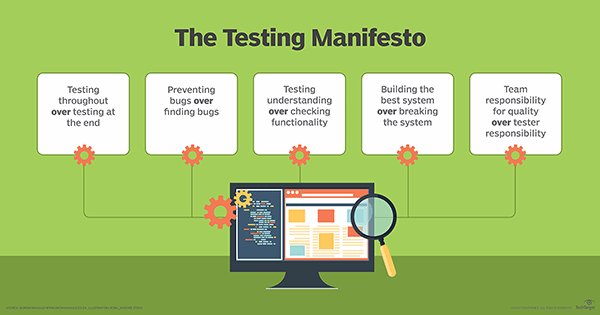
To reap the full benefits of DevOps — quicker releases of high-quality software — successful organizations must introduce continuous testing throughout their entire software delivery process. Testing can no longer exist as an isolated phase bolted onto the end of a development cycle. It must be woven into every stage, from the first commit to production deployment.
Continuous integration (CI) and continuous delivery (CD) often force this realization. These practices serve as the foundation for a mature DevOps approach, but they only deliver their full value when paired with a robust, automated testing strategy. What many IT leaders underestimate, however, is that adopting continuous testing requires significant cultural and process changes — not just new tooling.
Testing Must Happen at Every Stage of Development
The most important principle of continuous testing is straightforward: automated tests must run throughout the development process, not only after a feature is complete. There is real, measurable value in testing as you build rather than after the fact.
When a DevOps team tests code at each stage of the pipeline, issues surface while the relevant changes are still fresh in the developer’s mind. This tight feedback loop does two things simultaneously:
- Increases release velocity — defects caught early are cheaper and faster to fix than those discovered late in the cycle or, worse, in production.
- Improves software quality — incremental validation means problems never accumulate into a large, hard-to-diagnose backlog.
From a business perspective, continuous testing translates directly into faster delivery of high-quality features, which drives customer satisfaction and competitive advantage.
What Continuous Testing Actually Looks Like
A common misconception is that continuous testing means running every test against every change, around the clock. In practice, effective continuous testing means having the right test at the right stage of the pipeline — optimising for both speed and thoroughness.
Early-Stage: Smoke Tests
Early in the pipeline — typically triggered on every commit or pull request — teams should run a smaller, focused set of tests commonly called smoke tests. These tests serve several purposes:
- Catch major bugs and regressions before they propagate downstream.
- Verify that core functionality works as expected across a representative set of platforms.
- Execute quickly so they do not disrupt developer productivity or slow the CI loop.
For mobile application development, a practical best practice is to run smoke tests against iOS simulators and Android emulators rather than physical devices. This approach speeds execution time and reduces infrastructure cost while still providing meaningful early feedback.
Later-Stage: Full Regression Tests
Later in the pipeline — for example, before a release candidate is promoted to a staging or production environment — teams should run a comprehensive regression test suite. These tests are run less frequently than smoke tests and are designed to:
- Provide full regression coverage across the application’s feature set.
- Validate compatibility across a wide range of browsers, operating system versions, and real physical devices (for mobile).
- Ensure the end-user experience meets quality standards before release.
This two-tier approach — lightweight smoke tests early, comprehensive regression tests later — lets organisations move fast without sacrificing quality, and without incurring the cost of running a full test suite on every single commit.
Development Culture Must Evolve
Tooling changes alone will not make continuous testing succeed. The biggest obstacle is cultural. Many developers operate under the assumption that testing is the exclusive responsibility of a separate QA team. This silo mentality directly undermines any attempt to shift testing left and integrate it into the development workflow.
Breaking down this barrier requires a team-wide commitment to quality. In practice, that means:
- Developers learn to write testable code. Simple practices — such as consistently assigning unique identifiers to UI elements and objects — make test authoring and maintenance significantly easier for automation frameworks.
- Teams adopt test-first methodologies. Approaches like Test-Driven Development (TDD) and Behavior-Driven Development (BDD) require teams to write tests before writing application code. This fundamentally changes how requirements are understood and how code is designed.
- Ownership of quality is shared. In mature DevOps organisations, developers often write all or most of the automated tests, rather than delegating that responsibility entirely to QA engineers.
None of these changes happen overnight. They require investment in training, process redesign, and sustained leadership support. But teams that make the shift consistently report faster release cycles and fewer production incidents.
Looking Forward
The benefits of continuous testing — reduced defect rates, faster feedback, higher release velocity, and improved customer satisfaction — are well established in the DevOps community. However, realising those benefits demands that both developers and QA professionals fundamentally rethink their roles and their relationship to automated testing.
This transformation is neither quick nor easy. It requires dismantling long-standing organisational silos, adopting new development methodologies, and investing in automation infrastructure. But organisations that commit to it gain a compounding advantage: every improvement to the testing pipeline makes the next release faster and safer than the last.
For teams just beginning this journey, the most important first step is simply to start — pick one stage of your pipeline, automate one set of tests, and build from there. Continuous testing, like DevOps itself, is an iterative practice.
This article is based on concepts originally published on TechTarget.com. The image above is attributed to GrowingAgile.