Introduction
GraphQL tooling refers to the ecosystem of software and libraries designed to manage, optimize, and secure GraphQL APIs across their entire lifecycle. While GraphQL itself is a query language, the “tooling” provides the necessary infrastructure—such as schema design, automated code generation, real-time monitoring, and security gateways—to make development efficient and scalable.
In the current landscape, GraphQL has matured from a specialized technology into a standard for high-performance web and mobile applications. As systems grow more complex, these tools are essential for preventing “N+1” performance issues, ensuring end-to-end type safety, and managing distributed data graphs across multiple microservices.
Real-world use cases include:
- Federated Microservices: Unifying multiple backend services into a single, seamless data graph for front-end consumption.
- Rapid Prototyping: Instantly generating APIs from database schemas to speed up the development of MVP (Minimum Viable Product) features.
- Legacy Modernization: Wrapping older REST APIs with a GraphQL layer to provide a modern developer experience without rewriting backends.
- AI-Driven Data Fetching: Feeding structured, real-time data to AI agents and LLMs using specialized GraphQL connectors.
What buyers should evaluate:
- Schema Governance: Does the tool help enforce naming conventions and prevent breaking changes?
- Performance Overhead: How much latency does the tool add to the request-response cycle?
- Type Safety: Does it support automatic generation of TypeScript or other language types?
- Observability: Can you track which fields are being used and monitor query performance?
- Security Features: Does it include query depth limiting, cost analysis, and RBAC (Role-Based Access Control)?
- Integration Ecosystem: Does it work with your existing databases and cloud providers?
- Community & Support: Is there a large enough user base to provide tutorials and community support?
- Scalability: Can it handle high-traffic production environments with millions of requests?
Best for: Full-stack developers, API architects, and DevOps engineers managing complex data relationships in growing organizations.
Not ideal for: Simple applications with flat data structures or teams that are perfectly satisfied with their current REST implementation.
Key Trends in GraphQL Tooling
- AI-Powered Schema Design: Tools are now using LLMs to suggest optimal schema structures and automatically generate resolvers based on natural language descriptions.
- Native Federation V2 Support: Most enterprise tools have standardized on Apollo Federation V2 for building distributed “supergraphs” that scale across large teams.
- Real-time Subscriptions via SSE: A shift away from complex WebSockets toward Server-Sent Events (SSE) for lighter, more browser-friendly real-time updates.
- Zero-Config Data Graphs: The rise of “instant” GraphQL engines that connect directly to databases and auto-generate the entire API layer.
- Type-Safe RPC Convergence: A blending of GraphQL’s flexibility with the extreme type safety of tools like tRPC for internal developer-facing APIs.
- Edge-Native GraphQL: Deploying GraphQL gateways directly at the edge (CDN level) to cache and serve data closer to the end user.
- Machine-to-Machine Security: Enhanced standards for securing GraphQL APIs when they are consumed by AI agents rather than human-driven front-ends.
- GitOps for Schemas: Managing schema changes as code through CI/CD pipelines with automated linting and breaking-change detection.
How We Selected These Tools (Methodology)
Our selection process for the top 10 GraphQL tools focused on technical reliability and industry mindshare:
- Production Reliability: We chose tools known for high uptime and stability in enterprise environments.
- Developer Experience (DX): Priority was given to tools that reduce boilerplate and speed up the “time to first query.”
- Ecosystem Compatibility: We looked for tools that support major frameworks like React, Next.js, and Node.js.
- Security Posture: Selected tools must offer built-in protections against common GraphQL vulnerabilities.
- Community Engagement: We prioritized tools with active GitHub repositories and extensive documentation.
- Future-Proofing: Each tool was evaluated for its alignment with modern trends like Federation and AI integration.
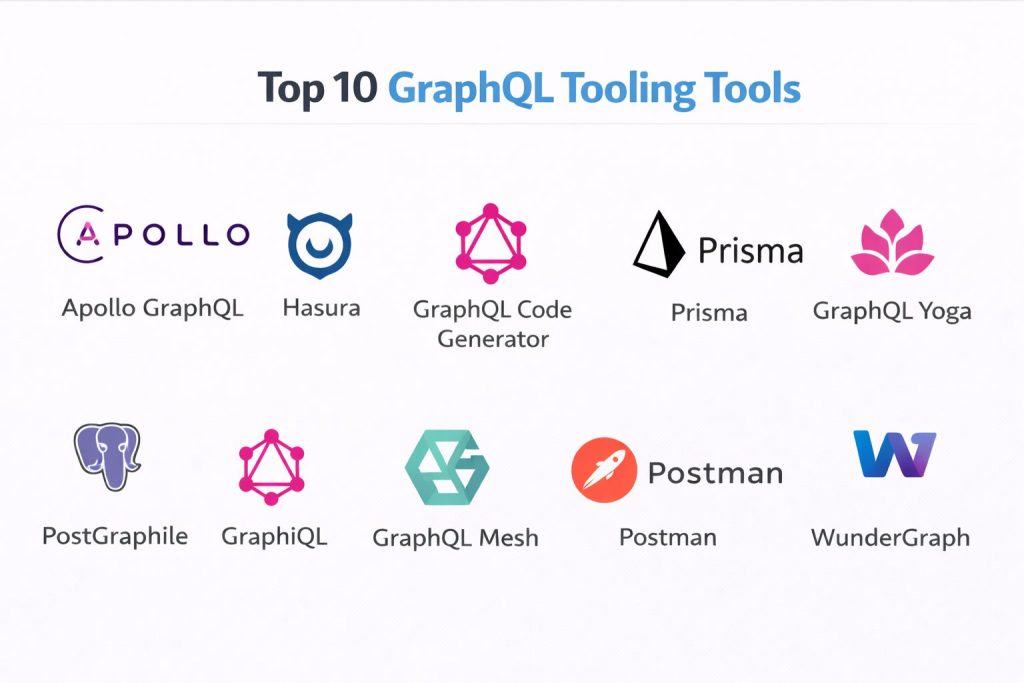
Top 10 GraphQL Tooling Tools
#1 — Apollo GraphQL
The industry-leading platform for building, securing, and managing a unified data graph. It is the gold standard for enterprise federation.
Key Features
- Apollo Federation: Connects multiple subgraphs into a single, unified “supergraph.”
- Apollo Client: A sophisticated state-management library that handles caching and data fetching automatically.
- GraphOS Studio: A centralized dashboard for schema delivery, monitoring, and field-level analytics.
- Schema Checks: Automatically detects breaking changes before they reach production.
- Subscription Support: Robust handling of real-time data updates via WebSockets or SSE.
Pros
- Most comprehensive ecosystem with the best documentation in the industry.
- Powerful observability tools that show exactly how your data is being used.
Cons
- Enterprise features can become very expensive as traffic grows.
- Can be overly complex for small, single-server projects.
Platforms / Deployment
- Web / Windows / macOS / Linux
- Cloud / Hybrid
Security & Compliance
- SSO/SAML, MFA, RBAC
- SOC 2 Type II, ISO 27001, GDPR
Integrations & Ecosystem
Apollo is designed to be the central hub of an API strategy.
- React / Next.js
- AWS / Azure / GCP
- GitHub (for CI/CD checks)
- Datadog (for monitoring)
Support & Community
Unmatched support. Between Apollo Odyssey (learning platform) and a massive Discord community, help is always available.
#2 — Hasura
An instant GraphQL engine that connects to your databases and provides a high-performance API without writing custom resolvers.
Key Features
- Instant CRUD: Automatically generates queries, mutations, and subscriptions from your DB schema.
- Role-Based Access Control: Granular security policies defined at the metadata level.
- Remote Schemas: Stitches external GraphQL APIs into your local graph.
- Actions: Allows you to extend Hasura with custom logic via REST webhooks.
- Event Triggers: Automatically triggers logic in response to database changes.
Pros
- Drastically reduces backend development time by automating the “boring” parts of API building.
- Extremely high performance with a small memory footprint.
Cons
- Highly coupled to the database structure; complex logic requires external “Actions.”
- Limited flexibility for highly custom, non-database-driven APIs.
Platforms / Deployment
- Windows / macOS / Linux (via Docker)
- Cloud / Self-hosted
Security & Compliance
- SSO, JWT-based Auth, Allow-listing
- HIPAA, SOC 2, GDPR compliant
Integrations & Ecosystem
- PostgreSQL / SQL Server / MySQL
- BigQuery / Snowflake
- AWS Lambda / Google Cloud Functions
Support & Community
Excellent documentation and a very active Discord community. Enterprise support tiers offer dedicated success managers.
#3 — GraphQL Code Generator
A must-have tool for TypeScript users that automatically generates types and hooks from your GraphQL schema and operations.
Key Features
- Type Safety: Ensures your front-end code always matches your backend schema.
- Plugin-Based: Supports a wide range of output formats (TypeScript, Flow, Java, etc.).
- React/Apollo Hooks: Automatically creates ready-to-use hooks like
useUserQuery. - Introspection Support: Can generate code by scanning a live GraphQL endpoint.
- CI/CD Integration: Can be run as a build step to prevent type-mismatch errors.
Pros
- Eliminates the need to manually write interfaces and types, saving hours of work.
- Keeps the entire stack in sync, significantly reducing runtime bugs.
Cons
- Requires a build step; code can occasionally become out of sync if not automated.
- Can generate a large amount of code in very large schemas.
Platforms / Deployment
- Windows / macOS / Linux (Node.js utility)
- Self-hosted (Build tool)
Security & Compliance
- Varies / N/A (Client-side build tool)
Integrations & Ecosystem
- React / Vue / Angular / Svelte
- Apollo Client / Urql / Relay
- Next.js
Support & Community
Maintained by The Guild, it has a massive open-source following and extremely fast update cycles.
#4 — Prisma
A next-generation ORM that makes database access easy and type-safe, often used as the foundation for GraphQL servers.
Key Features
- Prisma Schema: A clean, human-readable language to define your data model.
- Auto-Generated Client: Provides a type-safe API for CRUD operations in your resolvers.
- Migrations: Robust system for managing database changes safely.
- Studio: A visual editor to explore and edit your database data.
- Deep Integration: Works perfectly with Apollo Server or GraphQL Yoga.
Pros
- The best developer experience for interacting with databases in Node.js.
- Prevents “N+1” problems through efficient query batching out of the box.
Cons
- Adds an abstraction layer that can be tricky to debug for very complex SQL queries.
- Not a “direct” GraphQL tool; you still need to map Prisma to your GraphQL schema.
Platforms / Deployment
- Windows / macOS / Linux
- Cloud / Self-hosted
Security & Compliance
- Not publicly stated (Database-level security depends on the host)
Integrations & Ecosystem
- PostgreSQL / MySQL / SQLite / MongoDB
- Next.js / NestJS
- Fastify
Support & Community
Excellent documentation and a massive community. Their blog is a top-tier resource for backend engineering.
#5 — GraphQL Yoga
A lightweight, fully-featured GraphQL server that focuses on simplicity and standard compliance.
Key Features
- Envelop Plugins: Access to a massive library of plugins for auth, logging, and more.
- Platform Agnostic: Runs on Node.js, Deno, Bun, and even edge workers.
- Built-in SSE: Native support for Server-Sent Events for real-time subscriptions.
- Type-Safe: Excellent TypeScript support out of the box.
- Fastify/Express Compatible: Can be used as a standalone server or a middleware.
Pros
- Extremely fast and unopinionated; you only add what you need.
- Perfectly compliant with the latest GraphQL specifications.
Cons
- Lacks the “all-in-one” management features of Apollo.
- Requires more manual setup for complex enterprise needs like federation.
Platforms / Deployment
- Windows / macOS / Linux
- Cloud / Self-hosted / Edge
Security & Compliance
- Supports all standard auth patterns via plugins.
Integrations & Ecosystem
- Envelop (Plugin system)
- Next.js
- AWS Lambda
Support & Community
Maintained by The Guild, providing high-quality open-source support and frequent updates.
#6 — PostGraphile
Instantly generates a high-performance GraphQL API directly from your PostgreSQL schema.
Key Features
- Reflection Engine: Scans your DB and creates a schema including tables, views, and functions.
- Performance: Uses SQL aggregation to solve the N+1 problem at the database level.
- Smart Comments: Allows you to customize the GraphQL schema by adding comments to your SQL.
- RBAC: Leverages PostgreSQL’s native security and roles.
- Extensible: Support for custom plugins to add business logic.
Pros
- One of the fastest ways to build a production-ready GraphQL API.
- Keeps the “source of truth” in your database schema.
Cons
- Highly coupled to PostgreSQL; difficult to move if you switch databases.
- The “smart comments” workflow can feel strange to developers used to code-first.
Platforms / Deployment
- Windows / macOS / Linux
- Self-hosted
Security & Compliance
- Leverages enterprise-grade Postgres security and Row-Level Security (RLS).
Integrations & Ecosystem
- PostgreSQL (Strict requirement)
- Graphile Worker (for background tasks)
Support & Community
A dedicated niche community. Offers a “Pro” version for commercial support and advanced features.
#7 — GraphiQL
The “reference implementation” of the GraphQL IDE. It is the default tool for exploring and testing queries.
Key Features
- Interactive Editor: Features auto-complete, linting, and error highlighting.
- Documentation Explorer: Automatically generates docs by introspecting the schema.
- History: Keeps track of previous queries for easy re-running.
- Variables & Headers: Support for testing authenticated requests.
- Plugin System: Can be extended with custom UI components.
Pros
- Extremely lightweight and universally supported by almost every GraphQL server.
- The standard tool for learning and debugging GraphQL.
Cons
- Lacks the advanced “studio” features like performance monitoring or team collaboration.
- Design can feel basic compared to modern alternatives like Apollo Explorer.
Platforms / Deployment
- Web / Embedded in servers
- Varies
Security & Compliance
- N/A (Local/Development tool)
Integrations & Ecosystem
- Used as a default by Apollo, Yoga, Hasura, and more.
Support & Community
Maintained by the GraphQL Foundation; it is the industry standard for open-source API exploration.
#8 — GraphQL Mesh
A powerful tool that allows you to treat non-GraphQL sources (REST, gRPC, DBs) as if they were a unified GraphQL API.
Key Features
- Handler System: Connects to REST, SOAP, gRPC, and SQL sources.
- Unified Schema: Merges diverse sources into one cohesive graph.
- Declarative: Configuration is done via a YAML file rather than complex code.
- SDK Generation: Can generate a type-safe SDK for your entire merged graph.
- Mocking: Built-in support for mocking data for testing.
Pros
- Ideal for companies with a mix of legacy and modern APIs.
- Allows frontend teams to use GraphQL even if the backend is still REST.
Cons
- Adds a layer of complexity; debugging cross-source joins can be difficult.
- Performance depends heavily on the speed of the underlying sources.
Platforms / Deployment
- Windows / macOS / Linux
- Self-hosted / Hybrid
Security & Compliance
- Supports headers/JWT propagation to underlying sources.
Integrations & Ecosystem
- OpenAPI (Swagger)
- gRPC / Protobuf
- SQLite / Postgres / MySQL
Support & Community
Another strong tool from The Guild ecosystem with great technical documentation.
#9 — Postman
The world’s most popular API platform, which now features deep, dedicated support for the GraphQL lifecycle.
Key Features
- GraphQL Client: Full auto-complete and schema exploration for GraphQL endpoints.
- Test Automation: Write scripts to validate GraphQL responses in your CI/CD pipeline.
- Mock Servers: Create mock GraphQL APIs to unblock frontend teams.
- API Governance: Linting and security checks for your GraphQL schemas.
- Collaboration: Shared workspaces for teams to save and sync queries.
Pros
- Every developer already knows how to use it, making onboarding instant.
- Excellent for managing the “Full Lifecycle” of an API, not just the code.
Cons
- Not a specialized GraphQL tool; some advanced features (like federation mapping) are better in Apollo.
- The desktop app can be resource-heavy.
Platforms / Deployment
- Windows / macOS / Linux / Web
- Cloud (SaaS)
Security & Compliance
- SSO/SAML, SCIM, RBAC
- SOC 2, HIPAA, GDPR
Integrations & Ecosystem
- GitHub / GitLab / Bitbucket
- Jira / Slack
- Datadog
Support & Community
Massive. Professional support for enterprise customers and one of the largest API communities on earth.
#10 — WunderGraph
A “GraphQL-first” framework that focuses on turning GraphQL operations into secure, high-performance JSON-over-HTTP endpoints.
Key Features
- Operation-to-JSON: Automatically exposes your GraphQL queries as standard REST-like endpoints for security.
- Composition: Effortlessly joins multiple APIs (GraphQL, REST, etc.) into one.
- Zero-Trust Architecture: Designed to be secure by default without manual boilerplate.
- S3 Integration: Handles file uploads and management within the GraphQL workflow.
- AI Integration: Specialized tools for connecting LLMs to your data graph.
Pros
- Combines the flexibility of GraphQL with the security and caching benefits of REST.
- Extremely modern architecture designed for the 2026+ cloud-native era.
Cons
- Newer player in the market; community is smaller than Apollo or Hasura.
- Requires a mindset shift in how you “expose” your API.
Platforms / Deployment
- Windows / macOS / Linux
- Cloud / Self-hosted
Security & Compliance
- SOC 2 Type II, GDPR, OIDC/OAuth2 support
Integrations & Ecosystem
- S3 / PostgreSQL / MySQL
- Apollo Federation
- Next.js / Nuxt.js
Support & Community
Fast-growing community and high-quality technical blog posts. Their Discord is very responsive.
Comparison Table (Top 10)
| Tool Name | Best For | Platform(s) Supported | Deployment | Standout Feature | Public Rating |
| Apollo GraphQL | Large Enterprises | Win, Mac, Linux, Web | Cloud/Hybrid | Federation V2 | 4.8/5 |
| Hasura | Data-driven Apps | Win, Mac, Linux | Cloud/Self | Instant CRUD API | 4.7/5 |
| Code Generator | TypeScript Teams | Win, Mac, Linux | Self-hosted | Automated Type Safety | 4.9/5 |
| Prisma | Database Access | Win, Mac, Linux | Cloud/Self | Type-safe ORM | 4.8/5 |
| GraphQL Yoga | Lightweight Servers | Win, Mac, Linux | Edge/Self | Envelop Plugin System | 4.6/5 |
| PostGraphile | PostgreSQL Users | Win, Mac, Linux | Self-hosted | SQL-based Speed | 4.4/5 |
| GraphiQL | API Exploration | Web | Embedded | Reference IDE | 4.7/5 |
| GraphQL Mesh | Legacy Integration | Win, Mac, Linux | Self-hosted | REST-to-GraphQL | 4.5/5 |
| Postman | API Lifecycle | Win, Mac, Linux, Web | Cloud | Team Collaboration | 4.6/5 |
| WunderGraph | Secure Cloud Apps | Win, Mac, Linux | Cloud/Self | GraphQL-to-JSON | 4.5/5 |
Evaluation & Scoring of GraphQL Tooling
We have scored these tools based on the key pillars required for high-performance API development.
| Tool Name | Core (25%) | Ease (15%) | Integrations (15%) | Security (10%) | Performance (10%) | Support (10%) | Value (15%) | Weighted Total |
| Apollo | 10 | 6 | 10 | 9 | 8 | 10 | 6 | 8.3 |
| Hasura | 9 | 10 | 8 | 9 | 10 | 8 | 7 | 8.6 |
| Code Gen | 8 | 8 | 9 | 5 | 10 | 9 | 10 | 8.3 |
| Prisma | 9 | 9 | 8 | 6 | 9 | 9 | 8 | 8.4 |
| Yoga | 8 | 8 | 9 | 7 | 9 | 8 | 8 | 8.1 |
| WunderGraph | 8 | 7 | 8 | 10 | 9 | 7 | 8 | 7.9 |
| Postman | 7 | 9 | 10 | 8 | 7 | 9 | 7 | 8.0 |
| Mesh | 8 | 5 | 10 | 7 | 7 | 7 | 8 | 7.4 |
| PostGraphile | 7 | 8 | 6 | 8 | 10 | 7 | 9 | 7.8 |
| GraphiQL | 5 | 10 | 7 | 4 | 9 | 8 | 10 | 7.2 |
How to interpret the scores:
- 8.0 – 10.0: Industry leaders. These provide complete, end-to-end solutions for professional teams.
- 7.0 – 7.9: Excellent specialized tools. These are often the “best in class” for a specific task but may not be a complete platform.
- Weighted Total: This score reflects the overall ROI for a standard development team.
Which GraphQL Tooling Tool Is Right for You?
Solo / Freelancer
If you are a solo developer, Hasura or GraphQL Yoga are your best bets. Hasura gets you to market faster by automating the backend, while Yoga gives you a simple, lightweight server without any enterprise “bloat.”
SMB
For small to medium teams, Prisma combined with GraphQL Code Generator is the ultimate combination. This pairing ensures that your database and your frontend types are always in sync, which prevents the most common bugs in rapid development.
Mid-Market
Growing companies should look into Apollo GraphOS (Self-Service) or WunderGraph. These tools provide the governance and monitoring you need as you start to split your monolithic API into smaller, team-owned services.
Enterprise
For large organizations, Apollo Federation is a non-negotiable requirement. It is the only ecosystem with the depth of security, observability, and team-based workflows required to manage a data graph across hundreds of engineers.
Budget vs Premium
- Budget: Blender, GraphQL Code Generator, and GraphQL Yoga are all free/open-source.
- Premium: Apollo and Hasura Cloud can become significant investments for high-traffic apps.
Feature Depth vs Ease of Use
If you want “Power,” go with Houdini style procedurality in GraphQL Mesh. If you want “Easy,” Postman or GraphiQL provide the most intuitive entry point into the ecosystem.
Integrations & Scalability
Apollo and Hasura lead the pack here. They are designed to sit in front of massive, distributed architectures and scale horizontally as your traffic grows.
Security & Compliance Needs
If you work in finance or healthcare, Apollo and Postman offer the strongest enterprise security certifications (SOC 2, HIPAA) and audit trails to keep your data compliant.
Why Choose DevOpsSchool?
In the rapidly evolving world of API design and DevOps, staying ahead of the curve is no longer optional—it is a necessity. DevOpsSchool has cemented its position as a premier global platform for mastering the skills that power modern digital transformation.
Our GraphQL and DevSecOps training programs are meticulously crafted to bridge the gap between classroom theory and real-world production. We don’t just teach you the syntax; we teach you the architecture, the performance tuning, and the security protocols used by the world’s most successful tech companies.
Frequently Asked Questions (FAQs)
1. Does GraphQL replace REST entirely?
No, it is a complementary technology. While GraphQL is superior for complex, data-rich UIs, REST remains excellent for simple endpoints and public APIs where high-level caching is the primary concern.
2. Is GraphQL tooling secure by default?
No API is secure “by default.” However, tools like Apollo and WunderGraph provide built-in features like query depth limiting and cost analysis to prevent common attacks like nested-query DoS.
3. How does “Federation” work in simple terms?
Imagine a single “manager” (Gateway) that receives your request and knows exactly which “employee” (Microservice) has the data. It gathers all the pieces and hands you a single, complete response.
4. What is the most common mistake in GraphQL development?
The most common mistake is ignoring the “N+1 problem,” where a single query triggers hundreds of database calls. Using a tool like Prisma or a Dataloader library is essential to prevent this.
5. Can I use GraphQL with a legacy database?
Absolutely. Tools like Hasura and PostGraphile can sit on top of your existing PostgreSQL or SQL Server databases and generate a modern API layer without changing your data.
6. Is Apollo only for large companies?
While Apollo has enterprise-level features, their open-source libraries and “Free” cloud tier are excellent for small teams and individual developers starting their journey.
7. What is “Type-Safe” GraphQL?
It means that if you change a field in your database, your frontend code will automatically show an error during development, preventing bugs from ever reaching your users.
8. Do I need to learn a new language for GraphQL?
You only need to learn the GraphQL Schema Definition Language (SDL), which is very simple and looks like JSON. You can continue using your favorite language (JavaScript, Python, Go) for the actual logic.
9. Which tool is best for real-time apps?
Hasura and GraphQL Yoga offer the best native support for real-time subscriptions, making them ideal for chat apps, live dashboards, and collaborative tools.
10. How do I start learning GraphQL tooling?
Start by building a simple server with GraphQL Yoga and exploring it with GraphiQL. Once you understand the basics, you can move on to more advanced concepts like Prisma and Apollo Federation.
Conclusion
The “best” GraphQL tool is the one that solves your specific architectural bottlenecks. Whether you need the instant gratification of Hasura, the enterprise governance of Apollo, or the type-safety of GraphQL Code Generator, the 2026 ecosystem offers a solution for every scale.
As you look to future-proof your career and your applications, remember that a tool is only as good as the person wielding it. Your next step should be to shortlist 2 or 3 of these platforms, run a small pilot project, and validate that they meet your security and performance requirements.