Introduction
A recommendation engine is a specialized type of artificial intelligence designed to suggest items, content, or services to users based on their past behavior and preferences. In simple terms, it is like a digital personal shopper that observes what you like, what you ignore, and what people with similar tastes enjoy, then brings the most relevant options to the front of your screen. This technology has evolved from simple “people also bought” lists into complex systems that understand intent in the blink of an eye.
In the current digital environment, recommendation engines are the primary drivers of user engagement and revenue. As users become overwhelmed by an infinite sea of choices, these engines act as essential filters that prevent decision fatigue. By delivering the right message at the right time, businesses can transform a passive browser into a loyal customer, making these tools a non-negotiable part of any modern software stack.
Real-world use cases include:
- Streaming Services: Suggesting the next movie or song to keep users on the platform longer.
- E-commerce: Showing related products during checkout to increase the average order value.
- Content Portals: Recommending news articles or blogs based on reading habits to boost ad impressions.
- Social Media: Curating feeds to show posts from friends and interests that spark the most interaction.
What buyers should evaluate:
- Latency: How quickly does the engine update recommendations after a user action?
- Ease of Integration: Does it connect easily with your existing website or mobile app?
- Cold Start Capability: How well does it handle new users or new products with no history?
- Scalability: Can it handle millions of users during a peak shopping holiday?
- Algorithm Transparency: Do you have control over the “why” behind a recommendation?
- Security Standards: Does it meet global data protection requirements?
- Multichannel Support: Can it sync recommendations across web, app, and email?
- Technical Support: Is there a strong community or dedicated team to help with setup?
Best for: Online retailers, media publishers, SaaS companies, and digital marketing teams looking to hyper-personalize the user journey.
Not ideal for: Small local businesses with a very limited product range where manual curation is more cost-effective.
Key Trends in Recommendation Engines
- Real-Time Contextualization: Modern engines now look at immediate data like current weather, location, and device type to refine suggestions instantly.
- Generative AI Integration: Large Language Models are being used to explain “why” an item is recommended in natural language.
- Privacy-First Personalization: There is a shift toward “zero-party data” where systems respect privacy while still providing high-quality results.
- Explainable AI (XAI): Businesses are demanding more transparency to ensure recommendations are fair and don’t create “filter bubbles.”
- Edge Computing: Moving the recommendation logic closer to the user to achieve sub-millisecond response times.
- Cross-Session Persistence: Better tracking of anonymous users to provide a consistent experience when they finally log in.
- Hybrid Modeling: Combining collaborative filtering (behavior) with content-based filtering (item attributes) for maximum accuracy.
- Visual Search & Discovery: Recommending items based on visual similarity rather than just text descriptions or tags.
How We Selected These Tools (Methodology)
To select the top performers in this category, we applied a comprehensive evaluation framework:
- Market Adoption: We prioritized tools used by industry leaders and large-scale enterprises.
- Innovation Speed: We chose platforms that consistently release updates related to AI and deep learning.
- Reliability: Only tools with proven high uptime and performance during traffic spikes were included.
- Security Posture: We evaluated the availability of enterprise-grade security features like encryption and SSO.
- User Feedback: We looked for consistent positive signals regarding the ease of implementation and ROI.
- Ecosystem Depth: Tools were selected based on their ability to integrate with common data platforms and CMS systems.
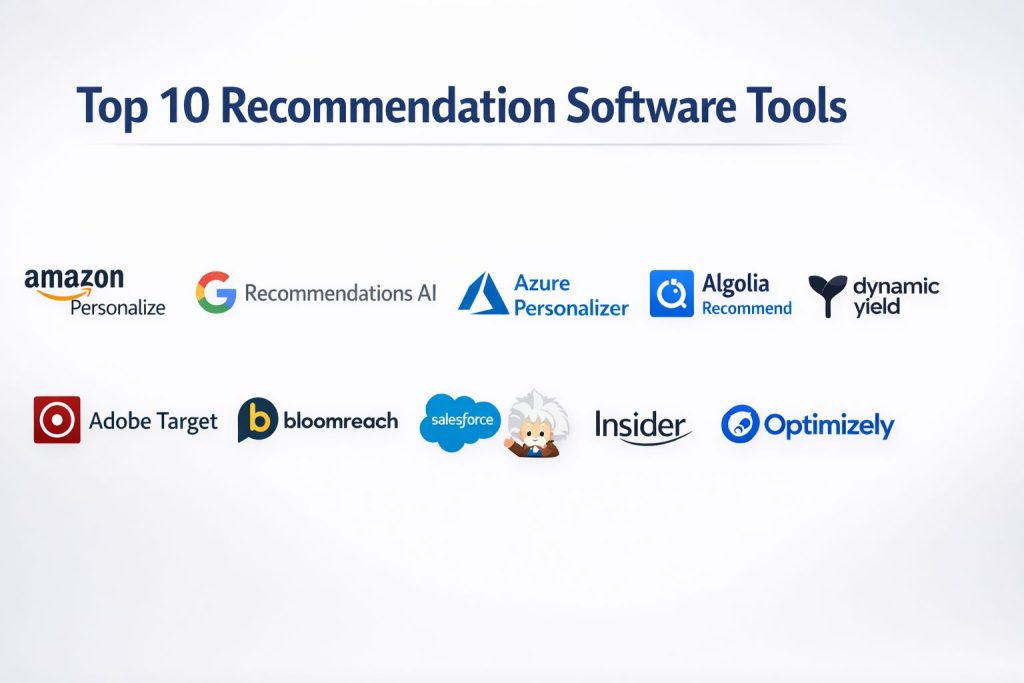
Top 10 Recommendation Software Tools
#1 — Amazon Personalize
Built on the same technology used by Amazon.com, this tool allows developers to build high-scale, real-time personalization into their apps.
Key Features
- Automated Machine Learning: Automatically selects the best algorithms and tunes parameters for your data.
- Cold Start Support: Dedicated recipes for recommending new items that don’t have historical interaction data yet.
- Real-Time Batching: Processes user events as they happen to update recommendations instantly.
- Segment Discovery: Uses AI to identify groups of users who have similar preferences for targeted marketing.
- Event-Based Triggers: Can trigger specific recommendations based on user actions like “added to cart.”
Pros
- Extremely scalable, capable of handling datasets with billions of interactions.
- Requires no prior machine learning expertise to deploy.
Cons
- Can become expensive if you have a massive number of users and products.
- Deeply tied to the AWS ecosystem, which might not suit multi-cloud strategies.
Platforms / Deployment
- Cloud (AWS)
- Web / Mobile SDKs
Security & Compliance
- SSO/SAML, MFA via AWS IAM
- SOC 1/2/3, ISO 27001, HIPAA, and GDPR compliant
Integrations & Ecosystem
As an AWS service, it integrates natively with the entire Amazon data suite.
- Amazon S3
- AWS Lambda
- Amazon Kinesis
- Salesforce (via AppFlow)
Support & Community
Extensive technical documentation and a massive community of AWS certified professionals. Enterprise support is available for higher-tier users.
#2 — Google Recommendations AI
A powerful cloud-based service that leverages Google’s decades of experience in search and discovery to deliver personalized suggestions.
Key Features
- Deep Learning Models: Uses advanced neural networks to find complex patterns in user behavior.
- Context-Aware Recommendations: Adjusts suggestions based on factors like time of day and device type.
- Omnichannel Support: Delivers consistent recommendations across web, mobile, and physical point-of-sale systems.
- Model Management: Provides a simple console to monitor model performance and accuracy over time.
- Automated Optimization: Constantly retrains models to ensure relevance as trends change.
Pros
- Exceptional accuracy, often outperforming manual rules by a significant margin.
- Seamlessly connects with Google Analytics and BigQuery.
Cons
- Setup can be technical and requires a clean data structure.
- Pricing is tied to the number of prediction requests, which can fluctuate.
Platforms / Deployment
- Cloud (Google Cloud Platform)
- Web / Android / iOS
Security & Compliance
- ISO 27001, SOC 2/3, HIPAA, and GDPR compliant
- Data encryption at rest and in transit
Integrations & Ecosystem
Deep integration with the Google Cloud data stack.
- BigQuery
- Google Tag Manager
- Google Analytics 4
- Looker
Support & Community
Backed by Google Cloud’s extensive support tiers and a large ecosystem of partner agencies specializing in AI.
#3 — Azure Personalizer
A cloud-based service that uses reinforcement learning to help your application choose the best content to show your users.
Key Features
- Reinforcement Learning: Learns from user feedback in real-time to improve its decision-making.
- Exploration vs. Exploitation: Balances showing “proven” favorites with testing new content to find new trends.
- Contextual Features: Takes in high-dimensional data like user location and browser settings.
- Reward System: Allows developers to define what a “success” looks like, such as a click or a purchase.
- Offline Evaluation: Lets you test new models against historical data before pushing them live.
Pros
- Highly adaptive to rapidly changing user interests.
- Great for situations where you have a “limitless” feed of content.
Cons
- Requires more careful “reward” configuration than traditional engines.
- Interface is more developer-focused than marketer-friendly.
Platforms / Deployment
- Cloud (Microsoft Azure)
- Web / Windows / Linux
Security & Compliance
- Azure Active Directory (SSO/MFA)
- FedRAMP, HIPAA, SOC 2, and GDPR compliant
Integrations & Ecosystem
Designed to work within the Microsoft enterprise environment.
- Azure Synapse Analytics
- Power BI
- Microsoft Dynamics 365
- Azure Functions
Support & Community
Strong documentation through Microsoft Learn and dedicated enterprise support for corporate clients.
#4 — Algolia Recommend
A fast, API-first recommendation solution that focuses on speed and developer experience.
Key Features
- Frequently Bought Together: Automatically finds product associations based on purchase history.
- Related Products: Suggests items that share similar attributes or descriptions.
- Sub-Millisecond Latency: Built on a distributed network for near-instant responses globally.
- Visual Rules: Allows non-technical users to “boost” or “bury” certain items manually.
- A/B Testing: Built-in tools to compare different recommendation strategies.
Pros
- Incredibly fast to implement, even for complex websites.
- Excellent documentation that is widely praised by developers.
Cons
- Primary strength is e-commerce; may be less flexible for complex social media feeds.
- Pricing can grow quickly with high search volumes.
Platforms / Deployment
- Cloud (SaaS)
- Web / Mobile
Security & Compliance
- SOC 2 Type II, ISO 27001, HIPAA, and GDPR compliant
- Two-factor authentication for admin accounts
Integrations & Ecosystem
Highly extensible via a powerful API.
- Shopify
- Adobe Commerce (Magento)
- Salesforce Commerce Cloud
- BigCommerce
Support & Community
Active community forums, high-quality Slack support for premium tiers, and a detailed “documentation-first” culture.
#5 — Dynamic Yield
An experience optimization platform that combines recommendations with A/B testing and personalization.
Key Features
- Deep Personalization: Targets users based on hundreds of segments including weather and local events.
- Multilevel Testing: Allows you to test layouts and recommendation algorithms simultaneously.
- Visual Experience Editor: Marketers can drag and drop recommendation widgets without coding.
- Inventory Awareness: Automatically stops recommending items that are out of stock.
- Social Proof Triggers: Adds “X people bought this today” labels to recommended items.
Pros
- Very user-friendly for marketing teams.
- Exceptional at combining recommendations with other conversion tools.
Cons
- Can feel like “overkill” for simple recommendation needs.
- Implementation requires a script tag that can occasionally impact page load times if not managed.
Platforms / Deployment
- Cloud / Web / Mobile App
- Hybrid
Security & Compliance
- ISO 27001, SOC 2 Type II, and GDPR compliant
- Privacy-by-design architecture
Integrations & Ecosystem
Broad connectivity with marketing and analytics tools.
- Google Analytics
- Segment
- SAP Commerce Cloud
- Oracle Marketing Cloud
Support & Community
High-touch support with dedicated success managers for enterprise accounts and a robust online “Knowledge Hub.”
#6 — Adobe Target
An enterprise-level personalization engine that uses Adobe Sensei AI to automate recommendations across massive digital footprints.
Key Features
- Adobe Sensei AI: Proprietary machine learning that powers one-click automated personalization.
- Visual Composer: Easy-to-use interface for creating and managing recommendation blocks.
- Cross-Channel Consistency: Ensures a user sees the same relevant items on email and web.
- Auto-Allocate: Automatically shifts traffic toward the best-performing recommendation model.
- Custom Criteria: Allows businesses to build their own specific rules for how items are selected.
Pros
- Deeply integrated with the Adobe Experience Cloud.
- Very powerful for large-scale enterprise organizations.
Cons
- High cost of entry makes it unsuitable for smaller businesses.
- The interface has a steep learning curve for new users.
Platforms / Deployment
- Cloud
- Web / Mobile / IoT
Security & Compliance
- FedRAMP, HIPAA, SOC 2, and GDPR compliant
- Strong enterprise governance controls
Integrations & Ecosystem
Best-in-class integration with other Adobe products.
- Adobe Analytics
- Adobe Experience Manager
- Marketo Engage
- Adobe Real-Time CDP
Support & Community
Massive enterprise support network and a global community of Adobe certified experts.
#7 — Bloomreach
A commerce-focused engagement platform that uses AI to connect products to the right shoppers.
Key Features
- Discovery Engine: Combines search, SEO, and recommendations in a single platform.
- Semantic Search: Understands the intent behind user queries to provide better suggestions.
- Merchandising Controls: Gives human teams the ability to override AI for seasonal campaigns.
- Customer Data Platform (CDP): Includes a built-in CDP to create a 360-degree view of the user.
- Headless Architecture: Can be used with any frontend framework like React or Vue.
Pros
- Specifically built for the complexities of modern e-commerce.
- Strong focus on driving measurable revenue growth.
Cons
- Setting up the unified data layer can be a large project.
- The platform’s breadth can be overwhelming for smaller teams.
Platforms / Deployment
- Cloud / SaaS
- Web / Mobile
Security & Compliance
- SOC 2, ISO 27001, and GDPR compliant
- Secure API access with granular permissions
Integrations & Ecosystem
- Shopify Plus
- BigCommerce
- SAP
- Algolia
Support & Community
Excellent onboarding services and a dedicated “Bloomreach Academy” for user training.
#8 — Salesforce Einstein
Built into the Salesforce platform, Einstein provides predictive recommendations across sales, service, and commerce.
Key Features
- Predictive Product Recs: Automatically suggests products in Salesforce Commerce Cloud.
- Next Best Action: Tells sales reps exactly what to offer a client based on their history.
- Case Classification: Recommends relevant knowledge base articles to support agents.
- Email Personalization: Tailors marketing emails in real-time when the user opens them.
- Low-Code Tools: Allows business users to set up AI with clicks, not code.
Pros
- Zero integration required if you are already using Salesforce.
- Unifies recommendations across the entire customer lifecycle.
Cons
- Limited for those not already using the Salesforce ecosystem.
- Some advanced AI features require higher-tier licensing.
Platforms / Deployment
- Cloud
- Web / Mobile / Desktop
Security & Compliance
- FedRAMP, HIPAA, SOC 2, and GDPR compliant
- Multi-layered security architecture
Integrations & Ecosystem
Works seamlessly with the entire Salesforce “Customer 360” suite.
- Commerce Cloud
- Marketing Cloud
- Sales Cloud
- MuleSoft
Support & Community
A massive “Trailblazer” community and a global network of consulting partners.
#9 — Insider
A growth management platform that focuses heavily on mobile and messaging-based recommendations.
Key Features
- Multichannel Recommendations: Delivers suggestions via WhatsApp, SMS, and Push.
- Smart Recommender: A suite of pre-built algorithms for “Trending,” “Most Viewed,” and “Personalized.”
- Progressive Profiling: Gradually learns about anonymous users to improve suggestions.
- Predictive Segments: Identifies users likely to churn or purchase in the next 7 days.
- Mobile App Optimization: Specifically tuned for the unique constraints of mobile screens.
Pros
- Strongest option for businesses with a mobile-first strategy.
- Quick time-to-value with many “out-of-the-box” templates.
Cons
- Web-side features are strong but sometimes play second fiddle to mobile.
- Analytics reporting could be deeper for technical data scientists.
Platforms / Deployment
- Cloud
- iOS / Android / Web
Security & Compliance
- SOC 2, ISO 27001, and GDPR compliant
- Secure data silos for enterprise clients
Integrations & Ecosystem
- Shopify
- Magento
- Oracle
- Google Analytics
Support & Community
High-touch support with dedicated “Growth Experts” to help companies hit their KPIs.
#10 — Optimizely
A complete digital experience platform that integrates recommendations with content management and experimentation.
Key Features
- Adaptive Recommendations: Learns from every interaction to refine the content feed.
- Content Intelligence: Automatically tags content to find relationships between different topics.
- Omnichannel Delivery: One engine powers recommendations for web, email, and social.
- A/B/n Testing: Test multiple recommendation algorithms against each other simultaneously.
- Visitor Intelligence: Deep analytics on user behavior and preference profiles.
Pros
- Excellent for content-heavy websites and publishers.
- Very strong data governance and testing capabilities.
Cons
- Pricing is generally geared toward mid-market and enterprise firms.
- Requires a well-organized content library to work effectively.
Platforms / Deployment
- Cloud
- Web / Mobile / Email
Security & Compliance
- SOC 2 Type II, GDPR, HIPAA, and ISO 27001 compliant
- Enterprise-grade user permissions
Integrations & Ecosystem
- Microsoft Dynamics
- Salesforce
- Adobe Creative Cloud
- Google Analytics
Support & Community
Extensive documentation through the “Optimizely Academy” and a dedicated global support team.
Comparison Table (Top 10)
| Tool Name | Best For | Platform(s) Supported | Deployment | Standout Feature | Public Rating |
| Amazon Personalize | Scalable AWS Power | Web, Mobile | Cloud | Automated ML Tuning | 4.6/5 |
| Google Recommendations AI | Google Ecosystem | Web, Android, iOS | Cloud | Deep Learning Models | 4.7/5 |
| Azure Personalizer | Adaptive Context | Web, Windows, Linux | Cloud | Reinforcement Learning | 4.5/5 |
| Algolia Recommend | Speed & Discovery | Web, Mobile | Cloud | Sub-1ms Latency | 4.8/5 |
| Dynamic Yield | Omnichannel Agility | Web, Mobile | Hybrid | Visual Exp. Editor | 4.6/5 |
| Adobe Target | Adobe-First Orgs | Web, Mobile, IoT | Cloud | Sensei AI Integration | 4.4/5 |
| Bloomreach | E-commerce Growth | Web, Mobile | Cloud | Semantic Search | 4.5/5 |
| Salesforce Einstein | Salesforce Users | Web, Mobile | Cloud | CRM-Native AI | 4.3/5 |
| Insider | Mobile & Messaging | iOS, Android, Web | Cloud | Messaging-based Recs | 4.6/5 |
| Optimizely | Content & Testing | Web, Mobile, Email | Cloud | Content Intelligence | 4.5/5 |
Evaluation & Scoring of Recommendation Engines
We have scored these tools based on their performance in a professional production environment.
| Tool Name | Core (25%) | Ease (15%) | Integrations (15%) | Security (10%) | Performance (10%) | Support (10%) | Value (15%) | Weighted Total |
| Amazon Personalize | 10 | 6 | 9 | 10 | 10 | 8 | 7 | 8.6 |
| Google Recommendations | 10 | 6 | 9 | 10 | 10 | 8 | 7 | 8.6 |
| Algolia Recommend | 8 | 9 | 9 | 8 | 10 | 9 | 8 | 8.5 |
| Dynamic Yield | 8 | 9 | 8 | 9 | 8 | 9 | 7 | 8.1 |
| Azure Personalizer | 9 | 5 | 9 | 10 | 9 | 8 | 7 | 7.9 |
| Optimizely | 8 | 7 | 8 | 9 | 8 | 9 | 7 | 7.7 |
| Bloomreach | 9 | 6 | 7 | 8 | 8 | 8 | 7 | 7.6 |
| Salesforce Einstein | 7 | 8 | 10 | 9 | 7 | 8 | 6 | 7.5 |
| Insider | 7 | 8 | 7 | 8 | 8 | 9 | 8 | 7.5 |
| Adobe Target | 8 | 5 | 9 | 9 | 8 | 8 | 5 | 7.2 |
How to interpret these scores:
- 8.0 – 10.0: Top-tier performers with massive scalability and advanced AI capabilities.
- 7.0 – 7.9: Reliable enterprise or niche tools that excel when used within their specific ecosystems.
- Below 7.0: Tools that may have higher costs or steeper learning curves compared to the current market average.
Which Recommendation Engine Tool Is Right for You?
Solo / Freelancer
If you are a developer building a personal project or a small blog, Algolia Recommend is your best bet. It is easy to set up and offers a generous free tier for low-volume sites.
SMB
Small to medium businesses should look at Dynamic Yield or Insider. These platforms provide a “marketer-friendly” interface that doesn’t require a dedicated data science team to operate. They allow you to get personalized widgets live on your site in a matter of days.
Mid-Market
For companies with more established data pipelines, Amazon Personalize or Google Recommendations AI offer the best performance. They provide high-level AI without the massive overhead of an all-in-one digital experience platform.
Enterprise
Large-scale corporations already using big software suites will benefit most from Adobe Target or Salesforce Einstein. The primary value here is the unified view of the customer across every single touchpoint.
Budget vs Premium
- Budget-Friendly: Algolia Recommend and the entry tiers of Insider.
- Premium Enterprise: Adobe Target and Bloomreach.
Feature Depth vs Ease of Use
If you want deep, custom machine learning control, go with Amazon Personalize. If you want a visual tool where you can “drag and drop” recommendations, Dynamic Yield is far superior.
Integrations & Scalability
Amazon and Google are the kings of scalability. They can handle tens of thousands of requests per second without a flinch. For integrations, Salesforce is the clear winner for CRM data.
Security & Compliance Needs
Organizations in highly regulated industries (like Finance or Healthcare) should prioritize Azure Personalizer or Amazon Personalize, as they offer the most robust government-level certifications and isolation features.
Frequently Asked Questions (FAQs)
1. What is the “Cold Start” problem in recommendation engines?
This happens when you have a new user with no history or a new product with no sales. Modern engines solve this by using “Content-Based Filtering,” which looks at the attributes of the product (like category or color) to find similar items that do have a history.
2. Do these tools slow down my website?
If implemented poorly, they can. However, most modern tools use “asynchronous” loading, meaning the recommendation engine waits for the rest of your page to load before it appears. Using an API-first tool like Algolia also helps keep things fast.
3. How much data do I need to get started?
While more data is always better, most modern AI engines can start providing value with as few as a few thousand user interactions. The key is quality over quantity; even a small amount of clean data is better than millions of “noisy” or messy records.
4. Is it better to build or buy a recommendation engine?
Unless you are a massive tech company with hundreds of data scientists, it is almost always better to “buy” (subscribe to a SaaS). The cost of maintaining servers and constantly updating complex AI models is far higher than a monthly software subscription.
5. Are recommendation engines compliant with GDPR?
Yes, but you must configure them correctly. Most top-tier tools offer “data residency” options (where data stays in a specific country) and tools to help you delete a user’s data upon request. Always check the security section of the tool’s documentation.
6. Can I use these for offline retail?
Absolutely. Many enterprise engines allow you to upload offline purchase data (from a physical store) to improve online recommendations. This “omnichannel” approach is a major trend.
7. What is the difference between Collaborative and Content-Based filtering?
Collaborative filtering looks at “people like you also liked this.” Content-based filtering looks at “you liked this blue shirt, so you might like this blue jacket.” Most top tools use a “Hybrid” approach that combines both.
8. How do I measure the success of my recommendation engine?
Common metrics include “Click-Through Rate” (CTR) on the recommendation blocks, “Conversion Rate,” and “Average Order Value.” High-end tools provide built-in dashboards to track these exact KPIs for you.
9. Can I override the AI with my own business rules?
Yes. Most professional tools (like Bloomreach or Cinema 4D) have “Merchandising” features. For example, if you want to push a specific brand during a holiday sale, you can “boost” it so it appears higher in the recommendation list.
10. Do recommendation engines only work for products?
No. They work for news articles, job listings, internal documentation for employees, and even “Next Best Action” steps for customer service agents. If you have a list of things and a user who needs to choose one, a recommendation engine can help.
Conclusion
The era of “one size fits all” digital experiences is over. A high-quality recommendation engine is the only way to keep up with user expectations for personalized, relevant, and fast interaction. Whether you choose the massive AI power of Amazon Personalize or the lightning-fast developer experience of Algolia Recommend, the most important step is to start gathering clean data today.
Remember that the “best” tool is the one that fits your current technical team’s skill level and your budget. Start with a single use case—like “related items” on a product page—measure the results, and then expand to a full omnichannel strategy.