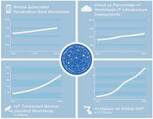
This article is adapted from a piece originally published on Forbes.com, authored by a VP of Engineering and General Manager for Google Cloud’s data analytics platform. It explores how AI, ML, and modern data platforms can empower entire organizations—not just specialist teams—to make better decisions with data.
Data as a Factor of Production
The World Economic Forum has described data as a “new factor of production”—one with the potential to reshape business models, shift industry boundaries, and create entirely new market structures. That framing resonates across industries: whether you work in finance, retail, gaming, or telecoms, the question executives are increasingly asking is not whether to invest in data analytics, but how to make those investments actually work for their teams.
The answer, increasingly, is not simply hiring more data scientists. It is about removing the bottlenecks that prevent every layer of the business—sales, marketing, logistics, operations—from acting on data independently and confidently.
The Bottleneck Problem: Why Most Data Teams Are Stretched Thin
In most organizations today, data access follows a chain of dependency that creates serious throughput problems:
- Business users (in sales, marketing, logistics) need data insights to do their day-to-day jobs—but they rely on data analysts to surface that information.
- Data analysts handle reporting and dashboards, but for predictive or advanced analytics they depend on data scientists.
- Data scientists build models, but they depend on data engineers to ensure that data pipelines, ingestion jobs, and processing infrastructure are running reliably.
This cascade means that a question from a sales manager can take days or weeks to become an answer—filtered through multiple specialists, each with their own queue of work. Restricting advanced analytical tools to a select few is not scalable, and it frustrates every layer of the team.
Democratizing Data Access: What It Actually Means
Democratizing data does not mean giving everyone unrestricted access to raw systems. It means providing role-appropriate interfaces so that each user can independently get the answers they need, without blocking someone else’s work. A well-designed modern analytics platform achieves this through layered access:
- Standard SQL interfaces for data analysts who already know the language—enabling them to write queries, build dashboards, and manage pipelines without waiting on engineers.
- Spreadsheet integrations (such as connected sheet views) for business users who are not comfortable with SQL but are fluent in tools like Excel or Google Sheets.
- Natural language query interfaces that allow non-technical users to ask plain-language questions of their data—no query syntax required.
- Notebook and API integrations (supporting environments like Jupyter, and libraries like Spark, Pandas, and Presto) for data scientists who want to stay in their preferred analytical environments while working against centralized data stores.
- Automated ML capabilities embedded in the SQL layer, so that data analysts can train and evaluate predictive models using familiar syntax—without requiring a dedicated data science handoff.
When data analysts can self-serve, data engineers are freed to focus on higher-value work: data quality, lineage, governance, and architecture. When business users can self-serve, data analysts shift their attention to complex analysis and model validation. Each layer moves up the value chain.
Real-Time and Predictive Analytics: Why They Matter Now
The COVID-19 pandemic demonstrated, more clearly than any business case document, that the ability to react to rapidly shifting conditions is not a luxury—it is a survival capability. Businesses that could observe customer behavior changes in near-real-time and act on predictive signals adapted more effectively than those relying on weekly or monthly reporting cycles.
Streaming analytics pipelines—where data is processed and surfaced as it arrives rather than in scheduled batch jobs—combined with ML-based forecasting give operational teams the situational awareness they need to make decisions in hours rather than days. This is especially relevant in logistics, retail demand planning, fraud detection, and customer service operations.
Practical Steps: Building a Data-Empowered Organization
Moving toward a data-driven operating model is a significant undertaking, but it does not need to happen all at once. A pragmatic sequence typically looks like this:
- Centralize your data. A single, governed data warehouse or lakehouse that all teams can query eliminates the silos that make cross-functional analytics nearly impossible.
- Standardize on open interfaces. Avoid proprietary query languages or formats where possible. SQL remains the most widely understood analytical language across data roles.
- Layer access by role. Deploy the right interface for each user type: SQL for analysts, spreadsheet connectors for business users, notebook APIs for scientists.
- Introduce AutoML gradually. Embedded ML capabilities (such as building a classification or forecasting model inside a SQL query) allow analysts to experiment with predictive analytics before committing to a full data science engagement.
- Measure the bottleneck reduction. Track time-to-insight for common business questions before and after tooling changes. This is your primary ROI signal.
- Evolve governance alongside access. As more users interact with data, invest in data cataloguing, lineage tracking, and role-based access controls to maintain trust and compliance.
The Strategic Payoff: Freeing Your Specialists for High-Value Work
One of the most underappreciated benefits of data democratization is what it does for your most skilled people. When data engineers are no longer spending the majority of their time making data available to analysts—running one-off extracts, fixing broken ad-hoc pipelines—they can concentrate on the architectural work that has lasting impact: building reliable ingestion frameworks, enforcing data quality standards, and designing scalable infrastructure.
Similarly, when data scientists are not bottlenecked on answering routine business questions, they can focus on developing more sophisticated, production-ready models and working on the operationalization (MLOps) challenges that turn a working notebook into a reliable business capability.
The organizations that get this right—where every person who needs data can access it in a form that works for them—are the ones that develop the institutional capacity to innovate continuously, rather than in occasional, expensive bursts.
Key Takeaways for DevOps and Data Engineering Teams
- Data bottlenecks are an organizational problem as much as a tooling problem—address both together.
- Self-service analytics platforms reduce ticket queues and free engineers for strategic infrastructure work.
- Embedding ML capabilities in SQL-based tools lowers the barrier to predictive analytics across data roles.
- Real-time streaming pipelines are increasingly a baseline expectation, not a premium feature.
- Governance and access control must scale alongside democratization—open access without guardrails creates data quality and compliance risk.
- Measure time-to-insight as a concrete engineering KPI to demonstrate the value of platform improvements.
Originally sourced from Forbes.com. The Google Cloud platform examples referenced (BigQuery, BigQuery ML, Connected Sheets, Data QnA) reflect the product landscape as described in the original 2020 article. Verify current product names, features, and availability in the official Google Cloud documentation.