Continuous Delivery (CD) has moved from a niche DevOps practice to a mainstream software delivery discipline. As organisations accelerate their release cadences and adopt cloud-native architectures, demand for CD tooling and platforms continues to grow. This article summarises publicly available market intelligence on the global Continuous Delivery market, including the major vendors active in the space, how the market is segmented, and which industries and regions are driving adoption.
Source note: Market sizing figures and forecasts cited in the original source were drawn from a Dataintelo syndicated research report published via latestherald.com (circa 2020). Specific revenue figures and CAGR projections from that report have not been independently verified and are therefore not reproduced here. Readers requiring precise market-size data should consult primary analyst sources directly.
What Is Continuous Delivery?
Continuous Delivery is a software engineering practice in which code changes are automatically built, tested, and prepared for release to production. Unlike Continuous Deployment, which pushes every passing build straight to production, CD ensures that every build could be released at any time — the actual deployment decision remains a human one. The discipline relies on a mature CI/CD pipeline, comprehensive automated testing, and configuration management tooling.
Adoption is driven by several forces: shorter product cycles, competitive pressure to ship faster, cloud migration projects that expose legacy release processes as bottlenecks, and the broader cultural shift toward DevOps and Site Reliability Engineering (SRE).
Major Vendors in the Continuous Delivery Market
The CD tooling ecosystem is broad, spanning open-source projects, commercial platforms, and cloud-provider-native services. The following companies were identified as significant market participants in the 2020 research period:
- Atlassian — Bitbucket Pipelines and integrations with Jira Software provide end-to-end traceability from issue to deployment.
- IBM — IBM UrbanCode Deploy (UCD) and IBM DevOps offerings target enterprise-scale release orchestration.
- XebiaLabs (now Digital.ai) — XL Deploy and XL Release focus on release orchestration and compliance-heavy environments.
- CA Technologies (now Broadcom) — Acquired by Broadcom; its Rally and Automic platforms serve enterprise DevOps and workload automation.
- Electric Cloud (now CloudBees CD) — Release automation and pipeline orchestration platform, later absorbed into the CloudBees portfolio.
- Puppet Enterprise — Infrastructure-as-code and continuous compliance platform used to enforce configuration across deployments.
- Chef Software (now Progress Chef) — Automation framework for infrastructure, compliance, and application delivery.
- CloudBees — Enterprise Jenkins distribution and CloudBees CI/CD platform; one of the largest pure-play CD vendors.
- Microsoft — Azure DevOps (Pipelines) and GitHub Actions are among the most widely used CI/CD services globally.
- Flexagon — FlexDeploy targets Oracle and hybrid-environment release automation.
- Micro Focus — Fortify and ALM Octane integrate security and quality into CD pipelines for regulated industries.
- Clarive — Release orchestration platform with strong ITSM and change-management integration.
This list reflects the commercial landscape as of approximately 2020. The market has continued to consolidate — notably Electric Cloud becoming CloudBees CD, XebiaLabs rebranding under Digital.ai, and GitHub Actions growing rapidly after Microsoft’s 2018 acquisition of GitHub.
Market Segmentation
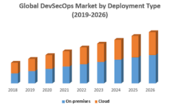
By Deployment Type
- On-premises — Preferred by regulated industries (finance, healthcare, government) where data residency, audit trails, and network isolation are mandatory. Legacy enterprise environments also favour on-premises deployment during initial CD adoption.
- Cloud — SaaS and cloud-hosted CD platforms lower the operational burden of maintaining pipeline infrastructure. Cloud-native organisations and SMBs tend to default to cloud-delivered CD. Managed services from AWS (CodePipeline), Azure (Pipelines), and Google Cloud (Cloud Build/Deploy) have accelerated this segment.
By Industry Vertical
CD adoption varies significantly by vertical, driven by release frequency requirements, regulatory constraints, and the maturity of existing engineering practices:
| Vertical | CD Adoption Driver |
|---|---|
| Banking, Financial Services & Insurance (BFSI) | Regulatory compliance automation, fraud-detection model updates, digital banking feature velocity |
| Telecommunications | Network function virtualisation, rapid service provisioning, OSS/BSS modernisation |
| Media & Entertainment | Streaming platform feature releases, content delivery infrastructure updates |
| Retail & eCommerce | Seasonal traffic scaling, A/B testing cadence, personalisation engine updates |
| Healthcare | EHR integrations, telehealth platform updates, compliance with HIPAA and regional equivalents |
| Manufacturing | Industrial IoT firmware updates, MES and ERP integration pipelines |
| Education | LMS feature rollouts, student data platform updates |
| Government, Transport & Logistics, Energy & Utilities | Modernisation of legacy systems, citizen-service portals, grid-management software |
Regional Market Overview
CD adoption is uneven across geographies, reflecting differences in cloud infrastructure maturity, developer talent density, and regulatory environments.
- North America — The US remains the largest single market, driven by a high concentration of technology companies, mature DevOps cultures, and significant cloud spend. Canada and Mexico show growing adoption, particularly in financial services and manufacturing.
- Europe — Germany, the UK, and France lead adoption. GDPR and sector-specific regulations (PSD2 in banking, MDR in medical devices) have pushed enterprises to invest in auditable, compliant CD pipelines. The UK’s fintech sector is a notable growth area.
- Asia Pacific — China, India, Japan, South Korea, and Australia drive the region. India’s large developer workforce and strong IT services sector make it both a consumer and a delivery hub for CD implementations. China’s domestic cloud ecosystem has produced parallel tooling ecosystems.
- Latin America — Brazil is the primary market. Fintech growth in the region is accelerating CD adoption in financial services.
- Middle East & Africa — Smaller in absolute terms but growing, with government digital-transformation programmes in the Gulf states and fintech in South Africa as leading drivers.
Factors Shaping the Market
Accelerators
- Cloud migration — Moving workloads to cloud exposes the cost of manual, slow release processes and creates a natural entry point for CD tooling.
- DevOps culture adoption — Organisations investing in DevOps transformation treat CD as a foundational capability, not an optional add-on.
- Microservices and containers — Decomposed architectures require automated deployment orchestration; manual processes do not scale to hundreds of independently deployable services.
- Security and compliance pressure — Shifting security left into the pipeline (DevSecOps) and generating automated audit trails for compliance are increasingly purchasing drivers.
Restraints
- Skill gaps — Implementing and maintaining mature CD pipelines requires expertise that many organisations lack internally.
- Legacy system complexity — Mainframes, monolithic architectures, and tightly coupled systems are difficult to bring into a CD pipeline without significant refactoring investment.
- Organisational resistance — CD requires changes to release governance, testing strategy, and cross-team coordination that can be politically and culturally difficult.
Key Takeaways for DevOps Teams
Understanding the competitive and adoption landscape helps DevOps practitioners make better tooling decisions and build the business case for CD investment:
- Vendor consolidation is ongoing. Several tools listed above have been acquired or rebranded. Evaluate the current roadmap and parent-company stability when selecting a long-lived CD platform.
- Cloud-native services are gaining share. For teams already on AWS, Azure, or GCP, the managed pipeline services lower the barrier to entry significantly, even if they lack the orchestration depth of specialist vendors.
- Industry vertical matters. A CD toolchain appropriate for a healthcare provider (heavy audit logging, approval gates, change-management integration) looks different from one suited to a consumer app startup (trunk-based development, feature flags, frequent releases).
- On-premises demand persists in regulated sectors. Despite cloud growth, financial institutions and government agencies continue to require self-hosted CD infrastructure for data-sovereignty and network-isolation reasons.
The Continuous Delivery market reflects the broader maturation of DevOps as a discipline. As more organisations commit to shorter feedback loops and higher deployment frequencies, investment in CD platforms — whether open-source, commercial, or cloud-native — will continue to be a strategic priority.
Original market data referenced in this article was sourced from a Dataintelo syndicated research report (circa 2020) as summarised by latestherald.com. Vendor names, product names, and parent-company details have been updated where significant changes (acquisitions, rebrands) are publicly known.