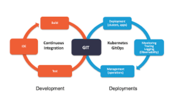
DevOps and GitOps are both rooted in the idea that development and operations teams should work more closely together. Yet despite that shared goal, they take meaningfully different approaches — and as containers, microservices, and CI/CD pipelines have matured, the gap between the two has become both more nuanced and more consequential for engineering teams choosing between them.
How DevOps Gave Rise to GitOps
DevOps emerged as the industry’s first systematic attempt to create a fluid pipeline from development to operations. Its core promise was straightforward: pass application characteristics, configuration requirements, and deployment instructions from one team to the next in a structured, repeatable way. Most early DevOps tooling focused on converting developer-authored instructions into deployment steps — scripts, configuration files, and pipeline definitions that operations teams could execute reliably.
Two pressures complicated that model as software architectures evolved:
- Increasing componentization. Applications decomposed into services and microservices introduced complex multi-component relationships that flat pipeline tools struggled to manage.
- Faster release cadences. CI/CD meant that a single “release” was no longer a monolithic event but a stream of component-level changes, each moving through the pipeline at its own pace.
The logical response to both challenges was a shared, version-controlled repository as a single source of truth — one that could anchor both development activity and operations configuration. Git was already the dominant choice for storing version-controlled code, so building an operations practice around it, and connecting development and operations through Git-based exchanges, was a natural step. That is the origin of GitOps.
Core Philosophical Differences
DevOps: Operations-Centric and Prescriptive
DevOps is fundamentally an operations-centric discipline. Its earliest tools were largely prescriptive — script-driven workflows that spelled out exactly what should happen at each deployment step. This approach suits environments where applications change slowly, infrastructure configuration changes frequently, and hardware issues are a daily operational concern.
DevOps accommodates both declarative and imperative (prescriptive) styles, and it works equally well with monolithic applications, partially componentized apps, virtual machines, and bare-metal servers. Its versatility is one of its most valuable attributes — particularly for organizations managing heterogeneous infrastructure or navigating a gradual cloud migration.
DevOps tooling has expanded over time to cover monitoring, configuration management, and infrastructure as code. What it has not historically provided is strong, native support for the development process itself — a gap that becomes more visible as CI/CD practices push development and operations closer together.
GitOps: Developer-Centric and Declarative
GitOps starts from a different premise. Rather than prescribing a sequence of deployment steps, GitOps declares a desired state — the contents of a Git repository describe what the system should look like — and then relies on automation to reconcile the actual system state with that declared state. This declarative model aligns naturally with cloud-native architectures built around services and microservices.
Because it is developer-centric and built around the repository as the source of truth, GitOps fits naturally into CI/CD workflows. It allows IT administrators to manage the coordinated deployment of multi-component applications where each component evolves on its own schedule. Changes are made through pull requests; the repository becomes the audit trail, the rollback mechanism, and the deployment trigger all in one.
GitOps vs. DevOps with Containers and Kubernetes
Containers and Kubernetes have sharpened the distinction between the two approaches. In practice, most DevOps users do not exclusively deploy containerized workloads — DevOps tools are designed to span a wide range of infrastructure models. GitOps, by contrast, has largely evolved within the container ecosystem, and the overwhelming majority of GitOps practitioners are running containerized applications.
Kubernetes is the de facto orchestration platform for containers, and it is a natural fit for the GitOps model: Kubernetes already operates declaratively, managing cluster state against a defined specification. GitOps tooling — such as Flux and Argo CD — builds on that foundation by treating the Git repository as the authoritative specification for cluster state, triggering reconciliation whenever the repository changes.
In this context, DevOps tooling can be adapted to containerized environments, but doing so requires reconciling imperative pipeline logic with Kubernetes’ declarative ecosystem — and the friction can be significant. GitOps sidesteps much of that friction because its model was designed with containers in mind from the start.
How GitOps and DevOps Relate to Each Other
GitOps is not a subset of DevOps, nor does it replace it entirely. The relationship is better understood as follows:
- In a pure GitOps model, DevOps tooling may still handle aspects of the CI pipeline — building images, running tests — while GitOps tooling takes responsibility for the CD side, watching the repository and reconciling cluster state.
- GitOps can feed inputs into a DevOps pipeline, but the reverse is less natural. A DevOps pipeline is not designed to manage the kind of continuous reconciliation loop that GitOps relies on.
- For teams committed to containerized, cloud-native application models, GitOps and the Kubernetes ecosystem together can fulfill many of the roles traditionally occupied by DevOps tooling — meaning DevOps is not always a required layer.
Which Approach Is Right for Your Team?
The right answer depends on where your organization sits in its infrastructure journey:
| Factor | DevOps | GitOps |
|---|---|---|
| Primary focus | Operations pipeline | Developer workflow + declarative state |
| Application model | Monolithic, mixed, or componentized | Microservices and cloud-native |
| Infrastructure | Bare metal, VMs, containers | Primarily containers and Kubernetes |
| Deployment style | Prescriptive or declarative | Declarative (desired state) |
| CI/CD fit | Strong CI; variable CD | Native fit for both CI and CD |
| Rollback mechanism | Tool-dependent | Git revert |
Organizations that are still running predominantly VM or bare-metal workloads, or that have not yet committed to containerization, will find DevOps tooling more immediately applicable. Organizations that are building new systems on Kubernetes and want a clear audit trail, fast rollbacks, and a developer-friendly deployment model should seriously evaluate a GitOps approach.
For many teams, the answer will be a hybrid: DevOps tooling handling CI — code build, test, and image publish — while GitOps tooling manages the CD phase, watching the repository and keeping cluster state aligned with the declared configuration.
Looking Ahead
If the long-term trajectory of enterprise infrastructure is toward containers and cloud-native architectures, then the declarative, repository-centric model at the heart of GitOps is well-positioned to become the dominant paradigm for application delivery. DevOps practices and tooling are not going away — their breadth and maturity are genuine strengths — but the gravitational pull of Kubernetes and cloud-native development is steadily narrowing the gap between the two approaches, and in some environments, GitOps is already the more natural choice.