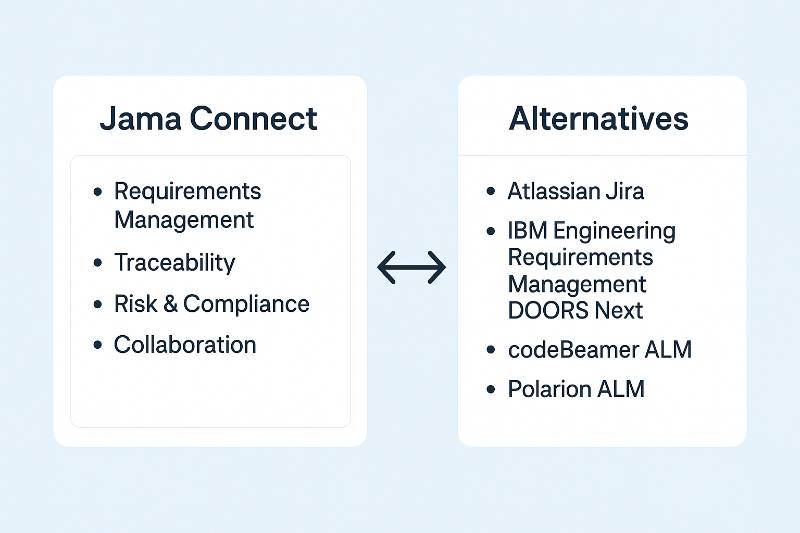
What is Jama Connect?
- Jama Connect is a software platform for requirements management, traceability, and product/lifecycle management. ()
- In simple terms: when you’re building a complex product (hardware and/or software) with many moving parts and regulations, Jama Connect helps you keep track of what needs to be done, who is doing it, how it’s tested, and how everything links together. ()
- It supports regulated industries (medical devices, aerospace, automotive) where traceability, compliance, risk management and versioning are critical. ()
- It offers both cloud and self-hosted/on-premises deployment options for flexibility. ()
Why do we need it? (What problems does it solve?)
Here are the key challenges Jama Connect addresses:
- Requirement definition & clarity
- With many stakeholders (engineering, software, hardware, QA, regulatory), ensuring everyone is aligned on “what must the product do?” is hard. Jama gives a central place to define, review and approve requirements. ()
- Traceability
- As changes happen (requirements shift, tests change, regulatory standards update) you need to know: “Which requirement does this test cover? Which design element implements this requirement? What happens if I change it?”. Traceability ensures you can answer those. ()
- Risk & compliance
- In regulated industries, you must demonstrate you followed correct processes, documented changes, managed risk, and validated the product. Jama supports regulated workflows, audit trails, compliance frameworks. ()
- Collaboration & change management
- When teams are large, distributed, working on overlapping systems, you need visibility, review/approval workflows, and mechanisms to reduce mis-communication, rework, and defects. Jama helps unify product, software, hardware teams. ()
- Reducing cost of errors and time to market
- By getting requirements right, maintaining traceability, and reducing rework, companies hope to deliver more reliably, fewer recalls or defects, and faster. The vendor claims this as a benefit. ()
Real use-cases (who uses it & how)
Here are examples of how teams use Jama Connect in practice:
- A medical device manufacturer uses it to manage requirements for their device (hardware + software), ensure each requirement links to risk assessment and test case, and produce traceability reports for regulatory submission.
- An automotive/EV company uses it to coordinate software-defined vehicle systems (e.g., sensors, control units, user-interface) and ensure that when a requirement changes (e.g., regulatory safety requirement), the impact across all systems is visible.
- An aerospace company uses it to manage complex systems engineering: multiple teams (structure, avionics, software), many requirements, many tests, many interdependencies—and they need a central tool to avoid “document hell” and ensure nothing falls through the cracks.
- A general technology company with hardware + software + firmware uses it so that their product development lifecycle is visible end-to-end: define requirements → design → implement → test → release, with feedback loops and traceability built in.
In short: any organization building complex, regulated or high-risk products with multiple interconnected teams and artifacts would benefit from Jama Connect.
Pros & cons (simplified)
Pros
- Strong support for traceability and compliance.
- Good for regulated, complex products.
- Central hub for requirements, tests, change management.
- Deployment flexibility (cloud or self-hosted).
- Integrations with other tools (e.g., issue trackers, ALM tools) to link work across toolchains. ()
Cons
- Because it is designed for complex use-cases, it may be overkill (and expensive) for small projects or simple software teams.
- Learning curve & process overhead: you may need to set up processes, workflows, train teams.
- If your project is small, simple, or non-regulated, simpler tools may be more agile/cheaper.
- Cost and time to adoption might be higher compared to lightweight project/issue trackers.
Best Alternatives & Better Options
If Jama Connect is good for heavy regulated/complex product development, you may consider alternatives (depending on your context: size, budget, complexity, regulatory needs). Here are some good options:
| Alternative | Why consider it |
|---|---|
| Atlassian Jira | Very popular issue/project tracker, flexible for software teams, lots of plugins/integrations. Cheap/accessible. (But less built-in for full traceability and regulated hardware). () |
| IBM Engineering Requirements Management DOORS Next | Strong requirements & traceability tool, more enterprise/regulation oriented. () |
| codeBeamer ALM | Another ALM/requirements management platform, alternative to Jama for regulated product development. () |
| Polarion ALM | Requirements + test + ALM platform, used in some regulated industries. () |
| Smaller/lightweight tools (depending on project size): Smartsheet, ClickUp, Jile | If your needs are less heavy (fewer regulations, fewer dependencies) these may be more cost-effective. () |
Which is “better”? It depends on your needs:
- If you are working in a regulated industry, building complex hardware-software systems with many interdependencies: Jama Connect (or one of the heavier ALM tools) makes sense.
- If you are a smaller software team, agile dev, low regulation: a simpler tool (Jira etc) may be “better” for you (lower cost, faster to deploy).
- If you want full lifecycle management (requirements → design → test → release) with strong traceability + risk management → pick the heavier tools.
- If you just need issue tracking / agile boards → pick lighter tools.
Summary
- What: Jama Connect = a requirements + traceability + risk + lifecycle tool for complex product development.
- Why: Because when you build complex/regulated systems, you need visibility, traceability, alignment, risk management across teams (hardware + software + firmware + tests + compliance).
- Use-cases: Medical devices, automotive systems, aerospace, any multi-discipline engineering teams.
- Alternatives: Many — from heavy ALM tools (DOORS, codeBeamer, Polarion) to lighter project/issue tracking tools (Jira, ClickUp). The “better” option depends heavily on your project size, complexity, regulation.
- Bottom line: If your development is complex and regulated, Jama Connect can bring value by reducing risk, rework, cost. If your development is simple/straightforward, you might be better off with a lighter, cheaper tool.
Very well-written article — it clearly explains how Jama Connect serves as a powerful requirements-management and traceability platform, ideal for complex or regulated product development (hardware + software) environments. I especially appreciate how it outlines Jama Connect’s value in centralizing requirement definition, enabling full traceability (from requirements → design → tests → compliance), supporting risk management, and facilitating collaboration across multiple teams — all of which help minimize errors, reduce rework, and speed up time-to-market. The use-case examples from industries like automotive, aerospace, medical devices make the benefits concrete and relatable. Overall, the article offers a concise yet thorough overview that helps professionals understand when and why Jama Connect is the right tool for complex engineering and product-lifecycle challenges.