Introduction
WebAssembly (Wasm) has evolved from a browser-based optimization for JavaScript into a high-performance, universal binary instruction format capable of running near-native speeds across diverse environments. Wasm runtimes and toolchains represent the backbone of “post-container” computing, offering microsecond cold starts and a capability-based security model that traditional Docker containers cannot match. These tools allow developers to compile code from languages like Rust, C++, and Go into a portable format that runs on edge servers, IoT devices, and cloud-native infrastructures.
For engineering leads and architects, choosing a Wasm stack is no longer just about execution speed; it is about the maturity of the Component Model implementation, support for WASI (WebAssembly System Interface), and the ability to integrate with existing observability and security frameworks. As server-side Wasm becomes the standard for event-driven microservices and serverless functions, evaluating these runtimes through the lens of memory safety and cross-platform interoperability is essential for building scalable, future-proof systems.
- Best for: Edge computing providers, serverless platform engineers, IoT developers, and high-performance web application architects.
- Not ideal for: Simple CRUD applications where standard Node.js or Python scripts meet performance requirements without the overhead of compilation.
Key Trends in WebAssembly Runtimes & Toolchains
- Stabilization of WASI Preview 3: The industry has moved toward a standardized system interface, allowing Wasm modules to access files, networks, and clocks securely across different runtimes.
- Wasm Component Model Adoption: Developers are now building “polyglot” applications where a Rust component, a Python component, and a Go component are linked into a single, high-performance executable.
- AI and Tensor Extensions: Modern runtimes are adding native support for WASI-NN (Neural Network), enabling high-speed AI inference directly within the Wasm sandbox.
- Microsecond Cold Starts: The focus has shifted to “scale-to-zero” architectures where runtimes can instantiate and execute a module in under 10 microseconds.
- Browser-to-Server Portability: Increased emphasis on “isomorphic Wasm” where the exact same binary runs in a Chrome tab and a Cloudflare worker.
- Security-First Sandboxing: Integration of Zero-Trust principles where every resource access (files, sockets) must be explicitly granted via a capability-based manifest.
How We Selected These Tools
- Performance Benchmarks: Evaluation of execution speed across JIT (Just-In-Time) and AOT (Ahead-of-Time) compilation modes.
- Compliance Standards: Prioritization of runtimes that strictly adhere to the Bytecode Alliance and W3C specifications.
- Developer Experience (DX): Assessment of the ease of use for the associated CLI tools, debuggers, and language bindings.
- Ecosystem Maturity: Review of the library support and the availability of “glue code” generators like wasm-bindgen or wit-bindgen.
- Security Architecture: Analysis of memory isolation, capability-based security, and support for hardware-level protections.
- Scalability: Ability to handle high-concurrency workloads in distributed environments like edge PoPs or Kubernetes clusters.
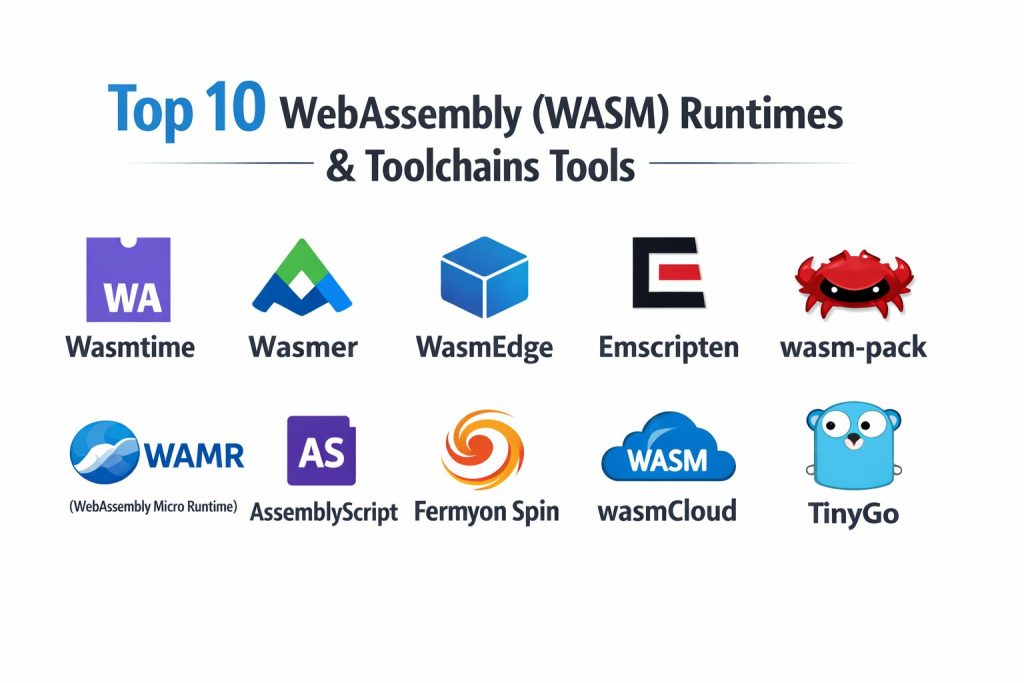
Top 10 WebAssembly (Wasm) Runtimes & Toolchains
1. Wasmtime
Developed by the Bytecode Alliance, Wasmtime is the reference implementation for WASI and a high-performance runtime built on the Cranelift compiler.
Key Features
- Cranelift Backend: A lightning-fast JIT compiler designed specifically for WebAssembly’s unique structure.
- Component Model Support: Full implementation of the latest proposal for composable Wasm components.
- Virtual Memory Sandboxing: Utilizes hardware-backed memory protection to isolate guest code from the host.
- Wasmtime-py and Wasmtime-go: Robust language bindings for embedding the runtime into existing applications.
- Async Support: Native integration with asynchronous programming patterns in Rust and other languages.
Pros
- Exceptional standards compliance; often the first to implement new Wasm proposals.
- Backed by a massive industry consortium including Fastly, Intel, and Microsoft.
Cons
- More complex to embed than some smaller, interpreter-based runtimes.
- Primarily optimized for x86_64 and AArch64; less focus on niche embedded architectures.
Platforms / Deployment
- Windows / macOS / Linux
- Server-side / Edge
Security & Compliance
- Capability-based security model; SOC2 and HIPAA compliant environments.
Integrations & Ecosystem
Acts as the default engine for platforms like Spin and various edge compute offerings, providing a “gold standard” for server-side Wasm.
Support & Community
Industry-leading support through the Bytecode Alliance and a highly active GitHub contributor base.
2. Wasmer
Wasmer is a versatile, universal WebAssembly runtime that focuses on ease of use and a massive ecosystem of pre-packaged Wasm modules.
Key Features
- Multi-Compiler Support: Choose between Single-pass (fastest startup), Cranelift, or LLVM (best execution speed).
- Wasmer Central: A built-in registry for sharing and deploying Wasm applications instantly.
- Headless Mode: Ability to run compiled AOT binaries without the full runtime overhead.
- WAPM Integration: Native package manager support for discovering and installing Wasm-based CLI tools.
- Edge Deployment: Integrated cloud platform for deploying Wasm apps with a single command.
Pros
- The best “out-of-the-box” experience for developers looking to run Wasm on their local machine.
- Supports a vast array of programming languages and platforms through its modular architecture.
Cons
- The focus on a proprietary cloud ecosystem can feel restrictive to some enterprise users.
- Performance can vary significantly depending on which of the three compilers is selected.
Platforms / Deployment
- Windows / macOS / Linux / iOS / Android
- Desktop / Cloud / Edge
Security & Compliance
- Provides sandboxed execution with configurable resource limits.
Integrations & Ecosystem
Strongest integration with its own “Wasmer Edge” platform and a growing library of thousands of packages.
Support & Community
Excellent documentation and a vibrant community centered around their public registry.
3. WasmEdge
A CNCF-hosted project, WasmEdge is specifically optimized for high-performance edge computing and AI inference.
Key Features
- AOT Optimization: Delivers near-native performance for computationally intensive tasks like image processing.
- WASI-NN Support: Native extensions for running TensorFlow, PyTorch, and OpenVINO models inside Wasm.
- Real-Time Extensions: Supports real-time operating systems (RTOS) for industrial and automotive use cases.
- Kubernetes Integration: Can be used as a “container-alternative” within K8s clusters via crun/youki.
- Lightweight Footprint: Very low memory overhead, making it ideal for resource-constrained edge nodes.
Pros
- The leader in Wasm-based AI; the fastest runtime for running large language models (LLMs) at the edge.
- Excellent integration with the broader cloud-native and Kubernetes ecosystem.
Cons
- Less focus on general-purpose “desktop” Wasm use cases compared to Wasmer.
- Documentation is heavily geared toward technical DevOps and systems engineers.
Platforms / Deployment
- Linux / macOS / Windows / RTOS
- Edge / Cloud / IoT
Security & Compliance
- Strictly isolated memory and capability-based access control; CNCF security-vetted.
Integrations & Ecosystem
Native support in various service mesh and edge orchestration tools within the CNCF landscape.
Support & Community
Robust community support through the Cloud Native Computing Foundation and various AI research groups.
4. Emscripten
The original Wasm toolchain, Emscripten is a complete compiler toolset used to bring large C and C++ codebases to the web.
Key Features
- LLVM-to-Wasm Compiler: Converts C/C++ source code into highly optimized WebAssembly modules.
- Web API Shims: Provides JavaScript-based implementations of OpenGL, SDL, and POSIX APIs.
- File System Emulation: Allows C++ apps to “read” and “write” files in the browser using indexedDB.
- Optimized Math Libraries: Includes specialized versions of standard libraries for maximum browser performance.
- Integration with CMake: Fits seamlessly into existing C++ build pipelines used for desktop apps.
Pros
- The most mature toolchain; responsible for bringing apps like Photoshop and Google Earth to the browser.
- Deeply integrated with web standards, making it the top choice for web-based 3D engines.
Cons
- Produces significant “glue code” (JavaScript) to bridge C++ and the browser.
- Not designed for server-side WASI-first development; purely web-focused.
Platforms / Deployment
- Browser-based (Chrome, Firefox, Safari, Edge)
- Web
Security & Compliance
- Inherits the browser’s security sandbox and Content Security Policy (CSP).
Integrations & Ecosystem
Unmatched integration with high-performance web graphics libraries like WebGL and WebGPU.
Support & Community
Large, established community with extensive documentation and years of stack-overflow history.
5. wasm-pack (Rust Toolchain)
A “one-stop shop” for building and publishing WebAssembly modules written in Rust to the npm registry.
Key Features
- Zero-Config Build: Automatically handles the compilation, optimization, and packaging of Rust code.
- wasm-bindgen Integration: Generates high-level JavaScript and TypeScript bindings automatically.
- npm Publishing: Prepares the Wasm module to be used exactly like a standard JavaScript library.
- Rust-to-Wasm Optimization: Includes tools like wasm-opt to shrink binary sizes for faster downloads.
- Test Suite Support: Run Rust tests directly in a headless browser to ensure Wasm compatibility.
Pros
- Provides the smoothest developer experience for the most popular Wasm-targeting language (Rust).
- Makes Wasm modules indistinguishable from standard JS packages for frontend developers.
Cons
- Strictly tied to the Rust ecosystem; not applicable for C++ or Go developers.
- Focused on the browser/Node.js pipeline rather than standalone server-side Wasm.
Platforms / Deployment
- Browser / Node.js
- Web
Security & Compliance
- Relies on Rust’s inherent memory safety and the host environment’s security layer.
Integrations & Ecosystem
Perfectly integrated with the Rust crate ecosystem and the JavaScript npm registry.
Support & Community
Highly active community within the Rust and WebAssembly working groups.
6. WAMR (WebAssembly Micro Runtime)
A specialized, small-footprint runtime designed for embedded devices and IoT applications.
Key Features
- Configurable Interpreters: Choose between a fast interpreter, JIT, or AOT depending on device memory.
- Multi-Platform Portability: Specifically designed to run on MCU-class hardware with very limited RAM.
- WASI Support for Embedded: Implements a subset of WASI suitable for sensors and controllers.
- Libc Support: Includes a lightweight C library for Wasm modules running in constrained environments.
- Remote Debugging: Tools for debugging Wasm code running on remote embedded hardware.
Pros
- The best choice for running Wasm on microcontrollers where every kilobyte of memory counts.
- Extremely modular; can be stripped down to a very small binary footprint.
Cons
- Lacks the advanced JIT optimizations found in server-side engines like Wasmtime.
- Smaller ecosystem of high-level language bindings compared to Wasmer.
Platforms / Deployment
- Embedded (Zephyr, AliOS, Linux)
- IoT / Industrial
Security & Compliance
- Hardened sandbox designed for mission-critical embedded systems.
Integrations & Ecosystem
Strongest in the industrial IoT sector and supported by several semiconductor manufacturers.
Support & Community
Managed through the Bytecode Alliance with a focus on the Embedded Special Interest Group.
7. AssemblyScript
A TypeScript-like language and compiler specifically designed to target WebAssembly with minimal overhead.
Key Features
- TypeScript Syntax: Allows web developers to write high-performance Wasm using familiar syntax.
- Standard Library: Includes built-in types and functions optimized for the Wasm instruction set.
- Binaryen Backend: Uses the industry-standard Binaryen tool for advanced optimization passes.
- Direct Memory Access: Provides low-level control over the Wasm memory buffer.
- No Garbage Collector: Uses a lightweight managed memory model that doesn’t require a large runtime.
Pros
- The fastest way for a JavaScript developer to start writing efficient WebAssembly.
- Resulting binaries are significantly smaller than those produced by Go or C#.
Cons
- It is a subset of TypeScript; many standard JS features (like closures) are not supported.
- The ecosystem of available libraries is smaller than Rust’s crates.io.
Platforms / Deployment
- Browser / Node.js / Server-side
- Web / Edge
Security & Compliance
- Type-safe language that compiles to a secure, sandboxed Wasm binary.
Integrations & Ecosystem
Strong integration with modern web bundlers and the standard JavaScript toolchain.
Support & Community
Active community-led project with excellent documentation for web-centric developers.
8. Fermyon Spin
A framework and toolchain for building and deploying serverless WebAssembly components.
Key Features
- Trigger-Based Model: Handles HTTP, Redis, and message-queue triggers natively.
- Multi-Language SDKs: Provides easy-to-use templates for Rust, Go, JavaScript, and Python.
- Built-in Key-Value Store: Abstracts data persistence without needing to configure external DBs.
- Wasmtime Engine: Leverages the stability and speed of Wasmtime under the hood.
- One-Click Deploy: Seamless integration with Fermyon Cloud for instant production hosting.
Pros
- Eliminates the “boilerplate” code required to build server-side Wasm microservices.
- Provides a developer experience that rivals the best serverless platforms like Vercel or AWS Lambda.
Cons
- More of an opinionated framework than a raw runtime; less flexibility for custom system setups.
- Higher level of abstraction can make low-level debugging more complex.
Platforms / Deployment
- Linux / macOS / Windows / Cloud
- Serverless / Microservices
Security & Compliance
- Implements strict per-request isolation and capability-based resource access.
Integrations & Ecosystem
Native integration with HashiCorp Nomad and Kubernetes for enterprise-scale orchestration.
Support & Community
Exceptional documentation and a growing community focused on the “serverless Wasm” movement.
9. wasmCloud
A universal application platform that uses Wasm to build distributed, actor-based systems.
Key Features
- Actor Model: Logic is written as small, stateless “actors” that communicate via defined interfaces.
- Capability Providers: Swaps out backends (e.g., swapping Redis for SQL) at runtime without changing code.
- Lattice Network: A self-healing mesh that connects Wasm actors across clouds and edge devices.
- Zero-Trust by Default: Every communication between actors is signed and verified.
- OTEL Integration: Native support for OpenTelemetry for distributed tracing of Wasm workloads.
Pros
- Ideal for complex, multi-cloud applications where logic needs to move between edge and core.
- Completely abstracts away the “plumbing” of distributed systems (networking, security).
Cons
- Requires a paradigm shift toward actor-based programming which can be a hurdle for some teams.
- Higher operational complexity to set up the “lattice” network compared to a simple runtime.
Platforms / Deployment
- Kubernetes / Bare Metal / Cloud / Edge
- Distributed Systems
Security & Compliance
- Industry-leading security with cryptographically signed identities for every component.
Integrations & Ecosystem
A CNCF project with strong ties to NATS.io and the broader cloud-native observability stack.
Support & Community
Active CNCF community with weekly community calls and deep enterprise participation.
10. TinyGo
A specialized Go compiler for small places, specifically optimized for WebAssembly and microcontrollers.
Key Features
- Optimized Runtime: Strips out the heavy Go runtime to create tiny Wasm binaries (under 100KB).
- LLVM-Based: Leverages LLVM to provide high-level optimizations and architecture support.
- Web API Access: Includes packages for interacting with the DOM and Web APIs from Go.
- WASI Support: Full support for the WebAssembly System Interface for non-browser use.
- Goroutine Support: Implements a lightweight version of Go’s concurrency model in Wasm.
Pros
- Allows Go developers to use their favorite language for Wasm without the massive binary size of the standard compiler.
- The only viable way to run Go logic on extremely small IoT devices.
Cons
- Not all standard Go libraries are supported (especially those using the
reflectpackage heavily). - Performance can be slightly lower than C++ or Rust due to the garbage collection overhead.
Platforms / Deployment
- Web / Embedded / Server-side
- IoT / Edge / Browser
Security & Compliance
- Inherits Go’s safety features and the Wasm sandbox’s isolation.
Integrations & Ecosystem
Strong integration with the Go toolchain and the specialized “Go for Wasm” community.
Support & Community
Very active open-source project with a dedicated user base in the embedded and Wasm spaces.
Comparison Table
| Tool Name | Best For | Platform(s) | Deployment | Standout Feature | Public Rating |
| 1. Wasmtime | Standards Reference | Win, Mac, Lin | Server/Edge | Component Model Lead | N/A |
| 2. Wasmer | Universal CLI / Cloud | Win, Mac, Lin | Desktop/Edge | Universal Registry | N/A |
| 3. WasmEdge | AI & Cloud Native | Lin, Mac, Win | Edge/AI | WASI-NN (AI Support) | N/A |
| 4. Emscripten | Legacy C++ to Web | Browser | Web | Web API Shims | N/A |
| 5. wasm-pack | Rust Developers | Node, Browser | Web | Auto npm Packaging | N/A |
| 6. WAMR | Embedded / IoT | RTOS, Linux | IoT/Industrial | Tiny Footprint | N/A |
| 7. AssemblyScript | Web Developers | Browser, Edge | Web/Edge | TypeScript Syntax | N/A |
| 8. Spin | Serverless Apps | Lin, Mac, Win | Cloud/Server | Microservice Templates | N/A |
| 9. wasmCloud | Distributed Systems | K8s, Cloud | Cloud/Lattice | Actor Model Security | N/A |
| 10. TinyGo | Go for Small Devices | Web, IoT | Embedded/Edge | Tiny Binary Sizes | N/A |
Evaluation & Scoring of WebAssembly Runtimes & Toolchains
The scoring below is a comparative model intended to help shortlisting. Each criterion is scored from 1–10, then a weighted total from 0–10 is calculated using the weights listed. These are analyst estimates based on typical fit and common workflow requirements, not public ratings.
Weights:
- Core features – 25%
- Ease of use – 15%
- Integrations & ecosystem – 15%
- Security & compliance – 10%
- Performance & reliability – 10%
- Support & community – 10%
- Price / value – 15%
| Tool Name | Core (25%) | Ease (15%) | Integrations (15%) | Security (10%) | Performance (10%) | Support (10%) | Value (15%) | Total |
| 1. Wasmtime | 10 | 6 | 9 | 10 | 9 | 10 | 8 | 8.85 |
| 2. Wasmer | 9 | 10 | 10 | 8 | 8 | 8 | 8 | 8.70 |
| 3. WasmEdge | 9 | 7 | 9 | 9 | 10 | 9 | 8 | 8.60 |
| 4. Emscripten | 8 | 5 | 8 | 7 | 8 | 9 | 9 | 7.55 |
| 5. wasm-pack | 8 | 9 | 10 | 7 | 8 | 8 | 10 | 8.40 |
| 6. WAMR | 7 | 6 | 6 | 9 | 8 | 8 | 9 | 7.25 |
| 7. AssemblyScript | 7 | 9 | 8 | 7 | 7 | 7 | 10 | 7.80 |
| 8. Spin | 8 | 10 | 9 | 9 | 8 | 8 | 7 | 8.20 |
| 9. wasmCloud | 9 | 5 | 8 | 10 | 8 | 9 | 7 | 7.90 |
| 10. TinyGo | 7 | 8 | 7 | 7 | 7 | 7 | 9 | 7.40 |
How to interpret the scores:
- Use the weighted total to shortlist candidates, then validate with a pilot.
- A lower score can mean specialization, not weakness.
- Security and compliance scores reflect controllability and governance fit, because certifications are often not publicly stated.
- Actual outcomes vary with assembly size, team skills, templates, and process maturity.
Which WebAssembly Runtime Is Right for You?
Solo / Freelancer
If you are a web developer looking to speed up a specific function, wasm-pack (for Rust) or AssemblyScript are the best choices. They integrate directly with your existing npm/JavaScript workflow with minimal friction.
SMB
Small teams building serverless microservices should look at Spin or Wasmer. These tools provide the necessary abstractions and cloud deployment paths to get into production without needing a dedicated DevOps team.
Mid-Market
For companies building high-performance edge applications or AI products, WasmEdge is the strategic choice. Its native AI extensions and AOT performance provide a competitive edge in processing speed.
Enterprise
Large organizations building distributed, resilient systems should adopt wasmCloud or Wasmtime. These tools offer the security, observability, and standards-compliance required for regulated industries and massive-scale infrastructure.
Frequently Asked Questions
1. Will WebAssembly replace JavaScript?
No. Wasm is designed to complement JavaScript, handling heavy computation while JS manages the DOM and user interaction.
2. Can Wasm run outside the browser?
Yes, via runtimes like Wasmtime and Wasmer, Wasm can run on servers, edge nodes, and even embedded IoT devices.
3. Is WebAssembly more secure than Docker?
In many ways, yes. Wasm uses a capability-based security model and has a much smaller attack surface than a full Linux container.
4. Which language is best for Wasm?
Rust is currently the most mature and widely used language for Wasm, followed closely by C++ and Zig.
5. How fast is WebAssembly compared to native code?
Generally, Wasm runs at about 80-90% of native speed, though this depends heavily on the runtime and the type of task.
6. What is the Wasm Component Model?
It is a way to link different Wasm modules together, even if they were written in different languages, into a single application.
7. Can Wasm access my computer’s files?
Only if you explicitly grant permission through the WASI interface. By default, it has no access to anything outside its sandbox.
8. What is the difference between JIT and AOT?
JIT (Just-In-Time) compiles code while it’s running, whereas AOT (Ahead-of-Time) compiles it before execution for faster startup.
9. Does Wasm have a garbage collector?
Native Wasm does not, but a recent “Wasm GC” proposal allows languages like Java and Kotlin to run more efficiently in the browser.
10. How do I debug WebAssembly?
Major browsers have built-in Wasm debuggers, and server-side runtimes often support DWARF symbols for traditional debugging tools.
Conclusion
The WebAssembly ecosystem has matured into a powerful, multi-platform infrastructure layer that is fundamentally changing how we build and deploy software. By moving away from heavy, slow-starting containers toward lightweight, secure Wasm components, organizations can achieve unprecedented levels of performance and efficiency. Whether your goal is to accelerate AI inference at the edge with WasmEdge, build distributed actor systems with wasmCloud, or simply optimize a web app with wasm-pack, the tools now exist to make “write once, run anywhere” a reality. I recommend auditing your most performance-sensitive microservices and testing a pilot migration to a Wasm runtime like Wasmtime to measure the immediate impact on cold starts and resource costs.