Introduction
A Warehouse Management System (WMS) is software that helps you run day-to-day warehouse operations with control and accuracy. It manages receiving, putaway, picking, packing, shipping, cycle counts, labor tasks, slotting, and inventory movement across locations. It matters now because warehouses face tighter delivery expectations, higher order volumes, more returns, and growing complexity from multi-channel selling. A strong WMS reduces errors, improves on-time shipment, and gives real-time visibility across people, inventory, and workflow.
Common use cases include e-commerce fulfillment, retail distribution, manufacturing warehouses, cold storage operations, spare parts depots, and third-party logistics providers. When evaluating a WMS, focus on inventory accuracy, picking efficiency, wave and batch logic, slotting, labor tools, yard and dock support, automation integration, reporting, scalability across multiple sites, and how cleanly it connects with ERP, TMS, and e-commerce platforms.
Best for: warehouses, distribution centers, and fulfillment teams in retail, e-commerce, manufacturing, pharma, FMCG, and logistics providers that need reliable, repeatable operations.
Not ideal for: very small storage rooms or low-volume stockrooms where basic inventory tools are enough and the effort of implementation is not justified.
Key Trends in Warehouse Management Systems
- More cloud-first WMS deployments to speed upgrades and reduce infrastructure overhead
- Stronger support for e-commerce flows like returns, kitting, and same-day dispatch
- Task-based mobile workflows becoming standard for floor execution and accountability
- Better integration with warehouse automation such as conveyors, sorters, AMRs, and ASRS
- More real-time visibility for inventory, labor, and dock operations through dashboards and alerts
- Slotting and replenishment logic improving to reduce travel time and stockouts
- Increased focus on multi-site orchestration with consistent rules and templates
- More configurable workflows to reduce custom development and make change safer
- Higher expectations for auditability, role-based access, and clean operational logs
- Integration patterns shifting toward API-first connectivity for ERP, TMS, marketplaces, and storefronts
How We Selected These Tools (Methodology)
- Picked tools with strong adoption across enterprise, mid-market, and SMB warehouses
- Prioritized functional completeness for core warehouse flows and exception handling
- Considered reliability signals from long-term operational usage in high-volume settings
- Evaluated integration readiness with ERP, TMS, e-commerce, and automation layers
- Looked for configurability that reduces heavy customization and supports change safely
- Included options that work for different warehouse styles: retail DC, 3PL, manufacturing, e-commerce
- Considered usability on handheld devices and floor execution practicality
- Weighed ecosystem strength such as implementation partners and support maturity
- Compared tools using a consistent scoring rubric to keep evaluation balanced
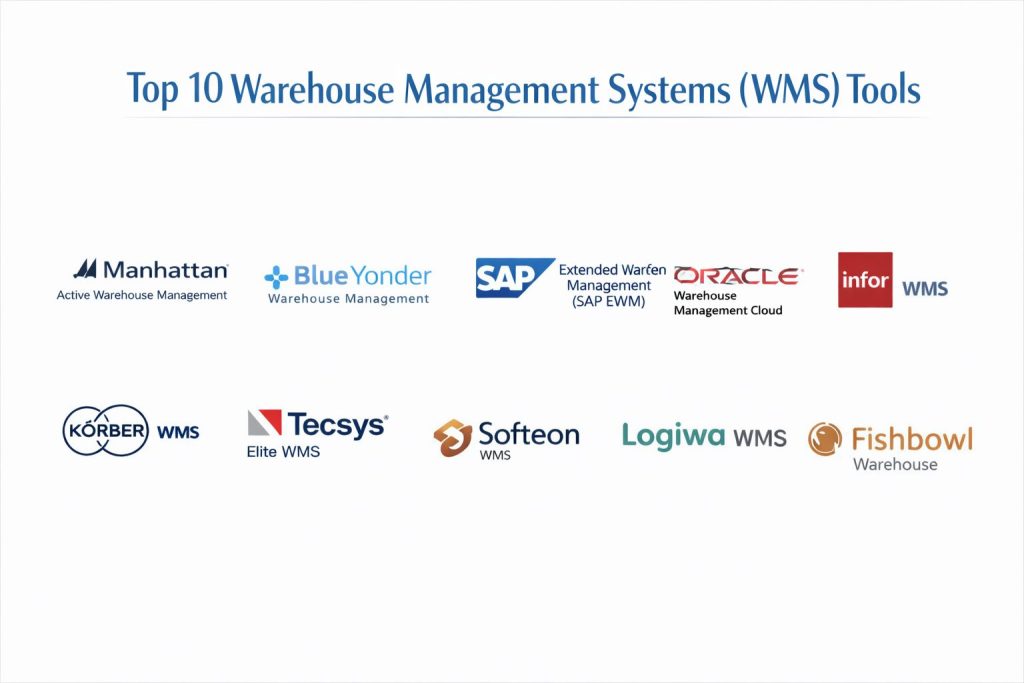
Top 10 Warehouse Management Systems (WMS)
1) Manhattan Active Warehouse Management
An enterprise-grade WMS designed for complex distribution and high-volume operations. Often chosen by large retailers and logistics networks that need advanced optimization and strong scalability.
Key Features
- Advanced picking, wave planning, and task orchestration for throughput
- Slotting and replenishment logic to reduce travel and improve pick rates
- Labor management and productivity tracking patterns (availability varies by package)
- Multi-site operational consistency with configurable process templates
- Exception handling for short picks, substitutions, and inventory variances
- Support for complex cartonization and packing workflows (depends on configuration)
- Integration patterns for automation and material handling layers (varies)
Pros
- Strong fit for high-volume and complex warehouse operations
- Mature process coverage with deep configurability for enterprise needs
Cons
- Implementation effort can be significant for teams without strong process maturity
- Cost and partner dependency can be higher than SMB-oriented platforms
Platforms / Deployment
- Web (operations and admin), Mobile devices (varies)
- Cloud / Hybrid (varies by contract)
Security & Compliance
- SSO/SAML, MFA, encryption, audit logs, RBAC: Not publicly stated
- SOC 2, ISO 27001, GDPR, HIPAA: Not publicly stated
Integrations & Ecosystem
Designed to connect with ERP, TMS, order management, and automation layers through enterprise integration patterns.
- ERP and order systems integration: Varies / N/A
- TMS integration: Varies / N/A
- Automation integration: Varies / N/A
- API and middleware patterns: Varies / N/A
Support & Community
Strong partner ecosystem and enterprise support models; onboarding quality depends on implementation partner and scope.
2) Blue Yonder Warehouse Management
A widely recognized WMS focused on scalable distribution operations and optimization. Often used by large supply chains that need strong planning, execution, and inventory control.
Key Features
- Wave, batch, and task logic for high-throughput fulfillment
- Inventory visibility with controls for lot, serial, and expiry (depends on setup)
- Replenishment and slotting support to reduce travel time
- Yard and dock process support patterns (availability varies)
- Exception management for operational disruptions
- Reporting and operational dashboards for performance tracking
- Integration patterns for broader supply chain planning workflows (varies)
Pros
- Strong fit for large distribution networks and complex fulfillment
- Mature functional depth for advanced operational needs
Cons
- Can be heavy for simpler warehouses with straightforward flows
- Implementation requires disciplined process design and testing
Platforms / Deployment
- Web, Mobile devices (varies)
- Cloud / Hybrid (varies by contract)
Security & Compliance
- SSO/SAML, MFA, encryption, audit logs, RBAC: Not publicly stated
- SOC 2, ISO 27001, GDPR, HIPAA: Not publicly stated
Integrations & Ecosystem
Commonly integrated with ERP, TMS, OMS, and analytics tools using enterprise integration layers.
- ERP integration: Varies / N/A
- TMS and carrier systems: Varies / N/A
- Automation systems: Varies / N/A
- APIs and middleware: Varies / N/A
Support & Community
Strong enterprise support channels and partner ecosystem; implementation experience varies by partner.
3) SAP Extended Warehouse Management (SAP EWM)
A warehouse execution solution often selected by organizations running SAP-centric landscapes. Best for manufacturing and distribution operations needing tight ERP alignment and detailed process control.
Key Features
- Deep receiving, putaway, picking, packing, and shipping flows
- Handling unit management patterns for controlled packing and movement
- Advanced warehouse structure modeling and storage type strategies
- Labor and resource planning patterns (availability varies by edition)
- Support for regulated inventory controls (depends on configuration)
- Strong integration story inside SAP environments
- Scales across multi-site operations with standardized process templates
Pros
- Strong alignment for organizations already standardized on SAP
- Deep configurability for complex warehouse and manufacturing needs
Cons
- Setup and process modeling can be complex and time-intensive
- Overkill for smaller warehouses without SAP-centered operations
Platforms / Deployment
- Web, Mobile devices (varies)
- Cloud / Self-hosted / Hybrid (varies by edition)
Security & Compliance
- SSO/SAML, MFA, encryption, audit logs, RBAC: Not publicly stated
- SOC 2, ISO 27001, GDPR, HIPAA: Not publicly stated
Integrations & Ecosystem
Designed for tight connectivity with SAP ERP and connected logistics components.
- SAP ERP integration: Varies / N/A
- TMS integration: Varies / N/A
- Automation and handheld ecosystems: Varies / N/A
- APIs and integration services: Varies / N/A
Support & Community
Large enterprise community and partner ecosystem; success depends on strong functional consulting and testing discipline.
4) Oracle Warehouse Management Cloud
A cloud-oriented WMS often used by organizations that want faster rollout and standardized processes. Suitable for multi-site distribution and companies looking for a cloud execution layer.
Key Features
- Cloud-based warehouse execution for receiving through shipping
- Directed picking and replenishment workflows for productivity
- Rules-based task orchestration with configurable strategies
- Visibility dashboards for operational status and exceptions
- Integration patterns with broader Oracle cloud supply chain products (varies)
- Multi-site control with shared configuration models (depends on setup)
- Support for mobile execution flows (device support varies)
Pros
- Cloud delivery can reduce infrastructure and simplify updates
- Strong for multi-site standardization with consistent rule sets
Cons
- Some deep niche processes may require careful configuration or workarounds
- Integration complexity depends on surrounding ERP and order systems
Platforms / Deployment
- Web, Mobile devices (varies)
- Cloud
Security & Compliance
- SSO/SAML, MFA, encryption, audit logs, RBAC: Not publicly stated
- SOC 2, ISO 27001, GDPR, HIPAA: Not publicly stated
Integrations & Ecosystem
Typically integrated with ERP, OMS, TMS, and e-commerce connectors using APIs and middleware.
- ERP integration: Varies / N/A
- OMS and order feeds: Varies / N/A
- TMS and carriers: Varies / N/A
- APIs and integration services: Varies / N/A
Support & Community
Enterprise-grade support options; implementation experience varies by partner and scope.
5) Infor WMS
A WMS frequently used in distribution and manufacturing contexts, especially where Infor ERP and supply chain components are present. Fits mid-market to enterprise warehouses with process depth needs.
Key Features
- Receiving, putaway, picking, packing, and shipping with configurable rules
- Wave management and task interleaving patterns for efficiency
- Slotting and replenishment support for warehouse optimization
- Visibility reporting and operational dashboards (varies by package)
- Support for multi-warehouse configurations and shared master data
- Integration patterns with ERP and order systems (depends on environment)
- Mobile workflows for floor execution (device support varies)
Pros
- Good balance of depth and configurability for complex warehouses
- Strong fit for organizations aligned with Infor supply chain stack
Cons
- Best outcomes require careful configuration and process governance
- Some deployments may rely heavily on partner expertise
Platforms / Deployment
- Web, Mobile devices (varies)
- Cloud / Self-hosted / Hybrid (varies)
Security & Compliance
- SSO/SAML, MFA, encryption, audit logs, RBAC: Not publicly stated
- SOC 2, ISO 27001, GDPR, HIPAA: Not publicly stated
Integrations & Ecosystem
Supports enterprise integration patterns with ERP, order flows, and shipping systems.
- ERP integrations: Varies / N/A
- TMS and carrier systems: Varies / N/A
- Middleware and API connectivity: Varies / N/A
- Automation integration: Varies / N/A
Support & Community
Established partner ecosystem and enterprise support options; onboarding depends on project scope and partner quality.
6) Körber WMS
A WMS used across diverse warehouse environments, including 3PL and distribution operations. Often selected for configurability and support for complex operational patterns.
Key Features
- Configurable receiving, putaway, picking, and shipping workflows
- Support for multi-client 3PL operations (availability varies by edition)
- Labor and task management patterns for floor productivity
- Rules engine support for allocation, replenishment, and wave planning
- Reporting and operational visibility tools (varies)
- Integration support for automation layers (varies)
- Extensibility for specialized warehouse processes (depends on setup)
Pros
- Strong fit for configurable warehouse operations and 3PL scenarios
- Good flexibility for varied warehouse styles and client requirements
Cons
- Implementation can be complex if scope is not tightly managed
- Some advanced needs may require partner-led customization
Platforms / Deployment
- Web, Mobile devices (varies)
- Cloud / Self-hosted / Hybrid (varies)
Security & Compliance
- SSO/SAML, MFA, encryption, audit logs, RBAC: Not publicly stated
- SOC 2, ISO 27001, GDPR, HIPAA: Not publicly stated
Integrations & Ecosystem
Often integrated with ERP, TMS, parcel systems, and automation layers.
- ERP integration: Varies / N/A
- TMS and carrier integrations: Varies / N/A
- Automation controls integration: Varies / N/A
- APIs and middleware: Varies / N/A
Support & Community
Strong implementation partner ecosystem; support tiers vary by contract.
7) Tecsys Elite WMS
A WMS often chosen for distribution operations that need strong execution control and industry-focused workflows. Fits organizations that prioritize inventory accuracy and standardized warehouse execution.
Key Features
- Directed picking and replenishment for consistent floor execution
- Inventory controls suitable for regulated and high-accuracy environments (depends on configuration)
- Wave and task logic to balance labor and throughput
- Multi-warehouse coordination patterns for distributed networks
- Reporting and performance visibility tools (varies)
- Integration options for ERP and order platforms (environment dependent)
- Mobile execution tools for warehouse operators (device support varies)
Pros
- Strong operational control for accuracy-focused environments
- Good fit for teams that want structured, standardized workflows
Cons
- Configuration requires clear process definition and strong testing
- May be heavier than needed for very small warehouses
Platforms / Deployment
- Web, Mobile devices (varies)
- Cloud / Hybrid (varies)
Security & Compliance
- SSO/SAML, MFA, encryption, audit logs, RBAC: Not publicly stated
- SOC 2, ISO 27001, GDPR, HIPAA: Not publicly stated
Integrations & Ecosystem
Designed to connect with ERP, OMS, and shipping ecosystems using standard integration patterns.
- ERP integration: Varies / N/A
- Order feeds and allocation: Varies / N/A
- Shipping and parcel systems: Varies / N/A
- APIs and middleware: Varies / N/A
Support & Community
Mid-to-enterprise support structure with implementation partners; community size varies by region and industry.
8) Softeon WMS
A configurable WMS used in distribution and fulfillment environments that need flexible process modeling. Suitable for warehouses with specialized flows and evolving requirements.
Key Features
- Configurable workflows for receiving through shipping
- Task-based mobile execution for floor operations (device support varies)
- Support for wave planning, replenishment, and inventory strategies
- Integration patterns for automation and material handling layers (varies)
- Reporting and analytics for throughput and accuracy tracking (varies)
- Multi-warehouse configurations with shared rules (depends on setup)
- Extensibility for specialized client or product requirements
Pros
- Flexible configuration for warehouses with unique operational needs
- Good fit for businesses expecting frequent process changes
Cons
- Flexibility can increase design effort if requirements are unclear
- Integration work may be meaningful depending on surrounding systems
Platforms / Deployment
- Web, Mobile devices (varies)
- Cloud / Self-hosted / Hybrid (varies)
Security & Compliance
- SSO/SAML, MFA, encryption, audit logs, RBAC: Not publicly stated
- SOC 2, ISO 27001, GDPR, HIPAA: Not publicly stated
Integrations & Ecosystem
Often used with ERP, TMS, shipping platforms, and automation layers via APIs and middleware.
- ERP integration: Varies / N/A
- Carrier and parcel integrations: Varies / N/A
- Automation integration: Varies / N/A
- API connectivity: Varies / N/A
Support & Community
Support depends on contract; implementation outcomes depend on partner and internal process maturity.
9) Logiwa WMS
A cloud-first WMS often used by e-commerce fulfillment and 3PL providers that want fast onboarding and standardized workflows. Strong fit for high order volumes with frequent daily changes.
Key Features
- Order-centric fulfillment workflows for e-commerce and 3PL operations
- Picking, packing, shipping flows optimized for small parcel operations
- Returns and exchange handling patterns (depends on configuration)
- Client billing and multi-client workflows for 3PLs (availability varies)
- Integration-friendly approach for storefronts, marketplaces, and shipping tools (varies)
- Dashboards for operational visibility and exception control
- Mobile workflows for warehouse execution (device support varies)
Pros
- Faster onboarding for many fulfillment-style use cases
- Strong fit for e-commerce and 3PL operations that need agility
Cons
- Some deep enterprise manufacturing flows may be limited or require workarounds
- Complex automation integration may require extra engineering effort
Platforms / Deployment
- Web, Mobile devices (varies)
- Cloud
Security & Compliance
- SSO/SAML, MFA, encryption, audit logs, RBAC: Not publicly stated
- SOC 2, ISO 27001, GDPR, HIPAA: Not publicly stated
Integrations & Ecosystem
Commonly integrates with storefronts, marketplaces, shipping systems, and ERPs through connectors and APIs.
- E-commerce platform integrations: Varies / N/A
- Shipping and label tools: Varies / N/A
- ERP integrations: Varies / N/A
- APIs and middleware: Varies / N/A
Support & Community
Implementation and support experience varies by plan; typically aligned with fulfillment-focused teams.
10) Fishbowl Warehouse
A WMS and inventory-focused solution commonly used by small businesses that need practical warehouse control without enterprise complexity. Best for SMBs needing better inventory visibility and warehouse execution basics.
Key Features
- Inventory tracking with location and movement control (depends on setup)
- Basic receiving, picking, packing, and shipping workflows
- Order and item management patterns suitable for SMB operations
- Barcode scanning support patterns (hardware compatibility varies)
- Reporting for inventory and operational visibility (varies)
- Integrations with accounting or ERP-style systems (varies)
- Practical workflow for smaller teams with limited IT support
Pros
- Easier adoption for SMB warehouses compared to enterprise WMS platforms
- Cost and setup effort can be more manageable for smaller operations
Cons
- May not scale well for high-complexity multi-site enterprise networks
- Advanced labor, slotting, and automation workflows can be limited
Platforms / Deployment
- Windows (others: Not publicly stated)
- Self-hosted (cloud options: Varies / N/A)
Security & Compliance
- SSO/SAML, MFA, encryption, audit logs, RBAC: Not publicly stated
- SOC 2, ISO 27001, GDPR, HIPAA: Not publicly stated
Integrations & Ecosystem
Typically integrates with SMB business systems for orders, inventory, and accounting workflows.
- Accounting and ERP-style integrations: Varies / N/A
- Shipping tool integrations: Varies / N/A
- API and connectors: Varies / N/A
Support & Community
SMB-oriented support and documentation; community presence varies by region.
Comparison Table (Top 10)
| Tool Name | Best For | Platform(s) Supported | Deployment (Cloud/Self-hosted/Hybrid) | Standout Feature | Public Rating |
|---|---|---|---|---|---|
| Manhattan Active Warehouse Management | Enterprise, high-volume distribution | Web (plus mobile varies) | Cloud / Hybrid (varies) | Advanced optimization and scalability | N/A |
| Blue Yonder Warehouse Management | Complex distribution networks | Web (plus mobile varies) | Cloud / Hybrid (varies) | Throughput-focused orchestration | N/A |
| SAP Extended Warehouse Management (SAP EWM) | SAP-centered enterprise warehouses | Web (plus mobile varies) | Cloud / Self-hosted / Hybrid (varies) | Tight SAP landscape alignment | N/A |
| Oracle Warehouse Management Cloud | Standardized cloud execution | Web (plus mobile varies) | Cloud | Cloud-first process standardization | N/A |
| Infor WMS | Mid-market to enterprise distribution | Web (plus mobile varies) | Cloud / Self-hosted / Hybrid (varies) | Balanced depth and configurability | N/A |
| Körber WMS | Configurable warehouses and 3PL | Web (plus mobile varies) | Cloud / Self-hosted / Hybrid (varies) | Flexible workflows for varied operations | N/A |
| Tecsys Elite WMS | Accuracy-driven distribution operations | Web (plus mobile varies) | Cloud / Hybrid (varies) | Structured execution control | N/A |
| Softeon WMS | Specialized, evolving warehouse flows | Web (plus mobile varies) | Cloud / Self-hosted / Hybrid (varies) | Configurability for unique processes | N/A |
| Logiwa WMS | E-commerce fulfillment and 3PL | Web (plus mobile varies) | Cloud | Fast onboarding for fulfillment workflows | N/A |
| Fishbowl Warehouse | SMB inventory and basic warehouse execution | Windows | Self-hosted (cloud varies) | Practical SMB warehouse control | N/A |
Evaluation & Scoring of Warehouse Management Systems (WMS)
Weights: Core features 25%, Ease of use 15%, Integrations and ecosystem 15%, Security and compliance 10%, Performance and reliability 10%, Support and community 10%, Price and value 15%.
| Tool Name | Core (25%) | Ease (15%) | Integrations (15%) | Security (10%) | Performance (10%) | Support (10%) | Value (15%) | Weighted Total (0–10) |
|---|---|---|---|---|---|---|---|---|
| Manhattan Active Warehouse Management | 9.5 | 7.0 | 9.0 | 6.5 | 9.0 | 8.0 | 6.5 | 8.11 |
| Blue Yonder Warehouse Management | 9.0 | 6.5 | 8.5 | 6.5 | 8.5 | 7.5 | 6.5 | 7.77 |
| SAP Extended Warehouse Management (SAP EWM) | 9.0 | 6.0 | 8.5 | 7.0 | 8.0 | 7.5 | 6.0 | 7.58 |
| Oracle Warehouse Management Cloud | 8.5 | 7.0 | 8.0 | 6.5 | 8.0 | 7.0 | 6.5 | 7.55 |
| Infor WMS | 8.5 | 7.0 | 8.0 | 6.5 | 8.0 | 7.0 | 7.0 | 7.63 |
| Körber WMS | 8.0 | 6.5 | 7.5 | 6.0 | 7.5 | 7.0 | 7.0 | 7.20 |
| Tecsys Elite WMS | 8.0 | 7.0 | 7.5 | 6.5 | 7.5 | 7.0 | 7.0 | 7.35 |
| Softeon WMS | 7.5 | 6.5 | 7.5 | 6.0 | 7.5 | 6.5 | 7.0 | 7.03 |
| Logiwa WMS | 7.5 | 8.0 | 7.5 | 6.0 | 7.5 | 6.5 | 7.5 | 7.45 |
| Fishbowl Warehouse | 6.5 | 8.0 | 6.0 | 5.5 | 6.5 | 6.0 | 8.0 | 6.83 |
How to interpret the scores:
- These totals compare options inside this list, not the entire WMS market.
- Higher totals usually indicate broader fit across multiple warehouse scenarios.
- Ease and value can matter more than depth for smaller teams moving fast.
- Security scoring is limited because public detail varies and environments differ.
- Always validate by piloting with real orders, real SKUs, and real floor workflows.
Which Warehouse Management System (WMS) Is Right for You?
Small business / single warehouse
If you need solid inventory visibility and basic warehouse execution without heavy implementation overhead, Fishbowl Warehouse can be a practical starting point. If you are fulfillment-heavy and need faster onboarding with cloud operations, Logiwa WMS can be a better match. For smaller teams, prioritize clear handheld workflows, simple replenishment rules, and low-friction integrations with your order sources.
SMB
SMBs that ship daily and need stronger picking control often benefit from Logiwa WMS for fulfillment-style operations. If you have more structured distribution needs and want more process control, Tecsys Elite WMS or Softeon WMS can be good options depending on complexity. Focus on measurable improvements: pick accuracy, time-to-ship, and inventory variance reduction.
Mid-market
Mid-market operations usually need multi-warehouse support, stronger task orchestration, and deeper exception handling. Infor WMS, Körber WMS, Tecsys Elite WMS, and Softeon WMS are often evaluated here. Choose based on warehouse style: retail DC, manufacturing warehouse, or 3PL. Also validate how easily you can change rules without risky customization.
Enterprise
Enterprises usually need advanced wave logic, automation readiness, multi-site standardization, and strong operational reporting. Manhattan Active Warehouse Management, Blue Yonder Warehouse Management, SAP Extended Warehouse Management (SAP EWM), and Oracle Warehouse Management Cloud are common enterprise evaluations. The best choice depends on ERP alignment, global rollout needs, and how you handle automation and labor planning.
Budget vs Premium
Budget-focused teams should optimize for adoption speed, usable handheld flows, and predictable integrations. Premium solutions can deliver higher throughput and deeper optimization, but only if your processes are disciplined and your implementation is well governed.
Feature depth vs ease of use
If your warehouse is simple, ease and adoption matter most. If you run multiple zones, complex replenishment, high SKU counts, and automation, depth becomes more important than easy setup. Match the tool to operational complexity rather than future imagination.
Integrations and scalability
WMS success depends heavily on clean integrations: ERP for inventory and finance, OMS for orders, TMS or carriers for shipping, and automation controls if present. Validate integration behavior early, especially around order changes, cancellations, partial shipments, and returns.
Security and compliance needs
Many security controls depend on your identity system, device management, network controls, and data governance practices. Where vendor compliance detail is not publicly stated, treat it as unknown and confirm via procurement checks and controlled pilot testing.
Frequently Asked Questions (FAQs)
1) What is a WMS and how is it different from an inventory system?
A WMS runs warehouse execution: receiving, putaway, picking, packing, shipping, and task control. Inventory systems usually track quantities, but often lack floor-level directed workflows and operational optimization.
2) How long does WMS implementation typically take?
It depends on warehouse complexity, integrations, and process maturity. Simple single-site rollouts can be faster, while multi-site and automation-heavy projects require more time for design, testing, and training.
3) What are the most common WMS implementation mistakes?
Rushing requirements, skipping floor pilots, not cleaning master data, and undertraining operators. Another frequent issue is over-customizing early instead of using standard workflows first.
4) Should I choose cloud or self-hosted deployment?
Cloud can simplify upgrades and reduce infrastructure effort, while self-hosted can be preferred for certain internal governance models. The best choice depends on IT capacity, integration constraints, and change management needs.
5) What integrations should I prioritize first?
Start with ERP inventory sync, order feed from OMS or e-commerce, and shipping label or carrier integration. After that, focus on returns, billing, and analytics once core execution is stable.
6) Does a WMS support barcode and RFID workflows?
Many do, but the depth varies by device, process, and configuration. Validate scanning flows for receiving, picking, packing validation, and cycle counts using your real hardware plan.
7) Can a WMS handle lot, serial, and expiry control?
Many enterprise and mid-market options support these controls, but configuration matters. Confirm that your required compliance flows, holds, and traceability reports are achievable in your target design.
8) How do I measure WMS success after go-live?
Track pick accuracy, order cycle time, on-time shipment rate, inventory variance, labor productivity, and return handling speed. Compare against a stable baseline from before rollout.
9) What is the best WMS for 3PL operations?
3PL needs include multi-client separation, billing support patterns, and flexible workflows by client. Körber WMS and Logiwa WMS are often considered, but the best fit depends on client complexity and integration requirements.
10) How do I shortlist a WMS safely?
Pick two or three tools, run a pilot using real SKUs and real orders, test integrations end-to-end, and validate floor usability with operators. Only then decide on standardization and rollout sequencing.
Conclusion
A WMS becomes valuable when it turns warehouse operations into consistent, measurable execution instead of manual work and guesswork. The best choice depends on your warehouse style, order volume, complexity, and how tightly you must integrate with ERP, shipping, and automation systems. Enterprise networks often lean toward Manhattan Active Warehouse Management, Blue Yonder Warehouse Management, SAP Extended Warehouse Management (SAP EWM), or Oracle Warehouse Management Cloud for scale and standardization. Mid-market teams commonly evaluate Infor WMS, Körber WMS, Tecsys Elite WMS, and Softeon WMS for a balance of depth and flexibility. Fulfillment-first teams may prefer Logiwa WMS, while SMBs can start with Fishbowl Warehouse. Shortlist two or three options, pilot with real workflows, validate integrations, and train floor teams early.