Introduction
Utility billing software is a specialized category of enterprise resource planning (ERP) tools designed to automate the complex lifecycle of meter-to-cash processes. These platforms serve as the operational core for water, gas, electricity, and waste management providers, enabling them to manage large-scale data from physical or smart meters and convert it into accurate financial statements. In a modern utility environment, these systems are no longer just calculators; they are sophisticated data hubs that integrate with Geographic Information Systems (GIS), Advanced Metering Infrastructure (AMI), and customer relationship management (CRM) modules. By automating usage calculations, rate applications, and payment collections, these tools eliminate the high margin of error associated with manual utility accounting.
The strategic implementation of these platforms is essential for operational resilience and regulatory compliance. As infrastructure modernizes, utilities must transition from legacy flat-rate billing to dynamic, time-of-use models that encourage resource conservation. A robust billing platform provides the transparency required for public audits while offering consumers digital portals to manage their own consumption. When selecting a utility billing partner, decision-makers must prioritize the software’s ability to handle complex tariff structures, its security posture regarding sensitive consumer data, and its capacity to integrate with existing field-service hardware. A well-integrated system ensures that the flow of data from the meter to the final ledger is seamless, secure, and verifiable.
Best for: Municipalities, cooperative utilities, sub-billing entities, property management firms, and private energy providers requiring automated usage-based invoicing and customer management.
Not ideal for: General retail businesses or service-based companies that do not deal with metered resources or complex commodity rate structures. Standard accounting software is typically sufficient for non-utility recurring billing.
Key Trends in Utility Billing Software
The most significant trend in the sector is the move toward cloud-native architectures that allow utility providers to scale their operations without investing in heavy on-premise server infrastructure. There is an increasing integration of artificial intelligence for predictive analytics, allowing providers to identify potential leaks or grid anomalies by analyzing consumption patterns in real-time. Smart meter integration through Advanced Metering Infrastructure has become the baseline requirement, enabling two-way communication between the utility and the consumer’s home.
Customer self-service has also seen a massive overhaul, with mobile-first portals that allow users to pay bills via digital wallets and receive real-time alerts about outages or high usage. We are also seeing a shift toward “multi-service” billing, where water, electric, and waste services are consolidated into a single unified invoice, simplifying the experience for the end-user. Furthermore, security protocols have tightened significantly, with platforms adopting zero-trust frameworks to protect critical national infrastructure and consumer privacy against increasingly sophisticated cyber threats.
How We Selected These Tools
The selection of these top ten platforms was based on a rigorous assessment of their technical maturity and their proven performance in the public and private utility sectors. We prioritized software that demonstrates high interoperability with various meter brands and hardware protocols, ensuring that providers are not locked into a single equipment vendor. Market longevity and the reliability of the developer’s support infrastructure were also key factors, as utility systems are long-term investments that require consistent updates.
Technical evaluation focused on the flexibility of the rate engine—specifically its ability to handle tiered pricing and regulatory-mandated adjustments. We scrutinized the security features of each platform, looking for robust encryption, multi-factor authentication, and compliance with financial auditing standards. We also considered the user experience for both the utility staff and the end-consumer, favoring platforms that offer intuitive dashboards and streamlined payment workflows. Finally, the ability to generate detailed regulatory reports and financial exports for secondary accounting systems was a prerequisite for inclusion.
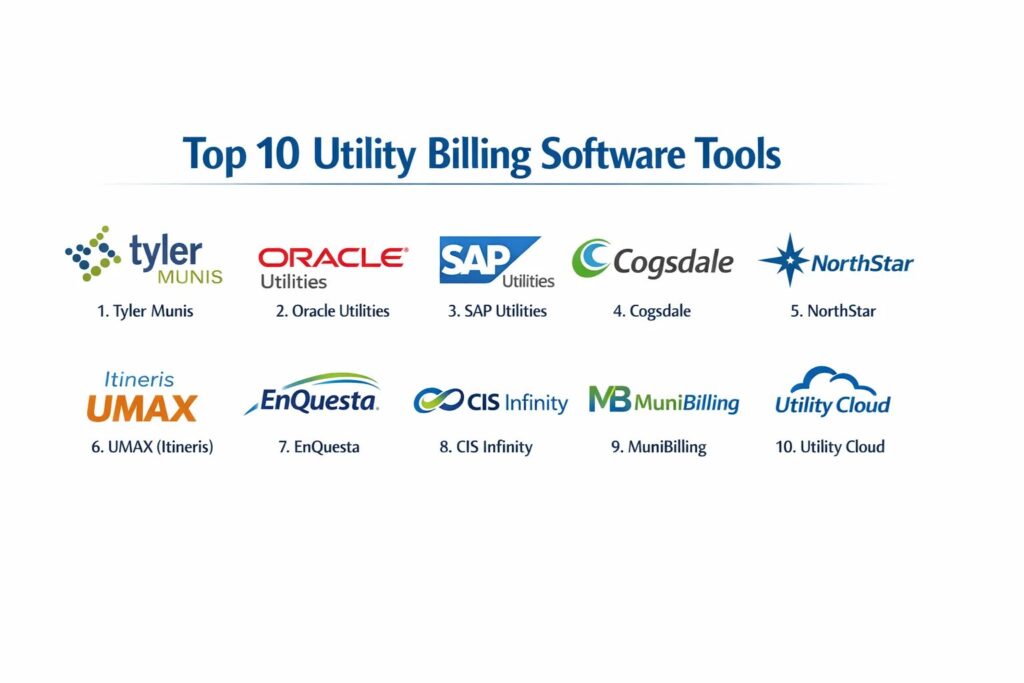
1. Tyler Technologies (Munis)
Tyler Technologies provides one of the most comprehensive utility billing solutions specifically tailored for public sector municipalities and local governments. As part of their broader ERP suite, the utility module integrates deeply with financial and citizen services, providing a 360-degree view of municipal operations.
Key Features
The platform features a robust “meter-to-cash” workflow that automates the entire billing cycle from initial reading to final payment. It includes an integrated work order management system that allows teams to dispatch field technicians directly from the billing interface. The software supports complex rate structures, including seasonal and tiered pricing models. Its citizen transparency portal allows residents to view historical usage data and manage their accounts online. Additionally, it offers automated delinquent account processing, including shut-off notices and payment plan management.
Pros
Exceptional integration with municipal financial systems ensures that utility revenue is perfectly synced with the general ledger. The company has a massive support infrastructure dedicated specifically to public sector needs.
Cons
The software is highly complex and typically requires a significant implementation period. The cost and resource requirements make it better suited for larger municipalities than small cooperatives.
Platforms and Deployment
Available as a cloud-hosted SaaS solution or on-premise deployment depending on municipal requirements.
Security and Compliance
Features enterprise-grade security including SOC 2 compliance, advanced encryption, and comprehensive audit trails for regulatory transparency.
Integrations and Ecosystem
Integrates natively with the full Tyler Technologies ERP suite and supports a wide range of AMI and AMR meter reading hardware.
Support and Community
Offers extensive training through Tyler University and provides a dedicated professional services team for implementation and ongoing support.
2. Oracle Utilities
Oracle Utilities is a global leader in providing mission-critical solutions for the world’s largest energy and water providers. Their Customer Cloud Service (CCS) is a highly scalable platform designed to handle millions of service points with extreme precision and speed.
Key Features
The platform utilizes a high-performance billing engine capable of processing massive volumes of meter data for time-of-use and real-time pricing. It features a sophisticated customer management module that uses AI to provide “next best action” recommendations for service representatives. The system includes built-in analytics for demand-side management and energy efficiency programs. It provides a modern, responsive customer self-service portal that supports various digital payment methods. The platform is built on a modular architecture, allowing utilities to add specific features for field service or asset management as needed.
Pros
Unrivaled scalability makes it the standard for large-scale investor-owned utilities. The deep analytics capabilities allow for sophisticated load forecasting and revenue protection.
Cons
The platform represents a major investment in both licensing and specialized personnel to manage the system. It may be overly complex for small to medium-sized utility providers.
Platforms and Deployment
Primarily delivered as a cloud-native SaaS platform with high availability and disaster recovery built-in.
Security and Compliance
Adheres to the highest international security standards, including ISO 27001 and specialized energy sector cybersecurity frameworks.
Integrations and Ecosystem
Extensive integration capabilities with the broader Oracle ecosystem and a wide variety of third-party smart grid technologies.
Support and Community
Provides global 24/7 support and a massive ecosystem of certified implementation partners and technical consultants.
3. SAP for Utilities
SAP for Utilities is an industry-specific solution that provides a centralized platform for managing all aspects of a utility business, from smart grid operations to financial accounting. It is favored by large multinational energy companies that require a unified global system.
Key Features
The software features an advanced Meter Data Management (MDM) system that handles data from millions of smart meters in real-time. It includes a specialized module for contract accounting that manages complex billing scenarios and high-volume payment processing. The platform provides a comprehensive view of the customer lifecycle, including sales, service, and billing. Its integrated analytics tools help utilities optimize their supply chains and manage regulatory compliance across different regions. It also supports “prosumer” scenarios, where customers both consume and contribute energy back to the grid.
Pros
Provides a truly integrated end-to-end business process that eliminates data silos between different departments. The system is highly customizable to meet specific regulatory requirements in any country.
Cons
Implementation is a massive undertaking that often requires significant organizational change management. The user interface can be technical and requires comprehensive staff training.
Platforms and Deployment
Available through SAP S/4HANA as a cloud, on-premise, or hybrid deployment.
Security and Compliance
Includes robust governance, risk, and compliance (GRC) tools and adheres to global standards for data protection and financial reporting.
Integrations and Ecosystem
Deeply integrated with the SAP enterprise ecosystem and supports wide-ranging industrial IoT and smart meter integrations.
Support and Community
Offers a vast network of global support, an active user community, and extensive technical documentation.
4. Cogsdale
Cogsdale provides a specialized utility billing and customer information system (CIS) built on the Microsoft Dynamics platform. It is particularly popular among mid-sized utilities and municipalities that want a familiar, Windows-based environment with deep financial integration.
Key Features
The system offers a unified environment for billing, financial management, and work orders. It features a flexible rate engine that can easily handle water, sewer, electric, and gas services on a single bill. The software includes a robust customer portal that allows for online payments and usage tracking. It provides specialized tools for managing service connections and disconnections based on payment status. The platform also features built-in reporting tools that allow staff to create custom financial and operational reports without needing specialized IT skills.
Pros
The integration with Microsoft Dynamics makes it very intuitive for staff already familiar with Microsoft products. It provides an excellent balance of features and ease of use for mid-sized organizations.
Cons
The platform’s performance can be dependent on the underlying Dynamics environment. It may not offer the extreme scalability required by the very largest national utility providers.
Platforms and Deployment
Available for both on-premise and cloud-hosted environments.
Security and Compliance
Leverages Microsoft’s enterprise security framework and includes internal controls for financial auditing.
Integrations and Ecosystem
Strongest integration is with Microsoft Dynamics and Office 365, along with support for major meter reading technologies.
Support and Community
Provides dedicated project management for implementation and ongoing technical support through a North American-based team.
5. Harris Utilities (NorthStar)
NorthStar, a division of Harris Utilities, is a dedicated Customer Information System (CIS) designed specifically for the needs of utility providers. It focuses on improving customer engagement while ensuring billing accuracy and operational efficiency.
Key Features
The platform features a highly configurable billing engine that supports a wide variety of utility types and complex rate schedules. It includes a comprehensive customer service module that provides staff with a complete history of interactions and billing data. The system offers an advanced customer engagement portal with features for paperless billing and automated payment reminders. It provides specialized tools for managing meter inventory and tracking maintenance schedules. The platform also includes a robust “Collections” module that automates the process of identifying and managing overdue accounts.
Pros
The software is designed by utility professionals for utility professionals, resulting in a very logical and efficient workflow. It is known for its high level of configurability without requiring custom coding.
Cons
The specialized nature of the tool means it may require additional work to integrate with non-standard third-party financial systems. The interface, while functional, is more traditional in design.
Platforms and Deployment
Flexible deployment options including local servers or a fully managed cloud environment.
Security and Compliance
Includes standard role-based access controls and is designed to meet the auditing requirements of public and private utility boards.
Integrations and Ecosystem
Supports a wide array of meter vendors and integrates with various third-party payment processors and GIS systems.
Support and Community
Offers a dedicated customer support portal, regular user group meetings, and a comprehensive knowledge base.
6. Itineris (UMAX)
UMAX by Itineris is a modern CIS and ERP solution built on the Microsoft Dynamics 365 platform. It is designed to help utility companies transform into agile, customer-centric organizations while optimizing their core billing processes.
Key Features
The platform provides an end-to-end view of the utility business, from asset management to customer service. It features a modern, web-based interface that is accessible from any device. The system includes advanced tools for managing “smart” energy services and demand-response programs. It provides a robust analytics engine that helps utilities identify operational efficiencies and improve revenue collection. The platform also features a highly flexible billing engine that can handle complex multi-utility and multi-commodity scenarios.
Pros
Leverages the power of the Microsoft Azure cloud for high scalability and reliability. The modern user interface significantly reduces the training time for new staff members.
Cons
As a high-end enterprise solution, it may be outside the budget of very small rural cooperatives. Implementation requires a partner with deep expertise in both Dynamics 365 and the utility sector.
Platforms and Deployment
Cloud-native solution built on the Microsoft Dynamics 365 and Azure platforms.
Security and Compliance
Benefit from Microsoft’s multi-billion dollar investment in cybersecurity and compliance, including GDPR and SOC certifications.
Integrations and Ecosystem
Seamlessly integrates with the entire Microsoft stack and a wide variety of utility-specific IoT and AMI technologies.
Support and Community
Provides global support and a dedicated success manager for enterprise-level clients.
7. EnQuesta (Systems & Software)
EnQuesta is a sophisticated CIS and billing solution developed by Systems & Software, a division of Harris Utilities. It is specifically designed to meet the rigorous demands of large water and electric utilities that require high-performance data processing.
Key Features
The platform features a high-speed billing engine that can handle millions of transactions with extreme accuracy. It includes a specialized module for managing “Complex Billing” for industrial and commercial customers. The system provides a comprehensive customer portal that supports high-volume payment processing and detailed usage visualizations. It features integrated work order and asset management tools that streamline field operations. The platform also includes a robust reporting suite that provides deep insights into revenue trends and operational performance.
Pros
Known for its exceptional reliability in high-volume environments. The software provides an extremely detailed level of control over every aspect of the billing and customer service lifecycle.
Cons
The depth of the feature set can lead to a more complex setup and configuration phase. It is primarily focused on the North American utility market.
Platforms and Deployment
Available as an on-premise solution or through a managed cloud service.
Security and Compliance
Includes advanced security features to protect consumer data and ensure compliance with public utility commission requirements.
Integrations and Ecosystem
Supports integration with a vast range of AMI/AMR systems, GIS platforms, and external financial packages.
Support and Community
Provides a dedicated support team and an active community of users who collaborate on best practices.
8. Advanced Utility Systems (CIS Infinity)
CIS Infinity is a flagship utility billing solution designed for water, electric, and gas providers. It focuses on providing a user-friendly interface that empowers utility staff to manage complex customer data and billing cycles with ease.
Key Features
The platform features a highly intuitive “Point-and-Click” interface that simplifies navigation and data entry. It includes a robust rate engine that can be configured for virtually any tariff structure without technical assistance. The system provides a comprehensive customer portal that supports self-service features like electronic billing and payment history. It features integrated tools for managing meter changes and testing. The platform also includes a powerful automated notification system that can send alerts via email, text, or voice.
Pros
The software is widely praised for its ease of use and the speed with which staff can become proficient. It offers excellent flexibility for mid-sized utilities with limited IT staff.
Cons
While it handles mid-sized loads perfectly, it may lack some of the extreme high-volume processing features found in SAP or Oracle. Some advanced features may require separate module licensing.
Platforms and Deployment
Offers cloud-hosted, web-based, and traditional on-premise installation options.
Security and Compliance
Adheres to industry-standard security protocols and provides detailed logging for financial and operational audits.
Integrations and Ecosystem
Extensive list of pre-built integrations with meter reading hardware, payment gateways, and financial software.
Support and Community
Provides a comprehensive training program and a responsive support team known for their deep utility domain knowledge.
9. MuniBilling
MuniBilling is a cloud-based utility billing platform designed specifically for small to medium-sized cities, towns, and private utility companies. It focuses on making complex utility billing accessible and affordable for organizations with smaller budgets.
Key Features
The platform offers a streamlined, web-based interface that can be accessed from any location. It features an easy-to-use rate builder that supports unlimited service types and tiered pricing. The system includes a secure online payment portal for customers and a mobile-friendly interface for field staff. It provides automated data import for meter readings and supports various hand-held reading devices. The software also features a “billing as a service” option where their team can handle the actual printing and mailing of bills.
Pros
The subscription-based pricing makes it highly accessible for small municipalities and HOAs. The setup process is significantly faster than traditional enterprise CIS systems.
Cons
It lacks the deep ERP and asset management integrations found in larger suites like Tyler Munis. It is not designed for the extreme scale of major metropolitan utility providers.
Platforms and Deployment
Purely cloud-based SaaS platform accessible via any modern web browser.
Security and Compliance
Utilizes secure cloud hosting with encrypted data transmission and standard financial security protections.
Integrations and Ecosystem
Supports standard meter reading files and integrates with common payment processors like PayPal and Stripe.
Support and Community
Offers personalized onboarding and a responsive help desk geared toward non-technical municipal staff.
10. Utility Cloud
Utility Cloud is a modern, operations-focused platform that combines asset management with utility billing. It is designed for providers who want to move away from legacy systems toward a more data-driven, mobile-centric approach to utility management.
Key Features
The platform features a powerful GIS-centric interface that allows staff to view billing data and asset locations on a map. It includes specialized tools for tracking regulatory compliance and environmental reporting. The system provides a mobile app for field staff that allows for real-time data entry and photo documentation. It features a flexible billing engine that integrates directly with field data for high accuracy. The platform also includes automated workflow tools that can trigger maintenance tasks based on usage thresholds or time intervals.
Pros
The GIS integration provides a unique and powerful way to manage utility operations visually. It is exceptionally strong in field service and asset management scenarios.
Cons
The billing module, while capable, is often seen as secondary to the platform’s asset management and operational features. It may require more configuration for complex commodity trading.
Platforms and Deployment
Cloud-native SaaS platform designed for high mobility and field use.
Security and Compliance
Provides robust data security and is designed to help utilities meet strict environmental and operational regulations.
Integrations and Ecosystem
Excellent integration with GIS platforms like Esri and various IoT-enabled field sensors and meters.
Support and Community
Offers a modern support experience with detailed video tutorials, live chat, and a focus on operational success.
Comparison Table
| Tool Name | Best For | Platform(s) Supported | Deployment | Standout Feature | Public Rating |
| 1. Tyler Munis | Large Municipalities | Web, Windows | Hybrid | Integrated Munis ERP | 4.4/5 |
| 2. Oracle Utilities | Tier-1 Global Utilities | Web, API | Cloud | High-Scale AI Engine | 4.6/5 |
| 3. SAP Utilities | Multinational Energy | Web, API | Hybrid | Global Financial GRC | 4.5/5 |
| 4. Cogsdale | Mid-market MS Users | Windows, Web | Hybrid | Dynamics Financial Link | 4.2/5 |
| 5. NorthStar | Dedicated CIS Needs | Web, Windows | Hybrid | Highly Configurable Engine | 4.3/5 |
| 6. UMAX (Itineris) | Modern D365 Users | Web, API | Cloud | Azure-native Analytics | 4.5/5 |
| 7. EnQuesta | High-Volume Water/Elec | Web, Windows | Hybrid | Complex Industrial Billing | 4.4/5 |
| 8. CIS Infinity | Ease of Use/Mid-sized | Web, Windows | Hybrid | Intuitive UI Workflow | 4.5/5 |
| 9. MuniBilling | Small Cities/HOAs | Web | Cloud | Billing-as-a-Service | 4.7/5 |
| 10. Utility Cloud | Operations/GIS Focus | Web, Mobile | Cloud | GIS-Centric Asset View | 4.3/5 |
Evaluation & Scoring of Utility Billing Software
The scoring below is a comparative model intended to help shortlisting. Each criterion is scored from 1–10, then a weighted total from 0–10 is calculated using the weights listed. These are analyst estimates based on typical fit and common workflow requirements, not public ratings.
Weights:
- Core features – 25%
- Ease of use – 15%
- Integrations & ecosystem – 15%
- Security & compliance – 10%
- Performance & reliability – 10%
- Support & community – 10%
- Price / value – 15%
| Tool Name | Core (25%) | Ease (15%) | Integrations (15%) | Security (10%) | Performance (10%) | Support (10%) | Value (15%) | Weighted Total |
| 1. Tyler Munis | 10 | 6 | 10 | 9 | 9 | 9 | 7 | 8.65 |
| 2. Oracle Utilities | 10 | 5 | 10 | 10 | 10 | 10 | 5 | 8.75 |
| 3. SAP Utilities | 10 | 4 | 10 | 10 | 10 | 10 | 5 | 8.60 |
| 4. Cogsdale | 8 | 8 | 9 | 8 | 8 | 8 | 8 | 8.15 |
| 5. NorthStar | 9 | 7 | 8 | 9 | 9 | 9 | 8 | 8.50 |
| 6. UMAX (Itineris) | 9 | 8 | 10 | 10 | 9 | 9 | 7 | 8.75 |
| 7. EnQuesta | 9 | 7 | 8 | 9 | 10 | 9 | 8 | 8.60 |
| 8. CIS Infinity | 8 | 10 | 8 | 8 | 8 | 10 | 8 | 8.70 |
| 9. MuniBilling | 7 | 10 | 7 | 8 | 7 | 9 | 10 | 8.20 |
| 10. Utility Cloud | 8 | 8 | 9 | 9 | 8 | 8 | 8 | 8.25 |
How to interpret the scores:
- Use the weighted total to shortlist candidates, then validate with a pilot.
- A lower score can mean specialization, not weakness.
- Security and compliance scores reflect controllability and governance fit, because certifications are often not publicly stated.
- Actual outcomes vary with assembly size, team skills, templates, and process maturity.
Which Utility Billing Software Tool Is Right for You?
Solo / Freelancer
While individuals rarely operate utilities, small sub-metering contractors or independent property managers should look toward MuniBilling. Its low barrier to entry and straightforward pricing make it ideal for managing a small number of service points without needing a dedicated IT department.
SMB
Small to medium-sized cooperatives and private energy providers will find the best balance in CIS Infinity or MuniBilling. These platforms prioritize ease of use and rapid deployment, allowing smaller teams to manage billing and customer service efficiently without being overwhelmed by enterprise-level complexity.
Mid-Market
Mid-sized municipalities and utility boards are best served by Cogsdale or NorthStar. These platforms offer the depth required to handle multiple service types (water, gas, electric) and complex rate structures while maintaining a reasonable total cost of ownership and manageable implementation timelines.
Enterprise
For state-level or investor-owned utilities, Oracle Utilities, SAP, or Itineris (UMAX) are the only viable options. These systems are built to process the massive datasets generated by millions of smart meters and provide the high-performance analytics required for grid management and regulatory reporting.
Budget vs Premium
MuniBilling is the clear leader for budget-conscious organizations, offering a powerful feature set for a fraction of the cost of traditional suites. On the premium end, SAP and Oracle represent the highest investment but provide unmatched capabilities for global utility operations.
Feature Depth vs Ease of Use
If ease of use is the primary goal for your staff, CIS Infinity is widely regarded as the most intuitive professional suite. For organizations that require extreme feature depth and the ability to customize every workflow, Tyler Munis or EnQuesta provide the most comprehensive configuration options.
Integrations & Scalability
For utilities that are heavily invested in the Microsoft ecosystem, UMAX or Cogsdale offer the most seamless integration. For those requiring massive scalability across diverse geographical regions, SAP and Oracle provide the most robust infrastructure.
Security & Compliance Needs
All listed enterprise tools meet high security standards, but for public sector organizations with strict governmental auditing requirements, Tyler Technologies (Munis) offers a specifically tailored compliance framework that aligns with municipal financial regulations.
Frequently Asked Questions (FAQs)
1. What is the difference between AMR and AMI?
AMR (Automated Meter Reading) is a one-way communication where data is collected by a passing vehicle or handheld device. AMI (Advanced Metering Infrastructure) is two-way communication that allows for real-time data flow and remote service commands.
2. Can utility billing software handle time-of-use pricing?
Yes, modern utility platforms are specifically designed to handle dynamic rate structures. This allows providers to charge different rates based on the time of day or peak demand periods to help manage grid load.
3. How long does a typical software implementation take?
For small cloud-based systems like MuniBilling, setup can take a few weeks. For large enterprise systems like SAP or Tyler Munis, a full implementation often takes 12 to 24 months due to data migration and staff training.
4. Does the software integrate with my existing meters?
Most professional utility software is “meter agnostic,” meaning it can import data from almost any hardware vendor. However, you should always verify that the software supports the specific file formats used by your reading devices.
5. How is customer data protected in these systems?
Enterprise utility software uses advanced encryption for data at rest and in transit. They also include role-based access controls to ensure that only authorized personnel can view sensitive customer information or financial records.
6. Can consumers pay their bills through the software?
Yes, almost all modern utility platforms include a customer portal. These portals allow users to pay via credit card, ACH, or digital wallets, and many support recurring auto-payments to improve collection rates.
7. Is utility billing software the same as a general ERP?
No, while some ERPs have utility modules, specialized utility billing software includes specific logic for meter reading, commodity rates, and regulatory reporting that standard accounting software lacks.
8. Can the software help detect water leaks?
Many platforms now include consumption analytics that flag unusual usage patterns. If a meter shows continuous flow over a 24-hour period, the system can automatically alert the customer or the utility staff to a potential leak.
9. What happens if the internet goes down?
Cloud-based systems require an internet connection, but most have offline data collection tools for field staff. For mission-critical operations, many utilities choose hybrid deployments to maintain local access during outages.
10. How much does utility billing software cost?
Pricing varies wildly based on the number of service points and required features. Small providers might pay a few hundred dollars a month for SaaS, while large utilities spend millions on licensing and implementation.
Conclusion
The selection of a utility billing platform is a decade-long commitment that directly impacts both the financial health of the provider and the satisfaction of the consumer. In the current landscape defined by smart infrastructure and heightened security expectations, the “best” software is the one that transforms raw meter data into actionable operational intelligence. Whether you are a small municipality transitioning away from paper ledgers or a large-scale energy provider managing a complex smart grid, your choice must prioritize interoperability and the flexibility to adapt to changing environmental regulations. The transition to a modern, data-driven billing environment is no longer optional; it is the fundamental prerequisite for delivering reliable, transparent, and sustainable utility services to the public.