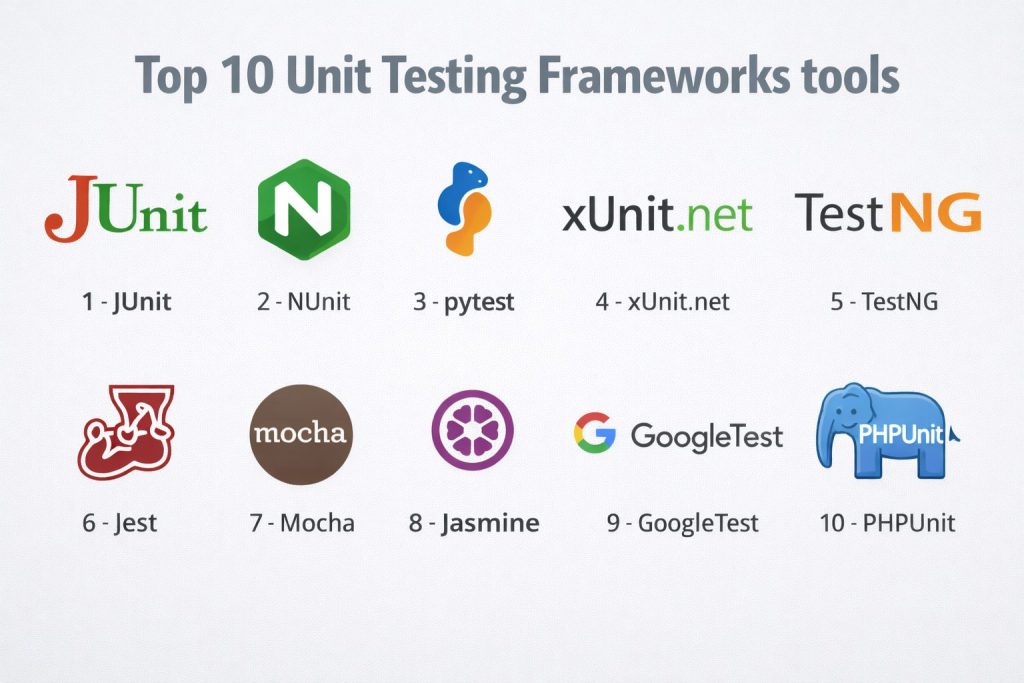
Introduction
Unit testing frameworks help developers verify the smallest pieces of code (functions, methods, classes) in isolation. In simple terms, they give you a consistent way to write tests, run them automatically, and see clear pass or fail results. When unit tests are reliable, teams ship faster because they catch bugs early, reduce risky changes, and make refactoring safer.
These frameworks matter now because software is released more frequently, codebases are more modular, and teams rely heavily on automation. Unit tests are also a strong foundation for quality gates in CI pipelines, code review confidence, and long-term maintainability.
Common real-world use cases include: validating business logic in backend services, preventing regressions in libraries, testing API controllers and handlers, verifying data transformations, and ensuring UI utilities behave correctly.
Key criteria to evaluate before choosing a framework:
- Language fit and ecosystem adoption
- Assertion clarity and failure reporting
- Mocking and dependency isolation support
- Test discovery and execution speed
- Parallel execution and stability
- CI friendliness and reporting outputs
- Extensibility (plugins, custom runners, hooks)
- Developer experience (DX) and learning curve
- Community maturity and documentation quality
- Compatibility with coverage and analysis tools
Best for: individual developers, product teams, QA automation engineers, and platform teams who need repeatable quality checks for code changes.
Not ideal for: teams that only need end-to-end testing, visual testing, or performance testing; in those cases, a dedicated integration or system testing tool may be a better primary choice.
Key Trends in Unit Testing Frameworks
- More focus on fast feedback loops with parallel runs and selective test execution
- Better developer experience through clearer error output and snapshots where relevant
- Increased emphasis on deterministic tests to reduce flaky pipelines
- Wider use of mocking, stubbing, and dependency injection patterns for isolation
- Stronger reporting expectations for CI dashboards and test analytics
- Growth of lightweight, “run-anywhere” test runners for container and cloud pipelines
How We Selected These Tools (Methodology)
- Picked frameworks with strong adoption in their language ecosystems
- Prioritized stability, reliability signals, and test runner maturity
- Considered readability of assertions and debugging experience
- Included a balanced mix across major languages and common stacks
- Considered CI compatibility, reporting outputs, and parallel execution options
- Favored tools with strong documentation and community support
Top 10 Unit Testing Frameworks Tools
1 — JUnit
JUnit is one of the most established unit testing frameworks for the Java ecosystem. It is widely used in enterprise services, libraries, and backend applications where consistent test structure and reporting are essential.
Key Features
- Annotation-based test structure and lifecycle hooks
- Strong IDE and build tool support in Java workflows
- Clear assertions and predictable test discovery
Pros
- Mature and widely understood in Java teams
- Excellent ecosystem compatibility for CI pipelines
Cons
- Advanced parameterization and fixtures can feel verbose in large suites
- Mocking and advanced patterns often rely on companion libraries
Platforms / Deployment
Windows / macOS / Linux
Self-hosted
Security & Compliance
Varies / N/A
Integrations & Ecosystem
JUnit integrates well with Java build and CI workflows and is commonly used as the unit testing base layer in enterprise systems.
- Common build runners and CI integration patterns
- Compatible with coverage tooling in typical Java pipelines
- Extensible through test engines and runner configurations
Support & Community
Strong documentation and a very large Java community. Support is typically community-driven plus enterprise support through toolchain vendors.
2 — NUnit
NUnit is a popular unit testing framework for the .NET ecosystem, often used for backend services and libraries. It supports a structured testing style with good extensibility and clear test results.
Key Features
- Attribute-based tests and lifecycle management
- Parameterized tests for reusable scenarios
- Works well with common .NET test tooling
Pros
- Familiar structure for .NET developers
- Good flexibility for organizing large test suites
Cons
- Teams may need to align with organization standards if multiple .NET frameworks are in use
- Some advanced patterns add complexity without strong conventions
Platforms / Deployment
Windows / macOS / Linux
Self-hosted
Security & Compliance
Varies / N/A
Integrations & Ecosystem
NUnit fits into typical .NET build pipelines and test reporting workflows.
- Compatible with common .NET runners and IDE tooling
- Works well with mocking libraries commonly used in .NET projects
- Supports structured output for CI consumption
Support & Community
Well-known in the .NET community with good documentation. Community support is strong.
3 — pytest
pytest is a widely used Python testing framework known for clean test syntax and powerful fixtures. It is popular for backend services, data pipelines, and automation where readability and modular testing matter.
Key Features
- Fixture system for reusable setup and dependency injection style testing
- Simple, readable test functions with strong discovery rules
- Rich plugin ecosystem for extending workflows
Pros
- Great developer experience for writing and maintaining tests
- Scales well from small scripts to large codebases
Cons
- Fixture overuse can create hidden coupling if not managed carefully
- Plugin-heavy setups require consistent team conventions
Platforms / Deployment
Windows / macOS / Linux
Self-hosted
Security & Compliance
Varies / N/A
Integrations & Ecosystem
pytest works well in automation pipelines and has strong ecosystem support across many Python stacks.
- Plugins for test selection, reporting, and integrations
- Works with common coverage and linting workflows
- Supports parallelization through ecosystem tooling (Varies / N/A)
Support & Community
Very strong Python community adoption, with abundant learning resources and examples.
4 — xUnit.net
xUnit.net is a modern unit testing framework for .NET that emphasizes clean test design and extensibility. It is often chosen for teams that want a consistent test structure and strong integration with .NET tooling.
Key Features
- Attribute-driven tests with modern design conventions
- Strong support for data-driven tests
- Extensible architecture for custom behaviors
Pros
- Clean approach that fits modern .NET projects
- Good long-term maintainability with clear patterns
Cons
- Teams migrating from other .NET frameworks may need style alignment
- Advanced lifecycle control may require deeper framework understanding
Platforms / Deployment
Windows / macOS / Linux
Self-hosted
Security & Compliance
Varies / N/A
Integrations & Ecosystem
Commonly used in CI pipelines for .NET applications with predictable reporting workflows.
- Fits well with standard .NET runners
- Pairs with popular mocking and assertion libraries
- Compatible with typical coverage reporting patterns
Support & Community
Strong community and documentation, widely used in professional .NET environments.
5 — TestNG
TestNG is a testing framework for Java that is often used when teams need flexible configuration, grouping, and advanced execution control. It is common in enterprise Java projects and automation-heavy setups.
Key Features
- Test grouping and flexible suite configuration
- Parameterization and data-driven test support
- Rich lifecycle hooks for setup and teardown workflows
Pros
- Strong control for complex test organization
- Useful for teams with large suites and structured execution needs
Cons
- Configuration can become complex without strict conventions
- Teams may prefer simpler frameworks for pure unit testing workflows
Platforms / Deployment
Windows / macOS / Linux
Self-hosted
Security & Compliance
Varies / N/A
Integrations & Ecosystem
Often used in Java test pipelines where structured suites and grouping are important.
- Works with common Java build tools and CI runners
- Produces test outputs suitable for CI dashboards
- Pairs with common Java ecosystem libraries for assertions and mocking
Support & Community
Well-known and established, with good community knowledge and examples.
6 — Jest
Jest is a popular unit testing framework for JavaScript and TypeScript projects. It is widely used for frontend and backend JS environments where fast test feedback and clear output matter.
Key Features
- Snapshot testing options for certain UI and object outputs
- Built-in mocking and test runner capabilities
- Strong developer feedback through clear failure reporting
Pros
- Good out-of-the-box experience for many JS projects
- Works well for teams that want a single integrated test tool
Cons
- Configuration can grow in complex monorepos
- Snapshot misuse can create noisy reviews if not managed
Platforms / Deployment
Windows / macOS / Linux
Self-hosted
Security & Compliance
Varies / N/A
Integrations & Ecosystem
Jest commonly sits at the center of JS unit testing workflows and integrates well into CI execution.
- Fits typical package and script-based pipelines
- Works with coverage workflows commonly used in JS projects
- Strong ecosystem patterns for React and TypeScript stacks (Varies / N/A)
Support & Community
Very large community, extensive tutorials, and widely shared best practices.
7 — Mocha
Mocha is a flexible JavaScript test framework that gives teams control over structure and style. It is often paired with assertion and mocking libraries based on team preference.
Key Features
- Flexible test structure and runner behavior
- Works well with different assertion styles (Varies / N/A)
- Good fit for custom testing setups
Pros
- Highly configurable and adaptable
- Useful when teams want to compose their own test stack
Cons
- Requires choosing additional libraries for assertions and mocks
- Configuration consistency is important for team scalability
Platforms / Deployment
Windows / macOS / Linux
Self-hosted
Security & Compliance
Varies / N/A
Integrations & Ecosystem
Mocha fits well into Node-based test pipelines and supports many patterns through the broader JS ecosystem.
- Often paired with assertion libraries and spies (Varies / N/A)
- Works in common CI workflows via script runners
- Extensible through reporters and plugins
Support & Community
Strong community presence and lots of examples, especially for Node-based testing.
8 — Jasmine
Jasmine is a JavaScript testing framework known for its behavior-driven style. It is commonly used for unit testing where readable test descriptions and structured suites are important.
Key Features
- Behavior-driven test organization style
- Built-in assertions and matchers
- Supports asynchronous testing patterns
Pros
- Clear test readability for teams and reviewers
- Works well in front-end style testing setups
Cons
- Some teams prefer more modern integrated stacks depending on environment
- Plugin ecosystem may feel smaller than some alternatives
Platforms / Deployment
Windows / macOS / Linux
Self-hosted
Security & Compliance
Varies / N/A
Integrations & Ecosystem
Often used in JS testing setups where readability and structured suites matter.
- Works with common CI execution approaches
- Supports reporting through standard runner outputs
- Pairs with browser-based testing setups (Varies / N/A)
Support & Community
Established and well-known, with clear documentation and community examples.
9 — GoogleTest
GoogleTest is a popular C++ unit testing framework designed for performance-focused and systems-level projects. It supports large test suites and is used widely in production-grade C++ codebases.
Key Features
- Rich assertions and matchers for C++ testing needs
- Structured test fixtures for repeatable setup and teardown
- Good support for large-scale suite organization
Pros
- Strong fit for modern C++ test suites
- Good structure for complex low-level testing scenarios
Cons
- Requires build system integration discipline
- Debugging failures can be harder in low-level environments
Platforms / Deployment
Windows / macOS / Linux
Self-hosted
Security & Compliance
Varies / N/A
Integrations & Ecosystem
GoogleTest is commonly integrated into C++ build pipelines and used alongside CI systems for structured reporting.
- Works with standard C++ build tooling patterns
- Supports common CI result parsing approaches
- Commonly paired with mocking libraries in C++ environments (Varies / N/A)
Support & Community
Strong adoption in C++ communities with many examples and long-term stability signals.
10 — PHPUnit
PHPUnit is the most widely used unit testing framework in the PHP ecosystem. It is a standard choice for backend applications and libraries where consistent test structure is needed.
Key Features
- Assertions and test structure tailored for PHP projects
- Fixtures and lifecycle patterns for reusable test setup
- Works well in typical PHP project layouts
Pros
- Strong default choice for PHP teams due to ecosystem alignment
- Clear test organization and output for CI pipelines
Cons
- Larger legacy codebases may require refactoring to test effectively
- Mocking and isolation patterns need team conventions
Platforms / Deployment
Windows / macOS / Linux
Self-hosted
Security & Compliance
Varies / N/A
Integrations & Ecosystem
PHPUnit integrates into PHP build pipelines and pairs with common tools used in PHP engineering workflows.
- Works with typical PHP CI execution patterns
- Supports outputs and reports used by CI dashboards
- Compatible with common coverage workflows in PHP environments
Support & Community
Very strong adoption in PHP communities, with wide documentation coverage and examples.
Comparison Table
| Tool Name | Best For | Platform(s) Supported | Deployment | Standout Feature | Public Rating |
|---|---|---|---|---|---|
| JUnit | Java unit testing standard | Windows / macOS / Linux | Self-hosted | Mature Java ecosystem fit | N/A |
| NUnit | .NET unit testing suites | Windows / macOS / Linux | Self-hosted | Structured attribute model | N/A |
| pytest | Python services and automation | Windows / macOS / Linux | Self-hosted | Powerful fixtures and plugins | N/A |
| xUnit.net | Modern .NET projects | Windows / macOS / Linux | Self-hosted | Extensible test architecture | N/A |
| TestNG | Java suites with grouping control | Windows / macOS / Linux | Self-hosted | Flexible suite configuration | N/A |
| Jest | JavaScript and TypeScript projects | Windows / macOS / Linux | Self-hosted | Integrated runner and mocks | N/A |
| Mocha | Custom JS testing stacks | Windows / macOS / Linux | Self-hosted | Flexible composition approach | N/A |
| Jasmine | Behavior-style JS unit tests | Windows / macOS / Linux | Self-hosted | Readable suite structure | N/A |
| GoogleTest | C++ systems and performance code | Windows / macOS / Linux | Self-hosted | Rich assertions for C++ | N/A |
| PHPUnit | PHP backend applications | Windows / macOS / Linux | Self-hosted | Ecosystem standard for PHP | N/A |
Evaluation & Scoring of Unit Testing Frameworks
This scoring model is a comparative framework for shortlisting. It reflects how well a tool typically fits broad unit testing needs across teams, not a public rating or a guaranteed outcome. Scores can change depending on language constraints, team experience, and CI setup. Use the weighted total to narrow down options, then validate by running a small pilot on real code and real workflows.
Weights used
Core features 25%
Ease of use 15%
Integrations and ecosystem 15%
Security and compliance 10%
Performance and reliability 10%
Support and community 10%
Price and value 15%
| Tool Name | Core (25%) | Ease (15%) | Integrations (15%) | Security (10%) | Performance (10%) | Support (10%) | Value (15%) | Weighted Total (0–10) |
|---|---|---|---|---|---|---|---|---|
| JUnit | 9 | 7 | 9 | 5 | 8 | 9 | 8 | 8.1 |
| NUnit | 8 | 7 | 8 | 5 | 8 | 8 | 8 | 7.7 |
| pytest | 9 | 8 | 8 | 5 | 8 | 9 | 9 | 8.4 |
| xUnit.net | 8 | 7 | 8 | 5 | 8 | 8 | 8 | 7.7 |
| TestNG | 8 | 6 | 8 | 5 | 7 | 8 | 8 | 7.4 |
| Jest | 8 | 8 | 9 | 5 | 7 | 9 | 9 | 8.2 |
| Mocha | 7 | 7 | 8 | 5 | 7 | 8 | 8 | 7.4 |
| Jasmine | 7 | 7 | 7 | 5 | 7 | 8 | 8 | 7.2 |
| GoogleTest | 8 | 6 | 7 | 5 | 8 | 8 | 9 | 7.6 |
| PHPUnit | 8 | 7 | 8 | 5 | 7 | 8 | 9 | 7.8 |
Which Unit Testing Framework Tool Is Right for You
Solo / Freelancer
If you work in one main language, choose the most standard framework for that ecosystem: pytest for Python, Jest for JavaScript and TypeScript, JUnit for Java, and PHPUnit for PHP. You will spend less time fighting tooling and more time shipping.
SMB
For small teams, prioritize clarity, speed, and stable CI output. Jest and pytest are common picks because they are quick to adopt and easy to scale with good conventions. For Java and .NET teams, JUnit and NUnit usually fit well when paired with consistent mocking patterns.
Mid-Market
As teams grow, consistency matters more than flexibility. Use the dominant ecosystem framework and standardize patterns for naming, fixtures, and test data. In Java, JUnit or TestNG works depending on how much grouping and suite control you need. In .NET, NUnit or xUnit.net is usually a clean choice.
Enterprise
Enterprises should standardize by language and reduce fragmentation. Choose frameworks that integrate cleanly into CI and reporting, and focus on deterministic tests to prevent pipeline noise. JUnit, xUnit.net, and GoogleTest are common in large codebases where discipline, structure, and reporting are central.
Budget vs Premium
Most unit testing frameworks are cost-effective as tools, but the true cost is time: learning, conventions, flaky tests, and CI maintenance. Favor the framework that minimizes friction in your ecosystem rather than chasing novelty.
Feature Depth vs Ease of Use
If you want strong structure with broad community patterns, pick JUnit, pytest, or Jest. If you need more suite configuration control in Java, consider TestNG. If you prefer composing your own JS stack, Mocha can work well with strong team standards.
Integrations & Scalability
Scalability comes from repeatable patterns: test naming, fixture discipline, stable mocks, predictable setup, and consistent reporting. Framework choice should support those standards and run reliably in CI.
Security & Compliance Needs
Unit testing frameworks typically do not provide compliance certifications directly. Security concerns usually relate to how tests access secrets, environments, and test data. Focus on safe test data, controlled credentials, and CI isolation rather than expecting the framework to provide compliance controls.
Frequently Asked Questions (FAQs)
1. What is a unit testing framework
It is a tool that helps you write and run small tests for individual pieces of code, showing pass or fail results with clear reporting.
2. Which framework should I choose first
Choose the most standard option for your language ecosystem, because it will integrate better with tools, teammates, and common workflows.
3. How many unit tests should a project have
There is no perfect number. Focus on critical logic, edge cases, and parts that change often, then expand coverage gradually.
4. Why do unit tests become flaky
Flakiness usually comes from time dependencies, randomness, shared state, network calls, or unstable mocks. Make tests deterministic.
5. Do unit testing frameworks replace integration testing
No. Unit tests validate small pieces of logic, while integration tests validate that components work together across boundaries.
6. How do I speed up unit tests
Keep tests isolated, avoid slow external calls, reduce heavy setup, and use parallel execution when your environment supports it.
7. What is the best way to use mocking
Mock external dependencies and unstable components, but avoid mocking everything. Too many mocks can hide real issues and reduce confidence.
8. Can I use multiple unit testing frameworks in one project
You can, but it often increases complexity. Most teams get better results by standardizing on one framework per language.
9. How do I add unit tests into CI
Run tests on every change, store reports for debugging, and fail builds on test failures. Keep test output consistent and easy to read.
10. What should I check before switching frameworks
Check migration effort, team retraining, CI reporting changes, and how assertions and fixtures will be rewritten. Pilot the migration first.
Conclusion
Unit testing frameworks are less about finding a universal winner and more about picking the best fit for your language, team habits, and CI workflow. JUnit and TestNG are strong choices for Java teams depending on how much suite control you need. NUnit and xUnit.net fit well for .NET codebases when paired with consistent patterns. pytest and Jest are popular for their readability, strong developer experience, and practical ecosystem support. Mocha and Jasmine can be effective when you want flexibility, while GoogleTest and PHPUnit are reliable standards in C++ and PHP. Shortlist two options only if you truly need to compare, run a small pilot on real modules, validate reporting in CI, and standardize conventions to avoid flaky tests.