Introduction
Trademark monitoring is the systematic process of tracking newly filed trademark applications, domain registrations, and online marketplaces to identify potential infringements that could dilute a brand’s value. The landscape of intellectual property (IP) protection has shifted from manual gazette reviews to automated, AI-driven surveillance that operates across 200+ jurisdictions simultaneously. These tools are no longer optional for businesses; they are the frontline defense against “brand-napping,” cybersquatting, and the rising tide of AI-generated counterfeit products that can saturate digital channels in hours.
As global trade becomes increasingly decentralized, the risk of “confusingly similar” marks appearing in emerging markets has skyrocketed. Effective monitoring tools now utilize neural networks to analyze not just text, but also visual similarities in logos and product packaging across social media and hidden web forums. For legal teams and brand managers, selecting a monitoring suite means choosing between high-velocity automated “takedown” engines and research-heavy platforms that provide deep case-law analytics for complex litigation.
Best for: Fortune 500 enterprises, specialized IP law firms, e-commerce conglomerates, and high-growth startups with global expansion plans.
Not ideal for: Local “mom-and-pop” shops with no online presence, or businesses that do not own registered trademarks and have no intent to defend a brand name.
Key Trends in Trademark Monitoring Software
- Computer Vision for Logo Detection: AI can now identify brand logos even when they are distorted, partially obscured, or applied to counterfeit goods in social media images.
- Predictive Risk Scoring: Advanced tools use historical case law to predict the likelihood of winning an opposition before a legal team even files a challenge.
- Automated Takedown Pipelines: Integration with major marketplaces (Amazon, Alibaba, Shopee) allows for “one-click” removal of infringing listings directly from the dashboard.
- Semantic & Phonetic AI: Monitoring has moved beyond exact matches to identifying marks that sound similar or share a “conceptual essence” across multiple languages.
- NFT & Metaverse Surveillance: Specialized modules now scan blockchain ledgers and virtual environments for unauthorized use of brand assets in digital collectibles.
- Dark Web Brand Protection: High-end tools now monitor illicit forums where “brand kits” for counterfeiters are sold, allowing companies to stop infringement at the source.
- OpenUSD Integration for Digital Twins: For industrial brands, monitoring includes checking digital twins and CAD-based assets in collaborative 3D environments.
How We Selected These Tools (Methodology)
The selection process for the top 10 trademark monitoring tools involved a rigorous evaluation of database breadth, detection accuracy, and response speed. We prioritized platforms that maintain direct, high-speed connections to official IP offices (USPTO, EUIPO, WIPO) and those that demonstrate a high “Signal-to-Noise” ratio, minimizing the false positives that often plague manual search results. Our 2026 assessment also placed heavy weight on the inclusion of AI-assisted risk assessment, which helps legal teams prioritize threats based on commercial impact.
Scalability was another critical factor; we looked for tools that can handle both a single boutique mark and a massive multi-national portfolio with thousands of variations. We also analyzed the “Actionability” of each platform—evaluating whether the tool simply provides an alert or offers a structured workflow for enforcement, such as auto-populated cease-and-desist letters or direct API links to marketplace legal departments. Finally, we considered the user experience (UX) to ensure that the software streamlines, rather than complicates, the daily workflow of an IP professional.
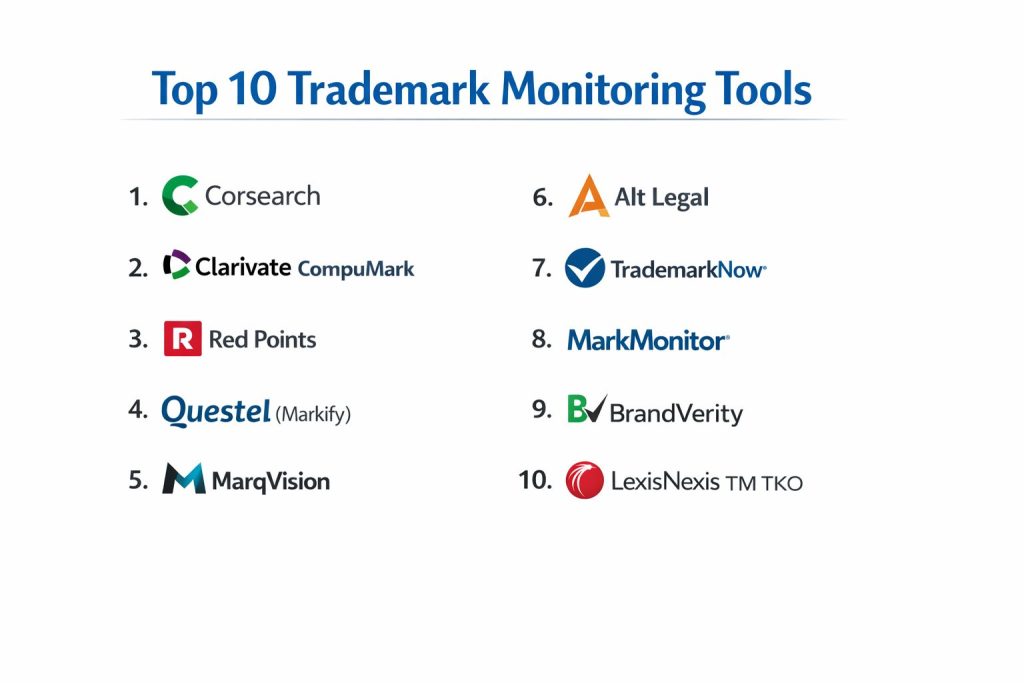
Top 10 Trademark Monitoring Tools
1. Corsearch
Corsearch is a global leader in brand protection, providing an end-to-end platform that combines trademark clearance, monitoring, and anti-piracy enforcement. It is favored by large enterprises for its comprehensive coverage of over 1,000 sources, including global registries and common law data.
Key Features
- AI-Powered Screening: Rapidly assesses the viability of new marks against millions of existing records.
- ExaMatch Technology: Uses advanced phonetic and semantic matching to find non-obvious infringements.
- Global Watch Services: Monitors trademark gazettes in 200+ jurisdictions for newly published applications.
- Online Brand Protection: Scans marketplaces and social media for unauthorized brand use and counterfeit sales.
- Integrated Workflow: Connects screening results directly to monitoring tasks for a seamless brand lifecycle.
- Expert Analyst Review: Offers human-in-the-loop verification to ensure the highest accuracy of alerts.
Pros
- Unmatched global database coverage and historical data depth.
- Highly sophisticated AI that significantly reduces manual review time.
Cons
- Can be more expensive than standalone or boutique monitoring services.
- The interface is dense with features, requiring professional training for full mastery.
Platforms / Deployment
- Web-based (SaaS)
- Desktop
Security & Compliance
- Features: SOC 2 Type II certified; enterprise-grade data encryption.
- Compliance: GDPR, CCPA.
Integrations & Ecosystem
Corsearch integrates with major IP management systems and provides APIs for custom enterprise workflows. It has a strong ecosystem of legal partners and brand protection experts.
Support & Community
Provides dedicated account managers and a global support team available 24/7. They offer regular webinars and industry reports on IP trends.
2. Clarivate CompuMark
CompuMark, a Clarivate company, is the industry benchmark for high-precision trademark research and watching. It leverages the world’s most extensive trademark database and includes unique insights from Darts-ip case law to assess the strength of potential oppositions.
Key Features
- Trademark Watch Analyzer: An AI-enhanced tool that intelligently prioritizes watch results based on risk.
- Darts-ip Integration: Provides litigation data to help predict the outcome of trademark disputes.
- Pharma-Specific Search: Specialized monitoring for the highly regulated life sciences and pharmaceutical sectors.
- Image Recognition: Scans for logo similarities across millions of industrial designs and trademark filings.
- Custom Analytics: Generates in-depth reports on competitor filing strategies and brand landscape trends.
- Gold-Standard Data: Verified data from 180+ jurisdictions with rigorous quality control.
Pros
- Access to proprietary case law data provides a massive advantage in legal strategy.
- Renowned for the highest data accuracy in the IP industry.
Cons
- The user interface can feel somewhat dated compared to newer AI-native startups.
- Pricing is aimed at large law firms and multinational corporations.
Platforms / Deployment
- Web-based (SaaS)
- API Integration
Security & Compliance
- Features: Multi-factor authentication; secure data centers.
- Compliance: ISO 27001.
Integrations & Ecosystem
Works seamlessly with other Clarivate products like Derwent for patents. It is the primary tool for many of the world’s top 100 law firms.
Support & Community
Offers world-class professional training and a vast knowledge base. Technical support is highly specialized and staffed by IP professionals.
3. Red Points
Red Points is an AI-driven brand protection and revenue recovery platform that focuses heavily on the digital and e-commerce space. It is designed to automatically detect and remove counterfeit listings, impersonations, and pirate content at scale.
Key Features
- Automated Takedowns: Features a “takedown bot” that can remove thousands of infringing listings per month automatically.
- Clustering Technology: Groups individual infringements to identify and target large-scale seller networks.
- Image Fingerprinting: Uses neural networks to identify brand logos and product designs in social media posts.
- Revenue Recovery: Tracks the economic impact of removals to demonstrate clear ROI to stakeholders.
- Marketplace Integrations: Direct API links to Amazon, eBay, Alibaba, and 5,000+ other global sites.
- Self-Service Dashboard: A highly intuitive interface that allows brand managers to oversee enforcement in real-time.
Pros
- Extremely effective for e-commerce brands struggling with high-volume counterfeiting.
- Flat-fee pricing model allows for unlimited detections and takedowns.
Cons
- Focuses more on online infringement than on the technical trademark filing process at the USPTO level.
- Setup requires significant initial “training” of the AI to distinguish between authorized and unauthorized sellers.
Platforms / Deployment
- Web-based (SaaS)
- Mobile App (iOS/Android)
Security & Compliance
- Features: Role-based access control; encrypted data transmission.
- Compliance: GDPR.
Integrations & Ecosystem
Integrates with major e-commerce platforms and social media APIs. It is frequently used by consumer goods and luxury brands.
Support & Community
Highly responsive customer success team that assists with the initial AI configuration. They provide detailed monthly performance reviews.
4. Questel (Markify)
Questel’s Markify platform is a modern, high-speed trademark monitoring and clearance solution. It is widely praised for its “Markify Comprehensive Search” which uses a proprietary algorithm to provide rapid results across 240+ databases.
Key Features
- Markify ProSearch: A combined screening and analysis platform that identifies similar word and image-based marks.
- AI-Driven Similarity: Goes beyond simple text to find misspellings, vowel variations, and phonetic equivalents.
- Automated Bulk Watching: Allows firms to set up monitoring for entire portfolios with a single upload.
- Pharmaceutical Search: Includes screening of INN (International Nonproprietary Names) and EMA data.
- Customizable Reporting: Features an intuitive report builder that can be white-labeled for law firm clients.
- Company Name Search: Monitors business registries to catch infringements before they even reach a trademark filing.
Pros
- Offers exceptional speed, often delivering complex search reports in minutes.
- Very competitive pricing for the level of global database access provided.
Cons
- The platform can feel overwhelming for users who do not perform searches daily.
- Less focus on “active enforcement” compared to platforms like Red Points.
Platforms / Deployment
- Web-based (SaaS)
- API Access
Security & Compliance
- Features: Secure cloud hosting; regular security audits.
- Compliance: Not explicitly stated.
Integrations & Ecosystem
Part of the broader Questel IP ecosystem, allowing for integration with patent and design data. It is a favorite for mid-sized law firms.
Support & Community
Questel offers a comprehensive training library and technical support. They are known for high user satisfaction scores on professional review sites.
5. MarqVision
MarqVision is an “AI-native” brand protection platform founded by Harvard Law graduates. It utilizes generative AI to detect disguised threats and automate the complex legal processes of trademark enforcement and counterfeit removal.
Key Features
- Generative AI Detection: Capable of identifying “hidden” or blurred logos that older algorithms might miss.
- Automated Legal Workflows: Drafts and sends formal cease-and-desist letters based on the detected infringement type.
- Disguised Threat Analysis: Identifies sellers who use intentional misspellings or creative keywords to bypass filters.
- Unified Dashboard: Consolidates trademark monitoring, domain tracking, and social media surveillance.
- Actionable ROI Metrics: Provides real-time data on the value of the brand equity protected.
- Global Legal Network: Connects users with a network of attorneys for high-level litigation needs.
Pros
- The most “future-proof” interface and AI logic in the current market.
- Very strong success rate (99%+) in removing identified counterfeit listings.
Cons
- Higher pricing tiers may be out of reach for small startups or solo practitioners.
- Dashboard can occasionally feel cluttered due to the high volume of real-time data.
Platforms / Deployment
- Web-based (SaaS)
Security & Compliance
- Features: SSO integration; secure API keys.
- Compliance: GDPR, SOC 2.
Integrations & Ecosystem
Integrates with over 1,500 marketplaces and social media platforms. It is designed to scale with rapidly growing direct-to-consumer (DTC) brands.
Support & Community
Offers a highly personal onboarding experience and proactive account management. Their blog is a leading source for AI-based IP law insights.
6. Alt Legal
Alt Legal is specifically designed for the modern law firm and in-house legal team, focusing on automating the “docketing” and monitoring of trademark filings. It is known for its deep integration with the USPTO and its user-friendly automation.
Key Features
- §2(d) Trademark Watch: Notifies users when their marks are cited in a USPTO Office Action as a source of “likelihood of confusion.”
- Trademark Application Match: Automatically scans all new global filings for marks that overlap with your docket.
- Auto-Docketing: Pulls data directly from the USPTO and other offices to eliminate manual entry.
- Client Portal: Allows law firms to share real-time monitoring results securely with their clients.
- Deadline Management: Automatically calculates and tracks all critical response dates for trademark filings.
- Flat-Fee Model: Provides a predictable cost structure regardless of the number of “hits” or users.
Pros
- The §2(d) watch is a unique feature that identifies threats already flagged by examiners.
- Extremely easy to set up and requires almost zero training for existing legal staff.
Cons
- Primarily focused on trademark office filings; lacks robust marketplace counterfeit detection.
- The global coverage is strong but less exhaustive than specialized tools like CompuMark.
Platforms / Deployment
- Web-based (SaaS)
Security & Compliance
- Features: 256-bit encryption; secure backup systems.
- Compliance: SOC 2.
Integrations & Ecosystem
Integrates with Clio, Salesforce, and NetDocuments. It is the gold standard for trademark docketing in the United States.
Support & Community
Known for having the best customer service in the legal tech industry. They host “Alt Legal Connect,” a major annual conference for IP professionals.
7. TrademarkNow (by Corsearch)
TrademarkNow is a specialized platform within the Corsearch ecosystem that focuses on “Instant Trademark Clearance.” It uses a sophisticated semantic AI to provide a multi-dimensional risk score for any proposed mark.
Key Features
- NameCheck: An instant similarity search tool that moves candidates from knockout to clearance in seconds.
- LogoCheck: Scans 180+ registers for visual similarities in industrial designs and logos.
- ExaMatch Algorithm: Uses advanced logic to detect phonetic, orthographic, and semantic similarities.
- Portfolio Analyzer: Allows businesses to benchmark the strength of their portfolio against competitors.
- Name Generator: An AI tool that suggests brand names that are already pre-screened for trademark availability.
- Automated Risk Ranking: Categorizes threats into “Red, Yellow, Green” based on the severity of the conflict.
Pros
- Incredible speed—ideal for branding agencies and marketing teams that need quick answers.
- The “Similarity Score” is intuitive and helps non-legal stakeholders understand risks.
Cons
- The subscription model is more optimized for screening than for ongoing long-term monitoring.
- Some users find the AI “too sensitive,” leading to many low-risk results that require filtering.
Platforms / Deployment
- Web-based (SaaS)
Security & Compliance
- Features: Part of the Corsearch secure infrastructure; high data redundancy.
- Compliance: ISO 27001.
Integrations & Ecosystem
Part of the broader Corsearch platform, allowing for easy transitions between screening and full watch services.
Support & Community
Offers rapid online support and extensive video tutorials. It is widely used in the pharmaceutical and life sciences industries.
8. MarkMonitor
MarkMonitor is a high-end enterprise solution specializing in online brand protection and domain management. It is the tool of choice for global corporations that face massive domain-squatting and phishing threats.
Key Features
- Global Domain Monitoring: Tracks millions of TLDs (top-level domains) for brand misuse and cybersquatting.
- Anti-Fraud & Phishing: Identifies and shuts down fraudulent websites designed to steal customer data.
- Social Media Monitoring: Scans all major social platforms for impersonation and unauthorized brand usage.
- Dark Web Surveillance: Monitors illicit marketplaces for the sale of counterfeit brand assets.
- Mobile App Protection: Detects unauthorized apps in global app stores that use your trademarks.
- Expert Advisory Services: Provides high-level strategic consulting for complex brand protection challenges.
Pros
- Unmatched in the domain name management and anti-phishing space.
- Trusted by more than half of the Fortune 100 brands for their most critical assets.
Cons
- Very high price point that is generally only accessible to large enterprises.
- The platform can be slow to update its user interface compared to newer AI startups.
Platforms / Deployment
- Web-based (SaaS)
Security & Compliance
- Features: Enterprise-grade security; redundant global data centers.
- Compliance: ISO 27001, SOC 2.
Integrations & Ecosystem
Highly integrated with corporate domain registrars and enterprise security suites. It is a central part of high-level corporate security strategies.
Support & Community
Provides dedicated security experts and 24/7 global response teams. They are a major presence at ICANN and other global internet governance forums.
9. BrandVerity
BrandVerity is a specialized monitoring tool that focuses on protecting brands within search engine results and affiliate marketing programs. It ensures that competitors and partners aren’t “poaching” your trademarks through paid ads.
Key Features
- Paid Search Monitoring: Detects when third parties bid on your trademarked keywords in Google and Bing.
- Affiliate Compliance: Ensures that affiliate partners are following brand guidelines and not misusing trademarks.
- Ad Copy Analysis: Scans for unauthorized use of brand names or slogans within competitor ad descriptions.
- Automated Complaints: Allows users to send bulk trademark complaints to Google Ads and Microsoft Advertising.
- Global Geo-Testing: Monitors ads across different countries to find region-specific trademark abuse.
- Competitor Benchmarking: Tracks how often competitors appear on your branded search terms.
Pros
- The most focused and effective tool for controlling “Paid Search” trademark infringement.
- Provides extremely clear evidence (screenshots) that is easily accepted by ad platform legal teams.
Cons
- It is a specialized tool; it does not monitor trademark office filings or physical counterfeit goods.
- The interface can feel a bit clunky for users accustomed to modern design-led software.
Platforms / Deployment
- Web-based (SaaS)
Security & Compliance
- Features: Standard SaaS security; data encryption in transit.
- Compliance: Not publicly stated.
Integrations & Ecosystem
Integrates with major affiliate platforms and digital marketing dashboards. It is essential for retailers and finance companies.
Support & Community
Known for very helpful sales and onboarding representatives. They offer deep expertise in search engine policy and digital advertising law.
10. LexisNexis TM TKO
LexisNexis TM TKO is a powerful “knockout” search and monitoring tool that leverages the massive LexisNexis legal database. it is built for speed and precision in the early stages of trademark selection and ongoing protection.
Key Features
- Knockout Search: Rapidly identifies direct conflicts across global databases to “knock out” risky brand candidates.
- Vast Legal Database: Integrates directly with LexisNexis’s unmatched repository of legal and business data.
- Similarity Alerts: Provides real-time notifications for newly filed marks that match your watch parameters.
- Common Law Monitoring: Scans news, business directories, and web content for unregistered “common law” use.
- Intuitive Dashboard: Features a clean, modern interface designed for fast navigation and decision-making.
- High-Poly Search: Capable of processing complex queries across multiple classes of goods and services simultaneously.
Pros
- Backed by the reliability and data depth of the LexisNexis ecosystem.
- Very efficient for high-volume research tasks where speed is the primary requirement.
Cons
- Lacks the specialized “active enforcement” (takedown) features found in brand protection suites.
- Can be expensive if purchased as a standalone without an existing LexisNexis subscription.
Platforms / Deployment
- Web-based (SaaS)
Security & Compliance
- Features: Enterprise-grade security standard for the legal industry.
- Compliance: ISO 27001.
Integrations & Ecosystem
Integrates with other LexisNexis legal research tools. It is widely used by corporate legal departments for preliminary risk assessment.
Support & Community
Offers professional-grade technical support and training. The community is focused on high-level legal research and IP strategy.
Comparison Table (Top 10)
| Tool Name | Best For | Platform(s) Supported | Deployment | Standout Feature | Public Rating |
| Corsearch | Full Brand Lifecycle | Web, Desktop | SaaS | ExaMatch AI | 4.8/5 |
| Clarivate CompuMark | Legal Research/High-Accuracy | Web, API | SaaS | Darts-ip Integration | 4.7/5 |
| Red Points | E-commerce Takedowns | Web, Mobile | SaaS | Automated Takedowns | 4.8/5 |
| Questel (Markify) | Rapid Clearance/Watching | Web, API | SaaS | Markify ProSearch | 4.6/5 |
| MarqVision | AI-Native Protection | Web | SaaS | Disguised Threat AI | 4.9/5 |
| Alt Legal | Law Firm Docketing | Web | SaaS | §2(d) USPTO Watch | 4.8/5 |
| TrademarkNow | Instant Screening | Web | SaaS | NameCheck Risk Score | 4.5/5 |
| MarkMonitor | Enterprise Domain/Security | Web | SaaS | Anti-Phishing Engine | 4.4/5 |
| BrandVerity | Paid Search/Affiliates | Web | SaaS | Automated Ad Appeals | 4.3/5 |
| LexisNexis TM TKO | Research/Knockout | Web | SaaS | Lexis Database Depth | 4.5/5 |
Evaluation and Scoring of Revenue Recognition Software
Weights
Core features 25 percent
Ease of use 15 percent
Integrations and ecosystem 15 percent
Security and compliance 10 percent
Performance and reliability 10 percent
Support and community 10 percent
Price and value 15 percent
| Tool Name | Accuracy (25%) | Global Reach (20%) | Automation (20%) | Security (10%) | UI/UX (15%) | Value (10%) | Weighted Total |
| Corsearch | 10 | 10 | 9 | 10 | 8 | 7 | 9.15 |
| Clarivate CompuMark | 10 | 10 | 8 | 9 | 7 | 6 | 8.75 |
| Red Points | 8 | 9 | 10 | 8 | 9 | 9 | 8.75 |
| Questel (Markify) | 9 | 9 | 8 | 8 | 8 | 9 | 8.55 |
| MarqVision | 9 | 9 | 10 | 9 | 9 | 8 | 9.10 |
| Alt Legal | 9 | 7 | 10 | 9 | 10 | 9 | 8.85 |
| TrademarkNow | 8 | 9 | 8 | 9 | 9 | 8 | 8.35 |
| MarkMonitor | 9 | 10 | 8 | 10 | 6 | 5 | 8.25 |
| BrandVerity | 9 | 8 | 9 | 8 | 7 | 8 | 8.25 |
| LexisNexis TM TKO | 9 | 9 | 7 | 10 | 8 | 7 | 8.35 |
Which Trademark Monitoring Tool Is Right for You?
Solo Practitioner / Boutique Law Firm
For the individual attorney, Alt Legal is the most efficient choice. Its focus on the USPTO, combined with automated docketing and the unique §2(d) watch, provides high value for a predictable flat fee.
SMB / E-commerce Brand
If you are a growing brand selling on Amazon or Shopify, Red Points is nearly essential. Its automated takedown bots and unlimited enforcement model allow you to protect your revenue without hiring a massive legal team.
Mid-Market / Branding Agency
Agencies and mid-sized companies that frequently launch new products should prioritize Questel (Markify) or TrademarkNow. These tools are built for speed, allowing you to “green-light” or “knockout” potential names in seconds during the creative phase.
Enterprise / Global Conglomerate
For massive corporations, Corsearch and Clarivate CompuMark are the only tools with the data depth required to protect a global portfolio. If domain security and phishing are also major concerns, MarkMonitor should be added as a specialized layer.
Budget vs Premium
Questel (Markify) offers the best balance of global data access for a reasonable price. MarqVision represents the premium AI-native tier for companies that want the absolute highest level of automated enforcement and modern analytics.
Feature Depth vs Ease of Use
Alt Legal wins on ease of use with its automated USPTO synchronization. Clarivate CompuMark offers the greatest feature depth for technical legal research but requires a much steeper learning curve.
Frequently Asked Questions (FAQs)
What is the difference between a trademark search and trademark monitoring?
A trademark search is a one-time check performed before you file for a mark to see if it’s available. Trademark monitoring is an ongoing surveillance service that alerts you whenever a new, similar mark is filed or used by someone else after you have already established your rights.
Why shouldn’t I just use Google Alerts for trademark monitoring?
Google Alerts only tracks the “public web” (news, blogs). It does not have access to the official, private databases of trademark offices where applications are filed. By the time a trademark appears on Google, it may already be too late to file a cost-effective opposition.
Can these tools detect infringements in foreign languages?
Yes, high-end tools like Corsearch and Markify use AI that understands translations and phonetic similarities across multiple languages, ensuring that a mark filed in Chinese that sounds like your English brand will still be flagged.
How often do these tools update their data?
Most professional tools update their data daily, synced directly with the major IP offices’ official gazettes and electronic filing systems. Some brand protection tools like Red Points monitor marketplaces 24/7 in real-time.
What is a §2(d) Watch?
A feature unique to Alt Legal, it alerts you when a USPTO examiner cites your trademark as the reason for rejecting someone else’s application. This is a “pre-screened” hit that shows a high likelihood of confusion.
Do these tools handle the actual legal filing of an opposition?
Most of these tools provide the evidence and the workflow, but the actual legal filing usually requires a licensed attorney. However, tools like Red Points and MarqVision can handle administrative “takedown” requests on marketplaces without a lawyer.
Can I monitor logos and images, or just text?
Modern platforms like Clarivate CompuMark and MarqVision use advanced computer vision to monitor logo designs and visual brand assets across global registries and social media.
What happens if a tool misses an infringement?
No tool is 100% perfect, which is why many high-end services offer “human-in-the-loop” review where expert analysts verify the AI’s findings. It is always recommended to use a tool with high data integrity to minimize this risk.
Is trademark monitoring worth the cost for a small business?
Yes, because the cost of “rebranding” a business due to an unchallenged infringement is significantly higher than the annual cost of a basic monitoring service like Alt Legal or Markify.
What is the importance of Darts-ip data?
Darts-ip is a massive database of global IP litigation. When integrated into tools like CompuMark, it allows you to see if a potential infringer has a history of losing court cases, which helps you decide whether to pursue legal action.
Conclusion
Trademark monitoring has evolved into a high-stakes digital arms race where speed and AI-driven precision are the primary advantages.The “all-or-nothing” approach to brand protection is obsolete; there is a tool specifically tailored for every stage of a brand’s life, from the initial knockout search in TrademarkNow to the enterprise-wide domain defense of MarkMonitor. By automating the tedious process of searching through thousands of daily filings, these tools allow legal professionals to shift their focus from discovery to high-value strategy and enforcement.
Selecting the right platform requires a balance between the breadth of the database and the depth of the automated response. For most businesses, the goal is not just to see a threat, but to stop it. As the digital world expands into the metaverse and decentralized commerce, maintaining a proactive and technologically advanced monitoring posture is the only way to ensure your brand’s integrity remains intact for the long term.