Introduction
Maritime vessel management software helps ship owners, operators, and managers run day-to-day vessel operations in a structured, auditable way. It centralizes maintenance, inspections, safety processes, crew administration, procurement, and operational reporting so teams on shore and onboard can work from consistent data instead of scattered spreadsheets and emails.
Real-world use cases include planned maintenance scheduling for critical equipment, safety and incident reporting across fleets, compliance documentation and audit readiness, crew certification tracking and rotations, spare parts and procurement workflows, and fuel/consumption and voyage-related operational reporting. When evaluating options, compare: planned maintenance depth, safety and quality modules, crew management, procurement and inventory controls, integration options, offline capability for vessels with limited connectivity, reporting and dashboards, scalability across fleets, configurability/workflows, and security expectations.
Best for: ship owners and operators, technical managers, fleet managers, HSQE teams, crewing departments, and maritime procurement teams across small fleets to global operators.
Not ideal for: very small operators running a single vessel with minimal compliance needs, or organizations that only need one narrow function (like standalone procurement or basic crew lists) rather than an integrated platform.
Key Trends in Maritime Vessel Management Software
- Stronger focus on end-to-end audit readiness through standardized workflows and evidence capture.
- More emphasis on offline-first or “sync when connected” capabilities for onboard operations.
- Expansion of mobile-first workflows for inspections, checklists, and incident reporting.
- Increased integration expectations with ERP, accounting, crewing, EAM, and BI/reporting tools.
- More configurable workflow engines to match company-specific procedures without heavy customization.
- Greater reliance on fleet-level dashboards for KPI visibility across maintenance, safety, and procurement.
- Higher expectations for access control, permissions, and activity traceability for regulated operations.
- Shift toward standardized data models to reduce duplication across technical, safety, and crewing teams.
- More automation around certificate/expiry reminders, task escalation, and approval routing.
- Consolidation pressure: buyers prefer fewer vendors with broader modules to simplify governance.
How We Selected These Tools
- Selected widely recognized maritime-focused platforms with strong presence in vessel operations management.
- Prioritized solutions that cover core vessel management functions rather than single-purpose point tools.
- Considered suitability for both onboard and shore users, including multi-vessel fleet scaling.
- Looked for breadth across planned maintenance, HSQE, procurement, crew, and reporting modules.
- Considered configurability and workflow support for different vessel types and operator processes.
- Considered integration readiness, including common enterprise system coexistence patterns.
- Considered support models and adoption signals such as community footprint and training availability.
- Avoided claiming certifications, ratings, or security features unless clearly known; otherwise marked as not publicly stated.
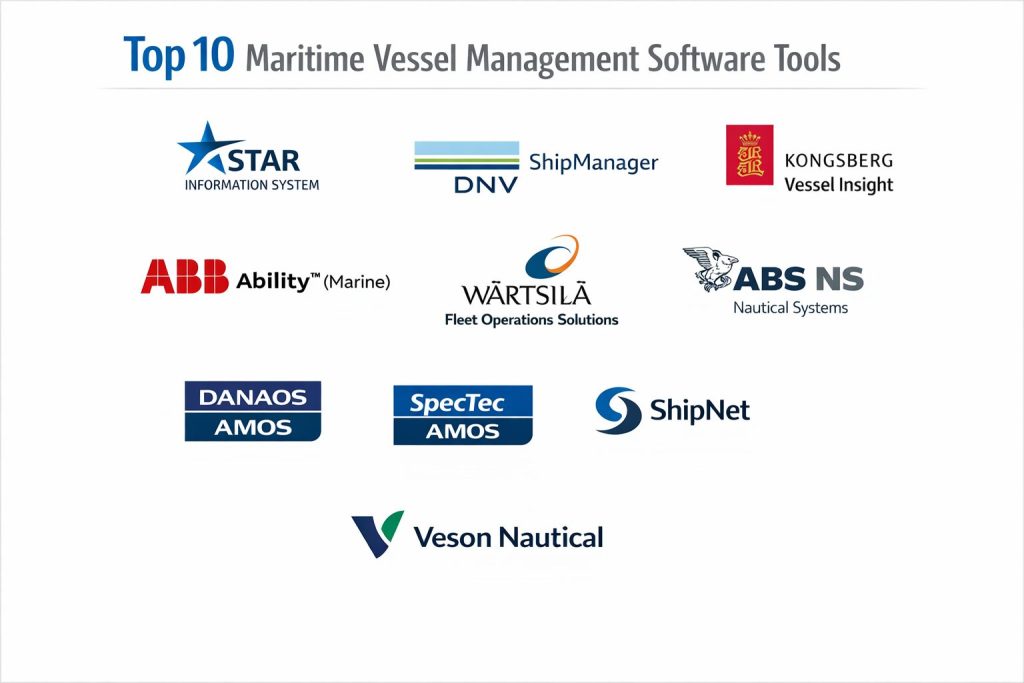
4) Top 10 Maritime Vessel Management Software Tools
1 — Star Information System (Star IS)
Star IS is a maritime operations platform used for managing technical operations, maintenance, safety processes, and fleet reporting. It suits ship managers and operators who want an established, maritime-specific system.
Key Features
- Planned maintenance workflows for vessel equipment and schedules
- Defect tracking and work order management
- HSQE documentation and reporting support (varies by setup)
- Fleet-level reporting and operational visibility
- Procurement support and requisition workflows (varies by module)
- Configurable forms and process tracking (varies)
Pros
- Maritime-focused structure fits vessel operations
- Works well for multi-vessel standardization
Cons
- Configuration and rollout can take time
- Some integrations may require project effort
Platforms / Deployment
Varies / N/A
Security & Compliance
Not publicly stated
Integrations & Ecosystem
Typically integrates through APIs, file-based exports/imports, or professional services depending on modules and customer setup.
- ERP/accounting integrations (varies)
- BI/report exports (varies)
- Crewing or HR system connections (varies)
- Document management patterns (varies)
Support & Community
Varies / Not publicly stated.
2 — DNV ShipManager
DNV ShipManager is a maritime management suite commonly used for planned maintenance, safety, and operational processes. It’s often considered by organizations that prefer a widely adopted maritime platform.
Key Features
- Planned maintenance and work order management
- Defect handling and equipment history tracking
- Safety and quality process support (varies by module)
- Inspection and checklist workflows (varies)
- Reporting for fleet oversight
- Standardization across vessels and fleets
Pros
- Strong fit for technical management workflows
- Useful for fleet-wide standard processes
Cons
- Implementation needs process alignment
- Licensing and module selection can be complex
Platforms / Deployment
Varies / N/A
Security & Compliance
Not publicly stated
Integrations & Ecosystem
Usually used as a core system with integration needs depending on customer environment and modules.
- Accounting/ERP connections (varies)
- Reporting and export workflows (varies)
- Interfaces to crewing systems (varies)
- Data exchange with other operational tools (varies)
Support & Community
Varies / Not publicly stated.
3 — Kongsberg Vessel Insight (maritime digital platform)
Kongsberg’s maritime digital platform is often used for connecting vessel data and supporting digital operations use cases. It can fit operators focused on data-driven fleet monitoring and operational insights.
Key Features
- Vessel data connectivity and aggregation (varies)
- Operational dashboards and monitoring use cases (varies)
- Support for fleet-level visibility (varies)
- Data sharing across systems (varies)
- Analytics enablement patterns (varies)
- Integration-friendly approach (varies)
Pros
- Helpful for data-driven fleet operations
- Supports broader digital transformation patterns
Cons
- May need pairing with a dedicated maintenance/HSQE suite
- Value depends on data availability and instrumentation
Platforms / Deployment
Varies / N/A
Security & Compliance
Not publicly stated
Integrations & Ecosystem
Often positioned around connecting vessel data streams and enabling integrations across operational systems.
- Data connectors (varies)
- API-based integration patterns (varies)
- BI/analytics workflows (varies)
- Partner ecosystem integrations (varies)
Support & Community
Varies / Not publicly stated.
4 — ABB Ability (marine digital solutions)
ABB’s marine digital solutions are commonly associated with vessel performance, equipment, and operational monitoring scenarios. It suits organizations focusing on performance and operational visibility.
Key Features
- Equipment and performance monitoring patterns (varies)
- Operational insights and analytics (varies)
- Support for condition-based maintenance approaches (varies)
- Fleet visibility use cases (varies)
- Reporting and alerting (varies)
- Integration approaches depending on scope (varies)
Pros
- Strong for operational and equipment-focused visibility
- Useful for performance-driven programs
Cons
- May not replace a full vessel management suite
- Scope varies heavily by chosen modules and services
Platforms / Deployment
Varies / N/A
Security & Compliance
Not publicly stated
Integrations & Ecosystem
Typically integrates with vessel systems and enterprise platforms depending on solution scope.
- Sensor/automation integrations (varies)
- Data exports/APIs (varies)
- Enterprise reporting connections (varies)
- Partner integrations (varies)
Support & Community
Varies / Not publicly stated.
5 — Wärtsilä Fleet Operations Solutions (digital fleet solutions)
Wärtsilä’s fleet digital solutions are used for operational performance and fleet-wide visibility use cases. They can fit operators seeking performance optimization and operational reporting.
Key Features
- Fleet-level operational monitoring (varies)
- Performance and efficiency insights (varies)
- Reporting and dashboarding (varies)
- Decision-support workflows (varies)
- Data integration patterns (varies)
- Support services depending on package (varies)
Pros
- Useful for fleet-level operational visibility
- Can support efficiency-focused initiatives
Cons
- Often complements, not replaces, core maintenance/HSQE tools
- Outcomes depend on data quality and adoption
Platforms / Deployment
Varies / N/A
Security & Compliance
Not publicly stated
Integrations & Ecosystem
Often used alongside other systems with data exchange depending on deployment scope.
- Data ingestion/connectors (varies)
- APIs or exports for reporting (varies)
- Integration with operational systems (varies)
- Partner ecosystem options (varies)
Support & Community
Varies / Not publicly stated.
6 — ABS NS (Nautical Systems)
Nautical Systems is known for maritime fleet management capabilities across maintenance, safety, and operations. It suits technical managers and fleet operators who want a comprehensive maritime platform.
Key Features
- Planned maintenance and defect management
- Safety and quality workflows (varies by module)
- Inventory and procurement processes (varies)
- Asset/equipment lifecycle history tracking
- Reporting and fleet visibility
- Workflow configuration (varies)
Pros
- Broad module coverage for vessel management
- Good for standardizing technical processes
Cons
- Implementation can be heavy for small teams
- Integrations may require planning and effort
Platforms / Deployment
Varies / N/A
Security & Compliance
Not publicly stated
Integrations & Ecosystem
Typically used as a central platform integrating with finance, reporting, and crewing systems based on customer needs.
- ERP/accounting integrations (varies)
- Reporting/BI exports (varies)
- Crewing system interfaces (varies)
- Document workflows (varies)
Support & Community
Varies / Not publicly stated.
7 — Danaos AMOS
AMOS is a maritime software suite used for technical management, maintenance, procurement, and related operations. It fits ship managers and operators that need structured workflows across fleets.
Key Features
- Planned maintenance and equipment management
- Procurement and inventory workflows (varies by module)
- Defect and job management
- Reporting and analytics (varies)
- Fleet standardization features
- Workflow and forms configuration (varies)
Pros
- Strong for technical management and maintenance workflows
- Suitable for multi-vessel fleet operations
Cons
- Setup and data migration can be demanding
- Training is needed for consistent usage onboard and ashore
Platforms / Deployment
Varies / N/A
Security & Compliance
Not publicly stated
Integrations & Ecosystem
Commonly integrated with enterprise systems and vessel reporting processes depending on customer environment.
- Accounting/ERP integration (varies)
- Data exports for reporting (varies)
- Interfaces to crewing tools (varies)
- API availability and integration methods vary (varies)
Support & Community
Varies / Not publicly stated.
8 — SpecTec AMOS (maritime management suite)
SpecTec AMOS is used for vessel maintenance management and broader operational processes in maritime contexts. It’s often evaluated for structured technical management and procurement workflows.
Key Features
- Planned maintenance and maintenance planning
- Work order execution and history tracking
- Procurement and spare parts workflows (varies)
- Reporting and dashboards (varies)
- Multi-vessel fleet standardization
- Configurable workflows (varies)
Pros
- Strong coverage of maintenance planning needs
- Supports fleet-wide consistency
Cons
- Requires disciplined data governance for best results
- Integration scope varies by deployment
Platforms / Deployment
Varies / N/A
Security & Compliance
Not publicly stated
Integrations & Ecosystem
Often used as a core tool with integrations depending on how finance, crewing, and reporting are organized.
- Integration with finance systems (varies)
- Reporting/BI outputs (varies)
- Crewing interfaces (varies)
- Document control patterns (varies)
Support & Community
Varies / Not publicly stated.
9 — ShipNet (maritime ERP and vessel management)
ShipNet is commonly positioned as a maritime ERP-style platform covering finance and operations, including vessel management-related workflows. It fits organizations that want operational processes connected to business management.
Key Features
- Operational process support tied to business workflows (varies)
- Procurement and inventory controls (varies)
- Maintenance-related workflows (varies)
- Reporting and management visibility (varies)
- Fleet and company-wide process standardization
- Data consolidation across departments
Pros
- Useful when finance and operations need tighter alignment
- Can reduce siloed systems for maritime companies
Cons
- May be heavier than teams need if they only want maintenance
- Implementation can require significant process alignment
Platforms / Deployment
Varies / N/A
Security & Compliance
Not publicly stated
Integrations & Ecosystem
Often acts as a backbone system with integration needs depending on existing enterprise tools.
- Accounting and finance workflows (varies)
- Data exports and reporting (varies)
- Interfaces to specialized maritime tools (varies)
- Integration approach varies (varies)
Support & Community
Varies / Not publicly stated.
10 — Veson Nautical (fleet and commercial operations ecosystem)
Veson Nautical is widely known in commercial maritime operations and is often used alongside operational systems for end-to-end processes. It can fit organizations that want commercial visibility connected to operational execution.
Key Features
- Commercial and operational workflow support (varies)
- Centralized data management for maritime operations (varies)
- Reporting and decision support (varies)
- Workflow standardization across teams (varies)
- Integration potential across maritime systems (varies)
- Scales across organizations (varies)
Pros
- Strong fit for commercial operations visibility
- Useful for connecting business decisions to operations
Cons
- May need pairing with a dedicated technical maintenance suite
- Capabilities vary based on selected modules and products
Platforms / Deployment
Varies / N/A
Security & Compliance
Not publicly stated
Integrations & Ecosystem
Commonly used in broader maritime stacks; integration depends on customer toolset and scope.
- Data exchange with technical systems (varies)
- Reporting integrations (varies)
- API and integration options (varies)
- Partner ecosystem connections (varies)
Support & Community
Varies / Not publicly stated.
Comparison Table
| Tool Name | Best For | Platform(s) Supported | Deployment | Standout Feature | Public Rating |
|---|---|---|---|---|---|
| Star Information System (Star IS) | Fleet technical operations standardization | Varies / N/A | Varies / N/A | Vessel-focused operational workflows | N/A |
| DNV ShipManager | Planned maintenance and fleet processes | Varies / N/A | Varies / N/A | Maintenance and vessel process management | N/A |
| Kongsberg Vessel Insight | Vessel data connectivity and fleet visibility | Varies / N/A | Varies / N/A | Data-driven operational monitoring | N/A |
| ABB Ability (Marine) | Equipment and performance visibility | Varies / N/A | Varies / N/A | Operational monitoring use cases | N/A |
| Wärtsilä Fleet Operations Solutions | Fleet efficiency and operational insights | Varies / N/A | Varies / N/A | Performance and fleet reporting | N/A |
| ABS NS (Nautical Systems) | Comprehensive vessel management modules | Varies / N/A | Varies / N/A | Broad maintenance and operations coverage | N/A |
| Danaos AMOS | Technical management and maintenance | Varies / N/A | Varies / N/A | Maintenance and procurement workflows | N/A |
| SpecTec AMOS | Maintenance planning and execution | Varies / N/A | Varies / N/A | Maintenance planning depth | N/A |
| ShipNet | Maritime ERP-style operations + business alignment | Varies / N/A | Varies / N/A | Business + operational consolidation | N/A |
| Veson Nautical | Commercial ops connected to maritime workflows | Varies / N/A | Varies / N/A | Commercial visibility and decision support | N/A |
Evaluation & Scoring of Maritime Vessel Management Software
| Tool Name | Core | Ease | Integrations | Security | Performance | Support | Value | Weighted Total |
|---|---|---|---|---|---|---|---|---|
| Star Information System (Star IS) | 8 | 6 | 7 | 5 | 7 | 6 | 6 | 6.70 |
| DNV ShipManager | 8 | 6 | 7 | 5 | 7 | 6 | 6 | 6.70 |
| Kongsberg Vessel Insight | 7 | 6 | 8 | 5 | 7 | 6 | 6 | 6.65 |
| ABB Ability (Marine) | 7 | 6 | 7 | 5 | 7 | 6 | 6 | 6.50 |
| Wärtsilä Fleet Operations Solutions | 7 | 6 | 7 | 5 | 7 | 6 | 6 | 6.50 |
| ABS NS (Nautical Systems) | 8 | 6 | 7 | 5 | 7 | 6 | 6 | 6.70 |
| Danaos AMOS | 8 | 6 | 7 | 5 | 7 | 6 | 6 | 6.70 |
| SpecTec AMOS | 8 | 6 | 7 | 5 | 7 | 6 | 6 | 6.70 |
| ShipNet | 7 | 6 | 7 | 5 | 7 | 6 | 6 | 6.50 |
| Veson Nautical | 7 | 6 | 7 | 5 | 7 | 6 | 6 | 6.50 |
How to interpret the scores:
- Scores are comparative and intended to support shortlisting, not to declare a universal winner.
- “Core” reflects vessel-management breadth across maintenance, safety, procurement, and operational workflows.
- Security scores are conservative because many vendors do not publicly list standardized enterprise controls in a single place.
- Your final decision should overweight the criteria that match your risk profile and operational reality.
Which Maritime Vessel Management Software Tool Is Right for You?
Solo / Freelancer
If you’re an individual consultant or a very small operator supporting a limited number of vessels, prioritize ease of setup, reporting, and a narrow scope that matches your immediate needs. Consider whether you truly need a full suite or only maintenance tracking and checklists.
SMB
SMBs should focus on standardizing maintenance planning, defect handling, and procurement basics across vessels. Choose a tool that supports consistent templates, onboard execution, and simple reporting without heavy process overhead.
Mid-Market
Mid-market operators often need stronger workflow governance, approval routing, and repeatable reporting across multiple departments. Prioritize tools that can support cross-team processes between technical, HSQE, and procurement, and validate how well onboard and shore users collaborate.
Enterprise
Enterprises should prioritize scalability, auditability, and integration patterns across finance, crewing, and reporting systems. Look for strong role-based access design, structured evidence capture, and a stable vendor support model suitable for global operations.
Budget vs Premium
Budget-focused teams should prioritize the modules that prevent downtime and reduce compliance risk: planned maintenance, defects, and essential reporting. Premium approaches typically emphasize broader suites, deeper configurability, and stronger support to reduce long-term operational friction.
Feature Depth vs Ease of Use
Deep feature sets can slow adoption if workflows become too complex. If your crews and shore teams need fast execution, choose simpler flows and strong templates; if you operate complex fleets, prioritize depth and governance even if training takes longer.
Integrations & Scalability
If you already have ERP, accounting, or crewing tools, integration fit becomes a deciding factor. Confirm how data flows for procurement, inventory, work orders, certificates, and reporting so you avoid double entry and inconsistent records.
Security & Compliance Needs
If you handle sensitive commercial or operational data, implement strong access governance and change control around workflows, users, and permissions. If specific certifications are not clearly published, treat them as not publicly stated and validate directly with vendors during procurement.
8) Frequently Asked Questions (FAQs)
1. What does maritime vessel management software actually manage?
It manages planned maintenance, defects, inspections, safety workflows, procurement, inventory, and operational reporting across vessels and shore offices. The goal is consistent execution and visibility across the fleet.
2. Is planned maintenance the most important module?
For many operators, yes, because it directly impacts reliability and downtime. However, safety workflows, procurement, and audit documentation are often equally critical in practice.
3. Can crews use these systems onboard with limited internet?
Some solutions support offline workflows or periodic synchronization, but capabilities vary. You should validate offline behavior for checklists, work orders, attachments, and approvals.
4. What should I look for in defect and work order management?
Look for clear prioritization, escalation, evidence attachments, and a strong history trail. Also check how defects link to equipment records, parts usage, and corrective actions.
5. How does procurement fit into vessel management?
Procurement connects maintenance to parts and consumables, enabling requisitions, approvals, and inventory tracking. A good workflow reduces delays caused by missing spares and unclear purchasing status.
6. How long does implementation typically take?
It depends on fleet size, data quality, and how many modules you roll out at once. A phased rollout often works best: start with maintenance and defects, then expand.
7. What are the most common mistakes during rollout?
Poor master data, inconsistent equipment hierarchy, and weak user training are the biggest issues. Another common mistake is trying to customize everything before basic workflows are stable.
8. How do I evaluate reporting and dashboards?
Start with the questions you need answered weekly: overdue maintenance, critical defects, procurement delays, safety observations, and vessel performance. Then test whether the tool can deliver those consistently without manual spreadsheet work.
9. What security controls should I expect?
At minimum, you should expect role-based permissions and good user management practices, but vendor specifics vary. If controls like SSO, audit logs, or encryption details are not clearly published, treat them as not publicly stated.
10. Can I switch systems later without major disruption?
Switching is possible but requires careful migration planning and data mapping. The biggest cost is usually process change management and retraining, not just data export/import.
Conclusion
Maritime vessel management software works best when it becomes the operational backbone for maintenance, safety execution, procurement coordination, and fleet visibility across both onboard and shore teams. The right choice depends on your fleet size, vessel types, connectivity constraints, and how disciplined your organization is with data and process adoption. Start by listing your must-have workflows, then shortlist a small set of tools that match your maintenance and HSQE priorities while still fitting procurement and reporting needs. Run a pilot with real vessel data, validate offline behavior and approvals, and confirm that roles and permissions match how your teams actually work before rolling out fleet-wide.