Introduction
Time series database platforms are built to store, query, and analyze data points that arrive over time, such as metrics, sensor readings, logs, events, and financial ticks. They matter because modern systems create massive streams of data every second, and teams need fast insights for reliability, performance, forecasting, and operational decisions. These platforms are designed for high-ingest workloads, efficient compression, time-based indexing, and quick aggregations over windows like minutes, hours, or days.
Real-world use cases include infrastructure and application monitoring, IoT telemetry and industrial sensors, security and audit event analytics, energy and utilities metering, and finance market data analysis. Buyers should evaluate ingestion speed, query latency, retention policies, downsampling support, compression efficiency, clustering and high availability, integrations with dashboards and alerting, data model flexibility, operational simplicity, and total cost for storage plus compute.
Best for: SRE and DevOps teams, data engineers, IoT teams, platform engineers, and analytics teams that handle continuous metrics or sensor streams.
Not ideal for: teams storing mostly documents, relational business records, or unstructured content where a relational or document database fits better.
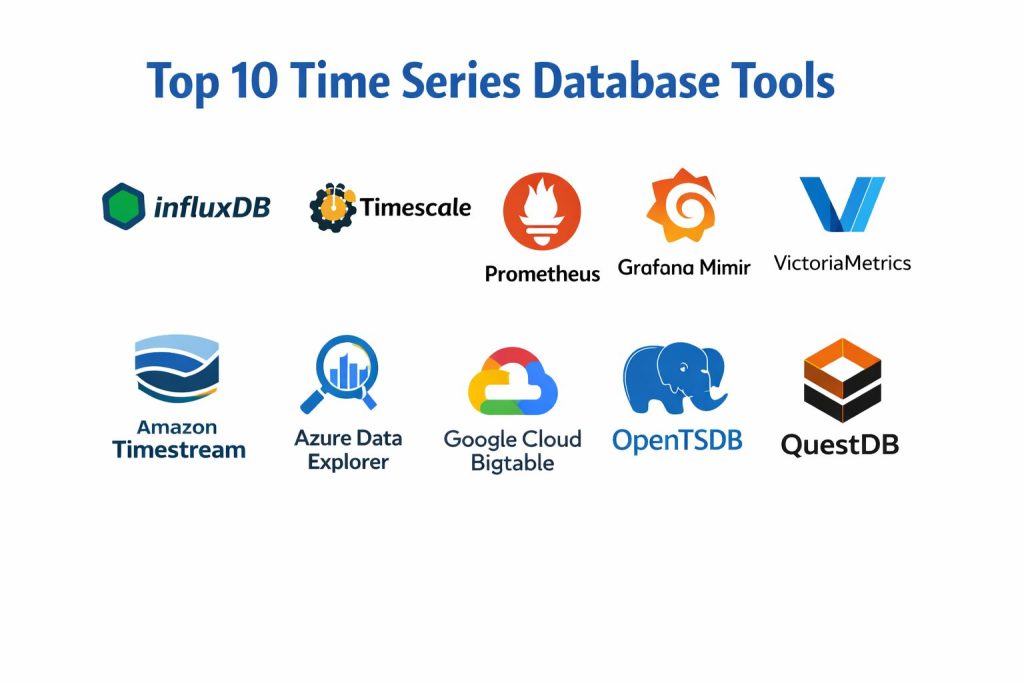
10 Tools Covered
Key Trends in Time Series Database Platforms
- Metrics and logs are being unified into one observability workflow with consistent queries and dashboards
- Long-term storage is moving toward object storage backed architectures for cost control
- High-cardinality metrics handling is becoming a major differentiator for large environments
- More teams are standardizing on Prometheus-compatible ingestion and query patterns
- Downsampling, retention policies, and tiered storage are becoming default expectations
- Real-time anomaly detection and forecasting are being layered on top of time series stores
- Multi-region replication and disaster recovery expectations are increasing for critical telemetry
- Compression and query acceleration are improving to reduce infrastructure spend
How We Selected These Tools (Methodology)
- Included platforms with strong adoption in observability, IoT, and real-time analytics
- Balanced open-source standards with managed cloud options
- Considered ingestion performance, query capabilities, and operational reliability
- Prioritized ecosystem compatibility with common collectors, agents, and dashboards
- Included tools that support both short-term monitoring and long-term retention patterns
- Chose a mix that fits solo teams, SMBs, and large enterprises
- Considered scalability signals such as clustering, sharding, and multi-tenant support
Top 10 Time Series Database Platforms Tools
1 — InfluxDB
A purpose-built time series database designed for high ingest, efficient storage, and fast time-based queries, commonly used for metrics and IoT telemetry.
Key Features
- Time series optimized storage engine with strong compression
- Retention policies and downsampling style workflows
- Query language support designed for time windows and aggregations
- Useful for metrics, sensor data, and operational telemetry
- Broad ecosystem support with collectors and integrations
Pros
- Strong ingestion and storage efficiency for time series workloads
- Practical tooling for retention and time-based analysis
Cons
- Some advanced scaling patterns require careful planning
- Feature choices vary depending on deployment approach
Platforms / Deployment
Windows, macOS, Linux, Cloud, Self-hosted, Hybrid
Security and Compliance
Not publicly stated
Integrations and Ecosystem
InfluxDB commonly fits into monitoring and IoT stacks where collectors and dashboards are standard.
- Works with many agents and collectors for telemetry ingestion
- Supports integration with dashboards and alerting workflows
- APIs and client libraries are used for custom ingestion
Support and Community
Strong community visibility and documentation; support tiers vary.
2 — Timescale
A time series database built on a relational foundation, often used when teams want time series performance while keeping relational query patterns and SQL workflows.
Key Features
- Time partitioning and compression focused on time series efficiency
- SQL-friendly time series queries and analytics
- Retention and data lifecycle control for large datasets
- Works well when time series relates to business entities
- Strong fit for analytics teams using SQL skills
Pros
- SQL-based access simplifies onboarding for many teams
- Strong for mixed workloads combining time series and relational data
Cons
- Scaling architecture decisions matter for large deployments
- Some workloads may require tuning for best performance
Platforms / Deployment
Windows, macOS, Linux, Cloud, Self-hosted, Hybrid
Security and Compliance
Not publicly stated
Integrations and Ecosystem
Timescale fits well in ecosystems where SQL tools and BI workflows are common.
- Works with many SQL-based analytics tools
- Integrates into observability pipelines through exporters and connectors
- APIs and drivers support application ingestion patterns
Support and Community
Good documentation and active community; support tiers vary.
3 — Prometheus
A widely used metrics platform that stores time series data and powers alerting and monitoring workflows, especially in cloud-native environments.
Key Features
- Pull-based metrics collection model with strong ecosystem support
- Query language designed for metric aggregations and filtering
- Alerting patterns used widely in modern monitoring stacks
- Strong fit for infrastructure and application telemetry
- Huge adoption in container and orchestration environments
Pros
- Strong community adoption and standardization benefits
- Large ecosystem of exporters and integrations
Cons
- Long-term retention can be challenging without additional components
- High-cardinality workloads require careful design
Platforms / Deployment
Linux, Windows, macOS, Self-hosted
Security and Compliance
Not publicly stated
Integrations and Ecosystem
Prometheus is often the center of metrics collection, feeding dashboards and alerting systems.
- Large exporter ecosystem for common systems and applications
- Commonly paired with visualization and alerting workflows
- Remote storage patterns vary by architecture
Support and Community
Very strong community, strong documentation, broad production knowledge.
4 — Grafana Mimir
A scalable, multi-tenant metrics platform designed for large-scale environments, often used for long-term storage and high-availability metrics at scale.
Key Features
- Multi-tenant architecture for large organizations
- Scalable ingestion and storage patterns for massive metrics volumes
- Strong compatibility with common metric ingestion patterns
- Designed for high availability and large retention windows
- Useful for centralized observability at enterprise scale
Pros
- Strong fit for multi-team and multi-tenant environments
- Designed for long-term metrics storage at scale
Cons
- Operational complexity can be higher than simpler setups
- Best value appears when you truly need multi-tenant scale
Platforms / Deployment
Linux, Cloud, Self-hosted, Hybrid
Security and Compliance
Not publicly stated
Integrations and Ecosystem
Mimir is commonly used where teams standardize on a metrics ecosystem and need centralized scale.
- Works well with common metrics ingestion patterns
- Fits into enterprise dashboarding and alerting workflows
- Integrations depend on chosen observability stack
Support and Community
Community and support options vary by distribution and deployment.
5 — VictoriaMetrics
A high-performance time series database often chosen for efficiency, simplicity, and scaling metrics storage with strong ingestion capabilities.
Key Features
- Strong ingestion performance with efficient storage design
- Supports common query patterns used in metrics ecosystems
- Scales from single node to clustered patterns
- Efficient for high-cardinality metric workloads with tuning
- Practical for cost-focused metrics retention
Pros
- Strong performance and storage efficiency
- Often simpler operations compared to heavier stacks
Cons
- Feature depth varies across editions and components
- Some enterprise features depend on deployment choices
Platforms / Deployment
Linux, Windows, Cloud, Self-hosted, Hybrid
Security and Compliance
Not publicly stated
Integrations and Ecosystem
VictoriaMetrics is commonly used as a backend for monitoring stacks that need speed and cost efficiency.
- Works with common collectors and ingestion patterns
- Supports integration with dashboards and alerting workflows
- APIs support custom ingestion and query use cases
Support and Community
Good documentation and growing community; support tiers vary.
6 — Amazon Timestream
A managed time series database designed for serverless-style scaling, often used for operational telemetry and IoT data without managing infrastructure.
Key Features
- Managed service model reduces operational burden
- Designed for time series ingestion and querying at scale
- Automatic lifecycle management patterns depending on setup
- Practical for cloud-native telemetry pipelines
- Integrates well within its broader cloud ecosystem
Pros
- Reduced ops overhead compared to self-managed databases
- Good fit for teams already using managed cloud services
Cons
- Vendor lock-in considerations for long-term strategy
- Cost can grow if query patterns and retention are not controlled
Platforms / Deployment
Cloud
Security and Compliance
Not publicly stated
Integrations and Ecosystem
Amazon Timestream is commonly used when telemetry pipelines already live in the same cloud ecosystem.
- Integrates with cloud-native ingestion and processing services
- Works well with dashboarding and alerting patterns through connectors
- API-driven ingestion supports custom applications
Support and Community
Vendor support depends on plan; community usage varies.
7 — Azure Data Explorer
A high-performance analytics platform frequently used for log and telemetry analytics, also supporting time series patterns for operational insights and monitoring analytics.
Key Features
- Fast ingestion and query for telemetry and event data
- Strong time window analysis and aggregation patterns
- Scales for large analytical workloads
- Useful for observability analytics and security event analysis
- Strong fit for teams already in the Azure ecosystem
Pros
- Strong for large-scale telemetry analytics and exploration
- Good performance for time-window aggregations
Cons
- Learning curve for its query approach if new to it
- Best value often appears with broader platform usage
Platforms / Deployment
Cloud, Hybrid
Security and Compliance
Not publicly stated
Integrations and Ecosystem
Azure Data Explorer fits well where teams ingest many streams and need interactive analytics for operations.
- Connects with common ingestion tools and pipelines
- Supports dashboards and exploration workflows
- APIs support automation and data operations patterns
Support and Community
Vendor support varies by plan; community resources exist but are platform-specific.
8 — Google Cloud Bigtable
A scalable, managed wide-column database that can serve time series workloads, often used when teams need extreme scale and predictable performance for large datasets.
Key Features
- Designed for high throughput and large scale storage
- Supports time series style modeling patterns
- Useful for large telemetry and event workloads at scale
- Managed operations reduce infrastructure overhead
- Strong fit for teams already operating in Google Cloud
Pros
- Strong scalability for very large datasets
- Managed model reduces ops burden for massive scale
Cons
- Data modeling requires careful design for time series efficiency
- Vendor ecosystem dependence for long-term strategy
Platforms / Deployment
Cloud
Security and Compliance
Not publicly stated
Integrations and Ecosystem
Bigtable is often used in data pipelines where scale is the primary requirement.
- Integrates with cloud-native ingestion and processing services
- Works with analytics tooling through connectors and pipelines
- APIs support application ingestion patterns
Support and Community
Vendor support depends on plan; community is more cloud-specific.
9 — OpenTSDB
A time series database built on top of a distributed storage layer, historically used for large-scale metrics storage with a focus on scalability.
Key Features
- Built for scalable time series storage patterns
- Useful for metrics-style ingestion and retention
- Designed to work with distributed backends
- Supports time window queries for operational analysis
- Often used in established legacy monitoring setups
Pros
- Can scale well with the right backend architecture
- Established usage in large metrics environments
Cons
- Operational complexity depends heavily on underlying backend
- May feel less modern compared to newer platforms
Platforms / Deployment
Linux, Self-hosted
Security and Compliance
Not publicly stated
Integrations and Ecosystem
OpenTSDB is typically used in environments where existing distributed storage infrastructure is already in place.
- Integrations depend on ingestion tooling and pipeline standards
- Works with dashboards and monitoring workflows
- Architecture choices heavily affect usability and cost
Support and Community
Community resources exist; enterprise support varies by vendor ecosystem.
10 — QuestDB
A fast time series database focused on ingestion speed and efficient queries, often used for real-time analytics and high-throughput time series workloads.
Key Features
- High ingestion throughput with time series optimized design
- Efficient SQL-style querying for time-based analysis
- Useful for real-time analytics use cases
- Works well for financial ticks and event streams
- Practical performance for time-window aggregations
Pros
- Strong speed and efficiency for real-time time series workloads
- SQL approach can simplify adoption for many teams
Cons
- Feature depth depends on deployment requirements
- Some enterprise capabilities may require validation for your needs
Platforms / Deployment
Windows, macOS, Linux, Cloud, Self-hosted, Hybrid
Security and Compliance
Not publicly stated
Integrations and Ecosystem
QuestDB often fits use cases where fast ingestion and fast queries are the main priorities.
- Works with common ingestion patterns and client libraries
- Supports dashboard and analytics workflows through connectors
- API support enables custom pipelines
Support and Community
Community is growing; documentation and support depend on plan.
Comparison Table
| Tool Name | Best For | Platform(s) Supported | Deployment | Standout Feature | Public Rating |
|---|---|---|---|---|---|
| InfluxDB | Metrics and IoT telemetry | Windows, macOS, Linux | Cloud, Self-hosted, Hybrid | Efficient time series storage and retention | N/A |
| Timescale | SQL-friendly time series analytics | Windows, macOS, Linux | Cloud, Self-hosted, Hybrid | Time series performance with SQL workflows | N/A |
| Prometheus | Cloud-native monitoring metrics | Windows, macOS, Linux | Self-hosted | Huge exporter ecosystem for metrics | N/A |
| Grafana Mimir | Multi-tenant metrics at scale | Linux | Cloud, Self-hosted, Hybrid | Long-term scalable metrics storage | N/A |
| VictoriaMetrics | Cost-efficient metrics retention | Windows, Linux | Cloud, Self-hosted, Hybrid | High performance with efficient storage | N/A |
| Amazon Timestream | Managed cloud time series | N/A | Cloud | Reduced ops with managed ingestion and storage | N/A |
| Azure Data Explorer | Telemetry analytics and exploration | N/A | Cloud, Hybrid | Fast time-window analytics on streams | N/A |
| Google Cloud Bigtable | Massive scale time series modeling | N/A | Cloud | Extreme scale wide-column storage | N/A |
| OpenTSDB | Scalable legacy metrics storage | Linux | Self-hosted | Distributed backend scalability | N/A |
| QuestDB | High-speed time series analytics | Windows, macOS, Linux | Cloud, Self-hosted, Hybrid | Fast ingestion and SQL queries | N/A |
Evaluation and Scoring of Time Series Database Platforms
Weights
Core features 25 percent
Ease of use 15 percent
Integrations and ecosystem 15 percent
Security and compliance 10 percent
Performance and reliability 10 percent
Support and community 10 percent
Price and value 15 percent
| Tool Name | Core | Ease | Integrations | Security | Performance | Support | Value | Weighted Total |
|---|---|---|---|---|---|---|---|---|
| InfluxDB | 8.8 | 7.8 | 8.2 | 6.0 | 8.5 | 7.5 | 7.8 | 7.93 |
| Timescale | 8.6 | 7.9 | 8.0 | 6.2 | 8.2 | 7.4 | 7.4 | 7.79 |
| Prometheus | 8.3 | 7.2 | 9.2 | 5.8 | 7.8 | 9.3 | 8.4 | 8.17 |
| Grafana Mimir | 8.4 | 6.6 | 8.8 | 6.0 | 8.4 | 7.6 | 7.6 | 7.74 |
| VictoriaMetrics | 8.1 | 7.4 | 8.5 | 5.8 | 8.6 | 7.4 | 8.6 | 8.05 |
| Amazon Timestream | 7.8 | 7.5 | 7.9 | 6.2 | 8.0 | 7.0 | 7.0 | 7.50 |
| Azure Data Explorer | 8.0 | 6.9 | 8.1 | 6.4 | 8.4 | 7.1 | 7.2 | 7.63 |
| Google Cloud Bigtable | 7.9 | 6.6 | 7.8 | 6.4 | 8.7 | 7.0 | 6.8 | 7.46 |
| OpenTSDB | 7.2 | 6.2 | 7.0 | 5.6 | 7.6 | 6.6 | 7.8 | 7.02 |
| QuestDB | 7.7 | 7.1 | 7.4 | 5.8 | 8.5 | 6.8 | 7.9 | 7.55 |
How to interpret the scores
These scores are comparative and help you shortlist tools based on your needs. A slightly lower total can still be the best choice if it matches your pipeline and constraints. Core and integrations drive long-term fit, while ease impacts onboarding speed. Performance matters most at high ingest and high-cardinality scale. Value can vary based on licensing, usage patterns, and retention strategy.
Which Time Series Database Platform Is Right for You
Solo or Freelancer
If you want a straightforward setup and community support for metrics, Prometheus is commonly used, especially for small environments. If you want a more general time series database for custom workloads, InfluxDB or QuestDB can be practical depending on your data and query style.
SMB
SMBs often benefit from a mix of simplicity and predictable scaling. InfluxDB and Timescale are common choices for time series plus analytics workflows. VictoriaMetrics can be strong when cost efficiency and retention matter. If you need a cloud-managed approach, Amazon Timestream can reduce operational effort.
Mid-Market
Mid-market teams often feel scaling pressure from higher ingest and more services. Grafana Mimir can help when multi-tenant metrics storage and long retention become important. VictoriaMetrics can also work well for scaling metrics storage without heavy complexity. Azure Data Explorer becomes attractive when you need powerful telemetry analytics.
Enterprise
Enterprises typically prioritize multi-team governance, long retention, and operational resilience. Grafana Mimir can fit centralized observability patterns. Azure Data Explorer is strong for large telemetry analytics workloads. Google Cloud Bigtable can fit extreme scale, but requires careful data modeling. Many enterprises also keep Prometheus at the edge and use a scalable backend for long-term retention.
Budget vs Premium
Budget-focused teams often use Prometheus with a cost-efficient backend and strict retention policies. Premium choices often involve managed services to reduce ops time. The real cost is usually driven by retention duration, query patterns, and high-cardinality metrics, not only licensing.
Feature Depth vs Ease of Use
Timescale and QuestDB can feel more approachable for teams comfortable with SQL. Prometheus is simple for metrics, but long-term storage can add complexity. InfluxDB is time series oriented and can be easy to start, but scaling choices should be planned early.
Integrations and Scalability
Prometheus has strong collector and exporter ecosystem benefits. Mimir and VictoriaMetrics often fit well when you need scalable storage behind common ingestion patterns. Managed services fit best when your pipelines already live in that cloud ecosystem and you want fewer servers to manage.
Security and Compliance Needs
Treat security as a full pipeline concern: collectors, transport, storage, access control, and dashboards. For tools where compliance details are not publicly stated, validate access controls, audit needs, and encryption expectations during evaluation. In regulated environments, focus on identity, least privilege, and data retention governance as much as raw database features.
Frequently Asked Questions
1. What type of data should go into a time series database
Metrics, sensor readings, events, and telemetry that arrive with timestamps fit best. If your data is mostly relational business data, a relational database may be better.
2. How long should we retain high-resolution metrics
Many teams keep high-resolution data for a short window and store downsampled data longer. Your retention should match alerting and investigation needs.
3. What is high cardinality and why does it matter
High cardinality means many unique label combinations in metrics. It can increase storage and query cost, so it influences tool choice and metric design.
4. Can these platforms handle IoT sensor data
Yes, many can. The key is ingestion strategy, batching, and a data model that supports time-window queries without excessive cost.
5. Should we choose a managed service or self-hosted
Managed services reduce operational load but increase dependency on a single cloud. Self-hosted offers more control but requires skilled operations.
6. How do I avoid performance issues in time series systems
Limit unnecessary labels, control cardinality, set retention policies, and validate ingestion patterns early. Poor metric design causes more issues than many people expect.
7. What dashboards work best with time series databases
Most teams choose a dashboard layer that supports time-based charts, alerts, and query exploration. Integration quality depends on your chosen stack.
8. How hard is it to migrate from one time series database to another
Migration effort depends on data model differences, query language differences, and retention needs. Many teams migrate by running systems in parallel during a transition period.
9. Are these tools good for forecasting and anomaly detection
They store and query time series well, but forecasting often needs additional analytics layers or ML tooling. Some stacks support add-ons for smarter detection.
10. What is the safest way to evaluate two platforms
Run a pilot using real production-like metrics, realistic cardinality, and your expected retention window. Measure ingest, query speed, operational effort, and integration fit.
Conclusion
Time series database platforms become critical when your systems generate continuous telemetry and you need fast, reliable insight for monitoring, alerting, and analytics. The best choice depends on your workload shape, especially ingestion rate, retention length, and metric cardinality. Prometheus is widely used for metrics collection and query workflows, while scalable backends like Grafana Mimir or VictoriaMetrics can help when long retention and multi-team scale are required. InfluxDB and Timescale are strong for broader time series use cases, especially when you want structured analysis patterns. Managed options like Amazon Timestream reduce operational burden, but you must watch cost and ecosystem fit. A smart next step is to shortlist two or three tools, run a realistic pilot, validate integrations, and finalize retention and governance before standardizing.