Introduction
Telemedicine platforms have redefined the modern healthcare landscape by bridging the geographical gap between providers and patients through high-definition video, secure messaging, and integrated diagnostic tools. These digital health ecosystems enable clinicians to conduct comprehensive virtual visits, manage chronic conditions remotely, and streamline administrative workflows without the constraints of a physical office. By leveraging cloud-based infrastructure and mobile accessibility, telemedicine ensures that quality medical consultation is available at any time, significantly reducing the burden on traditional emergency rooms and outpatient clinics.
The current generation of virtual care technology is focused on “Total Care Coordination,” where video calls are just one component of a broader digital health strategy. Modern platforms now integrate seamlessly with wearable devices and electronic health records to provide a 360-degree view of patient health in real-time. This shift allows for a more proactive approach to medicine, where data-driven insights help prevent hospitalizations and improve long-term outcomes. For healthcare organizations, adopting a robust telemedicine platform is no longer an optional digital upgrade but a core requirement for remaining competitive and accessible.
Real-World Use Cases
- Virtual Urgent Care: Patients suffering from non-emergency symptoms like flu, rashes, or minor infections can receive immediate consultations and prescriptions from home, bypassing crowded waiting rooms.
- Chronic Disease Management: Physicians use remote monitoring integrations to track blood pressure, glucose levels, and heart rates, allowing for timely adjustments to treatment plans without requiring in-person visits.
- Behavioral Health and Therapy: Telemedicine provides a private and comfortable environment for mental health sessions, increasing patient adherence and expanding access to specialized therapists who may not be locally available.
- Post-Operative Follow-ups: Surgical teams use video visits to inspect wound healing and monitor recovery progress, reducing the travel burden on recovering patients and freeing up clinic space for new consultations.
- Specialist e-Consults: Primary care doctors can virtually bring a specialist into a patient’s exam room via high-quality video links, facilitating immediate collaborative care and faster diagnosis for complex cases.
Buyer Evaluation Criteria
- HIPAA and Data Security Compliance: The platform must utilize end-to-end encryption and maintain strict compliance with healthcare privacy laws to ensure that sensitive patient data and video sessions remain confidential.
- Electronic Health Record (EHR) Integration: Evaluate how well the platform syncs with existing systems like Epic, Cerner, or Athenahealth to ensure that virtual visit notes and data are automatically updated in the patient’s permanent file.
- Ease of Use for Patients: The interface must be intuitive and ideally “download-free,” allowing patients to join a secure session with a single click from an email or text message link on any device.
- Clinical Workflow Customization: Look for tools that allow providers to mirror their physical clinic workflows, including digital waiting rooms, intake forms, and multi-party calling for family members or translators.
- Integrated Reimbursement and Billing: The software should support automated insurance verification, co-pay collection, and the generation of superbills to ensure the practice is compensated accurately for virtual services.
- Remote Patient Monitoring (RPM) Support: Determine if the platform can ingest data from medical-grade wearables and home devices to provide continuous health insights between scheduled appointments.
- Scalability and White-Labeling: For larger health systems, the ability to brand the platform with their own logo and scale across multiple departments and thousands of users is a critical requirement.
- Technical Stability and Support: High-quality video and audio are non-negotiable; buyers must assess the platform’s performance in low-bandwidth environments and the availability of 24/7 technical assistance.
- Multi-Platform Accessibility: The platform should function flawlessly across web browsers, tablets, and smartphones to accommodate the diverse hardware preferences of both clinicians and patients.
- Total Cost of Ownership (TCO): Beyond the monthly subscription, consider costs for implementation, specialized hardware (like digital stethoscopes), and any per-visit fees that may apply.
Best for: Private practices, large hospital systems, mental health clinics, and specialized wellness providers looking to extend their reach and improve patient convenience through digital channels.
Not ideal for: Emergency trauma situations requiring physical intervention, or specialized diagnostics that require physical tactile manipulation and high-complexity laboratory equipment.
Key Trends in Telemedicine Platforms
- AI-Assisted Clinical Documentation: Advanced platforms now use ambient AI to listen to virtual consultations and automatically generate structured clinical notes, allowing doctors to focus entirely on the patient.
- Augmented Reality (AR) Diagnostics: Providers are increasingly using AR overlays during video calls to guide patients through self-exams or to visualize complex anatomical structures for better patient education.
- Asynchronous Care Workflows: There is a growing shift toward “store-and-forward” care, where patients submit photos or data at their convenience, and doctors review and respond outside of a live video session.
- Wearable Data Orchestration: Telemedicine suites are becoming central hubs for consumer and medical-grade wearable data, using AI to flag abnormal trends and alert clinicians before a health crisis occurs.
- Integrated Prescription Management: Platforms now offer one-click e-prescribing directly within the video interface, sending orders to the patient’s preferred pharmacy and checking for drug interactions in real-time.
- Digital Health Equity Features: To bridge the digital divide, platforms are adding low-data modes for rural areas and integrated real-time translation services for non-native speaking patients.
- Virtual Nursing and Sitter Services: Large hospitals are deploying telemedicine “carts” to provide continuous remote monitoring of bedside patients, allowing a single nurse to oversee multiple rooms virtually.
- Direct-to-Consumer Wellness Models: Many platforms are evolving to support subscription-based wellness and longevity programs, moving beyond episodic care toward continuous health optimization.
How We Selected These Tools (Methodology)
Our selection of the top 10 telemedicine platforms involved a rigorous assessment of the global digital health market. We analyzed over 50 vendors based on their technological maturity, security protocols, and ability to serve different segments of the healthcare industry.
- Security and Compliance Standards: We prioritized platforms that have consistently met or exceeded HIPAA, GDPR, and other international healthcare data protection requirements.
- Integration Depth: Tools were scored on their ability to integrate with the most common Electronic Health Record (EHR) systems used by hospitals and private practices worldwide.
- Clinical Functionality: We evaluated the presence of essential medical tools, such as digital stethoscopes, high-res otoscope feeds, and integrated medical charting during live calls.
- Patient Engagement Metrics: We looked for platforms with high patient satisfaction scores, specifically focusing on the simplicity of the joining process and the quality of the mobile experience.
- Enterprise Reliability: Only platforms with a proven track record of 99.9% uptime and the ability to support large-scale health systems were considered for the top rankings.
- Innovation and AI Roadmap: We assessed how well each vendor is incorporating emerging technologies like AI scribing and predictive analytics into their core product offering.
- Market Presence and Longevity: Our list focuses on established leaders and high-growth innovators who have demonstrated financial stability and a commitment to long-term product support.
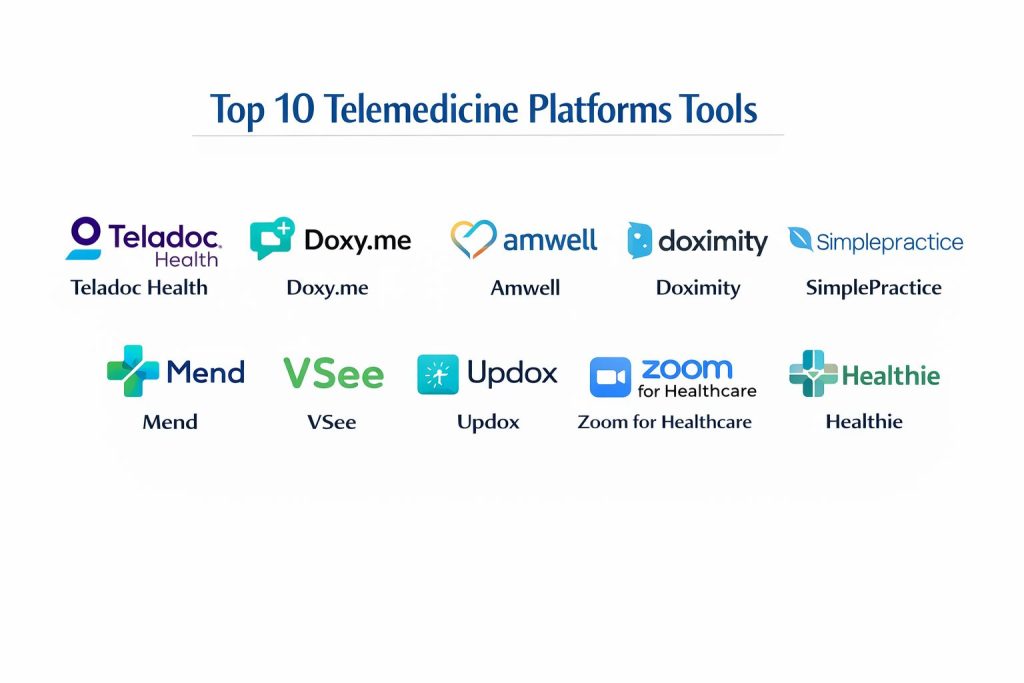
Top 10 Telemedicine Platforms
1. Teladoc Health
Teladoc Health is one of the world’s largest and most comprehensive telemedicine providers, offering an end-to-end platform for virtual care, chronic condition management, and mental health. It serves as a massive ecosystem that connects health plans, employers, and health systems with advanced virtual delivery tools.
Key Features
- Solo and Enterprise Editions: Provides tailored solutions ranging from individual private practices to the world’s largest integrated delivery networks.
- Chronic Care Management: Integrates the Livongo suite for managing diabetes and hypertension through connected devices and AI-driven health “nudges.”
- Primary360: A comprehensive virtual primary care model that assigns patients a dedicated care team for long-term health management and wellness planning.
- Integrated Mental Health: Offers a robust network of licensed therapists and psychiatrists accessible through the same unified patient portal.
- High-Definition Clinical Devices: Supports a range of FDA-cleared devices including digital stethoscopes and cameras for detailed remote physical exams.
- Global Network Access: Provides a vast network of board-certified physicians across hundreds of specialties, available 24/7 for urgent care needs.
- Advanced Analytics Dashboard: Gives health system administrators deep insights into patient utilization, clinical outcomes, and population health trends.
Pros
- Unmatched global scale and experience, making it a highly stable and reliable partner for large-scale healthcare deployments.
- One of the best suites for chronic disease management, moving beyond simple video calls into continuous patient monitoring.
- Deeply integrated ecosystem that covers everything from urgent care to specialized mental health and long-term wellness.
Cons
- The platform’s complexity and vast feature set can make the initial setup and configuration daunting for smaller practices.
- Enterprise-level pricing may be significantly higher than specialized or “video-only” competitors in the market.
- Because it is a massive organization, personalized customer support for smaller accounts can sometimes feel less responsive.
Platforms / Deployment
- Web / iOS / Android
- Cloud-based SaaS
Security & Compliance
- HIPAA, HITECH, and GDPR compliant.
- HITRUST CSF Certified for advanced data protection.
Integrations & Ecosystem
Teladoc Health is built to be the primary interface for virtual care within a health system.
- Deep native integration with Epic and Cerner EHR systems.
- Seamless connections with health insurance portals for automated billing and eligibility.
- Support for a wide array of medical-grade IoT devices for remote patient monitoring.
- Partnerships with major pharmacy chains for automated e-prescribing and medication home delivery.
Support & Community
Teladoc provides 24/7 clinical and technical support for its partners. They maintain an extensive library of white papers and clinical case studies to help organizations optimize their virtual care strategies.
2. Doxy.me
Doxy.me is a highly popular, “browser-based” telemedicine platform known for its extreme simplicity and ease of use. It is designed specifically to remove barriers to entry, requiring no downloads or accounts for patients, making it a top choice for individual therapists and small medical practices.
Key Features
- Download-Free Experience: Patients join a session simply by clicking a link in their browser on any device, eliminating the friction of app installations.
- Virtual Waiting Rooms: Allows clinicians to manage multiple patients, providing a personalized space where patients can read educational materials while waiting.
- Point-to-Point Encryption: Ensures that all video and audio streams are encrypted directly between the provider and patient for maximum privacy.
- Simple Clinician Dashboard: A streamlined interface that focuses on starting calls, managing a queue, and viewing patient check-in status.
- Custom Branding: Higher-tier plans allow clinics to add their own logos and colors to the waiting room for a professional, branded experience.
- Multi-Party Calling: Allows for the easy inclusion of family members, caregivers, or language interpreters into the virtual visit.
- In-Meeting File Sharing: Enables providers to securely share lab results, educational PDFs, or medical images during the live consultation.
Pros
- The most accessible platform for patients; if they can use a web browser, they can use Doxy.me without any technical hurdles.
- Offers a generous “Free” tier that includes unlimited minutes and sessions, making it perfect for startups and solo practitioners.
- Extremely fast deployment; a provider can be up and running with a secure virtual clinic in under five minutes.
Cons
- Lacks the deep, native EHR integrations found in more expensive enterprise-focused platforms.
- Advanced features like clinical device integration and automated billing workflows are only available on paid tiers.
- As a browser-based tool, video quality can be more susceptible to browser-level performance issues compared to native apps.
Platforms / Deployment
- Web (Mobile and Desktop)
- Cloud-based SaaS
Security & Compliance
- HIPAA, GDPR, PHIPA, and HITECH compliant.
- Utilizes VSee technology for secure, high-quality media streaming.
Integrations & Ecosystem
Doxy.me focuses on the video interaction itself rather than a full administrative suite.
- Integrates with various scheduling and billing tools through Zapier.
- Supports basic integration with several popular small-practice EHRs.
- Payments can be collected directly through the platform via Stripe integration.
Support & Community
Doxy.me provides an extensive Help Center and video tutorials. Paid tiers include priority email and chat support, and the platform hosts a large community forum for best-practice sharing.
3. Amwell
Amwell is a major enterprise telemedicine platform that powers virtual care for some of the world’s largest health plans and hospital systems. Its “Converge” platform is designed to unify all digital health services—from urgent care to tele-ICU—into a single, highly scalable architecture.
Key Features
- Converge Platform: A unified digital care delivery system that supports virtual visits, remote patient monitoring, and automated patient programs.
- Telehealth Carts and Kiosks: Provides specialized hardware for hospital settings, allowing specialists to “beam in” to patient rooms for consultations.
- Clinical Modular Apps: Features a “plug-and-play” architecture where clinics can add specific modules for behavioral health, dermatology, or chronic care.
- Automated Patient Intake: Streamlines the pre-visit process with digital forms, insurance verification, and clinical questionnaires.
- Advanced Multi-Party Visits: Supports complex clinical scenarios including medical students, specialists, and translators on a single secure call.
- Population Health Tools: Provides large-scale analytics to help health systems manage high-risk patient groups and track the effectiveness of virtual programs.
- SilverCloud Integration: Includes evidence-based digital mental health programs that patients can use between clinical sessions.
Pros
- One of the most mature and “battle-tested” platforms for massive health systems and insurance carriers.
- Exceptional hardware integration, offering some of the best mobile carts for inpatient and emergency room tele-consults.
- Highly flexible architecture that allows health systems to build their own custom virtual care experiences on top of the Amwell core.
Cons
- The high-end enterprise focus means it is generally too complex and expensive for a single-doctor private practice.
- Implementation can be a significant undertaking, requiring months of coordination with internal IT and clinical teams.
- The patient-facing interface, while professional, can sometimes feel more “corporate” and less personal than simpler tools.
Platforms / Deployment
- Web / iOS / Android / Specialized Hardware
- Cloud-based SaaS
Security & Compliance
- HIPAA, HITECH, and GDPR compliant.
- SOC 2 Type II certified and ISO 27001 compliant.
Integrations & Ecosystem
Amwell is a “system of record” for virtual care, designed for deep enterprise connectivity.
- Native, high-level integrations with Epic, Cerner, and Meditech.
- Direct integration with major health plan systems for automated claims processing.
- Supports a vast ecosystem of medical-grade peripherals for inpatient and outpatient care.
Support & Community
Amwell offers dedicated account management for enterprise clients and 24/7 technical support. They host “Amwell Connect,” a major industry event for digital health leaders.
4. Doximity
Doximity is primarily a professional network for physicians, but its “Dialer Video” tool has become one of the most widely used telemedicine features in medicine. It allows doctors to call patients from their personal cell phones while displaying their office number, ensuring privacy while maintaining a professional connection.
Key Features
- Dialer Video: A mobile-first tool that allows physicians to initiate video calls from their smartphone with a single click, showing the office Caller ID.
- HIPAA-Secure Pro Messaging: Enables secure, encrypted texting between clinicians and patients for quick follow-ups and coordination.
- Virtual Faxing: Provides a digital fax line so doctors can send and receive medical documents directly from their mobile devices.
- Integration with Personal Devices: Uses the native smartphone camera and microphone, making it familiar and easy for doctors to use on the go.
- One-Click Patient Entry: Patients receive a text message and click a link to enter the video room; no patient account or login is required.
- Screen Sharing: Allows doctors to show patients their X-rays, lab results, or educational diagrams directly from their mobile device or desktop.
- Voice-to-Video Seamless Transition: Doctors can start a standard phone call and “upgrade” it to a video session if the clinical need arises.
Pros
- Incredibly high adoption among physicians because it lives within an app they already use for professional networking and news.
- Provides the best “Caller ID” spoofing feature, allowing doctors to work from anywhere without giving out their personal cell number.
- The patient experience is virtually frictionless, as it relies on simple SMS links rather than complex app downloads.
Cons
- Not a full-scale clinical suite; it lacks integrated billing, intake forms, and long-term remote patient monitoring tools.
- Primarily designed for individual physician use rather than as a centralized “Control Tower” for a large health system.
- Features for the “Free” version are limited, and the full enterprise suite requires a professional subscription.
Platforms / Deployment
- iOS / Android / Web
- Mobile-first SaaS
Security & Compliance
- HIPAA compliant for video calls and messaging.
- Utilizes AES-256 encryption for all data transmissions.
Integrations & Ecosystem
Doximity focuses on physician mobility rather than deep institutional integration.
- Provides a browser extension for easy access from desktop EHRs.
- Basic scheduling integrations are available for major clinical calendars.
- Does not offer the same level of native “deep-sync” with EHRs as Teladoc or Amwell.
Support & Community
Doximity has a massive built-in community of over 80% of U.S. physicians. They offer high-quality technical support and a specialized knowledge base focused on physician productivity.
5. SimplePractice
SimplePractice is a leading practice management and telemedicine platform specifically tailored for behavioral health, speech therapy, and occupational therapy. It offers a “complete office” solution that combines scheduling, documentation, and virtual visits into one intuitive package.
Key Features
- Integrated Telemedicine: Provides a high-quality, HIPAA-secure video interface that is built directly into the therapist’s daily schedule.
- Client Portal: A centralized hub where patients can book appointments, fill out intake forms, and pay bills without ever calling the office.
- Paperless Intake and Assessments: Includes a library of standardized templates for mental health screenings and clinical progress notes.
- Automated Billing and Insurance: Allows for one-click insurance filing and automated credit card processing through Stripe.
- Mobile Practice Management: A comprehensive mobile app that lets clinicians manage their entire business, including video calls, from their phone.
- Secure Messaging: Enables encrypted chat between the therapist and client for appointment reminders and brief check-ins.
- Template Customization: Clinicians can build their own custom forms and questionnaires to fit their specific therapeutic niche.
Pros
- The most cohesive “all-in-one” platform for solo and small-group therapy practices.
- Significantly reduces administrative overhead by automating the billing, scheduling, and intake processes.
- The user interface is exceptionally clean and modern, providing a premium experience for both the clinician and the client.
Cons
- It is highly specialized for behavioral health and may lack the specific medical features (like peripheral device support) needed for general medicine.
- The platform becomes significantly more expensive as you add more clinicians and advanced features.
- Not designed for large-scale hospital environments that require deep integration with multi-billion dollar EHR systems.
Platforms / Deployment
- Web / iOS / Android
- Cloud-based SaaS
Security & Compliance
- HIPAA, HITRUST, and PCI compliant.
- Standard AES-256 encryption for all data and video.
Integrations & Ecosystem
SimplePractice is designed to be a standalone ecosystem for a private practice.
- Deep integration with Stripe for automated payment processing.
- Direct connections with insurance clearinghouses for one-click filing.
- Syncs with Google and Apple calendars for personal schedule management.
Support & Community
SimplePractice offers “Pollen,” an educational resource for private practitioners, and a robust Help Center. They provide high-quality email and chat support for all paid subscribers.
6. Mend
Mend is an AI-powered telemedicine platform that focuses on increasing practice efficiency through automated patient engagement and high-volume scheduling. It is particularly strong for large clinics that struggle with high “no-show” rates and need a more proactive way to manage patient flow.
Key Features
- Predictive No-Show AI: Uses machine learning to predict which patients are likely to miss an appointment and automatically sends extra reminders or triggers a re-scheduling workflow.
- Automated Patient Self-Scheduling: Allows patients to book their own virtual or in-person visits based on live provider availability.
- Integrated Digital Intake: Features advanced, mobile-friendly forms that patients can fill out before the call, which then sync directly into the clinician’s view.
- High-Volume Video Architecture: Designed to handle thousands of simultaneous visits with high stability and a low-bandwidth “audio-only” fallback.
- Multi-Modal Communication: Combines video with secure SMS, email, and automated voice calls to keep patients engaged throughout the care journey.
- Digital Waiting Room Content: Providers can upload videos or documents for patients to consume while they wait for their session to begin.
- Ad-Hoc Video Sessions: Allows providers to immediately “text a link” to a patient for an unscheduled video check-in.
Pros
- The best-in-class tool for reducing missed appointments, which is a major revenue drain for large medical practices.
- Highly customizable clinical workflows that can accommodate complex intake and assessment requirements.
- Very strong patient engagement tools that ensure high satisfaction rates and lower administrative burden for front-desk staff.
Cons
- The platform’s extensive customization options can lead to a longer and more complex implementation period.
- The AI features and high-volume tools are priced for larger clinics and may be out of reach for solo practitioners.
- Some users have noted that the sheer number of features can make the administrative dashboard feel cluttered.
Platforms / Deployment
- Web / iOS / Android
- Cloud-based SaaS
Security & Compliance
- HIPAA and HITECH compliant.
- SOC 2 Type II certified.
Integrations & Ecosystem
Mend is built to be a high-performance “front-end” for any major medical practice.
- Deep integrations with over 40 different EHR and PMS systems, including Greenway and Allscripts.
- Supports integrated payment processing for co-pays and balances.
- Native connections to pharmaceutical databases for e-prescribing.
Support & Community
Mend provides a dedicated implementation team for all new clients and 24/7 technical support. They are highly active in the “Health Tech” space and offer extensive webinars on practice optimization.
7. VSee
VSee is a telemedicine platform with a unique pedigree; it was chosen by NASA for the International Space Station and is used by the US Navy SEALs. It is designed for “low-bandwidth” environments, providing high-quality video in areas where other platforms would typically fail.
Key Features
- Low-Bandwidth Optimization: Uses a proprietary protocol that maintains video stability even on 3G networks or satellite links.
- Medical Peripheral Integration: Features specialized “plug-and-play” support for EKG monitors, ultrasound probes, and digital stethoscopes.
- Virtual Care Command Center: A specialized view for managing “e-clinics,” where a single coordinator can monitor dozens of patients and assign them to doctors.
- E-Triage and Intake: Automated systems to categorize patient severity before they reach the physician.
- HIPAA-Secure Messenger: Includes persistent secure chat for ongoing care coordination among medical teams.
- Screen Sharing and Annotation: Allows multiple clinicians to view and “draw” on the same medical image or lab result in real-time.
- Custom Clinic Branding: Offers full “white-label” options for hospitals to build their own branded telemedicine app.
Pros
- The most technically resilient platform on the list; if you are practicing in a rural area with poor internet, VSee is the best choice.
- Exceptional for high-acuity specialized care (like Tele-Stroke or Tele-ICU) due to its deep medical device integration.
- Highly versatile, supporting everything from a simple video chat to a full-scale “virtual hospital” deployment.
Cons
- The user interface is functional and efficient but lacks the “consumer-grade” polish of platforms like SimplePractice or Doxy.me.
- Setting up the more advanced clinical device integrations can be technically demanding for a non-IT medical staff.
- The focus on high-acuity care means it may lack some of the “softer” patient engagement features found in primary care tools.
Platforms / Deployment
- Web / Windows / macOS / iOS / Android
- Cloud-based SaaS / On-premise options for high security
Security & Compliance
- HIPAA and GDPR compliant.
- Used by NASA and the US Military for its high-level security architecture.
Integrations & Ecosystem
VSee is an “open” platform designed to be the nervous system for specialized clinical environments.
- Offers a robust API and SDK for developers to build custom medical apps.
- Integrates with major EHRs through the HL7 and FHIR standards.
- Supports an industry-leading range of medical-grade hardware peripherals.
Support & Community
VSee offers professional engineering support for custom integrations and 24/7 technical assistance. They have a strong presence in global health and humanitarian missions.
8. Updox
Updox is a comprehensive “Care Coordination” platform that began as a document management tool and evolved into a robust telemedicine suite. It is highly valued for its ability to handle all types of patient communication—fax, SMS, video, and email—in a single secure inbox.
Key Features
- Unified Communications Inbox: Consolidates all faxes, patient messages, and video call requests into one centralized view for the entire office staff.
- High-Definition Video Chat: A secure, one-click video tool that requires no patient login and works on any device.
- Integrated Electronic Faxing: Eliminates the need for physical fax machines by allowing staff to send and receive medical records digitally.
- Patient Engagement SMS: Allows for broadcast text messaging (e.g., flu shot reminders) and secure one-on-one patient texting.
- Electronic Forms and Signatures: Enables patients to sign consent forms or fill out histories on their phones and send them back securely.
- Payment Collection: Integrated tools to request and collect patient payments via text or email before or after a virtual visit.
- Broadcast Messaging: Allows the clinic to send important updates to their entire patient list with a single click.
Pros
- Excellent for office efficiency; it solves the “communication clutter” problem by putting everything in one place.
- The “fax-to-video” workflow is perfect for traditional medical practices that are transitioning to digital care.
- Very easy to learn for front-office staff, reducing the friction of adopting new technology.
Cons
- Lacks the deep chronic care and remote patient monitoring (RPM) features found in Teladoc or Amwell.
- Not as specialized for behavioral health as SimplePractice or mental-health-focused competitors.
- The platform is highly US-centric, with fewer features tailored for international healthcare systems.
Platforms / Deployment
- Web / Mobile Web
- Cloud-based SaaS
Security & Compliance
- HIPAA and HITECH compliant.
- PCI compliant for secure payment processing.
Integrations & Ecosystem
Updox is designed to be a “wrapper” around a clinic’s existing EHR.
- Direct, bi-directional integration with over 150 different EHRs.
- Certified partner with many popular smaller-market EHR systems.
- Integrates with various laboratory and pharmacy portals for seamless data flow.
Support & Community
Updox provides a comprehensive “Success Portal” and live training sessions. They have a very high satisfaction rating among independent medical practices.
9. Zoom for Healthcare
Building on the global success of its standard platform, Zoom for Healthcare offers a specialized, HIPAA-compliant version of its video software. It provides the familiar, high-performance video experience of Zoom while adding the security and administrative controls required for medical use.
Key Features
- HIPAA-Compliant Video/Audio: All sessions are encrypted with 256-bit AES encryption and are not recorded on Zoom’s servers by default.
- Epic EHR Integration: Features a deep, native integration with Epic, allowing doctors to launch a Zoom session directly from the patient’s chart.
- Waiting Room and Passcode Controls: Provides robust “gatekeeping” tools to ensure that only authorized patients and providers enter the virtual room.
- Far-End Camera Control: Allows a remote specialist to zoom, pan, and tilt a camera in a patient’s room (with compatible hardware).
- Multi-Device Support: Functions identically across desktop, mobile, and specialized “Zoom Room” medical hardware.
- Screen Sharing and Whiteboarding: Enables clear patient education by sharing lab results, surgical videos, or medical diagrams.
- High-Performance Video: Known for its “bandwidth-adaptive” technology, ensuring clear calls even on unstable internet connections.
Pros
- Extremely high “familiarity factor”; most patients and doctors already know how to use Zoom, reducing the need for training.
- Exceptional video and audio quality, often outperforming clinical-only platforms in pure performance.
- Very cost-effective for larger organizations that already use Zoom for their administrative staff.
Cons
- It is a “video-first” tool, meaning it lacks integrated medical charting, e-prescribing, and billing features found in dedicated medical platforms.
- Providers must manually manage the BAA (Business Associate Agreement) and ensure they are using the specific “Healthcare” version for compliance.
- Not a full “Practice Management” solution; it must be paired with an EHR or another administrative tool to be truly effective.
Platforms / Deployment
- Windows / macOS / iOS / Android / specialized hardware
- Cloud-based SaaS
Security & Compliance
- HIPAA and HITECH compliant (with BAA).
- SOC 2 Type II and GDPR compliant.
- FedRAMP authorized for government health use.
Integrations & Ecosystem
Zoom for Healthcare focuses on being the “video layer” for existing medical software.
- Native, deep-level integration with Epic through the App Orchard.
- Robust API and SDK for integration into custom hospital apps.
- Supports a wide range of “Tele-Health” hardware peripherals and carts.
Support & Community
Zoom provides a dedicated healthcare support team and a massive global user base. They offer specialized documentation for IT administrators to manage high-security medical deployments.
10. Healthie
Healthie is a specialized telemedicine and practice management platform designed for nutritional professionals, health coaches, and integrative medicine clinics. It focuses heavily on long-term patient engagement and lifestyle tracking rather than episodic urgent care.
Key Features
- Mobile Food Logging: Allows patients to take photos of their meals and log their nutrition, which the provider can review and comment on in real-time.
- Wearable Data Sync: Integrates with Apple Health, Google Fit, and Fitbit to provide a live view of the patient’s activity and sleep patterns.
- Integrated Telehealth: High-quality, secure video sessions that are linked to the patient’s nutrition and wellness plan.
- Client Engagement App: A premium, branded mobile experience for patients to track their progress and message their coach.
- Group Wellness Sessions: Supports large-scale webinars and group coaching calls with integrated chat and document sharing.
- Automated Billing and Subscriptions: Enables clinics to offer “Wellness Packages” and recurring subscription models for ongoing care.
- Electronic Charting for Nutrition: Includes specialized templates for ADIME notes and other nutritional assessment standards.
Pros
- The best platform for “Lifestyle Medicine”; no other tool offers the same level of granular nutrition and activity tracking.
- Exceptional for building a “brand” as a wellness professional, with high-quality mobile apps and client portals.
- Strong focus on long-term client retention through automated engagement and lifestyle data visualization.
Cons
- Lacks the advanced medical device integration (EKG, Otoscope) needed for a general primary care or surgical practice.
- The focus on nutrition and wellness means it may not fit the standard “high-volume” urgent care billing model.
- For smaller coaches, the feature-rich platform might be more than they initially need for a simple practice.
Platforms / Deployment
- Web / iOS / Android
- Cloud-based SaaS
Security & Compliance
- HIPAA and GDPR compliant.
- Standard AES-256 data encryption for all interactions.
Integrations & Ecosystem
Healthie is designed to be the “Coach’s Control Center.”
- Syncs with all major consumer wearable platforms.
- Integrates with Stripe for recurring subscription payments.
- Basic EHR integrations are available via API for larger clinics.
Support & Community
Healthie provides “Healthie University,” a massive library of educational content for wellness professionals. They are highly community-focused and provide excellent email and chat support.
Comparison Table (Top 10)
| Tool Name | Best For | Platform(s) Supported | Deployment | Standout Feature |
| Teladoc Health | Global Health Systems | Web, iOS, Android | Cloud (SaaS) | Integrated Chronic Care |
| Doxy.me | Solo/Small Practice | Web (All Browsers) | Cloud (SaaS) | Download-Free Access |
| Amwell | Large Hospital Systems | Web, Mobile, Hardware | Cloud (SaaS) | Tele-Health Carts |
| Doximity | Physician Productivity | iOS, Android, Web | Mobile SaaS | Caller ID Spoofing |
| SimplePractice | Behavioral Health | Web, iOS, Android | Cloud (SaaS) | All-in-One Office Suite |
| Mend | High-Volume Efficiency | Web, iOS, Android | Cloud (SaaS) | Predictive No-Show AI |
| VSee | Low-Bandwidth/Rural | Win, Mac, iOS, Android | Cloud/On-Prem | NASA-Grade Stability |
| Updox | Office Coordination | Web, Mobile Web | Cloud (SaaS) | Unified Communication Inbox |
| Zoom Healthcare | Familiarity/Performance | All Platforms | Cloud (SaaS) | High-Performance Video |
| Healthie | Wellness & Nutrition | Web, iOS, Android | Cloud (SaaS) | Mobile Food Logging |
Evaluation & Scoring of Telemedicine Platforms
The scoring below is a comparative model intended to help shortlisting. Each criterion is scored from 1–10, then a weighted total from 0–10 is calculated using the weights listed. These are analyst estimates based on typical fit and common workflow requirements, not public ratings.
Weights:
Price / value – 15%
Core features – 25%
Ease of use – 15%
Integrations & ecosystem – 15%
Security & compliance – 10%
Performance & reliability – 10%
Support & community – 10%
| Tool Name | Security (25%) | Integration (20%) | Clinical Tools (15%) | Ease of Use (15%) | Stability (10%) | Support (15%) | Weighted Total |
| Teladoc Health | 10 | 10 | 9 | 7 | 9 | 9 | 9.1 |
| Doxy.me | 9 | 5 | 6 | 10 | 8 | 8 | 7.7 |
| Amwell | 10 | 10 | 10 | 7 | 9 | 9 | 9.2 |
| Doximity | 9 | 6 | 5 | 10 | 9 | 8 | 7.8 |
| SimplePractice | 9 | 8 | 7 | 10 | 9 | 9 | 8.8 |
| Mend | 9 | 9 | 8 | 8 | 9 | 9 | 8.7 |
| VSee | 10 | 8 | 10 | 6 | 10 | 9 | 8.8 |
| Updox | 9 | 9 | 7 | 9 | 8 | 9 | 8.6 |
| Zoom Health | 9 | 9 | 5 | 10 | 10 | 8 | 8.5 |
| Healthie | 9 | 7 | 8 | 9 | 9 | 9 | 8.5 |
How to interpret the scores:
- Use the weighted total to shortlist candidates, then validate with a pilot.
- A lower score can mean specialization, not weakness.
- Security and compliance scores reflect controllability and governance fit, because certifications are often not publicly stated.
- Actual outcomes vary with assembly size, team skills, templates, and process maturity.
Which Telemedicine Platform Tool Is Right for You?
Solo / Individual Practitioner
If you are a solo doctor or therapist, Doxy.me is the gold standard for ease of use and low cost, allowing you to start visits immediately without a complex setup. For those who prioritize mobile productivity and professional privacy, Doximity offers the best tools for calling patients securely from a personal phone.
Mental Health / Small Group Therapy
SimplePractice is the undisputed leader for behavioral health professionals, providing a complete “business in a box” that handles everything from intake to billing and video. For larger behavioral health clinics that need to minimize no-shows, Mend provides the AI tools necessary to keep the schedule full.
Mid-Sized Specialist Practice
Specialist clinics that require detailed physical exams should look toward VSee or Teladoc Health, as these platforms provide the best support for peripheral clinical devices like stethoscopes and otoscopes. If your practice is heavily focused on document management and faxing, Updox will provide the most efficient administrative workflow.
Enterprise Hospital System
Large hospital systems require the scalability and deep EHR integration of Amwell or Teladoc Health. These platforms are designed to handle millions of patients across multiple hospital departments and offer the tele-health carts and kiosks necessary for inpatient care.
Budget vs Premium
For a free or low-cost entry point, Doxy.me and the basic version of Doximity are excellent. Amwell and Teladoc represent the premium, “enterprise-grade” tier where the investment is higher but the feature set and integration depth are far more extensive.
Feature Depth vs Ease of Use
Doxy.me and Zoom for Healthcare are the winners for pure simplicity and ease of use. VSee and Infor Nexus (for logistics) represent the other end of the spectrum, where the feature depth is immense but the technical requirements for the user are higher.
Integrations & Scalability
SAP Business Network (for logistics) and Oracle Transportation Management (for logistics) offer high scalability. In the medical world, Teladoc Health and Amwell are the most scalable platforms, with the best “deep-sync” integrations for major EHRs.
Security & Compliance Needs
While all platforms on this list are HIPAA-compliant, VSee and Zoom for Healthcare offer the most robust security architectures for high-stakes government and military medical use. Teladoc Health also stands out with its HITRUST CSF certification for maximum data protection.
Frequently Asked Questions (FAQs)
Are virtual visits covered by insurance in the same way as in-person visits?
In the current healthcare environment, most major private insurers and government programs like Medicare/Medicaid provide coverage for virtual visits, though reimbursement rates and “parity” laws can vary by region and specialty.
Do I need a high-speed fiber connection to use telemedicine?
While a stable connection is necessary, platforms like VSee and Zoom are specifically optimized to provide clear video and audio on standard 3G/4G cellular connections or basic broadband.
Can a doctor prescribe medication through a telemedicine platform?
Yes, most platforms include secure e-prescribing modules that allow doctors to send prescriptions directly to a patient’s local pharmacy, including controlled substances (depending on regional regulations).
Is patient data stored on the telemedicine platform’s servers?
Typically, video sessions are not recorded or stored unless specifically requested. Clinical notes and patient data are either stored in the platform’s secure cloud or synced directly into your Electronic Health Record (EHR).
Do patients need a high level of technical skill to use these platforms?
No, the industry has shifted toward “one-click” access. On platforms like Doxy.me and Doximity, patients only need to click a text or email link; no accounts, passwords, or downloads are required.
Can I conduct a physical exam virtually?
While a full tactile exam is impossible, doctors can conduct “assisted exams” using medical-grade peripherals like digital stethoscopes, otoscopes, and high-res cameras connected to platforms like Teladoc or VSee.
What happens if the video connection fails during a visit?
Most professional platforms have a “failover” system that automatically switches to a high-quality audio call if the video bandwidth becomes insufficient, ensuring the consultation can continue.
How do I collect co-pays during a virtual visit?
Platforms like SimplePractice, Mend, and Healthie have integrated payment processing that allows you to collect a co-pay before the session starts or automatically bill the patient’s card on file after the visit.
Can telemedicine platforms be used for group therapy sessions?
Yes, many platforms including Zoom for Healthcare and Healthie support secure multi-party calls, specifically designed for group therapy, wellness webinars, or multi-member care team meetings.
Are telemedicine platforms secure against hackers?
Professional healthcare platforms utilize AES-256 encryption and follow strict HIPAA/GDPR protocols to ensure that data is protected both “at rest” and “in transit,” making them significantly more secure than standard video apps.
Conclusion
Telemedicine platforms have matured into sophisticated care delivery ecosystems that offer far more than just video conferencing. While Teladoc Health and Amwell represent the pinnacle of enterprise-scale healthcare delivery, tools like Doxy.me and Doximity have democratized virtual care for small practices and solo physicians. The ultimate choice depends on your practice’s specialty and administrative needs—behavioral health providers will thrive with SimplePractice, while high-acuity rural clinics will find the stability of VSee indispensable. By selecting the right platform, healthcare providers can ensure they remain at the forefront of a patient-centric, digitally-enabled future.