Introduction
A Supply Chain Control Tower (SCCT) is a centralized digital hub that integrates data from across the global supply chain to provide end-to-end visibility, advanced analytics, and automated decision-making. These platforms have transitioned from simple “visibility dashboards” into intelligent orchestration layers that use AI to predict disruptions before they occur and suggest optimal resolutions. By breaking down functional silos between procurement, manufacturing, and logistics, a control tower allows enterprises to move from reactive firefighting to a proactive, resilient operating model.
The necessity for these platforms is driven by the increasing volatility of global trade, where even a minor port delay can ripple into a major production stoppage. Modern control towers leverage “digital twins”—virtual replicas of the physical supply chain—to simulate various “what-if” scenarios, enabling leaders to balance cost against service levels with surgical precision. Whether managing a fleet of autonomous trucks or a global network of multi-tier suppliers, the right control tower acts as the central nervous system for modern commerce, ensuring that information flows as smoothly as the physical goods.
Best for: Global manufacturers, retailers with complex omnichannel fulfillment, and logistics service providers requiring real-time, multi-enterprise coordination and risk mitigation.
Not ideal for: Local small businesses with limited supplier networks, or companies looking for a standalone ERP that does not require integration with external logistics partners.
Key Trends in Supply Chain Control Tower Platforms
- Autonomous Orchestration: Modern platforms no longer just alert users to problems; they deploy “AI digital workers” to automatically re-route shipments or re-allocate inventory within predefined guardrails.
- Multi-Tier Visibility: Visibility has expanded beyond “Tier 1” suppliers to include “Tier N” partners, revealing hidden risks deep within the sub-tier supply base.
- OpenUSD & Digital Twins: The use of standardized data formats allows for the creation of high-fidelity digital twins that can simulate global supply chain disruptions in real-time viewports.
- Sustainability & ESG Tracking: Control towers now integrate carbon footprint monitoring and ethical sourcing data directly into the logistics decision-making process.
- Predictive Risk Modeling: Using satellite data, weather patterns, and geopolitical signals, platforms can now predict port congestion or material shortages weeks in advance.
- Low-Code Customization: Enterprises are moving away from rigid vendor-dictated features toward low-code environments where they can build custom “resolution rooms” for specific business needs.
- Cybersecurity Hardening: As control towers connect more external partner systems, the focus has shifted to “Zero Trust” architectures and automated threat detection to protect sensitive shipment data.
How We Selected These Tools (Methodology)
Our selection process for the top 10 platforms focused on “Orchestration Maturity,” evaluating how effectively a tool moves from data ingestion to actionable execution. We prioritized platforms that demonstrate high interoperability with existing ERP, WMS, and TMS systems, as the value of a control tower is inherently tied to its ability to act as a “system of systems.” Market share and the ability to handle massive, high-velocity datasets in the current landscape were also critical factors in our assessment.
Furthermore, we analyzed the depth of the AI and Machine Learning capabilities, specifically looking for “Decision Intelligence” that offers explainable recommendations rather than black-box alerts. Security and compliance were non-negotiable, with a focus on ISO 27001 certification and GDPR compliance for global data handling. Finally, we considered user feedback regarding the “Time-to-Value,” favoring platforms that offer modular implementation paths over those requiring multi-year, all-or-nothing deployments.
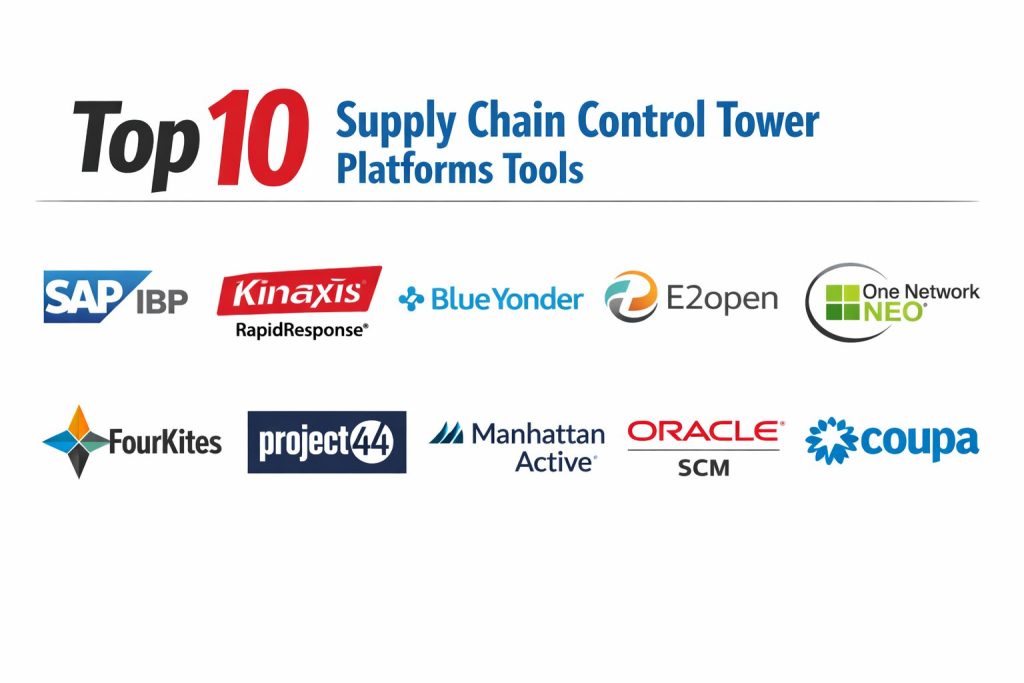
Top 10 Supply Chain Control Tower Platforms
1 SAP IBP Control Tower
SAP Integrated Business Planning (IBP) for Supply Chain is a cloud-native solution that provides a unified view of planning and execution. It excels in integrating with the broader SAP S/4HANA ecosystem, making it the top choice for large enterprises that rely on SAP as their core ERP.
Key Features
- Custom Alerting: Users can define rule-based monitoring to trigger alerts for specific KPI deviations or stock-out risks.
- Case Management: Built-in “resolution rooms” allow cross-functional teams to collaborate on issues directly within the platform.
- Intelligent Visibility: Features a map-based interface that overlays real-time logistics data onto the global supply chain network.
- S&OP Integration: Seamlessly connects operational alerts to long-term sales and operations planning cycles.
- What-If Analysis: High-speed simulation capabilities to test the financial and service impact of different supply chain responses.
- Scenario Sharing: Allows planners to create, compare, and share different supply chain versions across the enterprise.
Pros
- Unmatched integration with SAP ERP systems, ensuring a “single source of truth” for the entire organization.
- Very robust financial modeling that ties supply chain disruptions directly to the bottom line.
Cons
- Can be extremely complex to configure and may require significant specialized consultancy.
- The user interface can feel overwhelming due to the sheer volume of data and features available.
Platforms / Deployment
- Cloud (SaaS)
- Desktop (Web-based)
Security & Compliance
- Features: SAP Cloud Identity Access Management, AES-256 encryption for data at rest.
- Compliance: SOC 1/2, ISO 27001, GDPR.
Integrations & Ecosystem
SAP IBP is designed to be the hub of the SAP Digital Supply Chain, integrating with Ariba for procurement and SAP TMS for logistics. It also supports OData services for third-party data ingestion.
Support & Community
SAP offers extensive enterprise support, a massive global partner network, and a mature community portal with thousands of training modules.
2 Kinaxis RapidResponse
Kinaxis RapidResponse is a leader in concurrent planning, allowing users to see the ripple effect of a change across the entire supply chain instantly. It is highly valued for its speed and its ability to handle “what-if” simulations in seconds.
Key Features
- Concurrent Planning: Synchronizes demand, supply, and inventory planning so a change in one area is immediately reflected in all others.
- In-Memory Computing: Uses a high-performance data model to process massive amounts of supply chain data without latency.
- Maestro (AI Platform): Incorporates machine learning to sense demand patterns and suggest automated inventory adjustments.
- Collaborative Command Center: A unified dashboard that highlights exceptions and provides tools for cross-team resolution.
- Self-Healing Supply Chain: Uses AI to identify data inaccuracies and automatically correct them within the planning model.
- External Signal Integration: Pulls in external data like weather or port status to adjust lead times dynamically.
Pros
- Exceptionally fast simulation capabilities that allow for real-time decision-making during crisis meetings.
- High user adoption rates due to a more intuitive, spreadsheet-like interface compared to legacy systems.
Cons
- The platform’s high performance comes with a significant price tag, making it best suited for large-cap companies.
- Integration with non-SAP or legacy ERP systems can require more heavy lifting during the setup phase.
Platforms / Deployment
- Cloud (SaaS)
- Desktop (Web-based)
Security & Compliance
- Features: Single Sign-On (SSO), data encryption at rest and in transit, 24/7 security monitoring.
- Compliance: SOC 2 Type II, ISO 27001.
Integrations & Ecosystem
Kinaxis features pre-built connectors for major ERPs and has a growing ecosystem of “certified” apps that extend its planning capabilities into specific niche industries.
Support & Community
Kinaxis offers a dedicated “Trust Center” for security and a comprehensive “Kinaxis Learning Center” for user certification and training.
3 Blue Yonder Control Tower
Blue Yonder offers a highly advanced control tower focused on real-time orchestration and execution. It uses a patented “Luminate” AI engine to predict disruptions and automatically initiate corrective actions across warehouse and transport networks.
Key Features
- Luminate Cognitive Platform: An AI-driven engine that provides predictive ETAs and identifies potential stock-outs before they happen.
- Automated Exception Management: Can be configured to automatically resolve low-level disruptions without human intervention.
- Virtual Assistant (Alaia): An AI-powered interface that allows users to query supply chain status using natural language.
- Real-Time Logistics Tracking: Deep integration with carriers provides door-to-door visibility for all shipments.
- Inventory Sensing: Uses machine learning to identify slow-moving stock and suggest re-allocation to high-demand areas.
- Unified Control: Bridges the gap between planning and execution by connecting directly to TMS and WMS systems.
Pros
- Strong focus on execution and “closing the loop” between seeing a problem and fixing it.
- Excellent visualization of logistics flows, particularly for complex, multi-modal transportation networks.
Cons
- The platform’s modular nature can lead to a fragmented experience if multiple Blue Yonder products are used.
- Implementation can be a lengthy process, often taking 12 to 24 months for full global scale.
Platforms / Deployment
- Cloud (SaaS)
- Desktop / Mobile
Security & Compliance
- Features: Enterprise-grade RBAC, secure API gateways, and proactive vulnerability management.
- Compliance: GDPR, SOC 2.
Integrations & Ecosystem
Blue Yonder excels in logistics integrations, boasting one of the world’s largest carrier networks. It integrates deeply with Microsoft Azure for cloud-based data processing.
Support & Community
Offers “White Glove” support for enterprise clients and maintains an active user community through Maximize, their annual global conference.
4 E2open
E2open is a “network-first” control tower that specializes in multi-enterprise collaboration. It is designed to manage the complexities of global trade, connecting manufacturers with their entire ecosystem of suppliers and logistics providers.
Key Features
- Multi-Enterprise Network: Connects users to a pre-established network of over 400,000 global partners.
- Global Trade Management: Built-in compliance tools for customs, duties, and international shipping regulations.
- E2net: A secure data exchange layer that ensures all partners are working from the same real-time data.
- Supply Sensing: Uses downstream signals to predict upstream supply needs and identify potential bottlenecks.
- Demand Sensing: Analyzes point-of-sale data to create highly accurate short-term forecasts.
- Shipment Management: Provides granular tracking of goods across sea, air, and land with automated alerts.
Pros
- Best-in-class for managing complex, international supply chains with heavy compliance requirements.
- Large pre-existing network of partners significantly reduces the time required for supplier onboarding.
Cons
- The platform can feel less specialized for internal manufacturing planning compared to SAP or Kinaxis.
- The user interface has historically been viewed as less modern than its cloud-native competitors.
Platforms / Deployment
- Cloud (SaaS)
- Desktop (Web-based)
Security & Compliance
- Features: End-to-end data encryption, rigorous partner vetting, and secure multi-tenant architecture.
- Compliance: ISO 27001, SOC 2, Trade Compliance certified.
Integrations & Ecosystem
E2open is built as an “ecosystem of ecosystems,” with strong capabilities in integrating diverse data formats from global shipping lines and customs agencies.
Support & Community
Provides comprehensive professional services for global deployments and a structured “Client Success” program for long-term optimization.
5 One Network Enterprises (NEO)
The NEO platform by One Network Enterprises is a “multi-party” network that focuses on autonomous supply chain management. It is designed to eliminate information latency by allowing all parties in a transaction to see and act on data simultaneously.
Key Features
- NEO Intelligent Agents: Autonomous AI agents that monitor the network and can execute decisions like order expediting.
- Single Version of Truth: All partners see the same data at the same time, eliminating the need for reconciliations.
- Autonomous Forecasting: AI-driven demand and supply balancing that operates at the “near-theoretical minimum” threshold.
- Modular Store: Users can download and deploy specific modules for logistics, planning, or procurement as needed.
- Network-Aware Services: Services that understand the constraints of the entire network, not just a single company.
- Real-Time Synchronization: Constantly re-syncs demand and supply across all trading tiers in near real-time.
Pros
- Exceptional at reducing inventory levels and freight costs through high-speed autonomous decision-making.
- Very strong “multi-tier” capabilities that extend visibility well beyond the first layer of suppliers.
Cons
- The “intelligent agent” approach requires a high degree of trust in the system’s autonomous capabilities.
- The release cycle can be rigid, occasionally requiring users to adapt to new code updates on a set schedule.
Platforms / Deployment
- Cloud (SaaS)
- Desktop / Mobile
Security & Compliance
- Features: Patented data security for multi-party environments, ensuring partners only see data relevant to them.
- Compliance: SOC 2, ISO 27001.
Integrations & Ecosystem
One Network provides a “single connection” into the network that then bridges out to thousands of other companies and ERP systems.
Support & Community
Offers a global support network and a “Value Discovery” program to help companies calculate and achieve ROI.
6 FourKites
FourKites is a leader in real-time transportation visibility that has expanded into a full “Intelligent Control Tower.” It is the preferred choice for companies that prioritize logistics execution and facility management.
Key Features
- AI-Powered Digital Workers: Intelligent agents (Loft) that handle routine logistics tasks and exception management.
- Dynamic ETA: A machine-learning algorithm that provides highly accurate arrival times based on millions of data points.
- YardWorks AI: A specialized module for managing warehouse yards and optimizing gate appointments.
- Sustainability Hub: Real-time tracking of Scope 3 emissions across the transportation network.
- Carrier Connect: A secure workflow that accelerates carrier onboarding from days to minutes.
- Facility Manager: Provides visibility into dwell times and facility performance to identify bottlenecks.
Pros
- The largest real-time tracking network in the world, covering over 3 million shipments daily.
- Very fast implementation and a “Data Connector” that makes it easy to pull insights into existing BI tools.
Cons
- While excellent for logistics, it is less focused on deep manufacturing planning or procurement.
- Heavy reliance on carrier data quality can occasionally lead to inconsistencies in tracking accuracy.
Platforms / Deployment
- Cloud (SaaS)
- Desktop / Mobile (CarrierLink App)
Security & Compliance
- Features: ISO 27001, 27017, and 27018 certifications for cloud security and data privacy.
- Compliance: GDPR, SOC 2.
Integrations & Ecosystem
FourKites has deep integrations with major TMS and WMS providers and a robust “Partner Hub” for extended ecosystem services.
Support & Community
Known for being highly communicative, FourKites offers extensive online documentation and a dedicated “Success Manager” for large accounts.
7 Project44
Project44 is a high-velocity visibility platform that has evolved into a “Decision Intelligence” platform for the global supply chain. It focuses on removing the “blind spots” in global shipping across all modes, including ocean, rail, and air.
Key Features
- Movement Platform: A unified interface that provides a “single pane of glass” for all global shipment tracking.
- Workflow Automation: Uses AI to automate communication between shippers and carriers when delays occur.
- Multi-Agent Orchestration: Deploys various AI agents to solve specific logistics problems like detention and demurrage.
- High-Fidelity Tracking: Uses direct API integrations with carriers rather than unreliable “scraping” methods.
- Pre-Transit Visibility: Provides insights into shipments before they even leave the origin facility.
- Data Cleansing AI: Automatically fixes messy data from carriers to ensure clean reporting for the enterprise.
Pros
- Exceptionally clean data and high-fidelity tracking that is often more accurate than carrier-provided status.
- Very strong global coverage, particularly in the ocean and rail sectors.
Cons
- Primarily a visibility and logistics execution tool; it lacks the deep “planning” features of SAP or Kinaxis.
- Can be expensive for smaller shippers due to the volume-based pricing model.
Platforms / Deployment
- Cloud (SaaS)
- Desktop (Web-based)
Security & Compliance
- Features: SOC 2 Type 2 reports, ISO 27001 certification, and strict GDPR adherence.
- Compliance: ISO 27001, SOC 2.
Integrations & Ecosystem
Project44 is a “connective tissue” tool, designed to feed high-quality data into other control towers, ERPs, and TMS platforms.
Support & Community
Offers a robust “Trust Center” and professional services for global enterprises looking to digitize their logistics.
8 Manhattan Associates (Active)
Manhattan Associates is a powerhouse in warehouse and transportation management that has unified its suite into the “Manhattan Active” platform. It provides a control tower that is uniquely focused on the “execution” end of the supply chain.
Key Features
- Unified Distribution Control: Combines WMS, TMS, and Labor Management into a single real-time dashboard.
- Order Streaming: An intelligent orchestration engine that optimizes how orders are fulfilled across multiple channels.
- Versionless Architecture: The platform is continuously updated in the cloud with zero downtime or “upgrade projects.”
- Warehouse Execution System (WES): Built directly into the WMS to orchestrate robotics and human workers seamlessly.
- Real-Time Inventory Visibility: Provides a 100% accurate view of stock levels across all distribution centers.
- Gamification & Labor Management: Tools to engage and optimize the productivity of the warehouse workforce.
Pros
- The gold standard for retailers and distributors who need to manage complex omnichannel fulfillment.
- Cloud-native, microservices-based architecture ensures the platform is always current and highly scalable.
Cons
- Strong focus on “within the four walls” (warehouse) and transportation; less focused on upstream procurement.
- The premium positioning means it is generally too expensive for mid-sized or regional businesses.
Platforms / Deployment
- Cloud (Native SaaS)
- Desktop / Mobile
Security & Compliance
- Features: Microservices-level security, high-availability architecture, and standard data encryption.
- Compliance: SOC 2, PCI-DSS (for retail modules).
Integrations & Ecosystem
Manhattan Active is designed for a “plug-and-play” world, with extensive APIs for robotics, parcel carriers, and ERP systems.
Support & Community
Manhattan offers “Manhattan Exchange” for community learning and a high-tier professional support organization.
9 Oracle SCM Control Tower
Oracle’s Supply Chain Control Tower is a part of the broader Oracle Fusion Cloud SCM suite. It is designed for enterprises that need a highly integrated, AI-powered view of their global operations within a secure, governed environment.
Key Features
- Intelligent Track and Trace: Uses blockchain technology to create an immutable record of goods as they move through the chain.
- Predictive Lead Times: AI analyzes historical performance to predict more accurate lead times for planning.
- Unified Data Model: Ensures that data from finance, supply chain, and HR are all connected and consistent.
- Risk Management Cloud: A dedicated module for identifying and mitigating supplier and financial risks.
- Digital Twin for Logistics: Visualizes the entire shipping network and simulates the impact of route changes.
- Automated Exception Handling: Workflow engines that can be set to automatically re-order parts when levels drop.
Pros
- Excellent for organizations that need high levels of data governance and security.
- Deeply integrated with Oracle’s financial suite, making it easy to track the ROI of supply chain improvements.
Cons
- Like SAP, it is a “behemoth” of a system that can be slow to implement and difficult to customize.
- The focus on a “unified model” can make it harder to integrate with non-Oracle third-party apps.
Platforms / Deployment
- Cloud (Oracle Cloud Infrastructure)
- Desktop (Web-based)
Security & Compliance
- Features: Oracle’s “Defense in Depth” security, including always-on encryption and autonomous patching.
- Compliance: FedRAMP, SOC 2, ISO 27001.
Integrations & Ecosystem
Natively integrated with the entire Oracle Cloud suite (ERP, HCM, CX). It also supports various “Connectors” for non-Oracle data.
Support & Community
Oracle offers global “Premium Support” and a massive library of training resources through Oracle University.
10 Coupa (Supply Chain Design & Planning)
Coupa, primarily known for spend management, has integrated advanced supply chain design and planning (formerly LLamasoft) into its platform. It is the best choice for companies that want to tie supply chain “design” to day-to-day “execution.”
Key Features
- Supply Chain Modeler: The industry’s leading tool for designing and optimizing the global supply chain network.
- Digital Twin Modeling: Creates a detailed mathematical replica of the supply chain to test different strategic shifts.
- Continuous Design: Allows companies to move from annual “network studies” to ongoing supply chain optimization.
- Spend Integration: Directly links supply chain decisions to procurement costs and corporate spend goals.
- Risk Intelligence: Monitors supplier health and geopolitical risks to inform long-term network design.
- App Studio: A low-code environment where users can build custom supply chain apps tailored to their business.
Pros
- The most powerful platform for strategic network design and finding “hidden” cost savings.
- Excellent user interface that simplifies complex mathematical modeling for business users.
Cons
- Less focused on minute-by-minute “logistics execution” (like FourKites) than on strategic planning.
- Onboarding can be challenging for teams without a strong background in supply chain modeling.
Platforms / Deployment
- Cloud (SaaS)
- Desktop (Web-based)
Security & Compliance
- Features: Multi-layered security approach with SOC 2 reporting and strict data privacy controls.
- Compliance: ISO 27001, GDPR, SOC 2.
Integrations & Ecosystem
Coupa integrates with all major ERPs and has a unique “Open Business Network” that facilitates electronic transactions with millions of suppliers.
Support & Community
Offers the “Coupa Community” and extensive professional training through their “Success” and “Design” certification tracks.
Comparison Table (Top 10)
| Tool Name | Best For | Platform(s) Supported | Deployment | Standout Feature | Public Rating |
| SAP IBP | SAP Ecosystem | Web-based | Cloud | Case Management | 4.4/5 |
| Kinaxis RapidResponse | Rapid Planning | Web-based | Cloud | Concurrent Planning | 4.7/5 |
| Blue Yonder | AI Orchestration | Web/Mobile | Cloud | Cognitive AI Platform | 4.5/5 |
| E2open | Global Trade | Web-based | Cloud | Multi-Enterprise Net | 4.3/5 |
| One Network (NEO) | Autonomous Ops | Web/Mobile | Cloud | NEO AI Agents | 4.6/5 |
| FourKites | Logistics Vis | Web/Mobile | Cloud | Real-time Tracking | 4.8/5 |
| Project44 | High-Velocity Vis | Web-based | Cloud | High-Fidelity API | 4.7/5 |
| Manhattan Active | Fulfillment | Web/Mobile | Cloud | Versionless Arch | 4.6/5 |
| Oracle SCM | Data Governance | Web-based | Cloud | Blockchain Tracking | 4.2/5 |
| Coupa | Strategic Design | Web-based | Cloud | Supply Chain Modeler | 4.5/5 |
Evaluation & Scoring of Supply Chain Control Tower Platforms
The following scores are based on the core requirements for 2026 enterprise resilience and agility.
| Tool Name | Core (25%) | Ease (15%) | Integrations (15%) | Security (10%) | Performance (10%) | Support (10%) | Value (15%) | Weighted Total |
| SAP IBP | 10 | 4 | 10 | 9 | 8 | 9 | 6 | 8.10 |
| Kinaxis RapidResponse | 10 | 7 | 8 | 9 | 10 | 8 | 7 | 8.55 |
| Blue Yonder | 9 | 6 | 9 | 8 | 9 | 8 | 7 | 8.15 |
| E2open | 8 | 5 | 10 | 9 | 8 | 8 | 7 | 7.75 |
| One Network (NEO) | 9 | 6 | 9 | 9 | 9 | 7 | 8 | 8.30 |
| FourKites | 8 | 9 | 9 | 9 | 9 | 9 | 8 | 8.65 |
| Project44 | 8 | 9 | 9 | 9 | 10 | 8 | 7 | 8.45 |
| Manhattan Active | 9 | 7 | 8 | 8 | 9 | 8 | 7 | 8.05 |
| Oracle SCM | 9 | 5 | 8 | 10 | 8 | 9 | 7 | 7.95 |
| Coupa | 10 | 7 | 8 | 9 | 8 | 8 | 7 | 8.15 |
Which Supply Chain Control Tower Platform Is Right for You?
Solo / Freelancer (Consultants)
For independent supply chain consultants, proficiency in Blender is not applicable here, but mastering Kinaxis RapidResponse or SAP IBP is highly lucrative. These platforms are the most requested skills for high-value supply chain transformation projects in 2026.
SMB
Small businesses rarely need a full-scale “Control Tower.” Instead, they should look at the visibility tools of FourKites or Project44, which provide immediate logistics value without the six-figure setup costs of a planning suite.
Mid-Market
Growing companies should consider Blue Yonder or Manhattan Active if they are retail-heavy. These platforms offer modular paths that allow a company to start with transportation visibility and gradually scale up to full orchestration as they grow.
Enterprise
Global enterprises must choose between SAP IBP (if they are a “pure” SAP shop) and Kinaxis RapidResponse (if they need the fastest possible planning). For those managing massive global logistics, One Network or E2open offer the best multi-party collaboration features.
Budget vs Premium
Blender is free, but in the world of SCCT, there is no “free” version. Project44 is a more budget-friendly entry into visibility, while SAP and Oracle represent the high-premium, total-ecosystem investment.
Feature Depth vs Ease of Use
If you need absolute depth in modeling and “what-if” analysis, Coupa and Kinaxis are the leaders. If you need a tool that your logistics team can start using tomorrow with minimal training, FourKites is the clear winner.
Integrations & Scalability
SAP IBP and Oracle SCM offer the highest level of internal scalability. However, for external scalability (connecting to thousands of different partners), One Network and E2open are superior due to their pre-built networks.
Security & Compliance Needs
Organizations in highly regulated industries (Aerospace, Defense, Pharma) should prioritize Oracle SCM for its government-grade security or One Network for its unique, granular data-sharing permissions in multi-party environments.
Frequently Asked Questions (FAQs)
1 What is the primary difference between a Control Tower and an ERP?
An ERP manages internal resources (finance, HR, orders), whereas a Control Tower connects that internal data with real-time external signals from suppliers, carriers, and the environment to provide end-to-end visibility.
2 Can a Control Tower help reduce my carbon footprint?
Yes, most platforms like FourKites and Blue Yonder include “Sustainability Hubs” that calculate Scope 3 emissions and suggest “greener” transport routes to meet ESG targets.
3 How long does it take to see ROI after implementation?
Visibility-focused tools like Project44 can show ROI in 3-6 months by reducing detention fees. Comprehensive planning towers like SAP IBP usually take 12-18 months to show significant inventory and cost reductions.
4 Do I need to replace my existing TMS or WMS?
No, a Control Tower is designed to sit on top of your existing systems. It pulls data from your TMS, WMS, and ERP to provide a unified view, though some platforms like Manhattan Active offer integrated execution modules.
5 What is “Concurrent Planning”?
Concurrent planning, popularized by Kinaxis, means that a change in demand is instantly calculated across supply and inventory. Traditional systems use “batch” processing, which creates a delay between seeing a change and understanding its impact.
6 Is AI actually making decisions in these platforms?
We have moved to “Human-in-the-loop” AI. The system can autonomously handle simple exceptions (like re-booking a late truck), but it presents “recommendations” for complex decisions (like switching a key supplier).
7 How does a Control Tower handle data from small suppliers?
Platforms like E2open and One Network provide lightweight web portals or mobile apps so small suppliers can input status updates without needing their own complex IT infrastructure.
8 What are “Digital Workers” in a supply chain context?
Digital workers are AI agents trained to perform specific roles, such as an “Inbound Scheduler” that monitors incoming parts and automatically adjusts production schedules if a delay is detected.
9 Are these platforms secure from cyberattacks?
Yes, enterprise platforms use Zero Trust architectures and blockchain (like in Oracle) to ensure data integrity. They also sandboxing partner data to ensure one supplier cannot see another’s pricing or shipment info.
10 Which platform is best for “What-If” scenarios?
Kinaxis RapidResponse and Coupa are the leaders in scenario modeling. They allow planners to “sandbox” a crisis (like a canal closure) and see the financial impact of different solutions in real-time.
Conclusion
The selection of a Supply Chain Control Tower Platform is a defining move for any enterprise aiming for resilience in the face of global volatility. While FourKites and Project44 have revolutionized the visibility and logistics space, SAP IBP and Kinaxis RapidResponse remain the heavyweights for deep, concurrent planning. The transition from “seeing” to “acting” through AI-driven orchestration is now the primary differentiator between market leaders and those still struggling with manual spreadsheets and reactive workflows.
To move forward, organizations should first map their “visibility gaps” and then determine if their primary need is tactical (logistics tracking) or strategic (long-term network design). Most top-tier vendors offer “Discovery Workshops” to help you define your specific use cases and calculate the potential ROI before committing to a full-scale deployment.