Introduction
Supplier Relationship Management (SRM) software is a strategic digital framework used by procurement professionals to manage and optimize every interaction with their supply base. SRM has moved beyond simple databases to become intelligent ecosystems that utilize agentic AI to predict supply chain disruptions, automate compliance monitoring, and foster collaborative innovation. These platforms serve as the “nerve center” for a company’s external operations, ensuring that the lifecycle of every supplier—from initial onboarding and risk vetting to performance tracking—is handled with surgical precision.
As global markets face increasing geopolitical volatility and environmental mandates, the ability to maintain transparent, resilient, and data-driven supplier relationships is a competitive necessity. Modern SRM tools integrate directly with ERP systems to provide a 360-degree view of spend, quality, and risk, transforming suppliers from mere vendors into strategic partners. Evaluating these tools requires a focus on their ability to handle “Direct Spend” complexity, the robustness of their risk-mitigation AI, and their capacity to scale across global multi-tier supply chains.
Best for: Global procurement teams, manufacturing organizations, and high-growth enterprises requiring automated risk management and end-to-end spend visibility.
Not ideal for: Micro-businesses with three or fewer vendors, simple one-time retail purchases, or organizations without a centralized procurement function.
Key Trends in SRM Software
- Agentic AI Co-pilots: Tools now feature autonomous agents that can extract metadata from contracts and prescribe specific actions to mitigate supplier risk in real-time.
- Multi-Tier Supply Chain Visibility: New standards allow companies to map not just their direct suppliers, but their suppliers’ suppliers (Tier 2 and Tier 3), ensuring full transparency into raw material origins.
- Environmental, Social, and Governance (ESG) Scoring: Real-time integration of ESG data is now a standard feature, allowing firms to automatically disqualify suppliers who fall below sustainability thresholds.
- Digital Twin Supply Chains: Advanced SRM suites create virtual models of the supply chain to simulate “what-if” scenarios, such as port strikes or natural disasters, before they happen.
- Continuous Monitoring vs. Periodic Reviews: The industry has shifted from annual performance reviews to real-time “heartbeat” monitoring via IoT and live data feeds.
- Frictionless Onboarding Portals: Self-service portals have become highly automated, using AI-powered OCR to verify supplier banking and tax documentation in seconds.
- Post-Quantum Encryption: With the rise of quantum computing threats, top-tier SRM platforms are upgrading to quantum-resistant algorithms to protect sensitive trade secrets and financial data.
How We Selected These Tools (Methodology)
Our selection process for the top 10 SRM tools was driven by a rigorous data-driven evaluation of platform capability and market leadership. We analyzed over 20 global platforms, focusing specifically on their “Ability to Execute” as defined by modern procurement benchmarks. Key weight was given to tools that demonstrate high user adoption rates, as even the most powerful software is useless if suppliers and internal stakeholders find the interface too complex to navigate.
We also prioritized platforms that offer native integration with major ERP ecosystems like SAP, Oracle, and Microsoft Dynamics to ensure “single source of truth” data integrity. Security was another non-negotiable factor; we favored tools with robust SOC 2 compliance, GDPR readiness, and advanced fraud detection. Finally, we looked at the “Community Intelligence” aspect—how well a tool uses anonymized data from its entire network to provide benchmarks and risk alerts to individual users.
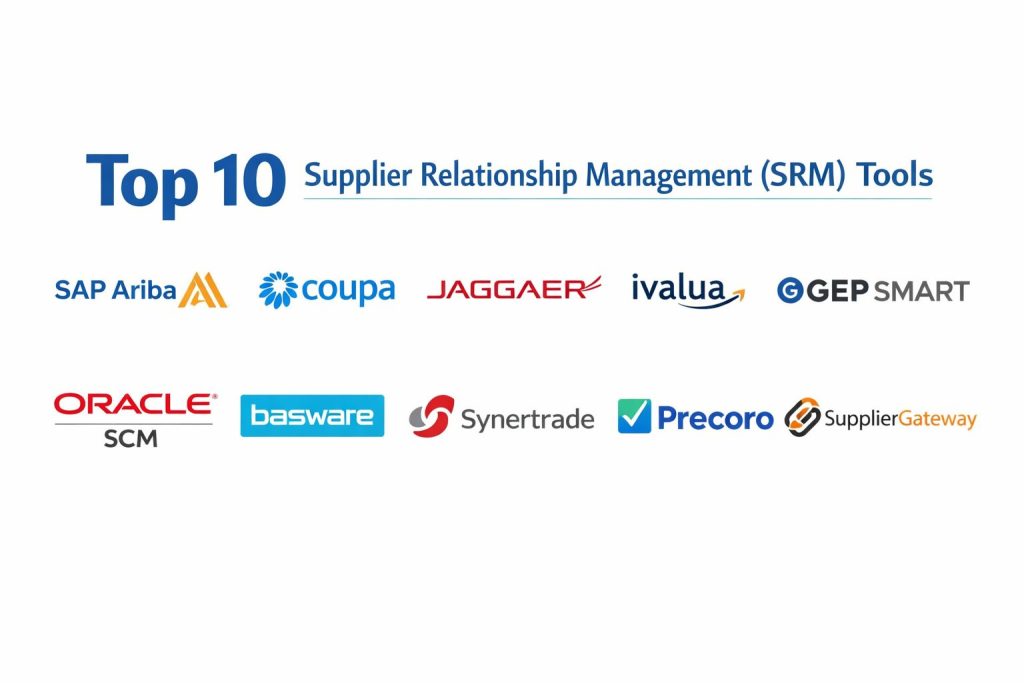
Top 10 Supplier Relationship Management (SRM) Tools
1 SAP Ariba
SAP Ariba is the world’s largest business commerce network, offering a comprehensive cloud-based suite for end-to-end procurement and supplier collaboration. It is the gold standard for large global enterprises that require deep integration with SAP S/4HANA and a massive pre-existing network of millions of suppliers.
Key Features
- Ariba Network: Access to a global ecosystem of over 5 million companies for immediate sourcing and collaboration.
- Guided Buying: A consumer-like interface that directs employees to preferred suppliers and compliant purchasing paths.
- SLP (Supplier Lifecycle & Performance): A unified vendor model that manages onboarding, qualification, and performance in one place.
- Sourcing Pro: Advanced tools for running complex eAuctions and RFPs to maximize competitive savings.
- Contract Management: Centralized repository with automated alerts for renewals and compliance gaps.
- Supply Chain Collaboration: Real-time visibility into order status, quality notifications, and shipping schedules.
Pros
- Unrivaled global reach and a massive pool of pre-vetted suppliers ready for transaction.
- Seamless, native integration with SAP ERP environments, reducing data latency.
Cons
- The user interface can feel complex and “heavy” compared to more modern, nimble competitors.
- Implementation is often a long, high-cost project requiring specialized consultants.
Platforms / Deployment
- Web / Mobile (iOS & Android)
- Cloud-native
Security & Compliance
- Features: Safe Scene Scripting, encrypted data transfer, and multi-factor authentication.
- Compliance: ISO 27001, SOC 1/2, GDPR.
Integrations & Ecosystem
SAP Ariba is built to be the centerpiece of the SAP ecosystem but offers open APIs for integration with other middleware and non-SAP ERPs.
Support & Community
SAP provides a massive support infrastructure, including the SAP Learning Hub and a global network of certified partners.
2 Coupa
Coupa is a leader in Business Spend Management (BSM), known for its “Value as a Service” approach. Its platform is highly distinguished by its use of “Community Intelligence,” which uses AI to analyze trillions of dollars in anonymized spend to give users prescriptive advice.
Key Features
- Coupa Navi AI: Autonomous AI agents that predict disruptions and prescribe specific optimizations for the supply chain.
- Unified Spend Management: A single platform for procurement, expenses, invoicing, and treasury.
- Supplier Risk Monitor: Continuous community-powered monitoring of supplier health and third-party risk.
- Digital Twin Modeling: The ability to model the entire supply chain to move toward continuous design and resilience.
- Global Payments: Frictionless cross-border payments across 30+ currencies with automated fraud detection.
- Intake & Orchestration: Uses natural language processing to convert complex requests into compliant POs automatically.
Pros
- Extremely high user adoption rates due to its modern, intuitive interface.
- Provides “Community Benchmarking” that lets you see how your supplier prices compare to the market average.
Cons
- Can be expensive for mid-market companies that don’t need the full suite of treasury and expense tools.
- Some users find the initial configuration of complex approval workflows to be time-consuming.
Platforms / Deployment
- Web / Mobile
- Cloud-native
Security & Compliance
- Features: AI-powered fraud detection and real-time transaction monitoring.
- Compliance: SOC 2, ISO 27001, HIPAA.
Integrations & Ecosystem
Coupa features “App Marketplace” with pre-built connectors for NetSuite, SAP, Oracle, and hundreds of other business apps.
Support & Community
Offers 24/7 live representative support and a robust user forum known as the Coupa Community.
3 Jaggaer
Jaggaer (formerly SciQuest) is a pioneer in “Autonomous Commerce,” specifically tailored for complex direct procurement and manufacturing. It excels in highly regulated industries like healthcare, education, and the public sector, where compliance is paramount.
Key Features
- Autonomous Sourcing: AI-driven smart-match recommendations that align buyer requirements with supplier competencies.
- JAGGAER ONE: A unified platform that covers everything from spend analysis to accounts payable.
- Direct Materials Management: Specialized tools for managing the complex Bills of Materials (BOM) found in manufacturing.
- Advanced Contract AI: Native AI that identifies risks and suggests alternative language during contract authoring.
- IoT Integration: Uses Internet of Things data to track the flow of goods and supplier performance in real-time.
- eInvoicing Compliance: Automatically adapts to country-specific VAT and tax regulations across the globe.
Pros
- Strongest choice for organizations with heavy “Direct Spend” and manufacturing requirements.
- Deep industry-specific expertise in higher education and government procurement.
Cons
- The interface can be clunky in some modules, requiring a steeper learning curve for new admins.
- Reporting between different modules sometimes requires manual effort or custom workarounds.
Platforms / Deployment
- Web / Mobile
- Cloud / On-premise hybrid
Security & Compliance
- Features: Robust audit trails and role-based access control (RBAC).
- Compliance: FedRAMP (select modules), GDPR, SOC 2.
Integrations & Ecosystem
Jaggaer integrates well with specialized ERPs used in education and healthcare, as well as mainstream platforms like Oracle and SAP.
Support & Community
Jaggaer provides dedicated customer success managers but has faced some criticism for slow response times in technical support.
4 Ivalua
Ivalua is a deeply unified Source-to-Pay platform built on a single codebase. It is highly valued for its “no-code/low-code” flexibility, allowing companies to tailor the software to their unique processes without losing the ability to upgrade.
Key Features
- Single Codebase: Ensures total data integrity as there are no “bridges” between different modules.
- Augmented Intelligence: Provides instant insights and automated document review for procurement teams.
- Supplier Performance Scorecards: Easily build and track KPIs like quality, delivery, and sustainability compliance.
- External Workforce Management: Specialized tools for managing contractors and service-based suppliers.
- Low-Code Customization: Allows businesses to create custom fields and workflows without needing a software developer.
- Direct & Indirect Spend: Manages all categories of spend, including complex raw materials, in one environment.
Pros
- Offers the highest degree of flexibility and customization among the top-tier enterprise SRM tools.
- Zero data silos; a supplier update in the onboarding module is reflected instantly in invoicing.
Cons
- The sheer depth of the platform can be overwhelming for smaller procurement teams.
- Because it is highly customizable, the initial implementation can be complex and requires clear strategy.
Platforms / Deployment
- Web
- Cloud-native
Security & Compliance
- Features: Advanced identity management and encrypted data storage.
- Compliance: ISO 27001, SOC 2 Type II, GDPR.
Integrations & Ecosystem
Ivalua boasts a wide range of “certified connectors” and is frequently recognized for its ability to integrate with complex, multi-ERP landscapes.
Support & Community
Ivalua maintains a high-touch support model and a growing community focused on “Human-Agent” collaboration.
5 GEP SMART
GEP SMART is an AI-powered, cloud-native procurement platform built on Microsoft Azure. It combines software with GEP’s strategic consulting expertise, making it ideal for firms undergoing a total procurement transformation.
Key Features
- AI-Powered Spend Analysis: Automatically cleanses and categorizes spend data to uncover hidden savings.
- Procurement on the Move: A mobile-native platform with full-featured apps for iOS and Android.
- GEP SMART AI: Uses proprietary algorithms for predictive sourcing and contract risk assessment.
- Robotic Process Automation (RPA): Automates repetitive tasks like PO processing and invoice entry.
- Supplier Collaboration Portal: A “consumerized” environment where suppliers can manage their own data and tasks.
- Global Multilingual Support: Supports all major European and Asian languages for global operations.
Pros
- Built on Azure, providing world-class cybersecurity and seamless integration with the Microsoft ecosystem.
- Exceptional mobile experience that allows executives to approve high-value orders on the go.
Cons
- Users have reported that the platform can be unstable during major software releases.
- Reporting dashboards, while functional, can be difficult for non-technical users to customize.
Platforms / Deployment
- Web / Mobile (Native App)
- Cloud (Azure)
Security & Compliance
- Features: Integrated cybersecurity protocols from the Microsoft Azure stack.
- Compliance: ISO 27001, SOC 2, HIPAA.
Integrations & Ecosystem
GEP SMART is platform-agnostic and works effortlessly with SAP, Oracle, JD Edwards, and PeopleSoft.
Support & Community
The platform is backed by GEP’s global consulting team, providing a blend of technical support and strategic advice.
6 Oracle Fusion Cloud SCM
Oracle Fusion Cloud SCM (Supply Chain Management) is a comprehensive suite that offers a holistic view of the supply chain. It is particularly strong for companies that already use Oracle’s financial or HCM modules and want a perfectly synchronized back office.
Key Features
- AI-Powered Forecasting: Uses machine learning to predict demand and adjust supplier requirements automatically.
- Supplier Collaboration: A secure portal for sharing production schedules and quality requirements in real-time.
- Risk Mitigation: Identifies potential disruptions early via a global monitoring dashboard.
- 3PL Management: Integrated tools for managing third-party logistics and outsourced warehousing.
- Real-Time Inventory Visibility: Tracks stock levels across multiple locations to prevent stockouts or excess.
- Global Trade Management: Ensures compliance with international trade regulations and customs requirements.
Pros
- Unmatched scalability for the largest global enterprises with the most complex logistics needs.
- Tight interconnectivity between SCM, Finance, and HR within the Oracle Cloud ecosystem.
Cons
- The initial setup is notoriously challenging and requires a significant investment of time and money.
- Some specific screens within the deep modules are considered less user-friendly than modern SaaS apps.
Platforms / Deployment
- Web / Mobile
- Cloud-native
Security & Compliance
- Features: Robust audit capabilities and Oracle’s enterprise-grade data protection.
- Compliance: SOC 1/2, ISO 27001, GDPR.
Integrations & Ecosystem
Oracle Fusion Cloud SCM is designed to be part of the larger Oracle suite but supports EDI and API integrations for external partners.
Support & Community
Oracle offers extensive documentation, a global support network, and a large user community focused on enterprise optimization.
7 Basware
Basware is a leader in Purchase-to-Pay (P2P) and AP automation, known for its ability to handle complex, high-volume global invoicing. It is the best choice for organizations where the “Relationship” with the supplier is centered on financial transparency and efficiency.
Key Features
- SmartPDF AI: An AI tool that learns to extract data from PDF invoices with increasing accuracy over time.
- Touchless Processing: High rates of automated three-way matching, reducing human intervention in the AP cycle.
- E-Invoicing Network: Connects with over 200 e-invoicing networks worldwide for global compliance.
- Supplier Portal: A dedicated space for suppliers to track payment status and manage their own data.
- AP Audit & Recovery: Tools to identify duplicate payments and fraud risks automatically.
- Global Regulatory Compliance: Ensures that electronic archiving meets the legal standards of over 45 countries.
Pros
- Exceptional at handling the “Invoicing” phase of the supplier relationship, significantly speeding up payment cycles.
- Very strong integration with Oracle Finance and other major ERP systems.
Cons
- Lacks the deep “Sourcing” and “Product Design” features found in tools like Maya or Ivalua.
- Performance can lag when processing massive amounts of data or performing multiple functions simultaneously.
Platforms / Deployment
- Web
- Cloud-native
Security & Compliance
- Features: 4-eye principle for invoice approval and secure document archiving.
- Compliance: ISO 27001, SOC 2, Peppol certified.
Integrations & Ecosystem
Basware excels at ERP integration, acting as the bridge between external suppliers and the internal financial system of record.
Support & Community
Known for having a high level of expertise in global tax compliance and providing stable technical support.
8 Synertrade
Synertrade (part of the Econocom Group) is a digital procurement solution that provides a powerful Source-to-Pay platform. It is a favorite in the European market for its multilingual support and its ability to handle both direct and indirect procurement categories.
Key Features
- Sourcing Intelligence: Tools for managing complex global RFQs and supplier selection.
- SRM Collaboration: A well-designed platform for managing supplier innovation and joint projects.
- Procure-to-Pay (P2P): Streamlines the entire cycle from requisition to payment within a single UI.
- Punch-out Catalogs: Supports deep integration with supplier catalogs for a seamless buying experience.
- Risk Management: Tools for assessing supplier financial health and operational stability.
- Spend Analysis: Provides clear visibility into spending patterns across different business units.
Pros
- Excellent multilingual capabilities and European market expertise for global firms.
- Offers a wide range of applications and modules for a competitive price point.
Cons
- Some users have noted that the implementation phase can take longer than initially estimated.
- The platform can be maintenance-heavy for custom-designed workflows.
Platforms / Deployment
- Web
- Cloud / SaaS
Security & Compliance
- Features: Standard user authentication and secure data auditing.
- Compliance: GDPR compliant, SOC 2.
Integrations & Ecosystem
Synertrade is a powerful tool with a broad experience in integrating with various manufacturing and consumer goods ERPs.
Support & Community
Provides strong support during the implementation and “hypercare” phases, with a focus on customer-centricity.
9 Precoro
Precoro is an agile procurement and SRM solution designed specifically for growing mid-market companies and SMBs. It focuses on eliminating manual “Excel-based” workflows and replacing them with fast, digital approval cycles.
Key Features
- Custom Approval Workflows: Build multi-step, parallel approvals without needing to write any code.
- AI-Powered OCR: Automatically captures invoice data and routes it for three-way matching.
- Real-Time Budget Tracking: Visual progress bars that alert users before they exceed department budgets.
- Supplier Management: Centralized database for vendor contacts, contracts, and performance history.
- Mobile App: Allows users to create requests and approve orders from anywhere.
- Integration Hub: Native connectors for QuickBooks Online, Xero, NetSuite, and Slack.
Pros
- One of the fastest implementation times in the industry, often going live in just weeks.
- Extremely intuitive interface that requires almost zero training for end-users.
Cons
- Lacks the deep “Direct Spend” and BOM management features required by heavy manufacturers.
- Does not currently offer a dedicated portal for suppliers to log in and manage their own tasks.
Platforms / Deployment
- Web / Mobile (iOS & Android)
- Cloud-native
Security & Compliance
- Features: IP white-listing, SSO, and advanced admin controls.
- Compliance: GDPR, SOC 2.
Integrations & Ecosystem
Precoro is the best choice for companies using cloud-accounting tools like Xero and QuickBooks, but it also scales to NetSuite.
Support & Community
Highly praised for its responsive and knowledgeable human support team and clear learning documentation.
10 SupplierGateway
SupplierGateway is a specialized SRM platform that focuses on supplier information management and diversity. It is the tool of choice for organizations that need to strictly manage supplier onboarding, data verification, and ESG compliance.
Key Features
- Enhanced Onboarding: Customizable questionnaires and automated document collection for new vendors.
- Diversity Tracking: Specialized tools for tracking and reporting spend with diverse-owned businesses.
- Economic Impact Reporting: Calculates the local economic benefits of your procurement activities.
- Risk & Compliance: Automatically verifies supplier tax IDs, banking, and insurance credentials.
- Corporate Social Responsibility (CSR): Integrated ESG scoring to align your supply base with corporate values.
- Sustainability Hub: A dedicated space for suppliers to report their carbon footprint and green initiatives.
Pros
- The gold standard for organizations with high “Supplier Diversity” and ESG reporting requirements.
- Deeply specialized in the “Information” side of SRM, ensuring high data accuracy and compliance.
Cons
- Not a full “Source-to-Pay” suite; usually needs to be paired with another tool for invoicing and POs.
- The focus is very specific, which may be too narrow for firms looking for an all-in-one procurement engine.
Platforms / Deployment
- Web
- Cloud-native
Security & Compliance
- Features: Secure document vaulting and automated credential verification.
- Compliance: SOC 2, GDPR.
Integrations & Ecosystem
SupplierGateway integrates with most major ERP and P2P systems to serve as the “Supplier Master Data” source.
Support & Community
Provides specialized expertise in global diversity standards and corporate social responsibility benchmarks.
Comparison Table (Top 10)
| Tool Name | Best For | Platform(s) Supported | Deployment | Standout Feature | Public Rating |
| SAP Ariba | Global Enterprise | Web, Mobile | Cloud | Global Network | 4.4/5 |
| Coupa | Spend Optimization | Web, Mobile | Cloud | Community Intelligence | 4.7/5 |
| Jaggaer | Manufacturing/Direct | Web, Mobile | Hybrid | Autonomous Commerce | 4.3/5 |
| Ivalua | Total Flexibility | Web | Cloud | Unified Codebase | 4.6/5 |
| GEP SMART | Digital Transf. | Web, Mobile | Cloud | Mobile-Native App | 4.5/5 |
| Oracle SCM | Complex Logistics | Web, Mobile | Cloud | AI Demand Forecast | 4.2/5 |
| Basware | AP/Invoicing | Web | Cloud | SmartPDF AI | 4.3/5 |
| Synertrade | EU Mid-Market | Web | Cloud | SRM Collaboration | 4.1/5 |
| Precoro | Mid-Market Growth | Web, Mobile | Cloud | Budget Progress Bars | 4.8/5 |
| SupplierGateway | Diversity & ESG | Web | Cloud | Sustainability Hub | 4.4/5 |
Evaluation & Scoring of SRM Tools
The following scores reflect a weighted analysis of these platforms based on the 2026 enterprise procurement landscape.
| Tool Name | Core (25%) | Ease (15%) | Integrations (15%) | Security (10%) | Performance (10%) | Support (10%) | Value (15%) | Weighted Total |
| SAP Ariba | 10 | 5 | 10 | 10 | 9 | 9 | 5 | 8.20 |
| Coupa | 9 | 9 | 10 | 9 | 10 | 9 | 7 | 8.75 |
| Jaggaer | 9 | 6 | 8 | 9 | 8 | 7 | 7 | 7.75 |
| Ivalua | 10 | 6 | 9 | 9 | 9 | 8 | 8 | 8.45 |
| GEP SMART | 9 | 8 | 9 | 9 | 8 | 8 | 8 | 8.50 |
| Oracle SCM | 10 | 4 | 9 | 10 | 9 | 8 | 6 | 7.85 |
| Basware | 7 | 8 | 9 | 9 | 8 | 8 | 8 | 7.90 |
| Synertrade | 8 | 7 | 8 | 8 | 8 | 8 | 7 | 7.60 |
| Precoro | 7 | 10 | 8 | 9 | 9 | 9 | 10 | 8.55 |
| SupplierGateway | 6 | 8 | 8 | 9 | 8 | 8 | 9 | 7.65 |
Which SRM Tool Is Right for You?
Solo / Freelancer
Supplier relationship management tools are generally built for organizations. If you are a solo consultant, Precoro is the only tool on this list that provides an affordable, simplified way to manage your small-scale purchasing without enterprise overhead.
SMB
For small-to-medium businesses focused on rapid growth, Precoro is the standout. It offers professional-grade budget control and PO management with an interface that won’t require you to hire a dedicated “system admin” just to keep it running.
Mid-Market
Growing companies with a global presence should look at GEP SMART or Coupa. These tools offer a balance of high-end AI features and user-friendly designs that help professionalize your procurement without the rigidity of legacy ERP systems.
Enterprise
For the world’s largest organizations, SAP Ariba and Oracle Fusion Cloud SCM are the primary contenders. If your business is built on an SAP foundation, Ariba is the logical choice; if you have a massive, complex manufacturing and logistics operation, Oracle is the powerhouse you need.
Budget vs Premium
Precoro is the clear winner for budget-conscious firms that need the best ROI. Ivalua and SAP Ariba are premium options where you are paying for depth, global compliance, and the ability to manage tens of billions in annual spend.
Feature Depth vs Ease of Use
If you need a tool that can be customized to every unique business rule you have, Ivalua is the deepest. If you want a tool that your employees will actually enjoy using every day, Coupa leads the market in user experience design.
Integrations & Scalability
For seamless data flow across multiple global entities, NVIDIA Omniverse is built for real-time collaboration, while Oracle SCM is the master of logistical scale. Both ensure that as you grow, your data remains synchronized.
Security & Compliance Needs
Organizations with high government compliance needs (like FedRAMP) should prioritize Jaggaer. For those focusing on the new ESG and sustainability laws, SupplierGateway provides the most specialized reporting tools.
Frequently Asked Questions (FAQs)
1 What is the difference between SRM and CRM?
CRM (Customer Relationship Management) focuses on the sales side—managing your relationships with people who buy from you. SRM focuses on the supply side—managing your relationships with the people you buy from.
2 Does SRM software include accounting features?
Most SRM tools include “Accounts Payable” (AP) automation, which handles the processing of invoices and payments. However, they are usually integrated with a main accounting system like QuickBooks or an ERP like SAP to handle the final General Ledger entries.
3 Can SRM software help with sustainability goals?
Yes, tools like SupplierGateway and Ivalua have dedicated modules to track supplier carbon footprints, diversity status, and labor practices to ensure your supply chain meets ESG targets.
4 How long does it take to implement an SRM tool?
Agile tools like Precoro can be live in 2 to 4 weeks. Major enterprise platforms like SAP Ariba or Oracle typically take 6 to 12 months for a full global rollout.
5 Do suppliers have to pay to use these platforms?
Most modern platforms like Coupa and GEP SMART do not charge suppliers to join the network. However, some older models like SAP Ariba may have fee structures for suppliers based on the volume of transactions.
6 What is “Three-Way Matching”?
It is a security process where the software automatically checks that the Purchase Order (what you ordered), the Receipt (what you got), and the Invoice (what they charged) all match before a payment is released.
7 Can SRM software predict a supply chain disruption?
Yes, tools like Coupa and Oracle SCM use AI to monitor global news, weather, and logistics data. They can alert you if a supplier in a specific region is likely to face delays due to a natural disaster or strike.
8 Is my supplier data safe in the cloud?
Top-tier tools use enterprise-grade encryption and have SOC 2 Type II certifications. Many are now moving toward “Post-Quantum Encryption” to ensure data remains secure even as computing power increases.
9 What is a “Punch-out Catalog”?
It allows your employees to click a link in your SRM tool that takes them directly to a supplier’s website (like Amazon Business or Dell). They shop there, but the “checkout” sends the order back to your SRM tool for internal approval.
10 Does SRM software help in price negotiations?
Absolutely. Tools like SAP Ariba and Jaggaer allow you to run eAuctions and RFPs, where suppliers compete for your business in real-time, often resulting in significant cost savings.
Conclusion
The evolution of Supplier Relationship Management tools has transformed procurement from a back-office function into a strategic engine for corporate resilience. Whether you choose the massive global network of SAP Ariba, the AI-driven prescribing power of Coupa, or the agile simplicity of Precoro, the goal remains the same: total visibility and collaborative strength. As supply chains become more complex and regulated, the choice of SRM software will define which companies can adapt to disruptions and which will be left behind.
Investing in a modern SRM platform is no longer just about cutting costs; it is about building a transparent, ethical, and resilient ecosystem of partners. We recommend starting with a clear audit of your “Direct” vs. “Indirect” spend needs and selecting a tool that matches your team’s technical maturity.