Introduction
Solar asset monitoring software has become the digital nervous system of the renewable energy sector, transitioning from simple data logging to sophisticated, AI-driven operational intelligence. As global solar capacity surges, the complexity of managing distributed energy resources (DERs) necessitates platforms that can aggregate disparate data streams from inverters, sensors, and meters into a single pane of glass. These tools provide real-time visibility into photovoltaic (PV) performance, utilizing advanced digital twin technology and machine learning to distinguish between expected environmental fluctuations and genuine equipment degradation. By automating the detection of “invisible” energy losses—such as soiling, shading, or component-level failure—monitoring software ensures that assets maintain their peak performance throughout their multi-decadal lifecycle.
The strategic deployment of these platforms is no longer optional for utility-scale developers or commercial operators. Beyond technical oversight, modern monitoring software serves as a financial safeguard, providing the “bankable” data required for debt servicing and investor reporting. These systems integrate directly with SCADA (Supervisory Control and Data Acquisition) and CMMS (Computerized Maintenance Management Systems) to streamline O&M (Operations and Maintenance) workflows, ensuring that field technicians are dispatched only when a clear ROI-justified fault is identified. In an era of shrinking energy margins and increasingly volatile grid requirements, the ability to predict failures before they occur and optimize energy dispatch in real-time is the primary differentiator between a high-performing solar portfolio and an underachieving asset.
Best for: Utility-scale IPPs (Independent Power Producers), EPC (Engineering, Procurement, and Construction) firms, asset managers, and commercial O&M teams who require high-fidelity performance data and automated fault detection across large or distributed portfolios.
Not ideal for: Small-scale residential DIYers or installers looking for simple “set-and-forget” production counters that do not require detailed performance ratio (PR) analysis or predictive maintenance capabilities.
Key Trends in Solar Asset Monitoring Software
The most significant shift is the democratization of predictive maintenance. Advanced algorithms now use satellite-derived irradiance data and thermal imaging to identify “hot spots” and potential failures at the string level before they escalate into outages. We are also seeing the rapid rise of “hybrid asset” monitoring, where platforms must simultaneously manage solar generation, battery storage systems (BESS), and EV charging infrastructure within a unified dashboard to facilitate grid balancing and flexibility services.
Another dominant trend is the shift toward “cloud-native” and “API-first” architectures. This allows for seamless data exchange between the monitoring software and broader enterprise resource planning (ERP) systems, enabling automated financial reconciliation and contract management based on actual generation. Cybersecurity has also moved to the forefront, with platforms implementing NERC CIP-compliant security layers and encrypted edge-to-cloud communications to protect critical energy infrastructure from digital threats. Finally, the integration of ESG (Environmental, Social, and Governance) reporting tools within monitoring dashboards is becoming standard, as owners seek to quantify carbon offset metrics with the same precision as their financial yields.
How We Selected These Tools
Our selection process focused on technical maturity and the ability to handle high-frequency data at scale. We prioritized platforms that are “hardware-agnostic,” meaning they can integrate with a vast range of inverter brands and sensor manufacturers without vendor lock-in. A major criterion was the robustness of the platform’s performance analytics—specifically the accuracy of their performance ratio (PR) calculations and their ability to perform weather-normalized benchmarking across geographically diverse sites.
We also evaluated the operational depth of each tool, looking for features like integrated ticketing systems, automated loss-attribution models, and mobile functionality for field teams. Reliability and uptime were non-negotiable, given the mission-critical nature of monitoring utility-grade infrastructure. Lastly, we considered the user experience, ensuring that the software can translate complex raw electrical data into actionable insights for both technical engineers and financial asset managers.
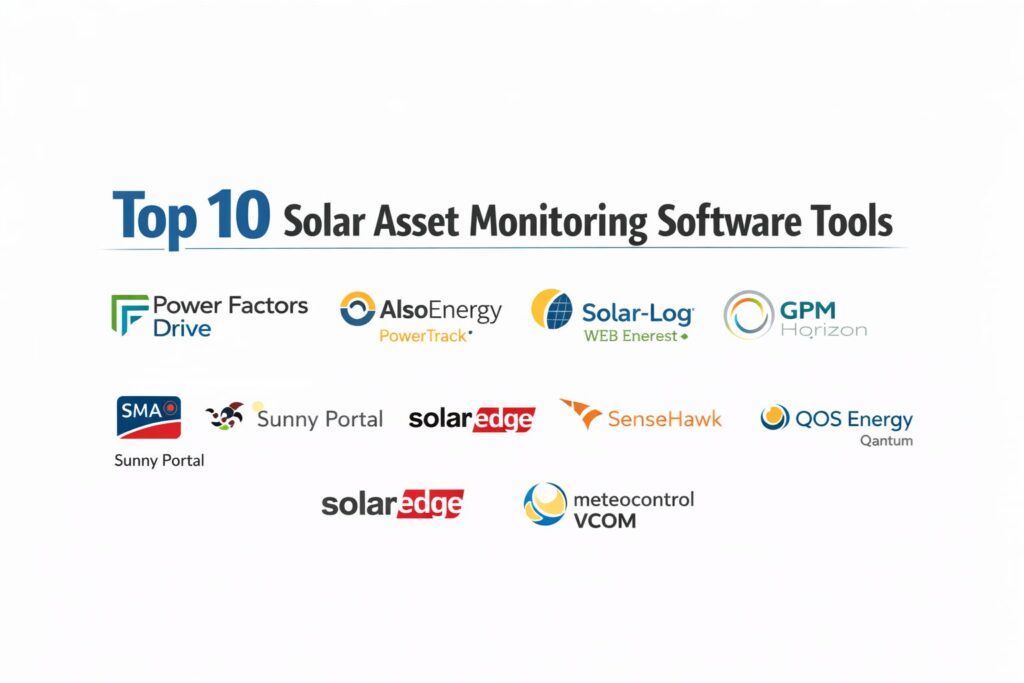
1. Power Factors Drive
Power Factors Drive is an enterprise-grade platform specifically designed for large-scale utility and commercial solar portfolios. It stands out for its high-level operational intelligence and its ability to act as a unified data platform for complex, multi-technology assets including wind and storage. It focuses on maximizing revenue by reducing time-to-repair and providing deep insights into technical underperformance.
Key Features
The platform features a proprietary performance engine that provides highly accurate loss-attribution analysis, identifying whether energy loss is due to weather, equipment, or grid constraints. It includes built-in incident management and CMMS integration to close the loop between detection and repair. Advanced SCADA connectivity allows for real-time control and plant-level visualization. The tool also offers standardized KPI reporting that aligns with international financial standards. Furthermore, it supports “event-based” alerting, which reduces alarm fatigue by grouping related technical faults into single actionable incidents.
Pros
Exceptional depth of analytics for large portfolios and high-volume data handling. The integration between technical performance and financial KPIs is seamless.
Cons
The platform’s complexity and cost make it less suitable for small commercial or residential players. The initial setup and configuration require a high level of technical expertise.
Platforms and Deployment
Cloud-based SaaS with high-availability infrastructure; support for edge-computing data gateways.
Security and Compliance
Adheres to NERC CIP, ISO 27001, and SOC2 standards for utility-grade security and data privacy.
Integrations and Ecosystem
Extensive integrations with major inverter brands, weather stations, and third-party CMMS/ERP tools.
Support and Community
Offers dedicated account management, enterprise-level professional services, and a comprehensive knowledge base for asset managers.
2. AlsoEnergy PowerTrack
AlsoEnergy’s PowerTrack platform is one of the most widely deployed monitoring solutions globally, serving a massive range of site sizes from commercial rooftops to utility-scale plants. It is renowned for its flexible reporting engine and its robust hardware ecosystem, providing a complete “end-to-end” monitoring solution.
Key Features
PowerTrack provides a highly customizable dashboard that allows users to create specific views for different stakeholders, from engineers to CFOs. It includes advanced shading and soiling analysis tools to help optimize cleaning schedules. The platform supports high-frequency data acquisition through its proprietary hardware controllers, ensuring granular visibility into inverter and string performance. It features a powerful “Fleet” view for managing hundreds of disparate sites simultaneously. Additionally, it offers automated “bankable” reports that simplify the task of proving performance to investors and utilities.
Pros
Highly flexible and scalable across diverse project sizes. Its long-standing market presence ensures wide-ranging hardware compatibility and reliable support.
Cons
The user interface can feel cluttered due to the sheer volume of available features. Some advanced analytics require significant manual configuration to optimize.
Platforms and Deployment
Web-based portal with dedicated hardware gateways for on-site data collection.
Security and Compliance
Features multi-factor authentication and role-based access control; complies with standard industry data protection protocols.
Integrations and Ecosystem
Integrates with thousands of devices across the solar value chain and offers a robust API for custom data exports.
Support and Community
Provides extensive regional support and a large network of certified installers and technicians.
3. Solar-Log WEB Enerest
Solar-Log is a veteran in the monitoring space, particularly strong in the commercial and industrial (C&I) sectors. Their WEB Enerest platform is hardware-agnostic, making it an excellent choice for operators who inherit mixed-brand portfolios through acquisitions.
Key Features
The platform offers three distinct service levels (M, L, and XL) to cater to different monitoring needs, from basic monitoring to professional asset management. It features “Component Monitoring,” which compares the performance of individual inverters within a site to detect anomalies instantly. It includes a sophisticated “Feed-in Management” tool to ensure compliance with grid regulations and avoid penalties. The system also supports smart energy management, allowing for the control of local loads like heat pumps or EV chargers. Its “Status Reports” provide a quick, color-coded overview of an entire portfolio’s health.
Pros
Extremely versatile hardware compatibility and localized support. Strong focus on smart energy and self-consumption optimization for C&I sites.
Cons
The platform can be less efficient for massive, utility-scale plants exceeding 100 MW compared to dedicated utility tools.
Platforms and Deployment
Web-based platform with proprietary hardware loggers for local site communication.
Security and Compliance
Standard SSL encryption and secure data hosting in localized data centers.
Integrations and Ecosystem
Compatible with over 100 different inverter manufacturers and various smart-home components.
Support and Community
Offers a wide range of training webinars and a dedicated technical support hotline for installers.
4. GreenPowerMonitor (GPM) Horizon
Part of the DNV group, GreenPowerMonitor is a data-driven platform that excels in utility-scale O&M. It is known for its “Horizon” platform, which offers deep operational visibility and a heavy emphasis on predictive insights for renewable portfolios.
Key Features
Horizon provides a GIS-integrated view of assets, allowing managers to see site performance in a geographic context. It utilizes machine learning for “Digital Twin” modeling, comparing real-time output against a perfect simulation of the plant to identify even the smallest deviations. The tool includes a robust O&M management module for tracking work orders and site visits. It features high-resolution SCADA data visualization for real-time plant control. The platform also offers advanced predictive maintenance modules that forecast component failures weeks in advance.
Pros
Backed by DNV’s engineering expertise, providing high credibility for performance reports. Excellent for managing massive, cross-continental portfolios.
Cons
Enterprise-level pricing and a technical interface that can be intimidating for non-engineers.
Platforms and Deployment
Cloud-based platform with localized edge-SCADA deployment options.
Security and Compliance
High-level cybersecurity architecture compliant with international energy infrastructure standards.
Integrations and Ecosystem
Deep integration with weather sensors, grid operator systems, and corporate reporting tools.
Support and Community
Provides expert-level technical consulting and global support centers.
5. Enphase Enlighten
Enphase Enlighten is the gold standard for microinverter-based systems. It is unique in providing granular, panel-level monitoring, making it the preferred choice for residential and small commercial systems where shading and individual module health are critical.
Key Features
The platform provides a color-coded “Array View” that shows the energy production of every single solar panel in real-time. It features automated system health checks and will proactively notify the installer if a specific microinverter is underperforming. The “Enlighten Manager” version offers more technical tools for professionals, including detailed per-panel graphing and historical data analysis. It also integrates seamlessly with the Enphase battery storage and EV charging ecosystem. The mobile app is widely praised for its simplicity and ease of use for end-customers.
Pros
Unrivaled granularity with panel-level data. The system is incredibly easy to navigate for both professionals and homeowners.
Cons
Limited to Enphase hardware; not a solution for sites using string inverters or third-party components.
Platforms and Deployment
Web-based dashboard and highly rated mobile apps for iOS and Android.
Security and Compliance
Secure cloud communication with encrypted data transmission from the Enphase Envoy gateway.
Integrations and Ecosystem
Tight integration within the Enphase ecosystem, with growing support for home automation standards.
Support and Community
Strong community forums and a very responsive remote troubleshooting support team.
6. SMA Sunny Portal
SMA is a global leader in inverter technology, and its Sunny Portal is one of the most established monitoring platforms in the world. It is designed to work seamlessly with SMA’s hardware, providing a highly reliable and professional monitoring experience for all plant sizes.
Key Features
The platform offers “SMA Smart Connected,” a proactive monitoring service where SMA’s systems analyze the inverter data and automatically initiate service actions if a fault is detected. It provides clear, actionable visualizations of energy yield and self-consumption. The “EnnexOS” platform addition allows for cross-sector energy management, integrating solar with thermal and storage systems. It features automated PDF reports that can be customized for different site owners. The system is also designed to manage large fleets efficiently through its “Sunny Portal Professional Package.”
Pros
Exceptional reliability and deep integration with SMA hardware. Proactive “Smart Connected” features significantly reduce downtime.
Cons
The interface can feel a bit traditional and less “modern” than some newer cloud-native competitors. Best performance is locked to SMA hardware.
Platforms and Deployment
Web portal with mobile app access and dedicated local controllers for larger sites.
Security and Compliance
Rigorous data security standards typical of high-end German engineering.
Integrations and Ecosystem
Excellent integration with SMA’s broader range of commercial and utility hardware.
Support and Community
Provides one of the industry’s largest support networks and extensive technical training programs.
7. SolarEdge Monitoring Platform
The SolarEdge platform is designed around its power optimizer technology, providing panel-level visibility similar to microinverters but with the architecture of a string inverter system. It is a powerful hybrid solution for residential and commercial sites.
Key Features
The platform features a “Logical Layout” and a “Physical Layout” of the array, allowing technicians to pinpoint the exact location of a faulty panel on a roof. It provides detailed alerts on everything from ground faults to individual optimizer issues. The system includes integrated battery management for the SolarEdge StorEdge solutions. It offers a unique “Public Display” feature, allowing businesses to show off their green energy stats in lobbies or on websites. Automated reports provide insights into energy production, consumption, and financial savings.
Pros
Provides the granularity of panel-level monitoring without the cost of a full microinverter system. Very strong visualization tools for marketing and customer engagement.
Cons
Requires the use of SolarEdge optimizers and inverters, limiting its use as a third-party management tool for existing generic plants.
Platforms and Deployment
Web-based dashboard with a feature-rich mobile app for owners and installers.
Security and Compliance
Encrypted communications and secure cloud hosting; compliant with standard e-commerce security protocols.
Integrations and Ecosystem
Integrates with smart meters, EV chargers, and home energy management systems within the SolarEdge family.
Support and Community
Global support network with a strong online learning center for certified installers.
8. SenseHawk
SenseHawk represents the “new wave” of monitoring, focusing on GIS-based asset management and the use of drones and AI to manage the lifecycle of a solar plant from construction through to operation. It is highly favored by utility-scale O&M teams.
Key Features
The platform uses a “map-first” approach, where every piece of data is linked to a specific geospatial coordinate on the solar farm. It integrates drone thermography data directly into the monitoring workflow, allowing for visual inspection of hundreds of thousands of panels in minutes. The “Core” module manages all site documentation, while the “Scan” module handles AI-powered defect detection. It provides a specialized workflow for “digitizing” a solar farm, creating a digital twin that evolves over time. The platform also includes tools for construction monitoring and inventory management.
Pros
Innovative use of GIS and AI for large-scale site inspections. Significantly improves the efficiency of field teams and aerial inspections.
Cons
May be “overkill” for smaller commercial sites that do not require aerial imaging or GIS integration.
Platforms and Deployment
Cloud-based web platform with mobile-friendly field tools.
Security and Compliance
Enterprise-grade data security with a focus on protecting proprietary site maps and technical data.
Integrations and Ecosystem
Connects with existing monitoring software and SCADA systems to add a layer of visual intelligence.
Support and Community
Provides specialized onboarding for large utility-scale projects and dedicated technical accounts.
9. QOS Energy Qantum
Qantum by QOS Energy is a high-performance, hardware-agnostic platform that focuses on data aggregation for large, multi-source renewable portfolios. It is a favorite among investment funds and large-scale asset managers.
Key Features
The platform is designed to handle “Big Data,” aggregating millions of data points from solar, wind, and storage assets. It features a powerful analytics engine that can perform complex “What-If” scenarios and financial forecasting. The system includes a fully customizable alerting engine that can handle complex logical conditions across multiple data tags. It provides a robust “Data Quality” tool that identifies and flags gaps or inaccuracies in the incoming sensor data. The platform also features automated contract management tools to track EPC and O&M performance against SLAs.
Pros
Unrivaled flexibility for aggregating data from virtually any source or hardware brand. Strong focus on data integrity and financial reporting.
Cons
Requires a significant investment in time to customize and build out the specific dashboards needed for a portfolio.
Platforms and Deployment
SaaS cloud platform with robust API capabilities.
Security and Compliance
Standard-compliant data security and high-level encryption for corporate data environments.
Integrations and Ecosystem
Extremely broad integration capabilities, supporting virtually any hardware with an open communication protocol.
Support and Community
Offers professional services for custom data integration and portfolio-wide setup.
10. Meteocontrol VCOM
Meteocontrol is a specialist in professional monitoring and control for large-scale solar plants. Their VCOM (Virtual Control Room) is a high-end platform used by professional O&M providers to manage massive global portfolios.
Key Features
VCOM offers a centralized “Control Room” view where all alarms across a global fleet are prioritized and managed. It features a highly accurate “Expected vs. Actual” performance comparison based on high-quality on-site meteorological data. The platform includes a comprehensive “O&M CMMS” that manages the entire lifecycle of a maintenance ticket. It supports high-resolution data acquisition and remote inverter control for grid compliance. Additionally, it offers specialized tools for “Investor Reporting” that are widely accepted by international banks.
Pros
A true professional-grade “Control Room” experience. The depth of their meteorological integration provides extremely high accuracy in performance benchmarking.
Cons
The platform has a high technical barrier to entry and is priced for professional O&M organizations rather than casual users.
Platforms and Deployment
Web-based platform with specialized hardware data loggers (blue’Log series).
Security and Compliance
Adheres to the highest European and international standards for energy data security and grid compliance.
Integrations and Ecosystem
Excellent integration with their own high-precision sensor hardware and major industrial SCADA systems.
Support and Community
Offers world-class technical support and professional training for O&M engineers and asset managers.
Comparison Table
| Tool Name | Best For | Platform(s) Supported | Deployment | Standout Feature | Public Rating |
| 1. Power Factors Drive | Utility Portfolios | Web, API | SaaS | Loss Attribution Engine | 4.8/5 |
| 2. AlsoEnergy PowerTrack | Commercial/Utility | Web, Hardware | Hybrid | Flexible Reporting Engine | 4.7/5 |
| 3. Solar-Log WEB Enerest | Mixed Hardware C&I | Web, Hardware | Hybrid | Hardware-Agnosticism | 4.5/5 |
| 4. GPM Horizon | Global IPPs | Web, SCADA | Cloud | Digital Twin Analytics | 4.6/5 |
| 5. Enphase Enlighten | Residential/Small C&I | Web, iOS, Android | Cloud | Panel-Level Granularity | 4.9/5 |
| 6. SMA Sunny Portal | SMA-Based Fleets | Web, Mobile App | Hybrid | Smart Connected Support | 4.6/5 |
| 7. SolarEdge Platform | Optimized Systems | Web, Mobile App | Cloud | Physical Layout Mapping | 4.7/5 |
| 8. SenseHawk | GIS-Based O&M | Web, Mobile | Cloud | Drone & AI Integration | 4.5/5 |
| 9. QOS Energy Qantum | Multi-Tech Assets | Web, API | SaaS | Data Integrity Checks | 4.4/5 |
| 10. Meteocontrol VCOM | Professional O&M | Web, Hardware | Hybrid | Virtual Control Room | 4.8/5 |
Evaluation & Scoring of Solar Asset Monitoring Software
The scoring below is a comparative model intended to help shortlisting. Each criterion is scored from 1–10, then a weighted total from 0–10 is calculated using the weights listed. These are analyst estimates based on typical fit and common workflow requirements, not public ratings.
Weights:
- Core features – 25%
- Ease of use – 15%
- Integrations & ecosystem – 15%
- Security & compliance – 10%
- Performance & reliability – 10%
- Support & community – 10%
- Price / value – 15%
| Tool Name | Core (25%) | Ease (15%) | Integrations (15%) | Security (10%) | Performance (10%) | Support (10%) | Value (15%) | Weighted Total |
| 1. Power Factors Drive | 10 | 6 | 9 | 10 | 10 | 9 | 8 | 9.05 |
| 2. AlsoEnergy PowerTrack | 9 | 8 | 10 | 9 | 9 | 9 | 9 | 8.95 |
| 3. Solar-Log WEB Enerest | 8 | 8 | 10 | 8 | 8 | 9 | 9 | 8.55 |
| 4. GPM Horizon | 10 | 6 | 8 | 10 | 10 | 9 | 7 | 8.70 |
| 5. Enphase Enlighten | 9 | 10 | 6 | 8 | 8 | 10 | 9 | 8.65 |
| 6. SMA Sunny Portal | 9 | 8 | 8 | 9 | 9 | 9 | 8 | 8.65 |
| 7. SolarEdge Platform | 9 | 9 | 7 | 8 | 9 | 9 | 9 | 8.65 |
| 8. SenseHawk | 8 | 7 | 8 | 9 | 9 | 8 | 8 | 8.05 |
| 9. QOS Energy Qantum | 9 | 6 | 10 | 9 | 9 | 8 | 8 | 8.45 |
| 10. Meteocontrol VCOM | 10 | 6 | 9 | 10 | 10 | 9 | 8 | 9.05 |
How to interpret the scores:
- Use the weighted total to shortlist candidates, then validate with a pilot.
- A lower score can mean specialization, not weakness.
- Security and compliance scores reflect controllability and governance fit, because certifications are often not publicly stated.
- Actual outcomes vary with assembly size, team skills, templates, and process maturity.
Which Solar Asset Monitoring Software Is Right for You?
Solo / Freelancer
For an independent solar installer or a small-scale entrepreneur, Enphase Enlighten or SolarEdge are the clear winners. These platforms handle the technical complexity in the background, offering a polished interface that you can hand over to your clients with minimal training.
SMB
Small to mid-sized commercial installers who deal with a variety of inverter brands should look at Solar-Log. Its hardware-agnostic nature allows you to consolidate different projects into one portal without being tied to a single manufacturer’s ecosystem.
Mid-Market
For professional O&M companies managing portfolios of 50–500 MW, AlsoEnergy PowerTrack offers the best balance of flexibility, reporting power, and cost. It provides the “bankable” data needed for stakeholders while remaining accessible to a broad technical team.
Enterprise
For utility-scale owners and global IPPs, Power Factors Drive or Meteocontrol VCOM are the industry standards. These tools are designed for high-stakes environments where even a 1% increase in performance translates into millions in revenue, justifying their higher technical requirements and costs.
Budget vs Premium
If the priority is lowering O&M costs through efficient automation, SMA Smart Connected offers high value by automating the service process. However, if the goal is premium, data-driven revenue optimization, the advanced loss-analytics of Power Factors is the superior choice.
Feature Depth vs Ease of Use
Enphase is the king of ease-of-use, but it lacks the enterprise depth of utility tools. Conversely, QOS Energy Qantum offers near-infinite feature depth but requires a dedicated data engineer to fully leverage its potential.
Integrations & Scalability
AlsoEnergy and Solar-Log excel in integrations due to their extensive hardware libraries. For scalability across different renewable types (Solar + Wind + Storage), Power Factors provides the most robust multi-asset framework.
Security & Compliance Needs
Operators of critical infrastructure must prioritize Meteocontrol or GPM Horizon, as these platforms are built from the ground up to satisfy the rigorous cybersecurity and grid-compliance requirements of national energy regulators.
Frequently Asked Questions (FAQs)
1. What is the difference between monitoring and asset management?
Monitoring is the real-time technical oversight of energy production and equipment health. Asset management is a broader function that includes financial reporting, contract compliance, insurance management, and long-term portfolio strategy.
2. Can I monitor solar and battery storage in the same app?
Yes, most modern platforms like Enphase, SolarEdge, and Power Factors now offer integrated storage monitoring to track state-of-charge, discharge rates, and round-trip efficiency alongside generation data.
3. What is a “Performance Ratio” (PR)?
The PR is a key metric that measures how effectively a plant converts sunlight into electricity compared to its theoretical maximum. It accounts for environmental factors like temperature and irradiance to show the true health of the system.
4. Why is hardware-agnostic software important?
If you acquire a portfolio with five different inverter brands, hardware-agnostic software like Solar-Log or Qantum allows you to see all your data in one place rather than logging into five different manufacturer portals.
5. How often does monitoring data update?
Residential systems typically update every 5–15 minutes. Utility-scale systems using SCADA integration often provide data in near-real-time (1-second to 1-minute intervals) for active grid management.
6. Does monitoring software help with soiling detection?
Yes, advanced tools compare your actual output with local weather data. If production drops on a sunny day without any equipment alerts, the software can flag “soiling” as the likely cause and suggest a cleaning.
7. Is a data logger necessary for every site?
For string-based or utility systems, a hardware data logger acts as the “brain” on-site to collect and transmit data. Microinverter systems like Enphase use a gateway (Envoy) to fulfill the same function.
8. Can monitoring software predict equipment failure?
Yes, by analyzing historical trends and using AI to spot thermal anomalies or decreasing efficiency in specific strings, platforms can notify operators of “early warning signs” before a total failure occurs.
9. How secure is solar monitoring data?
Leading platforms use industrial-grade encryption and secure cloud hosting. For utility-scale assets, software must comply with NERC CIP or similar national standards to protect the grid from cyberattacks.
10. What are the costs involved in monitoring software?
Costs vary from free (included with hardware) to several thousand dollars per year for enterprise portfolios. High-end tools typically charge based on the megawatt (MW) capacity being monitored.
Conclusion
Navigating the landscape of solar asset monitoring requires a transition from viewing software as a simple utility to recognizing it as a critical engine for financial and operational success. The complexity of the energy grid and the scale of solar deployments demand more than just basic data visibility; they require proactive, AI-driven insights that can protect long-term yields. The right platform selection depends entirely on your operational scale and the level of technical granularity required to satisfy your stakeholders. Whether you prioritize the ease of a manufacturer-integrated app or the enterprise power of a hardware-agnostic control room, your choice will ultimately determine your ability to scale in an increasingly competitive renewable market. By investing in a robust monitoring infrastructure today, asset owners can ensure their transition to green energy remains both sustainable and highly profitable.