Introduction
A Single Pane of Glass (SPOG) IT dashboard is a unified management console that integrates data from multiple disparate sources into a single, cohesive display. In the current enterprise environment, where technology stacks are spread across multi-cloud architectures, on-premises data centers, and edge computing locations, the “observability gap” has become a significant operational risk. These dashboards solve this by normalizing data formats from networking, security, application performance, and infrastructure tools, presenting a “source of truth” for the entire IT organization. For modern digital operations, this technology is the primary defense against “tool sprawl” and the inefficiencies caused by jumping between disconnected management interfaces.
The necessity of a unified dashboard is driven by the increasing complexity of microservices and the need for rapid incident response. When a critical service fails, IT teams cannot afford to spend hours correlating logs from three different cloud providers and five different monitoring agents. A robust SPOG platform enables real-time correlation, allowing engineers to see how a spike in database latency might be impacting end-user experience across a mobile application. When selecting a platform, organizations must evaluate the depth of the integration library, the sophistication of the AI-driven correlation engine, the customizability of the visualization layer, and the platform’s ability to scale without performance degradation.
Best for: IT Operations (ITOps) teams, Site Reliability Engineers (SREs), and Infrastructure Managers who need to monitor complex, hybrid environments and reduce the Mean Time to Resolution (MTTR) for technical incidents.
Not ideal for: Small businesses with a single, localized server and a handful of applications, or organizations that only use a single-vendor cloud stack that already provides its own built-in monitoring tools.
Key Trends in Single Pane of Glass IT Dashboards
The shift from reactive monitoring to proactive observability is the defining trend of this category, with platforms now utilizing AIOps to predict infrastructure failures before they impact users. We are seeing a move toward “OpenTelemetry” as the universal standard for data collection, which allows these dashboards to ingest data from almost any source without requiring proprietary agents. Real-time topology mapping is also becoming a core requirement, where the dashboard automatically discovers and visualizes the relationships between every component in a technical ecosystem, from a physical switch to a virtual container.
Security and Observability are converging into a single discipline often referred to as “SecOps Visibility,” where security threats are displayed alongside performance metrics to provide context for anomalies. There is also a significant trend toward “Business Observability,” where IT dashboards link technical metrics like CPU usage directly to business KPIs like checkout conversion rates. Furthermore, the “Platform Engineering” movement is driving the demand for self-service dashboards that allow individual developer teams to create their own custom views while remaining within the governed enterprise framework.
How We Selected These Tools
Our selection process involved a rigorous assessment of data ingestion capabilities and the flexibility of the visualization engines. We prioritized platforms that have demonstrated the ability to handle high-velocity data streams from a diverse array of sources including cloud providers, container orchestrators, and legacy on-premises hardware. A key criterion was the “Time to Value,” evaluating how easily a platform can auto-discover assets and begin providing meaningful insights without extensive manual configuration. We looked for a balance between out-of-the-box templates and the ability to build highly specific custom views for unique business requirements.
Scalability was also a major factor; we selected tools that can maintain dashboard responsiveness even when managing millions of data points per second. Security posture was scrutinized to ensure that these centralized consoles—which often have high-level access to sensitive infrastructure—utilize robust encryption and role-based access controls. Finally, we assessed the maturity of the AI and machine learning layers to ensure that the platforms go beyond simple charting and provide actual intelligence and noise reduction for busy operations teams.
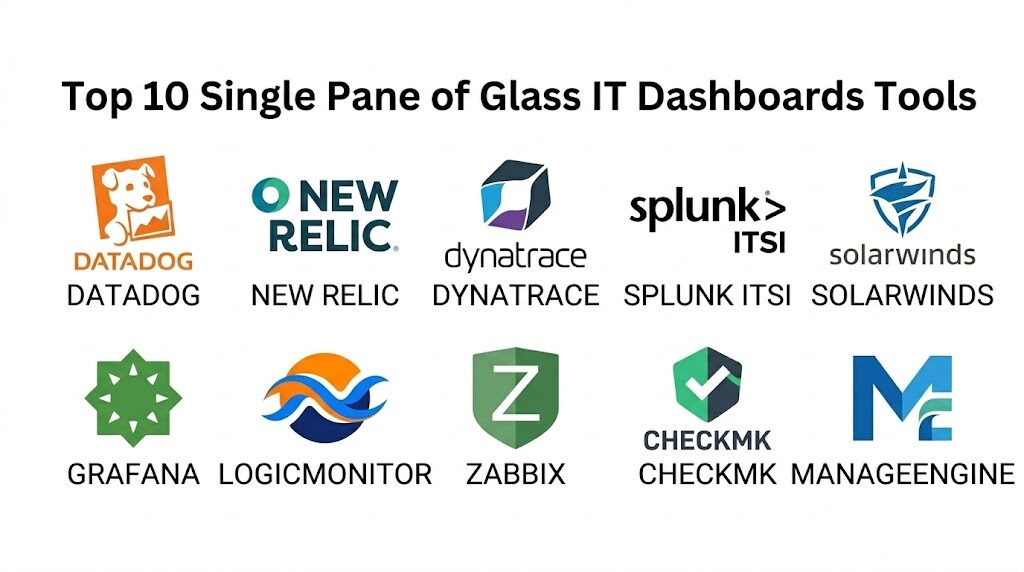
1. Datadog
Datadog is a cloud-native observability platform that has become the gold standard for unified IT dashboards. It provides a comprehensive view of the entire technology stack, from cloud infrastructure and databases to individual application traces and logs. Its ability to correlate performance data across different layers makes it a favorite for high-growth tech companies and modern enterprises.
Key Features
The platform features “Watchdog,” an AI engine that automatically detects anomalies and identifies root causes across the entire infrastructure. It includes over 600 vendor-supported integrations, allowing it to pull data from almost any technology in seconds. The dashboard engine supports “Screenboards” for high-level overviews and “Timeboards” for deep-dive technical analysis. It features a unique “Service Map” that visualizes how microservices interact in real-time. It also provides a robust “Log Management” module that links logs directly to specific performance spikes in the dashboard.
Pros
The speed of deployment is exceptional, with many users getting a full-stack view in under an hour. It offers a single, cohesive interface where every metric is clickable and drillable.
Cons
The pricing can become complex and expensive as more modules (logs, traces, security) are added. High data ingestion rates can lead to unexpected monthly costs.
Platforms and Deployment
SaaS (Cloud-based) with lightweight agents for Windows, Linux, macOS, and container environments.
Security and Compliance
SOC 2 Type II, HIPAA, and GDPR compliant, with robust role-based access control and data encryption.
Integrations and Ecosystem
Extensive ecosystem with native integrations for AWS, Azure, Google Cloud, Kubernetes, and hundreds of third-party apps.
Support and Community
Offers a massive documentation library, “Datadog Learning Center,” and a highly active global user community.
2. New Relic
New Relic is an all-in-one observability platform that emphasizes “Full-Stack Analysis.” It is designed to give engineers a single place to visualize every aspect of their digital business, focusing heavily on how infrastructure performance correlates with the end-user experience.
Key Features
The platform features “New Relic Explorer,” a unified view of all entities and their health status across the entire estate. It includes an “Errors Inbox” that consolidates errors from across the stack into a single actionable dashboard. The system features “Looker-style” querying capabilities for creating highly customized data visualizations. It offers “AIOps” features that automatically suppress alert noise and highlight critical incidents. It also provides a “Service Level Management” dashboard to track SLIs and SLOs in real-time.
Pros
The “one price per seat” model simplifies the licensing process for large teams. It offers exceptionally deep application performance monitoring (APM) capabilities.
Cons
The interface has undergone significant changes that some long-term users find difficult to navigate. The data retention costs can be a factor for organizations with massive logging needs.
Platforms and Deployment
SaaS (Cloud-based).
Security and Compliance
FedRAMP authorized, SOC 2, and GDPR compliant, ensuring high standards for government and enterprise data.
Integrations and Ecosystem
Offers over 500 integrations and a robust “Instant Observability” (I/O) marketplace for pre-built dashboards.
Support and Community
Provides “New Relic University” for training and an extensive online forum for technical support.
3. Dynatrace
Dynatrace is an enterprise-grade observability platform that relies heavily on automation and its proprietary AI engine, Davis. It is designed for large-scale environments where manual configuration is no longer feasible.
Key Features
The platform features “OneAgent,” which automatically discovers and monitors every component in the host environment without manual intervention. Its AI engine, “Davis,” provides precise answers about root causes rather than just showing a dashboard of alerts. The system features “Smartscape” topology mapping to show how everything is connected. It offers “Digital Experience Monitoring” to track actual user journeys on mobile and web. It also provides an “AutomationEngine” to trigger self-healing actions based on dashboard data.
Pros
The level of automation is the highest in the industry, making it ideal for massive, complex environments. The AI is highly accurate in reducing alert fatigue.
Cons
It is a premium product with a price point that may be out of reach for smaller organizations. The sheer depth of the platform can be overwhelming for simple use cases.
Platforms and Deployment
SaaS, Managed (Private Cloud), or Hybrid.
Security and Compliance
SOC 2, ISO 27001, HIPAA, and GDPR compliant.
Integrations and Ecosystem
Deep integrations with enterprise software like SAP, Oracle, and all major cloud platforms.
Support and Community
Offers premium “Platinum” support and a dedicated success manager for large enterprise accounts.
4. Splunk IT Service Intelligence (ITSI)
Splunk ITSI is a monitoring and analytics solution that leverages the power of the Splunk data platform to provide a “business-centric” view of IT operations. It is particularly strong in environments that already use Splunk for security and log management.
Key Features
The platform features “Glass Tables,” which allows users to create custom visualizations that map technical data to business processes. It includes “Predictive Analytics” that uses machine learning to forecast future service degradations. The system offers “Multi-KPI Alerts” that correlate different metrics to identify complex issues. It features “Service Analyzers” that provide a real-time health score for every critical business service. It also provides deep drill-down capabilities into the raw logs behind every dashboard metric.
Pros
Unrivaled power in log analysis and data correlation. It is highly flexible and can visualize almost any data source that can be turned into a log.
Cons
Requires significant expertise to set up and manage effectively. The cost of data ingestion in Splunk can be very high for large-scale infrastructure.
Platforms and Deployment
Cloud (SaaS), On-Premises, or Hybrid.
Security and Compliance
SOC 2 Type II, ISO 27001, and HIPAA compliant.
Integrations and Ecosystem
Thousands of apps available via Splunkbase, covering almost every possible data source.
Support and Community
Massive community of “Splunkers” and professional training through Splunk Education.
5. SolarWinds Orion (Platform Connect)
SolarWinds is a long-standing leader in network and systems management. Its platform provides a unified dashboard that is particularly strong for organizations that manage a heavy mix of physical networking hardware and virtualized servers.
Key Features
The platform features “PerfStack,” a tool that allows users to drag and drop different metrics onto a single timeline for correlation. It includes “AppStack,” which visualizes the relationship between applications, servers, and storage. The system offers a “Modern Dashboards” engine that uses a widget-based approach for easy customization. It features “NetPath,” which shows the network path between a user and an application, even across the internet. It also provides automated discovery and mapping of network topology.
Pros
Excellent for network-heavy environments and those managing physical infrastructure. The dashboard is straightforward and easy for traditional IT admins to use.
Cons
The platform has worked hard to rebuild trust following previous security incidents. It can feel less “cloud-native” than newer competitors like Datadog.
Platforms and Deployment
On-Premises, Self-hosted in Cloud, or Hybrid.
Security and Compliance
Adheres to strict software development lifecycle (SDLC) security protocols and provides standard enterprise compliance.
Integrations and Ecosystem
Integrates with a wide range of hardware vendors (Cisco, HP, Dell) and major cloud providers.
Support and Community
Supported by “THWACK,” one of the largest online communities for IT professionals.
6. Grafana Enterprise
Grafana is the industry leader in open-source visualization, and its Enterprise version provides the governance and security features required for a corporate Single Pane of Glass. It is known for its ability to pull data from almost any database without moving the data itself.
Key Features
The platform features “Data Source Plugins” that allow it to connect to SQL, NoSQL, and cloud-native databases simultaneously. It includes “Advanced Transformations” for normalizing data from different sources into a single chart. The system offers “Enterprise Logs” and “Enterprise Metrics” for a complete observability stack. It features “Explore” mode for ad-hoc data analysis and troubleshooting. It also provides a robust “Alerting” engine that can send notifications to any platform.
Pros
Offers the most beautiful and flexible dashboarding capabilities in the market. It allows you to visualize data without the cost of moving it into a proprietary storage engine.
Cons
The open-source roots mean it requires more manual configuration than some “all-in-one” tools. Managing multiple data sources can become complex as the environment scales.
Platforms and Deployment
Cloud (SaaS) or Self-hosted.
Security and Compliance
SOC 2 Type II and GDPR compliant, with advanced RBAC for dashboard access.
Integrations and Ecosystem
Has the widest range of data source connectors in the industry, from Prometheus to Snowflake.
Support and Community
Strong community and professional support from Grafana Labs for enterprise customers.
7. LogicMonitor
LogicMonitor is a fully automated, cloud-based infrastructure monitoring platform. It is designed to provide a unified dashboard for hybrid IT environments with minimal manual effort.
Key Features
The platform features “Envision” dashboards that are automatically populated upon device discovery. It includes over 2,000 pre-configured “LogicModules” for different hardware and software technologies. The system offers “LM Encept,” an AI-driven tool for anomaly detection and forecasting. It features “Cloud Insights” for monitoring AWS, Azure, and Google Cloud in a single view. It also provides “AIOps” features for alert suppression and root cause analysis.
Pros
Completely agentless for many use cases, making it very easy to deploy across a large network. The automated dashboarding saves significant administrative time.
Cons
The agentless approach can sometimes provide less granular data than agent-based tools. It is a SaaS-only product, which may not suit organizations requiring an on-premises console.
Platforms and Deployment
SaaS (Cloud-based).
Security and Compliance
SOC 2 Type II compliant and ISO 27001 certified.
Integrations and Ecosystem
Integrates with major ITSM tools like ServiceNow and PagerDuty for seamless incident management.
Support and Community
Offers 24/7 technical support and a comprehensive online training portal.
8. Zabbix
Zabbix is a powerful, open-source monitoring solution that is highly respected for its flexibility and ability to scale to massive environments. It provides a highly customizable SPOG for teams that have the technical expertise to build it.
Key Features
The platform features “Distributed Monitoring” using Zabbix Proxies to manage remote locations from a single dashboard. It includes “Auto-Discovery” for identifying new devices and services on the network. The system offers “Business Service Monitoring” (BSM) to group technical components into business services. It features a highly flexible “Template” system for rapid deployment of common monitoring tasks. It also provides a robust API for building custom front-ends and integrations.
Pros
Completely free to use with no licensing fees, offering incredible value. It is highly performant and can monitor hundreds of thousands of devices from a single server.
Cons
The user interface can feel dated and is less intuitive than modern SaaS platforms. It requires significant technical knowledge to configure and maintain at scale.
Platforms and Deployment
Self-hosted on Linux servers.
Security and Compliance
Security depends on the hosting environment; the software supports encrypted communication and MFA.
Integrations and Ecosystem
Wide range of community-developed templates and integrations available via the Zabbix Share portal.
Support and Community
Massive global community and professional support/training available from Zabbix SIA.
9. Checkmk
Checkmk is a comprehensive IT monitoring system that is designed for speed and scalability. It is particularly popular in Europe for its efficient data collection and powerful dashboarding engine.
Key Features
The platform features a “Micro Core” that allows it to monitor thousands of services with very low CPU usage. It includes an “Auto-Configuration” engine that suggests the best monitoring parameters for discovered devices. The system offers “Business Intelligence” (BI) modules that aggregate thousands of checks into a single service status. It features a highly customizable “Dashboard Editor” with a wide range of widgets. It also provides deep integration with Grafana for advanced visualization.
Pros
Extremely fast and lightweight, making it suitable for resource-constrained environments. It offers excellent out-of-the-box support for a wide variety of hardware.
Cons
The interface has a learning curve for those used to “modern” SaaS tools. Some of the most advanced features are restricted to the paid Enterprise version.
Platforms and Deployment
Self-hosted (Linux) or as a physical/virtual appliance.
Security and Compliance
Supports secure agent communication and standard enterprise access controls.
Integrations and Ecosystem
Integrates with standard IT management tools and has a growing marketplace of plugins.
Support and Community
Strong community presence and professional support tiers available from the vendor.
10. ManageEngine OpManager Plus
ManageEngine OpManager Plus is an integrated IT operations management (ITOM) solution that provides a single pane of glass for network, server, and application monitoring alongside configuration and address management.
Key Features
The platform features “Integrated Dashboards” that combine metrics from networking, storage, and server teams into one view. It includes “Workflow Automation” to trigger corrective actions based on threshold breaches. The system offers “Network Configuration Management” (NCM) within the same console as performance data. It features “IP Address Management” (IPAM) and switch port mapping. It also provides “Real-Time Bandwidth Monitoring” using NetFlow analysis.
Pros
Provides a very broad set of features in a single package, reducing the need for multiple tools. It is generally more affordable than many of its high-end enterprise competitors.
Cons
The interface can feel cluttered due to the sheer number of features. Some modules feel less “best-of-breed” than specialized tools like Datadog or Dynatrace.
Platforms and Deployment
On-Premises (Windows/Linux) or Cloud.
Security and Compliance
Standard enterprise security features with SOC 2 compliance for the cloud version.
Integrations and Ecosystem
Integrates natively with other ManageEngine products like ServiceDesk Plus.
Support and Community
Offers a wide range of training videos and a dedicated help desk for technical support.
Comparison Table
| Tool Name | Best For | Platform(s) Supported | Deployment | Standout Feature | Public Rating |
| 1. Datadog | Cloud-Native / DevSecOps | Win, Linux, Mac | Cloud SaaS | Watchdog AI | 4.7/5 |
| 2. New Relic | Full-Stack Engineers | Web-Based | Cloud SaaS | Errors Inbox | 4.5/5 |
| 3. Dynatrace | Enterprise Automation | Win, Linux | Hybrid | Davis AI Engine | 4.6/5 |
| 4. Splunk ITSI | Log-Heavy / Business View | Win, Linux | Hybrid | Glass Tables | 4.3/5 |
| 5. SolarWinds | Network / Hybrid Ops | Windows | Hybrid | PerfStack Correlation | 4.2/5 |
| 6. Grafana Enterprise | Visual / Multi-DB | Win, Linux, Mac | Hybrid | Data Source Plugins | 4.8/5 |
| 7. LogicMonitor | Hybrid / Agentless Ops | Web-Based | Cloud SaaS | LM Encept AI | 4.6/5 |
| 8. Zabbix | Tech-Savvy / Free | Linux | Self-hosted | Massive Scalability | 4.5/5 |
| 9. Checkmk | High-Performance Ops | Linux | Self-hosted | Micro Core Engine | 4.7/5 |
| 10. ManageEngine | All-in-One ITOM | Win, Linux | Hybrid | Integrated Config Mgmt | 4.4/5 |
Evaluation & Scoring of IT Dashboards
The scoring below is a comparative model intended to help shortlisting. Each criterion is scored from 1–10, then a weighted total from 0–10 is calculated using the weights listed. These are analyst estimates based on typical fit and common workflow requirements, not public ratings.
Weights:
- Core features – 25%
- Ease of use – 15%
- Integrations & ecosystem – 15%
- Security & compliance – 10%
- Performance & reliability – 10%
- Support & community – 10%
- Price / value – 15%
| Tool Name | Core (25%) | Ease (15%) | Integrations (15%) | Security (10%) | Performance (10%) | Support (10%) | Value (15%) | Weighted Total |
| 1. Datadog | 10 | 8 | 10 | 9 | 9 | 9 | 7 | 8.95 |
| 2. New Relic | 9 | 7 | 9 | 9 | 9 | 8 | 8 | 8.50 |
| 3. Dynatrace | 10 | 6 | 9 | 10 | 10 | 9 | 6 | 8.50 |
| 4. Splunk ITSI | 9 | 4 | 9 | 10 | 8 | 8 | 6 | 7.75 |
| 5. SolarWinds | 8 | 8 | 8 | 8 | 8 | 9 | 7 | 8.00 |
| 6. Grafana | 8 | 6 | 10 | 9 | 10 | 8 | 9 | 8.45 |
| 7. LogicMonitor | 9 | 9 | 9 | 9 | 8 | 8 | 7 | 8.45 |
| 8. Zabbix | 8 | 3 | 7 | 7 | 10 | 7 | 10 | 7.45 |
| 9. Checkmk | 9 | 6 | 8 | 8 | 10 | 8 | 9 | 8.50 |
| 10. ManageEngine | 8 | 7 | 8 | 8 | 8 | 8 | 9 | 7.95 |
How to interpret the scores:
- Use the weighted total to shortlist candidates, then validate with a pilot.
- A lower score can mean specialization, not weakness.
- Security and compliance scores reflect controllability and governance fit, because certifications are often not publicly stated.
- Actual outcomes vary with assembly size, team skills, templates, and process maturity.
Which Single Pane of Glass IT Dashboard Tool Is Right for You?
Solo / Freelancer
For startups or small technical teams, the priority is getting visibility quickly without a dedicated operations staff. A tool that provides “out-of-the-box” dashboards and agentless discovery is best, allowing you to focus on building your product rather than managing your monitoring infrastructure.
SMB
Organizations with a small IT department should prioritize tools that reduce the “noise” of alerts. You need a platform that uses AI to correlate events, ensuring that you only get paged when there is a real problem that requires human intervention, rather than every time a CPU spikes for a second.
Mid-Market
Mid-sized companies often have a mix of legacy hardware and new cloud services. You should look for a “hybrid-first” platform that can bridge the gap between your physical servers and your cloud containers, providing a single source of truth for your entire mixed environment.
Enterprise
Large organizations require deep governance and the ability to scale to millions of metrics. You should prioritize platforms that offer robust security, SSO integration, and the ability to handle massive, multi-departmental data streams without latency in the dashboard visualization.
Budget vs Premium
If budget is the primary driver, open-source solutions provide professional-grade power for no licensing cost. However, be prepared to invest in the technical talent required to maintain them. Premium SaaS platforms carry a higher cost but significantly reduce the “total cost of ownership” by handling all the backend infrastructure and updates for you.
Feature Depth vs Ease of Use
Highly technical teams may prefer the “infinite customizability” of a query-based platform. However, for teams that need to socialize IT data with non-technical business stakeholders, a tool with a visual “drag-and-drop” dashboard builder is often more valuable.
Integrations & Scalability
Your dashboard is only as good as the data it can ingest. Ensure the platform has a robust API and a wide library of native integrations. As your technology stack evolves, your dashboard must be able to add new data sources without requiring a total system migration.
Security & Compliance Needs
Since a SPOG dashboard has visibility into your entire infrastructure, its security is paramount. Ensure the platform supports multi-factor authentication, granular role-based access, and has the specific compliance certifications (like SOC 2 or FedRAMP) required for your industry.
Frequently Asked Questions (FAQs)
1. What is the difference between monitoring and observability?
Monitoring tells you when something is wrong by tracking predefined metrics. Observability allows you to understand why something is wrong by correlating metrics, logs, and traces to provide deep context into the internal state of a system.
2. Can I build a single pane of glass using free tools?
Yes, tools like Zabbix or the open-source version of Grafana allow you to build very powerful unified dashboards. However, you will need to invest significantly more time in manual configuration and maintaining the monitoring servers yourself.
3. Why do some dashboards require agents?
Agents are small pieces of software installed on a server that provide very granular, high-frequency data. While “agentless” monitoring is easier to set up, it often provides less detail than an agent that has a direct view of the operating system.
4. How does AIOps help in a unified dashboard?
AIOps uses machine learning to look at thousands of metrics simultaneously. It can identify patterns that humans would miss, such as a slight increase in latency in one service that consistently predicts a total failure in another service three hours later.
5. Can these tools monitor multi-cloud environments?
Almost all modern SPOG tools have native connectors for AWS, Azure, and Google Cloud. They can pull data from all three simultaneously and present them in a single chart, allowing you to see your entire cloud estate in one place.
6. Do these dashboards impact the performance of my applications?
Most modern monitoring agents are designed to have a very small footprint, typically using less than 1% of CPU. However, “agentless” monitoring that uses heavy API calls can sometimes impact the responsiveness of the cloud management console.
7. Is data privacy a concern with SaaS-based dashboards?
Since these tools collect metadata about your infrastructure rather than the actual content of your database, the risk is generally lower. However, you must ensure that your logging configuration doesn’t accidentally send sensitive PII to the dashboard provider.
8. Can I see business metrics on an IT dashboard?
Yes, many top-tier platforms allow you to ingest business data (like sales volume or user signups) and overlay it with technical data. This helps IT teams understand the real-world business impact of technical issues.
9. What is “tool sprawl” and how does a SPOG fix it?
Tool sprawl occurs when an organization has too many specialized monitoring tools that don’t talk to each other. A SPOG platform fixes this by acting as the central “hub” where data from all those specialized tools is unified and correlated.
10. How long does it take to implement a unified dashboard?
For SaaS platforms with automated discovery, you can see initial data in minutes. However, a fully tuned, production-grade SPOG dashboard for a large enterprise typically takes 30 to 90 days to refine the alerts and custom views.
Conclusion
In the modern enterprise, the ability to maintain a Single Pane of Glass view over the IT landscape is the difference between operational excellence and constant crisis management. As infrastructure continues to shift toward decentralized and ephemeral models, the value of a centralized, intelligent dashboard only grows. By consolidating metrics, logs, and traces into a single source of truth, organizations can empower their technical teams to act with precision and speed. The ideal dashboard is one that not only visualizes the current state of the environment but also provides the predictive insights needed to navigate the complexities of future growth.