INTRODUCTION
Secure software supply chain attestation tools have emerged as a critical defense mechanism against the rising tide of sophisticated cyberattacks targeting the software development lifecycle. These tools provide the technical framework for “attestation”—the process of creating cryptographically signed claims about how a piece of software was built, by whom, and in what environment. By generating SLSA (Supply-chain Levels for Software Artifacts) compliant provenance, organizations can move beyond simply scanning for vulnerabilities to ensuring the fundamental integrity of their artifacts. This paradigm shift focuses on “trust but verify,” where every component in a production environment must possess a verifiable birth certificate that proves it hasn’t been tampered with during transit from source to deployment.
The implementation of these tools is no longer optional for high-security environments, especially following global mandates for increased transparency in digital infrastructure. These platforms function by capturing metadata at every stage of the CI/CD pipeline, signing it with secure identities, and storing it in a way that downstream consumers can programmatically verify. The real-world application of these tools spans from securing containerized microservices in Kubernetes to protecting the distribution of open-source packages. As organizations adopt Zero Trust architectures, software supply chain attestation serves as the “identity” for code, ensuring that only authenticated and authorized software reaches the end-user.
Best for: DevSecOps teams, release engineers, and security compliance officers in regulated industries like finance, healthcare, and government contracting.
Not ideal for: Basic static websites with no backend dependencies, local personal projects, or environments where software is never distributed or updated.
KEY TRENDS IN SECURE ATTESTATION TOOLS
The industry is rapidly shifting toward “keyless” signing, a trend popularized by projects like Sigstore that eliminates the operational burden of managing long-lived cryptographic keys. Instead, ephemeral certificates tied to OIDC (OpenID Connect) identities are used, significantly reducing the risk of key theft. Another major trend is the widespread adoption of the SLSA v1.0 specification, which provides a standardized language for provenance that works across different build systems. There is also a growing movement toward “policy-as-code,” where tools like Kyverno or OPA (Open Policy Agent) are used to automatically block any container from running if its SLSA provenance cannot be verified. Furthermore, the integration of Graph-based metadata analysis is helping organizations understand the complex web of transitive dependencies, making it easier to trace the origin of a vulnerability across an entire software ecosystem.
METHODOLOGY
To identify the top ten tools in this specialized field, we evaluated a broad spectrum of open-source projects and commercial platforms focused on software integrity. The primary criteria included support for the SLSA framework and the ability to generate or verify in-toto attestations. We analyzed the robustness of each tool’s signing mechanisms, prioritizing those that support modern, keyless architectures. Integration capability was a significant factor, as these tools must operate seamlessly within existing CI/CD environments like GitHub Actions, GitLab, and Tekton. We also assessed the maturity of the verification engines, as the ability to enforce policies at the “gate” (e.g., admission controllers) is vital for real-world security. Finally, we considered the strength of the community and corporate backing, ensuring these tools are reliable enough for enterprise-grade deployment.
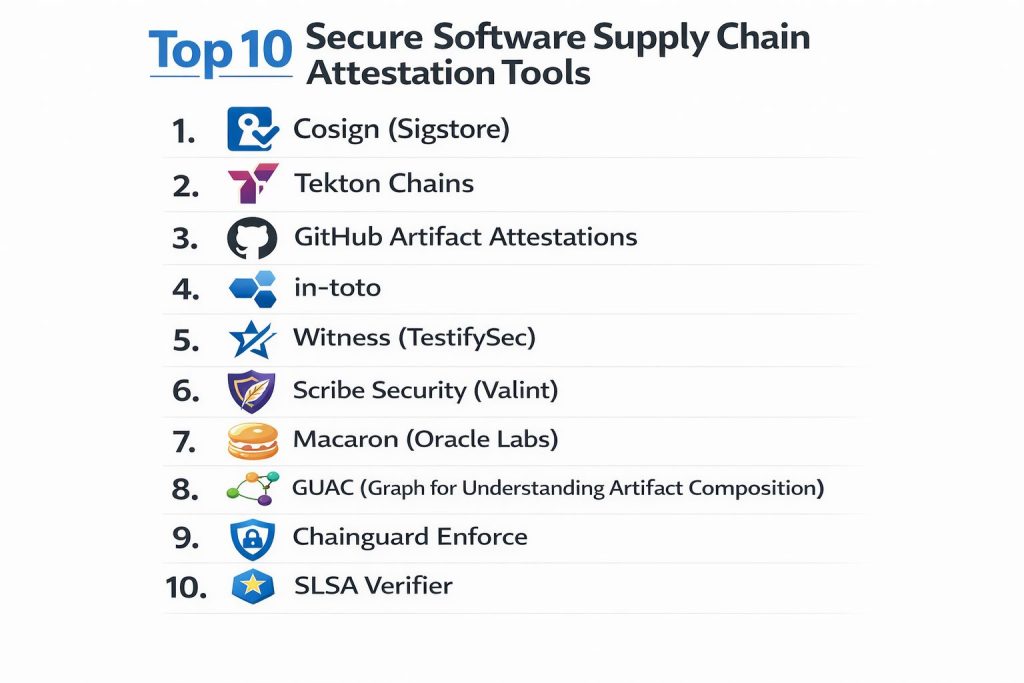
TOP 10 SECURE SOFTWARE SUPPLY CHAIN ATTESTATION TOOLS
1. Cosign (Sigstore)
Cosign is the flagship tool of the Sigstore project, designed specifically to make signing and verifying container images and other artifacts as simple as possible. It has become the de facto standard for cloud-native attestation due to its support for keyless signing and its ability to store signatures directly in OCI registries. This tool bridges the gap between traditional code signing and modern, automated CI/CD workflows.
The core strength of Cosign lies in its integration with Fulcio (a certificate authority) and Rekor (a transparency log). This allow users to sign artifacts using their existing OIDC identities (like GitHub or Google) without ever having to manage a private key. It also supports various types of attestations, including SBOMs and SLSA provenance, making it a versatile tool for any supply chain security strategy.
Pros:
Eliminates the complexity of key management through its keyless signing flow. It is widely supported by cloud providers and has a massive, active open-source community.
Cons:
The transparency log (Rekor) makes signing events public, which may not be suitable for some private enterprise requirements without a private instance.
Platforms / Deployment:
Linux / macOS / Windows / Kubernetes
CLI / GitHub Actions
Security & Compliance:
OIDC, Ephemeral Keys, Rekor Transparency Log
SLSA Level 3+ support
Integrations & Ecosystem:
Natively integrates with all major OCI registries, Kubernetes admission controllers, and the entire Sigstore suite.
Support & Community:
Large open-source community backed by the OpenSSF and major tech leaders like Google and Red Hat.
2. Tekton Chains
Tekton Chains is a Kubernetes-native controller designed to observe Tekton build tasks and automatically generate provenance for the resulting artifacts. It is an essential component for organizations using Tekton who wish to achieve high SLSA compliance levels without adding manual steps to their pipelines.
Once installed, Tekton Chains watches for completed TaskRuns and PipelineRuns. It captures the inputs, outputs, and environmental metadata of the build, signs this information using a configured secret or KMS, and then uploads the attestation to a registry or transparency log. This “set and forget” approach ensures that security is a byproduct of the build process.
Pros:
Provides fully automated, non-falsifiable provenance generation within the Tekton ecosystem. It supports multiple signing backends including KMS and Sigstore.
Cons:
It is strictly tied to the Tekton build system, making it irrelevant for teams using other CI tools like Jenkins or GitLab CI.
Platforms / Deployment:
Kubernetes
Cloud-native controller
Security & Compliance:
KMS Integration, RBAC, Secret-based signing
SLSA Level 3 compliance
Integrations & Ecosystem:
Works seamlessly with Tekton Pipelines and can push attestations to any OCI-compliant registry.
Support & Community:
Managed by the Continuous Delivery Foundation (CDF) with strong support from enterprise Kubernetes users.
3. GitHub Artifact Attestations
GitHub has introduced a native attestation service that allows users to easily sign and verify artifacts built within GitHub Actions. This service leverages the Sigstore infrastructure under the hood but provides a simplified, integrated experience directly within the GitHub platform.
The tool automatically links the produced artifact to the specific workflow run, commit hash, and repository that created it. By using the actions/attest-build-provenance action, developers can generate SLSA Level 3 compliant provenance with a single line of code. This significantly lowers the barrier to entry for securing the supply chain in the world’s most popular hosting platform.
Pros:
Requires almost zero configuration for existing GitHub users. It provides a built-in UI for viewing the “trust” status of artifacts within the repository.
Cons:
It is a proprietary feature of GitHub, which creates vendor lock-in and is not available for self-hosted GitLab or Bitbucket instances.
Platforms / Deployment:
Cloud / GitHub Actions
Integrated Platform
Security & Compliance:
OIDC (GitHub ID), Sigstore integration
SLSA Level 3
Integrations & Ecosystem:
Deeply integrated with the GitHub Actions ecosystem and GitHub’s internal security features.
Support & Community:
Direct support from GitHub/Microsoft and integrated into their enterprise security offerings.
4. in-toto
The in-toto framework is the foundational metadata standard upon which most modern attestation tools are built. It provides a systematic way to define the “layout” of a software supply chain, identifying exactly which steps should occur and which actors are authorized to perform them.
While other tools focus on the “how” of signing, in-toto focuses on the “what” and “who.” It allows users to verify that a product was actually built according to the prescribed process, ensuring that no unauthorized steps were added. It is the language that SLSA provenance uses to communicate its claims.
Pros:
Extremely flexible and language-agnostic. It can be used to secure almost any process, not just software builds, including hardware manufacturing or document workflows.
Cons:
It is a framework rather than a “plug-and-play” tool, requiring significant design effort to implement a full layout and verification logic.
Platforms / Deployment:
Cross-platform (Python, Go implementations)
CLI / SDK
Security & Compliance:
Cryptographic signatures (PGP, Sigstore)
Foundational for SLSA
Integrations & Ecosystem:
Integrated into many other tools on this list, including Cosign, Tekton Chains, and Witness.
Support & Community:
Academic and industry-backed via the CNCF and New York University.
5. Witness (TestifySec)
Witness is an extensible attestation framework that records and verifies the actions taken during a software build. It is designed to be “pluggable,” allowing it to capture everything from vulnerability scan results and test coverage to the specific environment variables used during a compile.
Witness works by wrapping build commands and recording “attestors” that capture specific pieces of data. These are then signed and bundled into an in-toto statement. When paired with Archivista, a graph-based storage service, Witness allows for complex queries to verify that all required security checks were passed before a release.
Pros:
Highly customizable; users can create their own attestors to capture proprietary metadata. It provides a very high level of detail in its provenance documents.
Cons:
Requires more configuration than “automatic” tools like GitHub Attestations. The complexity can be high for simple projects.
Platforms / Deployment:
Linux / macOS / Windows
CLI / CI-agnostic
Security & Compliance:
SPIFFE/SPIRE support, Sigstore integration
SLSA Level 3+
Integrations & Ecosystem:
Works with Archivista for storage and can be integrated into any CI/CD pipeline including Jenkins and GitLab.
Support & Community:
Developed by TestifySec with a growing open-source presence in the CNCF sandbox.
6. Scribe Security (Valint)
Scribe Security provides an end-to-end platform for software supply chain transparency, with its “Valint” CLI tool serving as the primary engine for generating and verifying SLSA provenance. It is designed to work across the entire SDLC, from developer machines to production environments.
Valint can generate both SBOMs and SLSA provenance for various targets, including container images, local directories, and git repositories. It supports “policy-as-code” enforcement, allowing teams to set rules like “no image can be deployed unless it has a signed SLSA attestation from a trusted builder.”
Pros:
Provides a unified interface for both SBOM management and SLSA attestation. Its commercial platform offers powerful visualization of the supply chain graph.
Cons:
Full features often require a connection to the Scribe Hub, which may be a concern for highly air-gapped or privacy-conscious environments.
Platforms / Deployment:
Linux / Windows / macOS
SaaS / CLI
Security & Compliance:
RBAC, SSO, X.509 support
SLSA & SSDF compliance
Integrations & Ecosystem:
Offers strong integrations with OCI registries and popular CI/CD tools through dedicated actions and plugins.
Support & Community:
Professional support provided by Scribe Security, with a focus on enterprise compliance needs.
7. Macaron (Oracle Labs)
Macaron is a specialized analysis tool from Oracle Labs that focuses on checking the SLSA compliance level of an artifact and its transitive dependencies. It is unique in that it doesn’t just generate provenance; it audits the build process of third-party libraries you might be using.
Macaron analyzes the repository of a dependency to verify if it follows secure build practices, such as using a trusted builder or providing its own verifiable provenance. It uses the Datalog language to express complex security policies, making it a powerful tool for organizations that need to vet a large number of open-source components.
Pros:
Excellent for third-party risk management and auditing the “upstream” supply chain. It provides clear HTML reports on the SLSA levels of all dependencies.
Cons:
Currently focused primarily on Maven and Java ecosystems, though it is expanding to others. It is more of an auditing tool than a real-time signing tool.
Platforms / Deployment:
Linux / macOS
CLI / Local Analysis
Security & Compliance:
Zero Trust analysis model
SLSA framework auditing
Integrations & Ecosystem:
Works as a standalone tool but can be integrated into security review workflows to automate the “vetting” of new libraries.
Support & Community:
Maintained by Oracle Labs with a focus on research-backed security practices.
8. GUAC (Graph for Understanding Artifact Composition)
GUAC is not a “signing” tool in the traditional sense, but it is an essential “attestation” tool that helps organizations make sense of the mountains of provenance and SBOM data they generate. It ingests metadata from various sources and builds a massive graph of how software components are related.
By using GUAC, a security team can ask questions like, “Which of my running images were built with a specific version of a vulnerable compiler?” This capability is only possible because GUAC links SLSA provenance, SBOMs, and vulnerability data into a single, searchable source of truth.
Pros:
Uniquely solves the “metadata overload” problem by providing a searchable graph of the entire software ecosystem. It is essential for rapid incident response.
Cons:
It is a heavy tool to deploy and maintain, requiring a backend database (like Neo4j) to manage the relationship data.
Platforms / Deployment:
Kubernetes / Docker
Backend Service
Security & Compliance:
Aggregates SLSA, SBOM, and VEX data
Enterprise visibility
Integrations & Ecosystem:
Integrates with Sigstore, Scribe, Witness, and many other metadata generators to ingest data.
Support & Community:
An OpenSSF project with significant contributions from Google, Kusari, and Purdue University.
9. Chainguard Enforce
Chainguard Enforce is a comprehensive platform designed to manage and enforce software supply chain policies. It acts as a centralized “control plane” that ensures only verified, compliant software is allowed to run in your Kubernetes clusters.
The platform continuously monitors clusters for “attestation drift” and can automatically block non-compliant containers. It relies heavily on Sigstore for signing and verification but adds an enterprise-grade management layer for defining who is allowed to sign what, across multiple teams and clusters.
Pros:
Provides a very powerful “admission controller” that goes beyond basic signature checking to verify full SLSA provenance and SBOM policies in real-time.
Cons:
It is a commercial SaaS offering, which may not fit the budget or architecture of smaller teams or purely open-source projects.
Platforms / Deployment:
Kubernetes / Cloud
SaaS Control Plane
Security & Compliance:
FIPS-compliant, SSO/SAML
SLSA Level 4 (internal)
Integrations & Ecosystem:
Deeply integrated with Sigstore and designed to work with any CI/CD system that can produce standard attestations.
Support & Community:
Professional enterprise support from the team that founded the Sigstore project.
10. SLSA Verifier
The SLSA Verifier is a high-assurance CLI tool specifically built for the verification of provenance generated by the SLSA-provenance-generator (used in GitHub Actions). It is designed to be the “final check” that a human or a deployment script runs to ensure an artifact is authentic.
It is purpose-built to be small, secure, and focused. It doesn’t just check that a signature is valid; it verifies that the signature was generated by the specific “trusted builder” (like a GitHub Actions runner) and that the build configuration matches the expected source repository.
Pros:
Extremely secure and reliable for its specific use case. It is the “official” way to verify GitHub-generated SLSA provenance.
Cons:
It is limited in scope, primarily supporting GitHub Actions provenance and OCI images, making it less versatile than a general-purpose tool like Witness.
Platforms / Deployment:
Linux / macOS / Windows
CLI
Security & Compliance:
OIDC Verification, Cryptographic Integrity
SLSA Level 3 Verification
Integrations & Ecosystem:
Designed to work with the GitHub SLSA generator and OCI registries.
Support & Community:
Maintained by the SLSA community and OpenSSF.
COMPARISON TABLE
| Tool Name | Best For | Platform(s) Supported | Deployment | Standout Feature | Public Rating |
| 1. Cosign | Container Signing | Linux, Mac, Win | CLI/K8s | Keyless OIDC Flow | 4.9/5 |
| 2. Tekton Chains | Tekton Users | Kubernetes | Controller | Auto-Provenance | N/A |
| 3. GitHub Attestations | GitHub Native | Cloud | SaaS | Zero-Config Setup | 4.8/5 |
| 4. in-toto | Framework Logic | Cross-platform | SDK/CLI | Layout Verification | N/A |
| 5. Witness | Detailed Metadata | Linux, Mac, Win | CLI | Pluggable Attestors | 4.5/5 |
| 6. Scribe Security | Compliance Policy | Linux, Mac, Win | SaaS/CLI | Policy-as-Code | 4.7/5 |
| 7. Macaron | Upstream Audit | Linux, macOS | CLI | Third-party Analysis | N/A |
| 8. GUAC | Metadata Search | Kubernetes | Service | Relationship Graph | N/A |
| 9. Chainguard Enforce | K8s Enforcement | Cloud | SaaS | Real-time Admission | 4.8/5 |
| 10. SLSA Verifier | Official Check | Linux, Mac, Win | CLI | High-Assurance Logic | N/A |
EVALUATION & SCORING OF ATTESTATION TOOLS
The scoring below is a comparative model intended to help shortlisting. Each criterion is scored from 1–10, then a weighted total from 0–10 is calculated using the weights listed. These are analyst estimates based on typical fit and common workflow requirements, not public ratings.
Weights:
- Core features – 25%
- Ease of use – 15%
- Integrations & ecosystem – 15%
- Security & compliance – 10%
- Performance & reliability – 10%
- Support & community – 10%
- Price / value – 15%
| Tool Name | Core (25%) | Ease (15%) | Integrations (15%) | Security (10%) | Performance (10%) | Support (10%) | Value (15%) | Weighted Total |
| 1. Cosign | 10 | 9 | 10 | 10 | 10 | 8 | 10 | 9.60 |
| 2. Tekton Chains | 9 | 7 | 6 | 9 | 9 | 7 | 9 | 8.10 |
| 3. GitHub Attestations | 8 | 10 | 8 | 9 | 10 | 9 | 10 | 8.95 |
| 4. in-toto | 10 | 4 | 9 | 10 | 10 | 7 | 10 | 8.55 |
| 5. Witness | 9 | 6 | 8 | 9 | 8 | 7 | 9 | 8.05 |
| 6. Scribe Security | 8 | 8 | 9 | 9 | 9 | 9 | 7 | 8.30 |
| 7. Macaron | 7 | 6 | 7 | 9 | 8 | 6 | 9 | 7.30 |
| 8. GUAC | 8 | 5 | 10 | 8 | 7 | 7 | 9 | 7.80 |
| 9. Chainguard Enforce | 9 | 8 | 9 | 10 | 9 | 10 | 6 | 8.65 |
| 10. SLSA Verifier | 8 | 9 | 7 | 10 | 10 | 7 | 10 | 8.65 |
How to interpret the scores:
- Use the weighted total to shortlist candidates, then validate with a pilot.
- A lower score can mean specialization, not weakness.
- Security and compliance scores reflect controllability and governance fit, because certifications are often not publicly stated.
- Actual outcomes vary with assembly size, team skills, templates, and process maturity.
WHICH SECURE ATTESTATION TOOL IS RIGHT FOR YOU?
Solo / Freelancer
If you are an individual developer, GitHub Artifact Attestations is the obvious choice. It requires no setup and provides high-level security for your public or private repositories for free. If you are working outside of GitHub, Cosign is the best CLI tool to start with.
SMB
Small businesses should look at Scribe Security or Cosign. Scribe provides a more “human-friendly” interface for managing compliance without needing a dedicated security engineering team, while Cosign is great for developers who are comfortable with the command line.
Mid-Market
For companies with a growing Kubernetes footprint, Witness and its storage backend Archivista provide a robust way to scale attestation across multiple pipelines. It offers the flexibility to capture specific business-related metadata that simpler tools might miss.
Enterprise
Large enterprises with strict regulatory requirements should consider Chainguard Enforce or a combination of Maya/Houdini-like depth in their supply chain with GUAC. These tools allow for complex policy enforcement and provide a global view of all dependencies across the entire organization.
Budget vs Premium
The Sigstore ecosystem (Cosign, SLSA Verifier) is free and open-source, offering world-class security at zero cost. Chainguard Enforce and Scribe Security represent premium, paid solutions that add significant management and compliance-reporting value.
Feature Depth vs Ease of Use
GitHub Attestations and SLSA Verifier are the easiest to use but are more limited in scope. in-toto and Witness offer the greatest depth but require a technical investment to implement correctly.
Integrations & Scalability
GUAC is the winner for scalability, as its purpose is to handle the massive amount of data produced by an enterprise-sized supply chain.
Security & Compliance Needs
If you must achieve SLSA Level 3 or higher for government contracts, Tekton Chains and the SLSA Verifier are the most rigorous tools currently available for ensuring build integrity.
FREQUENTLY ASKED QUESTIONS (FAQS)
What is the difference between an SBOM and an attestation?
An SBOM (Software Bill of Materials) is a list of ingredients in your software. An attestation is a signed statement that proves those ingredients were put together in a specific, secure way.
What does SLSA compliance actually mean?
SLSA is a framework that ranks the security of a software supply chain. Level 1 requires documentation, while Level 3 requires the build to happen in a secure, isolated environment with signed provenance.
Is keyless signing actually secure?
Yes, it is often more secure than traditional signing because it removes the risk of a developer’s private key being stolen or leaked. It uses short-lived certificates that expire in minutes.
Do I need a transparency log?
A transparency log (like Rekor) provides a public, immutable record of every signing event. This makes it impossible for an attacker to secretly sign a malicious artifact without being discovered.
Can I use these tools with old build systems like Jenkins?
Yes, tools like Witness and Cosign are CI-agnostic and can be added as steps within a Jenkins pipeline, though they may require more manual configuration than native GitHub or Tekton tools.
How do I verify an attestation at the time of deployment?
You can use a Kubernetes Admission Controller (like Kyverno or Chainguard Enforce) to check for a valid signature and SLSA provenance before any container is allowed to start.
What is “provenance” in software?
Provenance is the metadata that describes the origin of an artifact. It typically includes the source code URL, the commit hash, the build environment, and the time the build occurred.
Does signing an artifact slow down the build process?
The signing process itself is very fast (usually under a second). The only significant time added is usually for uploading the attestation to a registry or log.
Can attackers fake an attestation?
If the attestation is signed by a trusted builder (like GitHub Actions) using OIDC, an attacker would have to compromise the build system itself to generate a fake but valid-looking claim.
Which tool should I start with if I am new to this?
Start with Cosign. It is the most versatile and well-documented tool in the space, and learning it will help you understand the core concepts of modern software supply chain security.
CONCLUSION
Implementing secure software supply chain attestation is a fundamental step toward achieving a modern, Zero Trust security posture. By utilizing tools that generate verifiable SLSA provenance, organizations can ensure that their software remains untampered and authentic from the moment code is committed to the final deployment. Whether you choose a deeply integrated solution like GitHub Attestations or a highly flexible framework like Witness, the goal remains the same: replacing implicit trust with cryptographic proof. As the threat landscape continues to evolve, these tools will provide the necessary transparency to protect both developers and end-users from the next generation of supply chain attacks.