Introduction
Secure Access Service Edge (SASE) platforms bring networking and security together as a unified service so users, devices, and applications can connect safely from anywhere. Instead of sending all traffic back to a central office, SASE applies security controls closer to the user and routes traffic intelligently to cloud apps, private apps, and the internet. In practice, SASE usually combines capabilities such as secure web access, cloud app visibility and control, private app access based on identity, and wide-area connectivity that adapts to changing conditions.
SASE matters because work is distributed, applications live in multiple clouds, and traffic patterns change constantly. Teams want consistent policy enforcement, predictable performance, and less complexity than stitching together many separate products.
Common use cases include securing remote work, connecting branches without heavy on-prem hardware, controlling access to SaaS apps, protecting private apps without traditional VPN sprawl, and reducing attack surface through identity-based access.
Key evaluation criteria: security breadth (web, apps, private access), policy consistency, identity integration, performance and latency, global presence, visibility and reporting, integration with existing security stack, operational simplicity, migration path from legacy VPN and MPLS, and total cost over time.
Best for: IT and security teams modernizing remote access, branch connectivity, and cloud security with a single policy-driven approach, from small distributed businesses to large global enterprises.
Not ideal for: organizations with very simple single-site networking and minimal cloud usage, or teams that only need one narrow function (for example only web filtering) where a full platform adds unnecessary cost and rollout work.
Key Trends in SASE Platforms
- Consolidation of web security, cloud app control, and private app access into single policy engines
- Broader adoption of identity-first access models replacing legacy network-based trust
- Increased focus on experience monitoring to tie user performance issues to network and security paths
- More automated policy recommendations and risk scoring using analytics and assistive intelligence
- Greater emphasis on cloud app governance, including shadow IT discovery and granular controls
- Stronger integrations with endpoint and identity providers to enable consistent context-based decisions
- More flexible rollout paths that support mixed environments during migrations from legacy setups
- Growing expectation for unified logging and faster investigations across security and networking events
- Expansion of global points of presence to reduce latency for remote and branch users
- More competitive packaging that blends networking and security licensing for simpler procurement
How We Selected These Tools (Methodology)
- Included widely adopted vendors with strong presence in secure access and modern enterprise networking
- Prioritized breadth across core SASE capabilities rather than single-function point products
- Considered operational maturity: policy management, visibility, reporting, and day-to-day admin experience
- Weighed ecosystem strength: identity, endpoint, SIEM, and automation integration patterns
- Considered performance signals such as global presence, routing flexibility, and user experience tooling
- Looked for fit across different segments: solo IT teams, SMB, mid-market, and enterprise
- Assessed practical migration paths from VPN, proxy, and traditional WAN patterns
- Chose a balanced mix of security-led and networking-led approaches to SASE
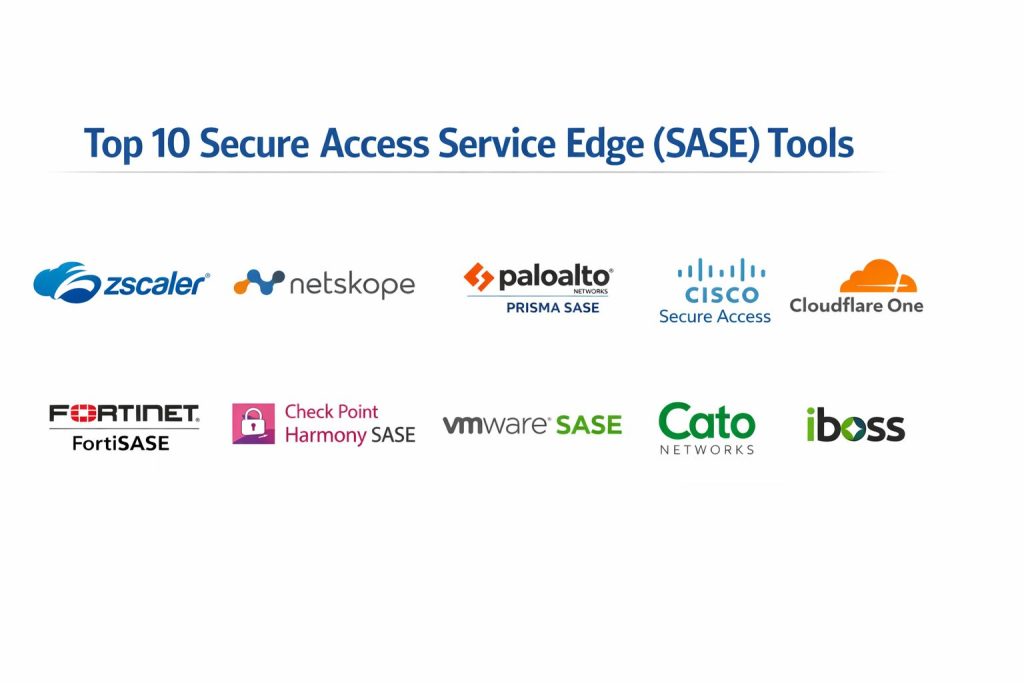
Top 10 SASE Platforms
1) Zscaler
A cloud-delivered secure access platform often chosen for large-scale internet and SaaS protection plus identity-based access to private applications. It is commonly evaluated when organizations want strong policy control, broad global reach, and a standardized security stack for distributed users.
Key Features
- Secure web access controls with centralized policy management
- Cloud app visibility and control for managed and unmanaged usage
- Identity-based private application access patterns that reduce VPN dependency
- Inline inspection and threat controls for outbound traffic (capability varies by plan)
- Centralized reporting and analytics for policy outcomes and user activity
- Options for traffic steering and integration with enterprise routing approaches
- Policy models designed for large-scale distributed deployments
Pros
- Strong fit for large distributed user bases needing consistent security policy
- Mature ecosystem and broad adoption in cloud-first security programs
Cons
- Architecture and rollout can be complex without solid traffic steering planning
- Licensing and packaging may feel complex for smaller teams
Platforms / Deployment
- Windows / macOS / Linux / iOS / Android (endpoint integration varies)
- Cloud
Security & Compliance
- SSO/SAML, MFA, encryption, audit logs, RBAC: Not publicly stated
- SOC 2, ISO 27001, GDPR, HIPAA: Not publicly stated
Integrations & Ecosystem
Zscaler is commonly integrated with identity providers, endpoint tools, SIEM platforms, and automation workflows so policy decisions can use user and device context.
- Identity providers and SSO integrations: Varies / N/A
- Endpoint posture and device context integrations: Varies / N/A
- SIEM and log pipelines: Varies / N/A
- API-based automation and policy workflows: Varies / N/A
- Browser and agent-based traffic steering options: Varies / N/A
Support & Community
Strong enterprise-focused support options depending on contract tier, large partner ecosystem, and significant practitioner community knowledge in large deployments.
2) Netskope
A SASE platform recognized for strong cloud app control and data-aware security approaches, often evaluated by teams prioritizing visibility into SaaS usage and consistent controls across web and cloud apps. It is frequently selected when organizations need fine-grained governance for modern cloud application behavior.
Key Features
- Cloud app visibility and granular policy controls for SaaS usage
- Data-aware controls that can help reduce risky data movement (capability varies by plan)
- Secure web access protections with centralized policy enforcement
- Private application access patterns based on identity and context
- Inline inspection options and threat controls (capability varies)
- Reporting designed for cloud app risk and usage understanding
- Policy frameworks that support distributed and hybrid environments
Pros
- Strong visibility and control for cloud app usage and governance
- Good fit for organizations focused on data protection and cloud workflows
Cons
- Requires careful policy design to avoid user friction in cloud apps
- Performance and traffic steering outcomes depend on deployment choices
Platforms / Deployment
- Windows / macOS / Linux / iOS / Android (endpoint integration varies)
- Cloud
Security & Compliance
- SSO/SAML, MFA, encryption, audit logs, RBAC: Not publicly stated
- SOC 2, ISO 27001, GDPR, HIPAA: Not publicly stated
Integrations & Ecosystem
Netskope is typically integrated with identity providers, endpoint controls, and logging pipelines to connect user identity and device context with cloud app governance.
- Identity and directory integrations: Varies / N/A
- Endpoint integrations for posture signals: Varies / N/A
- SIEM integrations and export formats: Varies / N/A
- API-based workflows for automation: Varies / N/A
- Cloud app catalogs and governance tooling: Varies / N/A
Support & Community
Strong documentation and enterprise onboarding options depending on contract, with a growing community of practitioners focused on cloud app governance.
3) Palo Alto Networks Prisma SASE
Overview: A platform approach that combines security controls with distributed connectivity options, typically evaluated by organizations that want a unified vendor strategy across network security and secure access. It is often considered when teams already use related security components and want tighter operational alignment.
Key Features
- Secure web access and policy-based internet protection
- Cloud app visibility and governance controls (capability varies)
- Identity-driven private application access to reduce VPN reliance
- Centralized management and analytics aligned to broader security operations
- Options for branch and remote connectivity patterns (capability varies by plan)
- Threat prevention features that align to a unified security posture (varies)
- Integration patterns for enterprise security toolchains
Pros
- Strong fit for organizations seeking consolidated security operations
- Broad security portfolio alignment can simplify tooling sprawl
Cons
- Packaging and architecture options can be confusing without a clear target design
- Some teams may face operational overhead during migration phases
Platforms / Deployment
- Windows / macOS / Linux / iOS / Android (endpoint integration varies)
- Cloud
Security & Compliance
- SSO/SAML, MFA, encryption, audit logs, RBAC: Not publicly stated
- SOC 2, ISO 27001, GDPR, HIPAA: Not publicly stated
Integrations & Ecosystem
Prisma SASE commonly integrates with identity systems, endpoint posture tools, and security analytics workflows, especially where teams want consistent policy across multiple security layers.
- Identity integrations: Varies / N/A
- Endpoint posture integrations: Varies / N/A
- SIEM and SOC workflows: Varies / N/A
- API and automation: Varies / N/A
- Partner ecosystem integrations: Varies / N/A
Support & Community
Enterprise support and partner ecosystem are typically robust; implementation experience depends on deployment design and internal expertise.
4) Cisco Secure Access
A secure access approach often evaluated by organizations that want to modernize web security and private access while aligning with Cisco networking ecosystems. It can be a strong fit when teams want integration with existing enterprise networking patterns and established vendor relationships.
Key Features
- Secure web access controls and policy management (capability varies)
- Cloud app visibility and governance controls (capability varies)
- Private access patterns based on identity and context
- Integration with broader network and security tooling ecosystems
- Centralized policy and reporting options for distributed use cases
- Support for enterprise traffic steering patterns and deployments
- Operational features for staged migration from legacy designs
Pros
- Familiar ecosystem for teams already invested in Cisco networking and security
- Broad enterprise reach with many integration pathways
Cons
- Some environments require careful design to avoid overlapping policy systems
- Feature depth may vary depending on selected components and licensing
Platforms / Deployment
- Windows / macOS / Linux / iOS / Android (endpoint integration varies)
- Cloud
Security & Compliance
- SSO/SAML, MFA, encryption, audit logs, RBAC: Not publicly stated
- SOC 2, ISO 27001, GDPR, HIPAA: Not publicly stated
Integrations & Ecosystem
Cisco Secure Access typically integrates with identity providers, endpoint security, and network tooling so policies can align across user and branch connectivity.
- Identity and directory: Varies / N/A
- Endpoint and posture signals: Varies / N/A
- SIEM export and logging: Varies / N/A
- Networking ecosystem integrations: Varies / N/A
- APIs and automation options: Varies / N/A
Support & Community
Large enterprise support footprint and partner network; admin experience is strongest when teams standardize on a clear reference design.
5) Cloudflare One
A cloud-based secure access suite built on a large global network presence, often chosen for organizations that want a simpler deployment path and strong performance for distributed traffic. It is commonly considered by teams that value speed, flexible rollouts, and broad internet-facing protections.
Key Features
- Secure web access controls with centralized policy enforcement
- Private access patterns that can replace or reduce traditional VPN usage
- Cloud app controls and visibility (capability varies)
- Network performance and routing optimization options (capability varies)
- Centralized logging and analytics for access decisions
- Integration options for identity and device posture (varies)
- Broad global presence that can help reduce latency
Pros
- Often straightforward to pilot and expand in phases
- Strong performance potential due to extensive network footprint
Cons
- Some advanced enterprise governance patterns may require deeper configuration
- Feature parity for niche use cases can vary by plan and environment
Platforms / Deployment
- Windows / macOS / Linux / iOS / Android (endpoint integration varies)
- Cloud
Security & Compliance
- SSO/SAML, MFA, encryption, audit logs, RBAC: Not publicly stated
- SOC 2, ISO 27001, GDPR, HIPAA: Not publicly stated
Integrations & Ecosystem
Cloudflare One commonly integrates with identity providers and device posture signals to support context-driven access, and it can fit into existing logging pipelines for investigations.
- Identity provider integrations: Varies / N/A
- Endpoint posture integrations: Varies / N/A
- SIEM and log export: Varies / N/A
- API-based automation: Varies / N/A
- Developer and network integrations: Varies / N/A
Support & Community
Strong documentation and a large community footprint; support experience depends on service tier and complexity of rollout.
6) Fortinet FortiSASE
A SASE offering often considered by organizations that already use Fortinet security and want a consistent approach across branch, remote access, and cloud security. It can be attractive when teams want integrated security operations and a familiar management style.
Key Features
- Secure web access protections and policy controls (capability varies)
- Cloud app visibility and control patterns (capability varies)
- Private access approach designed to reduce VPN reliance
- Centralized security management aligned to broader Fortinet ecosystems
- Options for branch and user connectivity alignment (varies)
- Threat controls that can align to a unified security posture (varies)
- Reporting and analytics for access and security outcomes
Pros
- Good fit for teams standardizing on Fortinet security platforms
- Can simplify operations when combined with existing Fortinet tools
Cons
- Best outcomes often require alignment across multiple Fortinet components
- Some advanced use cases may need careful architecture planning
Platforms / Deployment
- Windows / macOS / Linux / iOS / Android (endpoint integration varies)
- Cloud
Security & Compliance
- SSO/SAML, MFA, encryption, audit logs, RBAC: Not publicly stated
- SOC 2, ISO 27001, GDPR, HIPAA: Not publicly stated
Integrations & Ecosystem
FortiSASE typically integrates with identity systems and security operations tooling, especially when customers use broader Fortinet products for endpoint, network, and security management.
- Identity and directory integrations: Varies / N/A
- SIEM and logging integrations: Varies / N/A
- Endpoint and posture signals: Varies / N/A
- Automation and APIs: Varies / N/A
- Ecosystem integrations: Varies / N/A
Support & Community
Large enterprise presence with partner support; experience depends on tier and whether the deployment is standalone or part of a broader Fortinet ecosystem.
7) Check Point Harmony SASE
A SASE approach often evaluated by organizations that want strong security-centric policy controls and consistent protections for web, apps, and access. It can be a practical option for teams that prefer security-led design and centralized enforcement.
Key Features
- Secure web access policies for internet traffic control (capability varies)
- Cloud app governance and visibility options (capability varies)
- Identity-based private access patterns to protect internal apps
- Centralized security analytics and reporting
- Integration pathways into broader security operations workflows
- Threat prevention capabilities aligned with security-first posture (varies)
- Deployment options to support phased migration
Pros
- Security-first approach can fit teams led by security operations requirements
- Centralized policy design can reduce tool sprawl when standardized
Cons
- Best-fit depends on how well it aligns with existing network strategy
- Rollout complexity varies with identity integration and traffic steering choices
Platforms / Deployment
- Windows / macOS / Linux / iOS / Android (endpoint integration varies)
- Cloud
Security & Compliance
- SSO/SAML, MFA, encryption, audit logs, RBAC: Not publicly stated
- SOC 2, ISO 27001, GDPR, HIPAA: Not publicly stated
Integrations & Ecosystem
Harmony SASE commonly integrates with identity systems and logging pipelines so access decisions can be correlated with broader security events.
- Identity integrations: Varies / N/A
- Logging and SIEM export: Varies / N/A
- Endpoint posture integrations: Varies / N/A
- API automation options: Varies / N/A
- Security ecosystem integrations: Varies / N/A
Support & Community
Established enterprise support capabilities and partner network; community knowledge is strongest in security-centric deployments.
8) VMware SASE
A platform approach often associated with WAN modernization and secure access patterns, typically evaluated by organizations with distributed branches that want consistent connectivity plus integrated security controls. It can work well when teams focus on optimizing application performance for remote sites.
Key Features
- WAN optimization and application-aware routing patterns (capability varies)
- Secure access controls for distributed user and branch traffic (varies)
- Centralized management of connectivity policies and enforcement
- Private access options aligned to identity and context (varies)
- Visibility into application performance and path selection outcomes
- Integration options for enterprise identity and monitoring workflows
- Support for phased migration from legacy WAN models
Pros
- Strong fit for branch-heavy environments focused on WAN modernization
- Helpful application performance visibility for distributed connectivity
Cons
- Security breadth depends on chosen components and configuration
- Organizations not using VMware networking ecosystems may need more integration work
Platforms / Deployment
- Windows / macOS / Linux / iOS / Android (endpoint integration varies)
- Cloud
Security & Compliance
- SSO/SAML, MFA, encryption, audit logs, RBAC: Not publicly stated
- SOC 2, ISO 27001, GDPR, HIPAA: Not publicly stated
Integrations & Ecosystem
VMware SASE commonly integrates with identity providers and network monitoring approaches, especially in environments where application performance routing is a core requirement.
- Identity and directory: Varies / N/A
- Monitoring and logging: Varies / N/A
- Network tooling integrations: Varies / N/A
- API and automation: Varies / N/A
- Branch network ecosystem integrations: Varies / N/A
Support & Community
Enterprise support is available depending on contract; community strength is significant in WAN and branch networking-focused teams.
9) Cato Networks
A SASE-native approach often selected by organizations that want an integrated platform combining secure access and WAN connectivity in a single managed service style. It can be especially attractive for teams seeking simpler operations and faster global rollout without assembling many parts.
Key Features
- Unified secure web access and policy enforcement (capability varies)
- Built-in connectivity model for branches and remote users (varies)
- Private access patterns to internal apps without heavy VPN overhead
- Centralized policy and visibility for security and connectivity outcomes
- Global network presence designed for consistent routing and access
- Simplified operations model for smaller IT teams with many locations
- Reporting aimed at both security events and network experience
Pros
- Often simpler operational model for organizations with many sites
- Good fit for teams wanting one platform for security plus connectivity
Cons
- Advanced customization needs should be validated during pilot
- Fit depends on global coverage needs and specific routing requirements
Platforms / Deployment
- Windows / macOS / Linux / iOS / Android (endpoint integration varies)
- Cloud
Security & Compliance
- SSO/SAML, MFA, encryption, audit logs, RBAC: Not publicly stated
- SOC 2, ISO 27001, GDPR, HIPAA: Not publicly stated
Integrations & Ecosystem
Cato Networks typically integrates with identity systems and logging pipelines, and it is often deployed as a consolidated alternative to separate WAN plus security stacks.
- Identity integrations: Varies / N/A
- SIEM and logging export: Varies / N/A
- Endpoint posture signals: Varies / N/A
- API and automation: Varies / N/A
- Network migration tooling: Varies / N/A
Support & Community
Support experience is often tied to managed-style operations; community is growing, and onboarding can be efficient when the rollout model is standardized.
10) iboss
Overview: A cloud security-focused platform often evaluated for secure web access and cloud app control, with SASE-aligned capabilities depending on deployment scope. It can be a fit for organizations wanting cloud-delivered controls without heavy on-prem infrastructure.
Key Features
- Secure web access policy enforcement and web threat protections (varies)
- Cloud app visibility and governance controls (capability varies)
- Centralized policy configuration for distributed users
- Reporting and logging to support investigations and audits
- Options for integrating identity and device context (varies)
- Deployment models designed for remote and distributed use cases
- Controls aimed at reducing risky web and app behavior
Pros
- Cloud-delivered approach can reduce on-prem complexity
- Useful for organizations prioritizing web and cloud app controls
Cons
- Broader SASE networking features should be validated for your use case
- Ecosystem depth and rollout patterns vary by environment and plan
Platforms / Deployment
- Windows / macOS / iOS / Android (others: Varies / N/A)
- Cloud
Security & Compliance
- SSO/SAML, MFA, encryption, audit logs, RBAC: Not publicly stated
- SOC 2, ISO 27001, GDPR, HIPAA: Not publicly stated
Integrations & Ecosystem
iboss commonly integrates with identity systems and logging pipelines, and it may complement existing networking strategies depending on the scope of deployment.
- Identity provider integrations: Varies / N/A
- SIEM and log exports: Varies / N/A
- Endpoint context integrations: Varies / N/A
- API automation: Varies / N/A
- Ecosystem integrations: Varies / N/A
Support & Community
Support and onboarding experiences vary by plan; community footprint is smaller than the largest vendors, so formal support may matter more.
Comparison Table
| Tool Name | Best For | Platform(s) Supported | Deployment | Standout Feature | Public Rating |
|---|---|---|---|---|---|
| Zscaler | Large-scale secure access standardization | Windows, macOS, Linux, iOS, Android | Cloud | Strong policy-based secure access at scale | N/A |
| Netskope | Cloud app governance and visibility | Windows, macOS, Linux, iOS, Android | Cloud | Granular cloud app control | N/A |
| Palo Alto Networks Prisma SASE | Unified security operations alignment | Windows, macOS, Linux, iOS, Android | Cloud | Consolidated security-led platform approach | N/A |
| Cisco Secure Access | Enterprises aligning secure access with Cisco ecosystems | Windows, macOS, Linux, iOS, Android | Cloud | Broad enterprise integration pathways | N/A |
| Cloudflare One | Performance-focused cloud secure access | Windows, macOS, Linux, iOS, Android | Cloud | Global network footprint for low-latency access | N/A |
| Fortinet FortiSASE | Fortinet-standardized security and access | Windows, macOS, Linux, iOS, Android | Cloud | Alignment with broader Fortinet security stack | N/A |
| Check Point Harmony SASE | Security-first secure access design | Windows, macOS, Linux, iOS, Android | Cloud | Centralized security policy approach | N/A |
| VMware SASE | Branch-heavy WAN modernization with secure access | Windows, macOS, Linux, iOS, Android | Cloud | Application-aware routing plus access patterns | N/A |
| Cato Networks | All-in-one SASE-native consolidation | Windows, macOS, Linux, iOS, Android | Cloud | Unified connectivity plus security platform | N/A |
| iboss | Cloud-delivered web and app controls | Windows, macOS, iOS, Android | Cloud | Web and cloud app security focus | N/A |
Evaluation and Scoring
Weights: Core features 25%, Ease of use 15%, Integrations and ecosystem 15%, Security and compliance 10%, Performance and reliability 10%, Support and community 10%, Price and value 15%.
| Tool Name | Core (25%) | Ease (15%) | Integrations (15%) | Security (10%) | Performance (10%) | Support (10%) | Value (15%) | Weighted Total (0–10) |
|---|---|---|---|---|---|---|---|---|
| Zscaler | 9.5 | 7.8 | 9.0 | 9.0 | 8.8 | 8.5 | 7.5 | 8.65 |
| Netskope | 9.2 | 7.6 | 8.8 | 8.8 | 8.5 | 8.2 | 7.6 | 8.45 |
| Palo Alto Networks Prisma SASE | 9.0 | 7.4 | 9.2 | 8.6 | 8.6 | 8.3 | 7.2 | 8.37 |
| Cisco Secure Access | 8.6 | 7.3 | 8.8 | 8.2 | 8.2 | 8.4 | 7.4 | 8.16 |
| Cloudflare One | 8.4 | 8.1 | 8.4 | 8.0 | 8.7 | 8.0 | 8.3 | 8.29 |
| Fortinet FortiSASE | 8.5 | 7.2 | 8.6 | 8.1 | 8.3 | 8.1 | 8.0 | 8.14 |
| Check Point Harmony SASE | 8.2 | 7.4 | 8.2 | 8.4 | 8.0 | 8.0 | 7.8 | 8.00 |
| VMware SASE | 8.1 | 7.1 | 8.3 | 7.8 | 8.0 | 7.8 | 7.6 | 7.83 |
| Cato Networks | 8.7 | 8.2 | 8.1 | 8.3 | 8.4 | 8.1 | 8.4 | 8.36 |
| iboss | 7.9 | 7.6 | 7.8 | 8.2 | 7.8 | 7.6 | 7.9 | 7.83 |
How to interpret the scores:
These scores are a comparative guide within this specific list, not a universal ranking. A higher total suggests broader strength across many buying criteria, but it may not match your priorities. Ease and value can matter more than depth for smaller teams moving quickly. Security and compliance scoring is constrained because many vendor details are not publicly stated in a consistent way. Always validate with a pilot using your real identity provider, endpoints, applications, and traffic patterns.
Which SASE Platform Is Right for You?
Solo or Freelancer
Most solo operators do not need a full SASE platform unless they manage multiple clients, multiple devices, and strict access controls. If you do need it, prioritize simple rollout, clear policy design, and predictable cost. A practical approach is to choose a platform that pilots quickly, supports identity-based access, and offers clear reporting so you can prove value without heavy operations overhead.
SMB
SMBs should focus on fast deployment, simplified management, and an easy path away from legacy VPN and ad-hoc web filtering. Cato Networks and Cloudflare One are often considered when teams want speed and consolidation, while Fortinet FortiSASE can fit well if the SMB already uses Fortinet security elsewhere. The key is to avoid over-engineering: start with secure web access and private app access for a small group, then expand.
Mid-Market
Mid-market teams usually have enough complexity to benefit from stronger governance and integrations. Netskope can be attractive when SaaS governance and data controls are the main driver, while Zscaler can fit well for organizations standardizing secure access at scale. Cisco Secure Access and Palo Alto Networks Prisma SASE can be strong options when integration into existing enterprise ecosystems is a top priority. Prioritize operational clarity, logging, and a realistic migration sequence.
Enterprise
Enterprises should emphasize global performance, policy consistency, strong identity integration, and scalable operations. Zscaler, Netskope, Palo Alto Networks Prisma SASE, and Cisco Secure Access are commonly evaluated in enterprise programs because they can align with broader security operations and large-scale rollouts. Enterprises should also plan for change management, phased migration, governance, and how to measure experience across regions.
Budget vs Premium
Budget-focused teams should prioritize consolidation, predictable licensing, and low operational burden. Premium-focused teams often prioritize deep controls, large ecosystem integrations, and global performance footprints. Your best choice depends on whether your primary pain is security risk, network performance, tool sprawl, or operational load.
Feature Depth vs Ease of Use
If you need deep policy controls and advanced governance, expect more setup and ongoing tuning. If you need simplicity, choose a platform that is easy to pilot and run day to day, even if it has fewer advanced knobs. The best approach is to decide upfront which controls are must-have and which are optional.
Integrations and Scalability
If your organization relies on a mature identity provider, endpoint posture signals, and centralized logging, choose a platform that cleanly integrates with these systems. Scalability is not only user count; it is also how well policy, reporting, and operations work across regions and business units.
Security and Compliance Needs
If you have strict compliance requirements, do not assume capabilities. Validate identity flows, audit logs, encryption, and admin access controls during your pilot. When certifications are not publicly stated, treat them as unknown and confirm through procurement and security review.
Frequently Asked Questions
1. What problem does SASE solve compared to a traditional VPN and firewall approach?
SASE reduces dependence on backhauling traffic to a central site by applying security controls closer to users and applications. It also shifts access decisions toward identity and context rather than network location alone.
2. Do I need to replace my existing firewall to adopt SASE?
Not always. Many organizations adopt SASE in phases, starting with remote users and SaaS security, then extending to branches. Your transition plan depends on current architecture and risk tolerance.
3. How long does a typical rollout take?
Timelines vary widely based on number of users, branch locations, identity readiness, and policy complexity. A phased pilot approach usually reduces risk and makes rollout smoother.
4. What should I test in a pilot before committing?
Test identity integration, device posture signals, private app access behavior, SaaS controls, logging quality, and user experience across multiple locations. Also test failover behavior and policy change workflows.
5. Will SASE slow down my users?
It can improve or degrade performance depending on global presence, routing design, and traffic steering. Always measure latency and application experience during a pilot using real user locations.
6. How does SASE relate to zero trust?
SASE often implements zero trust principles by enforcing identity-based access, continuous policy checks, and least-privilege access to private apps. The exact maturity depends on configuration and integrations.
7. What are the most common mistakes in SASE projects?
Rushing into a full rollout without a pilot, copying legacy VPN rules into modern policy models, and ignoring user experience monitoring. Another common issue is unclear ownership between networking and security teams.
8. Can SASE help with shadow IT and risky SaaS usage?
Yes, many platforms provide cloud app discovery and governance controls. The depth of visibility and control varies, so validate it with your most-used apps during evaluation.
9. How do I compare platforms if security certifications are not clearly listed?
Treat unknown items as “Not publicly stated” and validate practical controls instead: SSO, MFA, RBAC, audit logs, encryption, and operational workflows. Use procurement processes to confirm formal attestations.
10. What is the safest way to migrate from legacy VPN to SASE private access?
Start with a small set of low-risk applications and a limited user group, validate access policies and logging, then expand gradually. Keep rollback options and document clear cutover criteria before scaling.
Conclusion
SASE platforms can simplify modern security and connectivity by bringing policy enforcement closer to users, improving consistency across web, cloud apps, and private applications. The right choice depends on your environment, not on a single “best” vendor. If you need large-scale standardization and mature enterprise patterns, Zscaler and Netskope are often evaluated. If you want consolidation across security ecosystems, Palo Alto Networks Prisma SASE, Cisco Secure Access, Fortinet FortiSASE, and Check Point Harmony SASE can align well. If you want fast rollout and simplified operations, Cloudflare One and Cato Networks can be attractive. Shortlist two or three platforms, pilot with real users and apps, validate integrations and logs, then scale in phases.