Introduction
SD-WAN management platforms are the control layer that helps you design, deploy, monitor, and troubleshoot SD-WAN networks across branches, data centers, cloud edges, and remote users. In plain terms, they turn many distributed network devices into one manageable system, with central policies, visibility, and faster change control. This matters because modern WANs must handle mixed connectivity, application performance expectations, security controls, and frequent site changes without constant manual work.
Common use cases include rolling out new branches quickly, enforcing application-aware routing, monitoring user experience per app, standardizing security policies across sites, integrating WAN with cloud connectivity, and reducing downtime with faster diagnostics. When evaluating a platform, focus on policy depth, monitoring and analytics quality, ease of deployment at scale, integration with security and cloud, role-based access controls, automation APIs, operational workflow fit, reliability during outages, and the real cost of ownership across licenses, support, and operational effort.
Best for: network teams, IT operations, managed service providers, and security teams managing multiple sites and multiple links.
Not ideal for: very small environments with only one or two locations, or teams that only need basic routing changes without centralized policy and analytics.
Key Trends in SD-WAN Management Platforms
- More focus on application experience monitoring, not just link uptime
- Faster policy rollout with templates, intent-based rules, and automation workflows
- Deeper SASE alignment where SD-WAN and security policies are managed together
- Growing use of analytics for anomaly detection and faster root-cause isolation
- Standardized integration patterns with identity, endpoint, and security tooling
- Higher expectations for multi-tenant operations for service providers
- Greater emphasis on API-first operations and infrastructure-as-code style changes
- More reliance on cloud-delivered controllers, with hybrid options still common
How We Selected These Platforms (Methodology)
- Chosen for credibility and real-world adoption across enterprise and service-provider environments
- Included a mix of traditional enterprise SD-WAN controllers and cloud-delivered management approaches
- Evaluated policy depth, operational workflows, and visibility into application performance
- Considered ecosystem fit, integrations, and extensibility for automation and reporting
- Balanced platforms suited for branch scale with platforms better for cloud and remote-first models
- Prioritized platforms that reduce operational effort, not only provide features
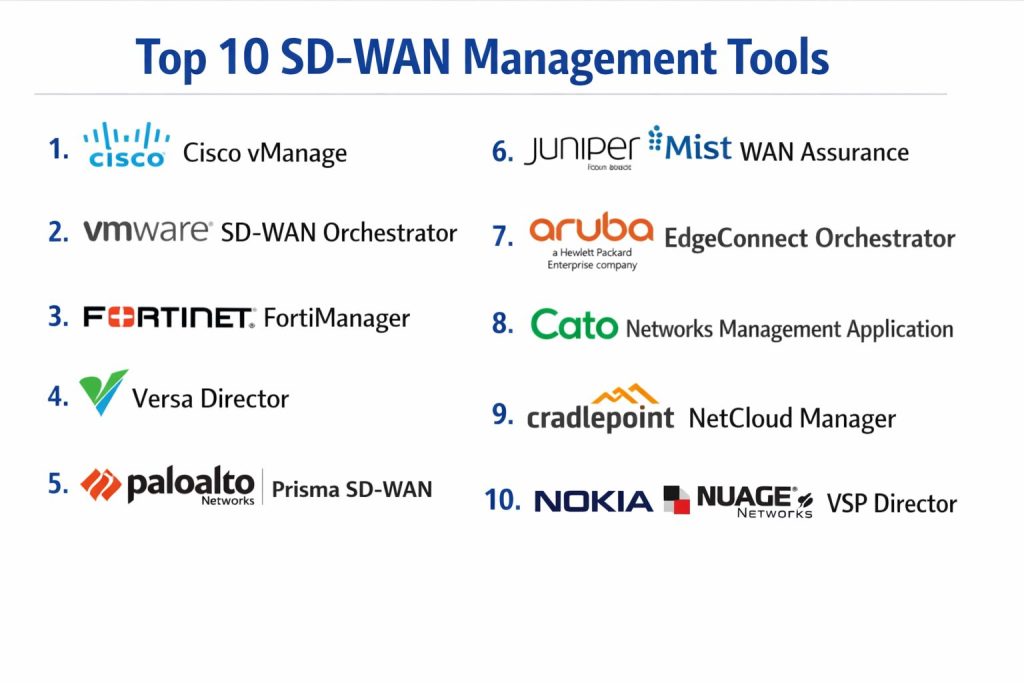
Top 10 SD-WAN Management Platforms
1 — Cisco vManage
Central management for SD-WAN policy, configuration, monitoring, and troubleshooting across large distributed networks, commonly used in enterprise WAN standardization.
Key Features
- Centralized policy and template-based configuration
- Application-aware routing and policy controls
- Monitoring dashboards and operational visibility
- Workflow support for change control and rollout
- Troubleshooting tools for site and tunnel health
Pros
- Strong fit for large-scale enterprise WAN operations
- Mature policy model for consistent standards
Cons
- Complexity can rise with advanced deployments
- Operational discipline is needed for clean lifecycle management
Platforms / Deployment
Web, Cloud / Self-hosted / Hybrid, Varies / N/A
Security and Compliance
Not publicly stated
Integrations and Ecosystem
Often used in environments where network workflows, identity, and security tooling must align.
- APIs and automation patterns, Varies / N/A
- Integration with logging and monitoring tools, Varies / N/A
- Ecosystem depth depends on deployment choices
Support and Community
Strong enterprise support availability, community strength varies by deployment and partner ecosystem.
2 — VMware SD-WAN Orchestrator
A centralized SD-WAN management layer designed for branch connectivity, application performance policies, and operational visibility across many sites.
Key Features
- Centralized configuration and policy templates
- Application performance monitoring and analytics
- Link steering and path optimization controls
- Operational dashboards for site health
- Workflow support for rollouts and maintenance
Pros
- Strong operational experience for distributed branch WANs
- Good balance of usability and policy depth
Cons
- Full value depends on consistent edge standards
- Some advanced needs may require additional ecosystem components
Platforms / Deployment
Web, Cloud / Self-hosted / Hybrid, Varies / N/A
Security and Compliance
Not publicly stated
Integrations and Ecosystem
Commonly aligned with enterprise operational tooling and network workflows.
- API-based integration options, Varies / N/A
- Logging and monitoring integration patterns, Varies / N/A
- Ecosystem fit depends on target architecture
Support and Community
Enterprise support options vary, community is strong in SD-WAN-focused environments.
3 — Fortinet FortiManager
Centralized management used to orchestrate policies and configuration for Fortinet environments, including SD-WAN policy workflows when Fortinet SD-WAN is part of the design.
Key Features
- Central policy and configuration management
- Unified workflow patterns for network and security changes
- Central monitoring and reporting options
- Role-based admin workflows for larger teams
- Consistent template-based deployment support
Pros
- Strong when SD-WAN and security operations must be unified
- Efficient for teams standardizing Fortinet-based deployments
Cons
- Best fit when Fortinet components are core to the network
- Some capabilities depend on overall Fortinet architecture choices
Platforms / Deployment
Web, Cloud / Self-hosted / Hybrid, Varies / N/A
Security and Compliance
Not publicly stated
Integrations and Ecosystem
Often used where centralized governance and reporting are required.
- Integration with logging and analytics tools, Varies / N/A
- Automation via APIs and workflow tooling, Varies / N/A
- Ecosystem alignment depends on broader platform usage
Support and Community
Strong enterprise adoption, support tiers vary, community availability is generally solid.
4 — Versa Director
A centralized controller and management platform designed for SD-WAN operations, policy management, and service-provider-style multi-site control.
Key Features
- Centralized policy management for SD-WAN
- Multi-tenant and segmentation-friendly workflows
- Monitoring and operational visibility for sites
- Template-driven site rollout and lifecycle controls
- Support for complex enterprise routing scenarios
Pros
- Strong for segmented enterprise WAN designs
- Useful for provider-style operations and scale
Cons
- Operational complexity can be higher for smaller teams
- Best results require disciplined templates and standards
Platforms / Deployment
Web, Cloud / Self-hosted / Hybrid, Varies / N/A
Security and Compliance
Not publicly stated
Integrations and Ecosystem
Often paired with enterprise operational tooling and provider workflows.
- APIs and automation patterns, Varies / N/A
- Monitoring and logging integration, Varies / N/A
- Ecosystem fit depends on service design
Support and Community
Support model varies by contract and partner, community is more specialized than broader enterprise vendors.
5 — Palo Alto Networks Prisma SD-WAN
An SD-WAN management approach that emphasizes application performance and policy control, often considered when security alignment and modern WAN design are priorities.
Key Features
- Centralized SD-WAN policy workflows
- Application-aware routing and performance focus
- Monitoring views designed around application experience
- Templates for consistent site rollouts
- Operational tools for troubleshooting and visibility
Pros
- Strong for app-driven WAN operations
- Good fit where security alignment is a priority
Cons
- Best value depends on broader architecture choices
- Some integrations may require validation per environment
Platforms / Deployment
Web, Cloud / Self-hosted / Hybrid, Varies / N/A
Security and Compliance
Not publicly stated
Integrations and Ecosystem
Often considered in environments that want tight alignment across WAN and security operations.
- Logging and monitoring integration patterns, Varies / N/A
- API and automation options, Varies / N/A
- Ecosystem fit depends on security architecture
Support and Community
Enterprise support options vary, community strength depends on regional adoption.
6 — Juniper Mist WAN Assurance
A management and assurance layer that focuses on operational visibility, telemetry, and experience-driven insights, often used to improve troubleshooting speed and operational clarity.
Key Features
- Experience and telemetry-focused monitoring
- Insights to speed up issue isolation and triage
- Operational dashboards for distributed sites
- Workflow support for ongoing optimization
- Reporting to support operational accountability
Pros
- Strong for operational visibility and troubleshooting workflows
- Useful when experience metrics matter to stakeholders
Cons
- Best results depend on consistent telemetry coverage
- Some environments may need additional WAN control layers
Platforms / Deployment
Web, Cloud / Hybrid, Varies / N/A
Security and Compliance
Not publicly stated
Integrations and Ecosystem
Commonly paired with IT operations workflows and monitoring ecosystems.
- Integration with incident workflows, Varies / N/A
- Telemetry and analytics integrations, Varies / N/A
- Automation options depend on environment
Support and Community
Support tiers vary, documentation quality is generally strong, community presence varies by region.
7 — HPE Aruba EdgeConnect Orchestrator
A centralized orchestration and management layer for EdgeConnect-style SD-WAN deployments, focused on policy control and operational management at branch scale.
Key Features
- Centralized orchestration and policy configuration
- Application-aware routing controls
- Monitoring dashboards and site visibility
- Templates for standardized branch rollout
- Operational tooling for troubleshooting workflows
Pros
- Strong for branch-heavy deployments needing consistency
- Good fit for standardizing application policies across sites
Cons
- Full value depends on edge standardization and rollout discipline
- Some integrations may require environment-specific validation
Platforms / Deployment
Web, Cloud / Self-hosted / Hybrid, Varies / N/A
Security and Compliance
Not publicly stated
Integrations and Ecosystem
Often used in enterprise WAN operations where visibility and consistency matter.
- Integration with monitoring and logging tools, Varies / N/A
- API-driven automation options, Varies / N/A
- Ecosystem depends on broader network stack
Support and Community
Enterprise support availability varies, partner ecosystems can be important for onboarding and rollout.
8 — Cato Networks Management Application
A cloud-delivered management experience designed to run policy, visibility, and operations from a single console, often appealing to teams that want simplicity and centralized control.
Key Features
- Central policy management in a cloud console
- Unified visibility across sites and users
- Simplified rollout patterns for distributed environments
- Monitoring designed for operational speed
- Workflow support for ongoing network changes
Pros
- Simple operational model for distributed networks
- Strong fit for teams preferring cloud-delivered management
Cons
- Less control over underlying components by design
- Architecture fit should be validated for specialized routing needs
Platforms / Deployment
Web, Cloud
Security and Compliance
Not publicly stated
Integrations and Ecosystem
Typically integrates into IT operations tooling through standard logging and workflow patterns.
- Operational reporting integrations, Varies / N/A
- API options and extensibility, Varies / N/A
- Ecosystem fit depends on operational model
Support and Community
Support tiers vary, user community is growing, documentation quality varies by use case.
9 — Cradlepoint NetCloud Manager
A centralized management layer commonly used for remote connectivity operations, especially where cellular connectivity and rapid deployment for distributed endpoints matter.
Key Features
- Centralized management for distributed connectivity
- Visibility into link performance and device health
- Policy patterns for remote and mobile sites
- Monitoring and alerting for field operations
- Tools that support large-scale device lifecycle workflows
Pros
- Strong for connectivity operations in distributed or mobile environments
- Useful where cellular-first connectivity is common
Cons
- Not a universal fit for all enterprise WAN designs
- Some advanced SD-WAN needs may require additional components
Platforms / Deployment
Web, Cloud
Security and Compliance
Not publicly stated
Integrations and Ecosystem
Often used with IT operations and field-service monitoring workflows.
- Integrations for alerts and ticketing, Varies / N/A
- Reporting and telemetry options, Varies / N/A
- Ecosystem depends on connectivity model
Support and Community
Support model varies by contract, community is more niche than broad enterprise SD-WAN platforms.
10 — Nokia Nuage Networks VSP Director
A centralized SD-WAN and network management platform commonly associated with large-scale network designs and segmentation needs, often used in complex enterprise or provider environments.
Key Features
- Centralized policy and segmentation controls
- Multi-site operations and lifecycle management
- Monitoring views for operational oversight
- Template-driven workflows for scale
- Support for structured network governance patterns
Pros
- Useful for complex segmentation and governance needs
- Strong when scale and policy structure are central requirements
Cons
- Can be complex for small teams
- Best results require disciplined operational standards
Platforms / Deployment
Web, Cloud / Self-hosted / Hybrid, Varies / N/A
Security and Compliance
Not publicly stated
Integrations and Ecosystem
Often paired with provider-style workflows and structured network governance tooling.
- APIs and automation patterns, Varies / N/A
- Monitoring and logging integration patterns, Varies / N/A
- Ecosystem depends on deployment model
Support and Community
Support tiers vary, community is more specialized, documentation quality varies by deployment.
Comparison Table
| Tool Name | Best For | Platform(s) Supported | Deployment | Standout Feature | Public Rating |
|---|---|---|---|---|---|
| Cisco vManage | Large enterprise SD-WAN standardization | Web, Varies / N/A | Cloud / Self-hosted / Hybrid, Varies / N/A | Policy depth at scale | N/A |
| VMware SD-WAN Orchestrator | Branch SD-WAN operations | Web, Varies / N/A | Cloud / Self-hosted / Hybrid, Varies / N/A | Operational visibility for many sites | N/A |
| Fortinet FortiManager | Unified SD-WAN and security governance | Web, Varies / N/A | Cloud / Self-hosted / Hybrid, Varies / N/A | Central governance workflows | N/A |
| Versa Director | Segmented WAN designs and multi-site control | Web, Varies / N/A | Cloud / Self-hosted / Hybrid, Varies / N/A | Multi-tenant style operations | N/A |
| Palo Alto Networks Prisma SD-WAN | App-focused SD-WAN policy operations | Web, Varies / N/A | Cloud / Self-hosted / Hybrid, Varies / N/A | Application experience focus | N/A |
| Juniper Mist WAN Assurance | Telemetry-driven WAN assurance | Web, Varies / N/A | Cloud / Hybrid, Varies / N/A | Experience-oriented insights | N/A |
| HPE Aruba EdgeConnect Orchestrator | Branch-heavy SD-WAN orchestration | Web, Varies / N/A | Cloud / Self-hosted / Hybrid, Varies / N/A | Orchestration at branch scale | N/A |
| Cato Networks Management Application | Cloud-delivered centralized operations | Web | Cloud | Single-console operations | N/A |
| Cradlepoint NetCloud Manager | Remote and cellular-centric connectivity ops | Web | Cloud | Fleet-style lifecycle management | N/A |
| Nokia Nuage Networks VSP Director | Structured policy governance at scale | Web, Varies / N/A | Cloud / Self-hosted / Hybrid, Varies / N/A | Segmentation and governance | N/A |
Evaluation and Scoring of SD-WAN Management Platforms
Weights
Core features 25 percent
Ease of use 15 percent
Integrations and ecosystem 15 percent
Security and compliance 10 percent
Performance and reliability 10 percent
Support and community 10 percent
Price and value 15 percent
| Tool Name | Core | Ease | Integrations | Security | Performance | Support | Value | Weighted Total |
|---|---|---|---|---|---|---|---|---|
| Cisco vManage | 9.2 | 7.2 | 9.0 | 8.2 | 8.8 | 8.2 | 7.0 | 8.30 |
| VMware SD-WAN Orchestrator | 8.8 | 8.0 | 8.5 | 7.8 | 8.5 | 8.0 | 7.2 | 8.19 |
| Fortinet FortiManager | 8.5 | 7.5 | 8.0 | 8.5 | 8.0 | 7.8 | 8.0 | 8.08 |
| Versa Director | 8.7 | 7.0 | 8.6 | 8.0 | 8.2 | 7.5 | 7.2 | 7.96 |
| Palo Alto Networks Prisma SD-WAN | 8.6 | 7.4 | 8.4 | 8.2 | 8.2 | 7.8 | 7.0 | 7.99 |
| Juniper Mist WAN Assurance | 8.0 | 8.2 | 8.0 | 7.6 | 8.0 | 7.6 | 7.2 | 7.83 |
| HPE Aruba EdgeConnect Orchestrator | 8.6 | 7.6 | 8.2 | 7.8 | 8.4 | 7.8 | 7.0 | 7.97 |
| Cato Networks Management Application | 8.2 | 8.4 | 7.8 | 8.0 | 8.2 | 7.8 | 7.6 | 8.02 |
| Cradlepoint NetCloud Manager | 7.8 | 8.0 | 7.6 | 7.6 | 7.8 | 7.6 | 7.8 | 7.76 |
| Nokia Nuage Networks VSP Director | 8.0 | 6.8 | 7.8 | 7.8 | 8.0 | 7.0 | 7.0 | 7.52 |
How to interpret the scores
These scores are comparative and meant for shortlisting, not declaring a universal winner. A slightly lower total can still be the best choice if it matches your operational model and deployment constraints. Core features and integrations typically affect long-term fit, while ease affects rollout speed and adoption. Security and performance should be validated in your environment because public details can be limited. Use the table to shortlist, then pilot with real sites and real traffic patterns.
Which SD-WAN Management Platform Is Right for You
Solo or Small IT Team
If you prefer a simplified operations model and want fewer moving parts, cloud-managed options like Cato Networks Management Application or Cradlepoint NetCloud Manager can reduce operational overhead. If you already have a defined vendor edge stack, choose the matching controller to avoid integration friction.
SMB
SMB teams usually win by picking a platform that is easy to operate and supports consistent templates. VMware SD-WAN Orchestrator and HPE Aruba EdgeConnect Orchestrator often fit teams that want structured rollouts without overbuilding the architecture. If security and network governance are tightly linked, Fortinet FortiManager can be attractive.
Mid-Market
Mid-market environments benefit from stronger segmentation, repeatable templates, and better observability. Cisco vManage or Versa Director can work well when you need policy depth across many sites. Juniper Mist WAN Assurance can add operational clarity if troubleshooting speed and experience visibility are major pain points.
Enterprise
Enterprises often prioritize standardization, governance, role separation, and large-scale lifecycle control. Cisco vManage is commonly associated with large policy-driven WAN operations. Versa Director and Nokia Nuage Networks VSP Director can fit structured segmentation and governance needs. Prisma SD-WAN may fit teams that want application experience emphasis with security-aligned operations, depending on architecture.
Budget vs Premium
Budget decisions should include operational effort, not only licensing. A platform that reduces outages and troubleshooting time can be cheaper overall even if licensing looks higher. If budget is tight, standardize on one vendor stack and minimize integration complexity. If budget allows, prioritize observability, automation, and governance.
Feature Depth vs Ease of Use
Feature depth helps when your WAN design is complex, segmented, and rapidly changing, but it can increase operational complexity. Ease of use helps smaller teams move faster and reduce mistakes. Use the pilot to measure how quickly engineers can deploy a new site and recover from a simulated outage.
Integrations and Scalability
If you need many integrations, focus on API maturity, logging export, and compatibility with your incident workflows. For scale, measure template reuse, multi-tenant controls if needed, and how well the platform handles large numbers of sites without performance issues.
Security and Compliance Needs
Because public compliance details can be limited, treat “Not publicly stated” as a prompt to verify. Validate role-based access controls, audit logs, MFA support, encryption expectations, and how admin actions are tracked. Also assess the security of the surrounding operational stack, including identity, device onboarding, and configuration approval workflows.
Frequently Asked Questions
1. What is an SD-WAN management platform in simple terms
It is the central console that controls SD-WAN devices and policies across all sites. It helps you push changes, monitor health, and troubleshoot issues without logging into each device.
2. Do I need cloud-managed or self-hosted management
Cloud-managed is often easier to operate and scale, while self-hosted can fit strict control requirements. The best choice depends on your governance model and operational constraints.
3. What should I test in a pilot before selecting a platform
Test site onboarding speed, policy rollout accuracy, application visibility, and outage recovery. Also test how easy it is for new engineers to follow the operational workflow.
4. How important is application experience monitoring
Very important for business outcomes because users care about app performance, not tunnel health. A platform that shows app-level degradation can reduce downtime and finger-pointing.
5. Can one platform manage mixed vendor SD-WAN edges
Sometimes, but capabilities vary and may be limited. Many teams standardize on one SD-WAN edge family to keep policy and troubleshooting consistent.
6. What are common mistakes teams make during rollout
Common mistakes include inconsistent templates, poor naming standards, skipping change approvals, and not defining escalation workflows. Another mistake is ignoring telemetry and logs until an outage happens.
7. How do integrations affect long-term success
Integrations with identity, ticketing, monitoring, and logging reduce manual work and speed up incident response. Without them, teams often rely on tribal knowledge and slow troubleshooting.
8. What security controls should I validate
Validate role-based access, audit logs, admin change tracking, MFA expectations, and how secrets and device onboarding keys are handled. If details are not publicly stated, verify through vendor documentation and trials.
9. How do I plan for growth in sites and traffic
Measure controller performance, template reuse, segmentation design, and operational workflow load. Also assess whether your team can manage growth without adding too many manual steps.
10. What is the simplest way to shortlist tools
Shortlist two or three platforms that match your edge vendor strategy and operational model. Then run a pilot using real sites, real apps, and realistic failure scenarios to confirm fit.
Conclusion
The right SD-WAN management platform depends on how your organization operates, how many sites you manage, and how tightly you want WAN control aligned with security and cloud connectivity. Some platforms shine in large, policy-driven enterprise standardization, while others win by simplifying operations through cloud-delivered management and faster onboarding. Start by mapping your needs across three areas: policy depth, operational visibility, and integration with your incident and security workflows. Then shortlist two or three options, run a controlled pilot with real traffic, validate troubleshooting speed and change control, and confirm that roles, auditing, and access controls match your governance expectations. This approach avoids costly rework and delivers a platform your team can run confidently.