Introduction
Sanctions screening tools are the primary defensive layer for financial institutions and global corporations against money laundering, terrorist financing, and regulatory violations. These platforms automate the process of checking customers, vendors, and transactions against global watchlists maintained by governments and international bodies like OFAC, the UN, and the EU. By utilizing advanced fuzzy matching and natural language processing, these tools ensure that businesses do not inadvertently engage with sanctioned individuals or entities, which could lead to massive fines and reputational ruin.
In the current regulatory environment, “checking the box” is no longer sufficient; regulators demand high-fidelity, real-time screening that minimizes both false negatives and the operational burden of false positives. Modern platforms integrate directly into payment rails and CRM systems, providing instantaneous “pass/fail” results during the onboarding or transaction process. As global sanctions lists become more dynamic and complex, these tools have evolved into essential compliance engines that allow organizations to scale safely across international borders while maintaining a zero-tolerance posture for financial crime.
Real-World Use Cases
- Customer Onboarding (KYC): Financial institutions use these tools during the initial account opening process to ensure that a new client does not appear on any global PEP (Politically Exposed Person) or sanctions list before the relationship begins.
- Real-Time Transaction Monitoring: Payment processors integrate screening engines into their transaction flow to scan sender and receiver details instantly, pausing any suspicious transfer for manual review before the funds are moved.
- Third-Party Risk Management: Global manufacturers screen their entire supply chain, including vendors and sub-contractors, to ensure they are not indirectly funding sanctioned regimes through their procurement processes.
- Mergers and Acquisitions Due Diligence: During M&A activities, firms screen the target company’s entire client and employee database to identify any hidden regulatory risks that could jeopardize the deal or bring liability to the buyer.
- Continuous Monitoring: Compliance teams set up automated re-screening of their entire database whenever a government update is released, ensuring that an existing customer hasn’t been added to a restricted list overnight.
Buyer Evaluation Criteria
- Fuzzy Matching Sophistication: Does the tool utilize advanced algorithms to catch intentional misspellings, phonetic similarities, and name inversions (e.g., “Jon Smith” vs. “John Smyth”)?
- Watchlist Coverage and Update Frequency: Evaluate if the platform provides real-time updates from all major global lists (OFAC, UN, EU, HMT) and if it includes niche or regional lists relevant to your specific market.
- False Positive Reduction: Look for tools that use AI and secondary data points (like date of birth or nationality) to automatically clear false matches, reducing the manual workload for compliance officers.
- Scalability and API Performance: Ensure the tool can handle your transaction volume with millisecond latency, especially if you are integrating it into a high-speed digital payment or checkout environment.
- Configurability and Risk Scoring: Can the tool be customized to your specific risk appetite, allowing you to set different thresholds for different jurisdictions, products, or customer types?
- Case Management and Audit Trail: The platform must provide a robust system for documenting why a match was cleared or escalated, providing a defensible audit trail for future regulatory examinations.
- Adverse Media Integration: Determine if the tool only checks official lists or if it also scans global news and social media for negative sentiment that might indicate a high-risk profile.
- Ease of Integration: Prioritize tools with well-documented REST APIs and pre-built connectors for major banking cores, CRMs like Salesforce, and ERP systems like SAP.
- Global Language and Script Support: If you operate internationally, the tool must be able to screen names in non-Latin scripts, such as Arabic, Cyrillic, and Chinese characters, without losing accuracy.
- Total Cost of Ownership: Consider the license fee relative to the “hidden costs,” such as the number of compliance staff required to manage the alerts generated by the system.
Best for: Banks, fintechs, insurance companies, and global trade entities that require automated, high-volume screening to meet stringent AML (Anti-Money Laundering) and KYC (Know Your Customer) regulations.
Not ideal for: Small local businesses with no international transactions or high-risk clients where manual, occasional checks on public government websites may suffice.
Key Trends in Sanctions Screening Tools
- AI-Powered “Entity Resolution”: Platforms are moving beyond simple name matching to “Entity Resolution,” which uses multiple data points to determine if a “John Doe” is the same sanctioned person regardless of variations in data.
- Explainable AI (XAI) for Compliance: Regulators now require AI-driven decisions to be “explainable,” leading to tools that provide clear, human-readable logic for why an alert was generated or suppressed.
- Real-Time Perpetual KYC: The industry is shifting from periodic “refreshers” to “Perpetual KYC,” where customers are continuously screened against updated lists in the background without manual intervention.
- Graph Technology for Hidden Links: Advanced tools use graph databases to uncover complex ownership structures, identifying entities that are not themselves sanctioned but are 50% or more owned by a sanctioned individual.
- Behavioral and Contextual Screening: Tools are beginning to factor in the context of a transaction, such as the unusual speed of a transfer or the involvement of specific high-risk corridors, rather than just name-matching.
- Regulatory Sandbox Integration: Vendors are increasingly building “sandbox” environments that allow compliance teams to test new matching rules and thresholds against historical data before going live.
- Global Script Transliteration: Improved neural networks now allow for near-perfect transliteration of names from non-Latin scripts, drastically reducing the “noise” created by variations in translation.
- Consolidation of AML Suites: There is a strong trend toward “All-in-One” financial crime platforms that combine sanctions screening, transaction monitoring, and fraud detection into a single unified dashboard.
How We Selected These Tools (Methodology)
Our selection of the top 10 sanctions screening tools involved an objective assessment of technological maturity, global list coverage, and market reputation. We prioritized platforms that have successfully adapted to the rapid-fire updates characteristic of modern geopolitical shifts and those that offer the highest level of automation.
- Matching Accuracy and Efficiency: We evaluated the sophistication of the fuzzy matching engines, specifically looking for those that demonstrate the lowest industry rates of false positives while maintaining zero false negatives.
- List Breadth and Real-Time Updates: We selected tools that offer comprehensive coverage of international and regional watchlists with a proven track record of updating within minutes of a government release.
- API and Enterprise Readiness: Tools were scored on the robustness of their documentation, their ability to handle high-volume throughput, and their ease of integration into complex financial ecosystems.
- Case Management Functionality: We prioritized tools that provide a superior user experience for compliance analysts, including clear data visualization and automated report generation for regulators.
- Regulatory Acceptance: Our list includes vendors that are widely used by Tier-1 financial institutions and have been vetted during multiple high-level regulatory audits globally.
- Innovation and Future-Proofing: We looked for vendors investing heavily in machine learning, entity resolution, and adverse media screening to stay ahead of evolving financial crime techniques.
- Customer Support and Professional Services: We assessed the quality of the vendor’s support structure, ensuring that enterprise clients have access to technical experts during critical system implementations.
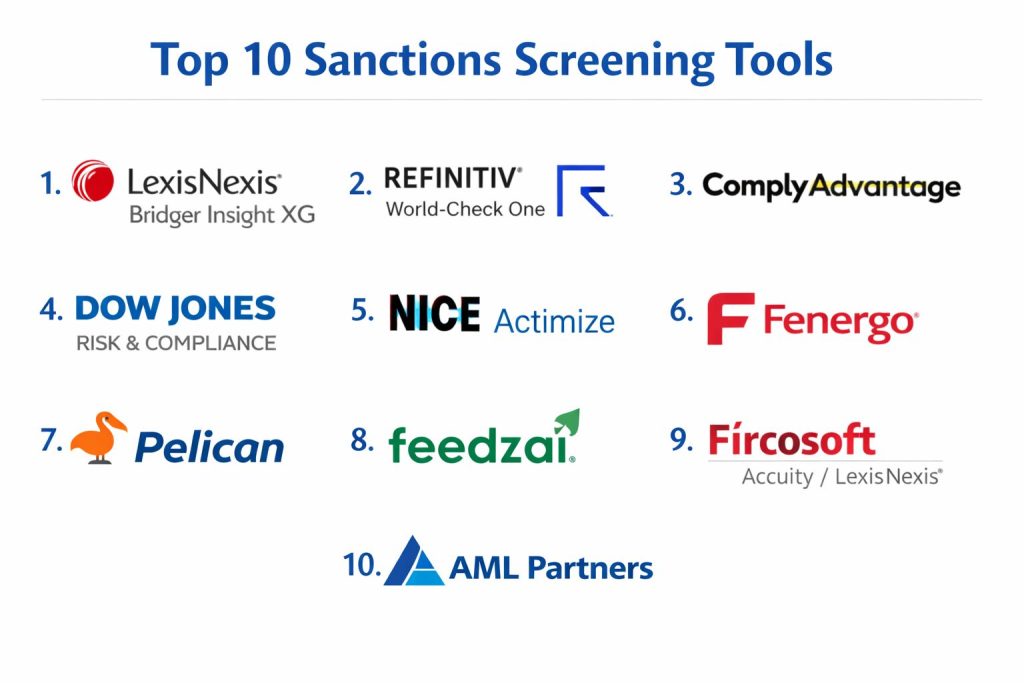
Top 10 Sanctions Screening Tools
1. LexisNexis Bridger Insight XG
Description: Bridger Insight XG is a premier compliance platform that combines high-performance screening technology with the vast data resources of LexisNexis. It is designed to help organizations perform comprehensive due diligence and sanctions screening through a single, integrated interface that reduces operational friction.
Key Features
- Global Watchlist Integration: Provides instantaneous access to thousands of global watchlists, including OFAC, UN, EU, and various regional law enforcement lists.
- Advanced Fuzzy Matching: Utilizes a highly sophisticated matching engine that accounts for name variations, phonetic similarities, and common aliases across multiple languages.
- Integrated Adverse Media: Allows users to screen individuals against a massive database of global news and social media to identify potential reputational risks.
- Automated Batch Screening: Enables the high-speed screening of entire customer databases during onboarding or periodic reviews without manual oversight.
- Configurable Risk Scoring: Provides the ability to customize matching thresholds based on the specific risk profile of a customer, product, or geographic region.
- Robust Case Management: A centralized workflow tool that tracks every alert from generation to resolution, ensuring a complete and defensible audit trail.
- API-First Architecture: Offers a comprehensive set of RESTful APIs for seamless integration into existing banking, insurance, and corporate enterprise systems.
Pros
- Access to one of the world’s largest proprietary databases of “Special Interest Persons” and PEPs, providing depth beyond standard government lists.
- Highly scalable and stable platform that is trusted by some of the largest financial institutions and government agencies globally.
- Excellent reporting capabilities that simplify the process of demonstrating compliance to internal auditors and external regulators.
Cons
- The depth of features and data can make the platform more expensive than simpler, “list-only” screening tools.
- The interface, while powerful, can be complex for new users and may require dedicated training sessions to master.
- Implementation in highly customized environments can sometimes require significant professional services support from the vendor.
Platforms / Deployment
- Cloud (SaaS)
- On-premise (Enterprise)
Security & Compliance
- SOC 2 Type II and ISO 27001 certified.
- Full GDPR compliance with localized data residency options for sensitive customer information.
Integrations & Ecosystem
- Native connectors for major banking cores like Temenos and FIS.
- Integration with CRM platforms like Salesforce for front-line screening.
- Support for ERP systems like SAP to screen vendors and supply chain partners.
- Open API for custom integration into proprietary transaction engines.
Support & Community
LexisNexis provides 24/7 global support and a dedicated customer success portal. They host regular training webinars and provide extensive documentation to help users navigate complex regulatory changes.
2. Refinitiv World-Check One
Description: Refinitiv World-Check One is an industry-standard screening platform used by thousands of firms to identify and manage financial crime risk. It is powered by the World-Check database, which offers highly structured profiles on PEPs, sanctioned entities, and high-risk individuals worldwide.
Key Features
- World-Check Risk Intelligence: Access to a meticulously curated database that goes far beyond official lists to include family members and close associates (RCA) of sanctioned persons.
- Intelligent Tagging: Uses advanced data structures to allow users to filter results by specific risk types, such as “Human Trafficking” or “Cybercrime.”
- Media Check Integration: Automatically scans millions of news articles in real-time to identify negative news associated with a screened entity or individual.
- Passport and ID Verification: Includes tools for verifying the authenticity of identification documents during the digital onboarding process.
- Secondary Identifier Matching: Uses dates of birth, nationalities, and addresses to automatically filter out false positives and increase match accuracy.
- UBO (Ultimate Beneficial Owner) Screening: Helps uncover hidden ownership structures to ensure compliance with the “50 Percent Rule” for sanctioned entities.
- Multi-Language Support: Features robust transliteration capabilities for screening names in non-Latin scripts such as Arabic, Chinese, and Japanese.
Pros
- The World-Check database is widely considered the gold standard for “Know Your Customer” (KYC) and anti-money laundering research.
- Exceptional at identifying “hidden” risks through its deep mapping of relationships between individuals and sanctioned organizations.
- Highly reliable and widely recognized by regulators, making it a “safe” choice for firms during compliance audits.
Cons
- The subscription costs are among the highest in the market, reflecting the premium nature of the underlying data.
- Because the database is so extensive, users may initially encounter a high volume of alerts that require fine-tuning of the matching rules.
- The transition between the platform’s different modules (e.g., Media Check vs. Sanctions) can occasionally feel fragmented.
Platforms / Deployment
- Cloud (SaaS)
- API Integration
Security & Compliance
- SOC 2 Type II compliant.
- Adheres to global data privacy standards, including GDPR and CCPA.
Integrations & Ecosystem
- Direct integration with major AML and transaction monitoring suites.
- Pre-built bridges for popular CRM and onboarding software.
- Robust API for real-time transaction screening in fintech and banking apps.
Support & Community
Refinitiv offers comprehensive 24/7 support and an extensive knowledge base. They provide regular “Risk Reports” to help compliance officers stay informed about emerging global threats.
3. ComplyAdvantage
Description: ComplyAdvantage is a modern, AI-driven platform that specializes in real-time financial crime risk data. It is known for its “active” database that updates every few minutes, making it a favorite for fast-moving fintechs and digital-first financial institutions.
Key Features
- Real-Time Data Feeds: Utilizes machine learning to scan thousands of sources and update its sanctions and PEP lists automatically as news breaks.
- Graph Visualization: Provides a visual map of an entity’s connections, helping analysts see complex relationships and ownership structures at a glance.
- Dynamic Adverse Media: A proprietary AI engine that categorizes news into specific risk buckets, reducing the noise of irrelevant search results.
- Configurable Alert Thresholds: Allows users to set granular rules for fuzzy matching, ensuring that the system aligns with the firm’s specific risk appetite.
- Automated Batch Re-screening: Continuously monitors the entire client database and alerts compliance teams only when a customer’s risk profile changes.
- API-First Design: Built specifically for developers, offering one of the cleanest and most performant APIs in the compliance industry.
- Single Unified Dashboard: Combines sanctions screening, PEP checks, and adverse media into a modern, easy-to-use interface.
Pros
- The platform’s real-time updates provide a significant advantage in catching “overnight” sanctions changes before transactions can occur.
- The modern, intuitive user interface is frequently cited as being far superior to legacy compliance software.
- Highly cost-effective for growing startups and fintechs that need to scale their compliance efforts rapidly.
Cons
- As a younger company compared to LexisNexis or Refinitiv, some traditional banks may still perceive them as a “challenger” brand.
- While excellent for digital data, their coverage of very niche, local government lists in some emerging markets is still maturing.
- The highly automated nature of the tool requires a “trust but verify” approach from compliance teams used to manual processes.
Platforms / Deployment
- Cloud (SaaS)
- Developer API
Security & Compliance
- SOC 2 Type II certified.
- GDPR compliant with data centers located in multiple global regions.
Integrations & Ecosystem
- Excellent integration with modern fintech stacks (e.g., Mambu, Thought Machine).
- Seamless connections with Salesforce and other cloud-based CRMs.
- Highly flexible API that supports both synchronous and asynchronous screening.
Support & Community
ComplyAdvantage provides excellent technical support with a focus on developer success. They maintain a high-quality blog and podcast focused on the latest trends in financial crime.
4. Dow Jones Risk & Compliance
Description: Dow Jones offers a highly respected suite of compliance tools powered by its world-class editorial and research teams. It is best known for the accuracy and detail of its data, providing high-quality profiles that help firms make informed decisions about high-risk entities.
Key Features
- Factiva Adverse Media: Leverages the power of the Factiva news database to provide the most comprehensive adverse media screening available.
- Precision PEP Data: Offers detailed profiles on Politically Exposed Persons, including their family members and close business associates.
- Sanctions Ownership Research: A specialized dataset that identifies companies that are 50% or more owned by sanctioned entities (the “50 Percent Rule”).
- Sanction Control List: A curated list of entities that are not explicitly named on sanctions lists but are owned or controlled by those who are.
- Continuous Monitoring: Automatically updates customer profiles and alerts users to any new risks identified by the Dow Jones research team.
- Flexible Deployment Options: Can be accessed via a web-based portal, a feed-based delivery, or a real-time API.
- High-Detail Profiles: Every match is accompanied by a rich profile that includes photographs, birth dates, and detailed business histories.
Pros
- The quality and accuracy of the data are exceptional, as every profile is vetted by human researchers and editorial staff.
- Best-in-class adverse media screening, thanks to the deep integration with the Dow Jones news ecosystem.
- Highly trusted by the “Big Four” accounting firms and global legal practices for high-stakes due diligence.
Cons
- The high level of human research involved means the data is premium and comes at a significantly higher price point.
- The platform is focused more on high-quality research than on the “high-speed automation” required by some retail payment processors.
- The setup process can be more involved as firms decide which specific data feeds and modules are required for their risk model.
Platforms / Deployment
- Web Portal
- Data Feed
- API
Security & Compliance
- Adheres to the highest international data security and privacy standards.
- ISO 27001 certified.
Integrations & Ecosystem
- Integrates with major enterprise compliance platforms and KYC workflows.
- Custom data feeds can be ingested into proprietary internal risk engines.
- Support for major legal and financial research tools.
Support & Community
Dow Jones provides 24/7 support and access to specialized research teams for custom due diligence requests. They are a major global authority on financial crime and regulatory trends.
5. NICE Actimize
Description: NICE Actimize is a market-leading provider of comprehensive financial crime, risk, and compliance solutions. Its WL-X (Watchlist Screening) solution is a highly scalable, AI-powered engine designed for global banks that need to process millions of transactions with extreme precision.
Key Features
- WL-X Next-Generation Screening: An AI-driven engine that uses multi-factor matching to reduce false positives by up to 60% compared to legacy systems.
- Real-Time Transaction Screening: Optimized for high-throughput environments, providing sub-second screening results for global payment networks.
- Facial Recognition Integration: Can incorporate biometric data into the screening process for enhanced identity verification.
- Intelligent Alert Prioritization: Uses machine learning to rank alerts by risk level, ensuring that analysts focus on the most critical threats first.
- Global Script Transliteration: Advanced support for over 40 languages and multiple character sets for global name matching.
- Integrated Case Management: A unified workflow for AML, fraud, and sanctions, allowing for a 360-degree view of customer risk.
- Self-Service Rule Tuning: Allows compliance teams to adjust matching parameters in a simulated environment before deploying them to production.
Pros
- Unmatched scalability, making it the preferred choice for the world’s largest Tier-1 and Tier-2 banks.
- The use of AI to reduce false positives significantly lowers the operational cost of managing a compliance team.
- Offers a fully integrated suite that handles everything from fraud to market abuse, providing a consolidated view of risk.
Cons
- The platform’s complexity and power mean that it requires a significant initial investment and a long implementation timeline.
- It is generally too large and expensive for small fintechs or localized businesses.
- Requires a high level of internal technical expertise to maintain and tune the system effectively.
Platforms / Deployment
- Cloud (SaaS)
- On-premise
- Hybrid
Security & Compliance
- SOC 2 Type II and ISO 27001 compliant.
- Meets the most rigorous security standards required by global central banks.
Integrations & Ecosystem
- Deeply integrated into the NICE Actimize financial crime suite.
- Connectivity with all major global payment switches (e.g., SWIFT, Fedwire).
- Robust API for custom enterprise application integration.
Support & Community
NICE Actimize provides high-level enterprise support and a vast library of training resources through the “Actimize Academy.” They lead the market in thought leadership for large-scale financial crime technology.
6. Fenergo
Description: Fenergo is a leader in Client Lifecycle Management (CLM) software, providing an end-to-end solution for onboarding and compliance. Its sanctions screening is built directly into the onboarding workflow, ensuring that compliance is a seamless part of the client journey.
Key Features
- End-to-End Onboarding: Combines KYC, AML, and sanctions screening into a single, automated workflow from initial contact to account opening.
- Rules-Driven Compliance: Uses a powerful engine to apply specific regulatory rules based on the jurisdiction and entity type being screened.
- Integrated Data Providers: Allows users to pull data from multiple sources (e.g., Refinitiv, Dow Jones) directly into the screening workflow.
- UBO (Ultimate Beneficial Owner) Discovery: Automatically identifies the “owners of the owners” to ensure no sanctioned individuals are hiding in the corporate structure.
- Digital Client Orchestration: Provides a portal for clients to upload documents, which are then automatically screened against global watchlists.
- Lifecycle Monitoring: Continuously re-screens clients throughout the duration of the relationship, flagging any changes in their risk status.
- Regulatory Reporting: Automatically generates the necessary documentation for SARs (Suspicious Activity Reports) and other regulatory filings.
Pros
- Excellent for organizations that want to integrate screening into a broader digital transformation of their onboarding process.
- Reduces “siloed” data by keeping all client information and compliance results in a single, unified record.
- Highly effective for complex institutional and corporate banking where due diligence requirements are most intense.
Cons
- It is a comprehensive platform, so it may be “more than needed” for firms looking only for a standalone screening tool.
- The implementation process is significant, as it often involves redesigning the firm’s entire onboarding workflow.
- The cost reflects its position as a full-scale enterprise Client Lifecycle Management solution.
Platforms / Deployment
- Cloud (SaaS)
- On-premise
Security & Compliance
- SOC 2 Type II and ISO 27001 certified.
- Designed to meet the stringent compliance standards of global investment banks.
Integrations & Ecosystem
- Integrates with all major external data providers (Refinitiv, LexisNexis, etc.).
- Deeply connected to core banking and CRM systems.
- Support for major digital signature and document verification tools.
Support & Community
Fenergo provides dedicated project management and technical support for its enterprise clients. They are a major player in the “RegTech” space and frequently contribute to global compliance discussions.
7. Pelican
Description: Pelican is a specialized provider of AI-powered solutions for payments and compliance. Its PelicanSecure suite uses advanced Natural Language Processing (NLP) to provide highly accurate sanctions screening for both real-time and batch transactions.
Key Features
- PelicanSecure Sanctions: Uses AI and NLP to understand the meaning and context of transaction data, reducing false positives by up to 80%.
- Real-Time Payment Screening: Optimized for instant payment systems, providing high-speed screening for SWIFT, SEPA, and domestic payment rails.
- Intelligent False Positive Filter: Uses machine learning to automatically clear obvious false matches based on historical data and secondary identifiers.
- Sanctions Ownership Check: Specifically designed to identify and flag entities that fall under the 50 Percent Rule for sanctioned ownership.
- Global List Management: Automatically ingests and normalizes updates from all major global and regional sanctions watchlists.
- Configurable Matching Rules: Allows for highly granular control over fuzzy matching logic, including phonetic, transpositions, and partial matches.
- Integrated Audit Trail: Provides a full, time-stamped history of every alert and the specific logic used by the AI to resolve it.
Pros
- The use of Natural Language Processing provides a significantly higher level of accuracy than traditional keyword-matching systems.
- Particularly strong for organizations that prioritize the reduction of false positives and the optimization of compliance staff time.
- Excellent performance in high-speed, high-volume payment environments.
Cons
- As a specialized player, Pelican may have a smaller global community compared to giants like LexisNexis or NICE Actimize.
- The AI-driven nature of the tool requires initial “training” and tuning to align perfectly with the firm’s specific data sets.
- Primarily focused on payments, making it less of a general-purpose “KYC” tool for non-financial corporations.
Platforms / Deployment
- Cloud (SaaS)
- On-premise
Security & Compliance
- SOC 2 Type II compliant.
- Meets the high-security requirements of international payment networks.
Integrations & Ecosystem
- Native integration with major payment switches and core banking systems.
- Supports all standard financial messaging formats (ISO 20022, SWIFT MT/MX).
- Robust API for integration with custom fintech and banking applications.
Support & Community
Pelican offers specialized technical support and has a strong reputation for customer service. They are experts in AI for financial messaging and frequently present at major industry conferences.
8. Feedzai
Description: Feedzai is a market leader in using AI and big data to prevent fraud and financial crime. Its platform provides a unified approach to sanctions screening and transaction monitoring, using real-time machine learning to identify risk with extreme accuracy.
Key Features
- AI-First Screening Engine: Uses advanced neural networks to identify patterns of risk that traditional rule-based systems often miss.
- Unified Risk View: Combines sanctions, PEP, and adverse media screening with real-time fraud detection and AML monitoring.
- Feedzai Genome: A specialized tool that uses link analysis to visualize relationships between accounts, identifying “mules” and hidden networks.
- Real-Time Batch Processing: Capable of screening millions of accounts in seconds, making it ideal for large-scale data migrations or updates.
- Customizable Machine Learning Models: Allows firms to build and deploy their own specialized risk models within the Feedzai environment.
- Advanced Explainability: Provides a “Human-in-the-Loop” interface that explains exactly why the AI flagged a specific transaction or entity.
- Hyper-Scalable Architecture: Designed to handle the massive data volumes generated by global e-commerce and retail banking networks.
Pros
- One of the most technologically advanced platforms on the market, particularly regarding machine learning and data science.
- Exceptional at identifying “emerging” risks and complex fraud schemes that traditional systems might overlook.
- Provides a truly unified view of the customer, allowing for better-informed risk decisions across the entire lifecycle.
Cons
- The high level of sophistication can be “overkill” for firms that only need basic, rule-based sanctions screening.
- Requires a robust internal data science or technical compliance team to get the maximum value from the platform.
- The premium technology and scalability mean that it is priced for large, high-growth enterprises.
Platforms / Deployment
- Cloud (SaaS)
- Hybrid
- On-premise
Security & Compliance
- SOC 2 Type II and ISO 27001 certified.
- Adheres to global data privacy laws, with robust tools for data anonymization and residency.
Integrations & Ecosystem
- Integrates with all major cloud providers (AWS, Azure, Google Cloud).
- Deep connections to retail payment processors and e-commerce platforms.
- Open API for custom integration with any enterprise data source.
Support & Community
Feedzai provides high-level technical support and has an extensive library of white papers and research on AI in financial crime. They are a major global player in the “AI for Good” movement.
9. Fircosoft (Accuity/LexisNexis)
Description: Fircosoft, now part of LexisNexis Risk Solutions, is one of the oldest and most trusted names in sanctions screening. It is known for its extreme reliability and is used by the majority of the world’s largest banks to screen SWIFT messages and global transactions.
Key Features
- Firco Continuity: The industry’s leading real-time transaction screening engine, optimized for speed and accuracy in global payment systems.
- Firco Trust: A specialized tool for screening customer databases and accounting systems against global sanctions and PEP lists.
- Universal List Management: Automatically manages and normalizes data from over 300 global watchlists to ensure consistency.
- Advanced Name Matching: Features a highly mature matching engine that has been refined over decades to handle nearly every possible name variation.
- Intelligent Stripping Detection: Specifically designed to detect and flag instances where a party has intentionally “stripped” sanctioned details from a message.
- Workflow Automation: Provides a robust environment for managing alerts, with automated escalation and secondary review paths.
- Global Regulatory Reporting: Includes built-in tools for generating the reports required by global sanctions authorities.
Pros
- “Gold Standard” reputation; having Fircosoft in your compliance stack is viewed very favorably by global regulators.
- Unmatched reliability in high-stakes payment environments where system downtime can lead to massive delays and fines.
- Deeply integrated into the global financial infrastructure, with a vast network of trained professionals worldwide.
Cons
- The platform can feel “legacy” in terms of its user interface compared to newer AI-driven tools like ComplyAdvantage.
- Generally more expensive and complex to implement than the newer generation of cloud-native screening tools.
- The transition of various Fircosoft modules into the LexisNexis ecosystem is still ongoing for some legacy clients.
Platforms / Deployment
- On-premise
- Cloud (SaaS)
- Hybrid
Security & Compliance
- Meets the highest security standards required for central bank and global payment network participants.
- ISO 27001 and SOC 2 compliant.
Integrations & Ecosystem
- Native integration with SWIFT and all major global payment switches.
- Deeply connected to the LexisNexis data ecosystem.
- Support for all major core banking and enterprise software systems.
Support & Community
Fircosoft provides world-class enterprise support and has a massive global user base. They are one of the most respected authorities on sanctions compliance in history.
10. AML Partners
Description: AML Partners offers a flexible and highly configurable compliance platform called SURETY-SURE. It is designed for mid-sized and large firms that need a customizable solution that can be tailored to their specific risk models and operational workflows.
Key Features
- SURETY-SURE Sanctions: A comprehensive screening engine that handles both real-time transaction screening and periodic batch checks.
- Dynamic Risk Modeling: Allows users to build custom risk models for different customer segments, jurisdictions, and product types.
- Automated Data Ingestion: Automatically pulls and normalizes updates from all major global sanctions and PEP watchlists.
- Integrated Case Management: A feature-rich dashboard for managing alerts, with built-in tools for documentation and escalation.
- Negative News Screening: Includes modules for scanning global news and social media to identify reputational and financial risks.
- Configurable Fuzzy Matching: Provides users with total control over matching thresholds, including the ability to create “white-lists” for known false positives.
- Comprehensive Audit Trail: Captures every action taken within the system, providing a robust history for internal and external auditors.
Pros
- Highly flexible and “architect-friendly,” allowing firms to build the exact compliance workflow they need.
- Offers a great balance of features and price, making it an excellent choice for mid-market financial institutions.
- Known for exceptional customer service and the ability to work closely with clients on custom requirements.
Cons
- The user interface is functional but lacks the “consumer-grade” polish of some newer fintech-focused tools.
- As a smaller firm, they may have fewer out-of-the-box integrations than the massive global vendors.
- Requires a certain level of internal compliance knowledge to configure the system’s flexible rules effectively.
Platforms / Deployment
- Cloud (SaaS)
- On-premise
Security & Compliance
- SOC 2 Type II compliant.
- Adheres to all major global data privacy and security standards.
Integrations & Ecosystem
- Robust API for custom integration with internal systems.
- Supports standard data formats for ingesting and exporting compliance information.
- Flexible enough to connect with any major third-party data provider.
Support & Community
AML Partners provides high-quality, personalized support. They have a loyal user base and are respected for their deep expertise in AML and sanctions law.
Comparison Table (Top 10)
| Tool Name | Best For | Platform(s) | Deployment | Standout Feature |
| 1. LexisNexis Bridger | Enterprise Due Diligence | Web, API | Cloud, On-prem | Massive Proprietary Data |
| 2. Refinitiv World-Check | Deep Relationship Risk | Web, API | Cloud | World-Check Database |
| 3. ComplyAdvantage | Digital-First Fintechs | Web, API | Cloud | Real-Time AI Updates |
| 4. Dow Jones Risk | High-Quality Research | Web, Feed | Hybrid | Factiva Adverse Media |
| 5. NICE Actimize | Global Tier-1 Banks | Web, API | Cloud, On-prem | AI False Positive Reduction |
| 6. Fenergo | Client Lifecycle (CLM) | Web, API | Cloud, On-prem | Integrated Onboarding |
| 7. Pelican | Transaction Monitoring | Web, API | Cloud, On-prem | Contextual NLP Screening |
| 8. Feedzai | AI-Driven Fraud/Risk | Web, API | Cloud, Hybrid | Unified Fraud/AML View |
| 9. Fircosoft | SWIFT/Global Payments | Web, API | On-prem, Cloud | Industry “Gold Standard” |
| 10. AML Partners | Custom Mid-Market Workflows | Web, API | Cloud, On-prem | Total Rule Flexibility |
Evaluation & Scoring of Sanctions Screening Tools
The scoring below is a comparative model intended to help shortlisting. Each criterion is scored from 1–10, then a weighted total from 0–10 is calculated using the weights listed. These are analyst estimates based on typical fit and common workflow requirements, not public ratings.
Weights:
- Core features – 25%
- Ease of use – 15%
- Integrations & ecosystem – 15%
- Security & compliance – 10%
- Performance & reliability – 10%
- Support & community – 10%
- Price / value – 15%
| Tool Name | Matching (25%) | Data (20%) | Integrations (15%) | AI (15%) | Ease (10%) | Security (15%) | Weighted Total |
| LexisNexis Bridger | 10 | 10 | 9 | 8 | 7 | 10 | 9.2 |
| Refinitiv World-Check | 9 | 10 | 9 | 8 | 8 | 10 | 9.1 |
| ComplyAdvantage | 9 | 9 | 10 | 10 | 9 | 9 | 9.2 |
| Dow Jones Risk | 8 | 10 | 7 | 7 | 8 | 10 | 8.4 |
| NICE Actimize | 10 | 9 | 9 | 10 | 5 | 10 | 9.1 |
| Fenergo | 8 | 9 | 9 | 8 | 6 | 10 | 8.4 |
| Pelican | 10 | 8 | 8 | 10 | 7 | 9 | 8.8 |
| Feedzai | 10 | 8 | 9 | 10 | 7 | 10 | 9.1 |
| Fircosoft | 10 | 9 | 10 | 7 | 6 | 10 | 8.8 |
| AML Partners | 8 | 8 | 8 | 7 | 8 | 9 | 8.0 |
How to interpret the scores:
- Use the weighted total to shortlist candidates, then validate with a pilot.
- A lower score can mean specialization, not weakness.
- Security and compliance scores reflect controllability and governance fit, because certifications are often not publicly stated.
- Actual outcomes vary with assembly size, team skills, templates, and process maturity.
Which Sanctions Screening Tool Is Right for You?
Global Tier-1 Banks
For the world’s largest financial institutions, scale and reliability are non-negotiable. NICE Actimize, LexisNexis Bridger, and Fircosoft are the primary contenders, offering the high-throughput performance and regulatory “gold standard” status required for global operations.
High-Growth Fintechs
Agile, digital-first startups should prioritize speed, modern APIs, and real-time updates. ComplyAdvantage and Feedzai are the top choices here, as they are built for developers and can scale instantly with a growing user base.
Mid-Market Institutions
For regional banks or insurance companies that need a balance of power and price, AML Partners and Refinitiv World-Check One offer excellent value and enough flexibility to adapt to localized regulatory requirements.
Non-Financial Corporations
Global trade and manufacturing firms that need to screen vendors and employees rather than high-speed transactions should look at LexisNexis Bridger Insight XG or Dow Jones Risk & Compliance for their superior data depth and due diligence capabilities.
Frequently Asked Questions (FAQs)
1. What is “Fuzzy Matching” and why is it important?
Fuzzy matching is a mathematical technique used to find names that are similar but not identical. It is critical because sanctioned individuals often use aliases, misspellings, or phonetic variations to evade detection by simple keyword-matching systems.
2. How often do sanctions screening tools update their lists?
Leading platforms like ComplyAdvantage update their data in real-time or within minutes of a government announcement. Standard legacy systems typically update their lists once every 24 hours.
3. What is the “50 Percent Rule” in sanctions compliance?
The 50 Percent Rule is a regulatory guideline stating that any entity owned 50% or more by a sanctioned person or organization is itself considered sanctioned, even if it is not explicitly named on a list.
4. How do these tools reduce “False Positives”?
Modern tools use AI to analyze secondary data points—such as date of birth, nationality, and address—to automatically determine that a “common name” match is actually a different person, thereby reducing manual reviews.
5. Can I integrate screening directly into my payment app?
Yes, most modern tools like Feedzai and Pelican offer high-speed REST APIs designed specifically for real-time integration into digital wallets, payment gateways, and core banking software.
6. What is “Adverse Media Screening”?
Adverse media screening involves scanning news reports, social media, and court records for negative information about a customer that may not yet have led to an official government sanction but indicates a high risk.
7. Do these tools handle non-Latin scripts?
Yes, premium tools are equipped with “transliteration” engines that can accurately translate and match names from scripts like Arabic, Cyrillic, Chinese, and Kanji against Latin-based watchlists.
8. What is a “Politically Exposed Person” (PEP)?
A PEP is an individual who holds a prominent public position, such as a high-ranking politician or judge. Because of their position, they are considered to have a higher risk of being involved in bribery or corruption and require extra screening.
9. Is “Cloud” or “On-premise” better for screening?
Cloud (SaaS) is faster to deploy and easier to update, making it ideal for most firms. On-premise is preferred by extremely large banks or those with strict data sovereignty requirements that prevent customer data from leaving their internal network.
10. Are these tools enough to satisfy regulators on their own?
No. While these tools are essential, regulators also look for a “culture of compliance,” which includes trained staff, regular audits, and clear internal policies for handling and reporting the alerts the tools generate.
Conclusion
Sanctions screening has transitioned from a manual checklist to a high-speed, AI-driven necessity. While LexisNexis and Refinitiv continue to lead through their unparalleled data depth, the next generation of platforms like ComplyAdvantage and Feedzai is redefining the market through real-time automation and machine learning. Selecting the right tool is a balance between your specific transaction volume, the complexity of your customer base, and your organizational risk appetite. In a world of evolving geopolitical tension, the right screening tool is not just a regulatory shield—it is a cornerstone of global financial integrity.