Introduction
Sales and Operations Planning (S&OP) software has become the neurological system of the modern enterprise, bridging the traditional gap between high-level financial goals and day-to-day manufacturing reality. These platforms synchronize disparate data from sales, finance, and supply chain teams into a single, cohesive plan that ensures product availability without bloating inventory. S&OP is no longer a monthly meeting process; it is a continuous, AI-augmented workflow that allows companies to pivot instantly in response to shifting consumer demand or global supply shocks.
The transition has seen S&OP software evolve from static reporting tools into predictive “decision-centric” engines. By leveraging Digital Twins and Agentic AI, these platforms allow leaders to simulate thousands of “what-if” scenarios—such as a sudden tariff change or a spike in raw material costs—and see the immediate impact on the bottom line. For organizations navigating the complexities of 2026, a robust S&OP tool is the primary defense against margin erosion and the key to maintaining a competitive edge in an increasingly volatile global marketplace.
Real-World Use Cases
- Executive Decision Support: Leadership teams use S&OP dashboards to evaluate the financial impact of different supply chain strategies, such as the trade-off between higher air-freight costs and the risk of lost sales.
- Demand Sensing and Shaping: Retailers integrate social media trends and local weather patterns into their planning tools to predict demand spikes and adjust marketing spend or inventory levels proactively.
- Supply-Demand Balancing: Manufacturers use the software to automatically adjust production schedules across global factories when a specific component supplier experiences a localized delay.
- New Product Introduction (NPI): Marketing and operations teams collaborate on “what-if” launch scenarios to ensure the supply chain can support various adoption rates for a new product line.
- Financial Integration: CFOs use S&OP data to align the operational plan with the annual budget, ensuring that manufacturing capacity is funded and revenue targets are physically achievable.
Buyer Evaluation Criteria
- Concurrent Planning Capabilities: Evaluate if the platform updates the entire supply chain model instantly when a single variable changes, or if it requires slow, batch-processed updates.
- AI and Predictive Sophistication: Look for advanced machine learning that moves beyond simple linear forecasting to “sensing” demand based on external causal factors like inflation or port delays.
- Scenario Modeling Depth: The tool must allow users to create and compare multiple “what-if” versions of the plan simultaneously to identify the most profitable and resilient path forward.
- Cross-Functional Collaboration: Ensure the platform features built-in communication tools, workflow approvals, and audit trails to keep sales, finance, and operations teams in sync.
- Enterprise ERP Integration: The software must offer high-speed, native connectors for major systems like SAP S/4HANA, Oracle Cloud, and Microsoft Dynamics to ensure data integrity.
- Digital Twin Representation: Check if the platform can create a high-fidelity digital replica of your entire supply chain network, including constraints like machine capacity and warehouse space.
- Ease of Use for Non-Mathematicians: A successful tool must offer intuitive visualizations and “natural language” queries so that sales and marketing staff can interact with complex data.
- Financial Alignment Features: Does the platform speak the language of finance, providing clear views of Gross Margin, COGS, and Cash Flow impact for every operational decision?
- Scalability and Performance: Ensure the system can process millions of SKUs and transactions without lag, especially during high-stress month-end or quarter-end planning cycles.
- Implementation Time-to-Value: Determine if the vendor offers industry-specific templates and pre-configured models that can get the S&OP process running in weeks rather than months.
Best for: Global manufacturers, large-scale retailers, and CPG companies managing complex multi-echelon supply chains and seeking total financial and operational alignment.
Not ideal for: Small service-based businesses or companies with simple, low-volume product lines where manual spreadsheets still suffice for basic planning.
Key Trends in S&OP Software
- From S&OP to IBP: The focus has shifted from simple Sales & Operations Planning to Integrated Business Planning (IBP), where finance is a core participant rather than just a reviewer.
- Autonomous Scenario Generation: AI agents don’t just wait for questions; they proactively identify risks and generate multiple resolution scenarios before the planner even logs in.
- Demand Sensing via External Signals: Planning engines now ingest “hyper-local” data like regional energy costs, localized labor strikes, and consumer sentiment to refine short-term forecasts.
- Sustainability-Led Planning: Carbon footprint and ESG metrics are now integrated into the S&OP process, allowing planners to optimize for “Green Margins” alongside traditional profitability.
- Knowledge Graph Architecture: Leading platforms use knowledge graphs to map the “why” behind data, helping users understand the complex ripple effects of a single supplier failure.
- Conversational AI Planning: Planners can now ask their system questions like “Show me the margin impact if we shift 20% of our production to the Mexico plant,” and receive a detailed report instantly.
- Real-time Inventory Rebalancing: AI-driven S&OP now executes “multi-echelon inventory optimization” (MEIO) daily, moving stock across the network to prevent localized stockouts.
- Edge-to-Cloud Synchronization: Integration with IoT sensors on the factory floor allows the S&OP plan to be updated with real-time machine performance and downtime data.
How We Selected These Tools (Methodology)
Our selection of the top 10 S&OP tools is based on an objective analysis of technological maturity, enterprise adoption, and the ability to solve the “synchronization” problem in large supply chains. We prioritized platforms that have successfully integrated AI into the core of their planning engine.
- Concurrent Planning Maturity: We looked for tools that eliminate “silos” by allowing multiple users to change the plan simultaneously with immediate visibility into the impact.
- Financial-Operational Integration: Each tool was rated on its ability to bridge the gap between “number of units” and “dollar value,” ensuring the CFO and COO are looking at the same plan.
- AI/ML Innovation Score: We evaluated the depth of the vendor’s AI roadmap, prioritizing those moving toward autonomous planning and generative insights.
- Market Presence and Reliability: Only established leaders or high-growth “visionaries” with a proven track record of supporting Fortune 500 implementations were considered.
- User Experience (UX): We focused on platforms that have modernized their interfaces for 2026, making complex planning accessible to non-technical business users.
- Cloud-Native Architecture: We selected tools that offer the scalability and security of the modern cloud, ensuring they can handle the massive data requirements of global enterprises.
- Ecosystem Connectivity: Preference was given to platforms with a wide range of pre-built connectors for ERP, CRM, and external data providers.
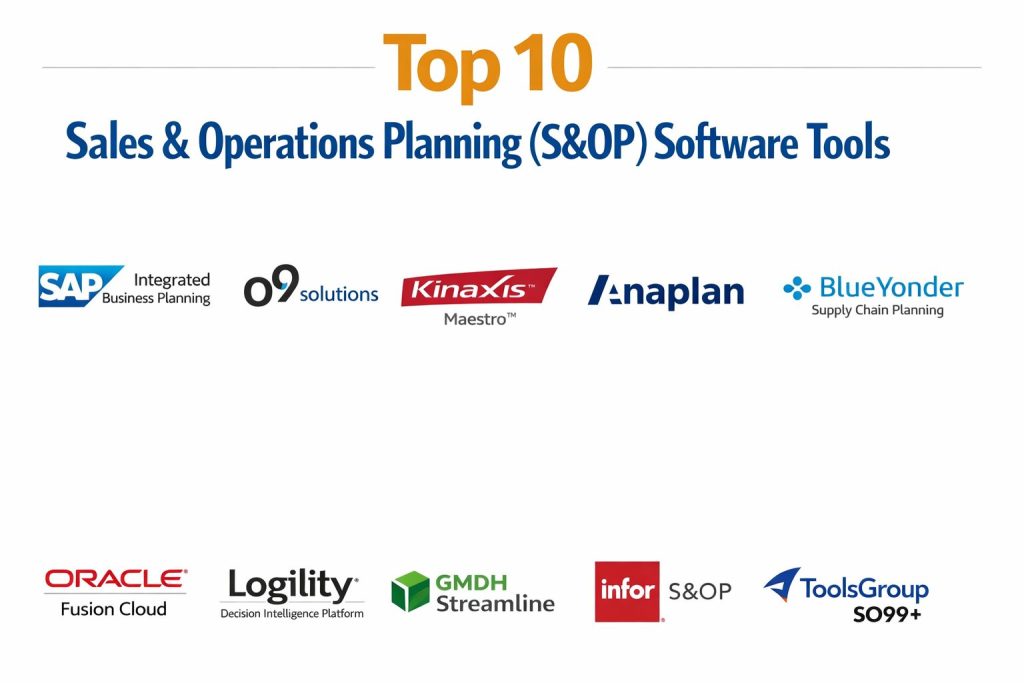
Top 10 Sales & Operations Planning (S&OP) Software
1 SAP Integrated Business Planning (IBP)
SAP IBP is a cloud-based planning suite that sits natively atop the SAP S/4HANA digital core. It is the gold standard for large enterprises that require a unified environment for demand, supply, inventory, and S&OP, offering unmatched data integration and financial alignment.
Key Features
- Demand Sensing: Uses machine learning to analyze short-term demand signals and improve the accuracy of the near-term forecast.
- Response and Supply: Generates feasible supply plans based on real-world constraints like material availability and production capacity.
- S&OP Module: A dedicated collaboration workspace that aligns cross-functional teams and provides clear executive-level dashboards.
- What-if Scenario Analysis: Allows users to create multiple simulation versions of the plan to test different business strategies without affecting the live data.
- Inventory Optimization: Automatically calculates the optimal safety stock levels across all locations in the multi-echelon supply chain.
- Financial Integration: Directly links operational units to financial value, enabling real-time views of revenue and profit projections.
- User-Centric Web UI: A modern, tile-based interface that simplifies complex planning tasks and improves user adoption.
Pros
- Unrivaled integration with SAP ERP systems, ensuring a “single source of truth” across the entire enterprise.
- Massive global partner network of consultants and implementation experts to support large-scale rollouts.
- Robust security and compliance, meeting the highest standards for data protection in regulated industries.
Cons
- The implementation process is highly complex and typically requires a significant investment in specialized consulting.
- The system’s depth can be overwhelming for smaller organizations that do not have dedicated planning teams.
- Total cost of ownership (TCO) is among the highest in the market, making it suitable mainly for large enterprises.
Platforms / Deployment
- Web / Cloud-based SaaS
- Optimized for SAP S/4HANA
Security & Compliance
- SOC 1, SOC 2 Type II, and ISO 27001 certified.
- Full GDPR and regional data residency compliance.
Integrations & Ecosystem
SAP IBP is the centerpiece of the SAP supply chain ecosystem.
- Native, high-speed integration with SAP S/4HANA and SAP ECC.
- Direct connection to SAP Ariba for procurement and SAP SuccessFactors for labor planning.
- Integration with SAP Analytics Cloud (SAC) for advanced executive reporting.
- Open APIs for connecting to non-SAP data sources and legacy systems.
Support & Community
SAP offers 24/7 global “Premium Support” and maintains one of the largest professional user communities in the world. They host “SAP Sapphire” and various regional user groups for continuous learning and networking.
2 o9 Solutions (Digital Brain)
o9 Solutions is widely considered the most “visionary” platform in the S&OP space, featuring its signature “Digital Brain.” It uses a Knowledge Graph-based architecture and advanced AI to model the complex interdependencies of the modern global supply chain.
Key Features
- Digital Brain Architecture: Uses a knowledge graph to map the relationships between products, suppliers, customers, and market events.
- Enterprise Knowledge Graph: Captures tribal knowledge and market intelligence to provide a richer context for planning decisions.
- AI-Driven Forecasting: Leverages proprietary algorithms that factor in external drivers like weather, macroeconomics, and competitor activity.
- Concurrent Planning: Updates the entire supply chain model in real-time as changes are made, eliminating the need for batch processing.
- Integrated Business Planning (IBP): Provides a unified view of commercial, financial, and operational plans for total organizational alignment.
- Digital Control Tower: Offers real-time visibility into supply chain exceptions and allows for immediate collaborative resolution.
- Sustainability Planning: Integrates ESG metrics into the S&OP process to help companies achieve their “Net Zero” goals.
Pros
- Highly flexible and customizable, allowing it to model even the most unique and complex business rules.
- Leading-edge AI capabilities that move beyond traditional forecasting into proactive “decision automation.”
- Modern, visually engaging interface that makes complex data easier to interpret for non-technical users.
Cons
- The high level of flexibility means the initial implementation can be time-consuming and resource-intensive.
- Requires a strong internal data science or analytical team to fully leverage the advanced AI capabilities.
- The “visionary” nature of the product can lead to frequent updates that require careful change management.
Platforms / Deployment
- Web / Cloud-based SaaS
- Native mobile apps for executive dashboards
Security & Compliance
- SOC 2 Type II and ISO 27001 compliant.
- Adheres to strict enterprise data privacy and encryption standards.
Integrations & Ecosystem
o9 is designed to be a “data-agnostic” platform that aggregates information from across the tech stack.
- Certified connectors for SAP, Oracle, and Microsoft Dynamics.
- Integration with big data sources like Snowflake and Google BigQuery.
- Support for unstructured data ingestion from emails, news feeds, and social media.
- Robust API for building custom applications on top of the Digital Brain.
Support & Community
o9 offers 24/7 global support and a dedicated “Success Manager” for enterprise clients. They host the annual “aim10x” global summit, which focuses on the future of AI-driven planning.
3 Kinaxis (Maestro™)
Kinaxis is a pioneer in “Concurrent Planning,” offering a platform that allows for high-speed, real-time synchronization of the end-to-end supply chain. It is exceptionally popular among companies in volatile industries like high-tech, automotive, and life sciences.
Key Features
- Concurrent Planning: Eliminates the delays of traditional “cascade” planning by linking demand, supply, and S&OP in a single, live model.
- Maestro™ AI: An integrated AI engine that provides automated insights, demand sensing, and anomaly detection.
- RapidResponse Engine: A patented in-memory database that allows for instantaneous “what-if” simulations on massive datasets.
- Self-Healing Supply Chain: AI that identifies supply chain deviations and suggests corrective actions automatically.
- Integrated Business Planning: Aligns strategic financial targets with detailed operational plans in a single environment.
- Capacity and Material Constrained Planning: Ensures that every plan generated is physically executable based on real-world limits.
- Executive S&OP Dashboards: High-level visualizations that translate operational data into financial KPIs like margin and cash flow.
Pros
- Unmatched speed; what takes other systems hours to calculate, Kinaxis can often do in seconds.
- Excellent for “exception-based” planning, allowing teams to focus only on the problems that matter.
- High user adoption due to its ability to handle complex calculations without the need for manual spreadsheets.
Cons
- The platform’s unique “Concurrent” approach requires a significant shift in how the organization thinks about planning.
- Implementation can be expensive, particularly for companies with highly fragmented or poor-quality master data.
- While visually clean, the interface can feel more “technical” compared to newer AI-first competitors like o9.
Platforms / Deployment
- Web / Cloud-based SaaS
- Enterprise mobile access
Security & Compliance
- SOC 1, SOC 2, and ISO 27001 certified.
- Trusted by government and defense contractors for high-security data management.
Integrations & Ecosystem
Kinaxis is built to act as the “nervous system” over existing ERP investments.
- Native connectors for SAP, Oracle, and Microsoft.
- Integration with major TMS and WMS providers for end-to-end visibility.
- Support for external data feeds, including weather and port congestion data.
- Open API for custom dashboard and workflow development.
Support & Community
Kinaxis provides 24/7 global support and a comprehensive “Kinaxis Academy” for user training. They host “Kinaxis Kinexions,” a major annual conference for supply chain innovators.
4 Anaplan
Anaplan is a highly flexible “Connected Planning” platform that allows organizations to build custom S&OP models tailored to their exact business needs. It is favored by finance-led organizations that want to bridge the gap between financial forecasting and operational reality.
Key Features
- Hyperblock™ Technology: A proprietary in-memory calculation engine that enables complex, multi-dimensional modeling at scale.
- Connected Planning Framework: Allows different departments (HR, Finance, Sales, Ops) to build their own models that stay synchronized.
- Scenario Modeling: Exceptionally strong capabilities for building “what-if” scenarios for any part of the business, not just the supply chain.
- Predictive Forecasting: Integrates AI and machine learning to improve the accuracy of demand and financial forecasts.
- Collaborative Workflow: Built-in tools for managing the S&OP review cycle, including approvals, comments, and audit trails.
- App Hub: Access to pre-built planning models and templates for various industries and functional areas.
- Real-time Data Visualization: Dynamic dashboards that update instantly as planning assumptions change.
Pros
- Extreme flexibility; if you can model it in a spreadsheet, you can build a more powerful version in Anaplan.
- Excellent for companies where S&OP must be tightly integrated with workforce planning and complex financial models.
- Rapid deployment for specific use cases compared to full-scale ERP-based planning suites.
Cons
- The “blank canvas” nature of the platform means you have to build (or buy) your own logic, which can be prone to human error.
- Not as “supply-chain-native” as competitors like SAP or Kinaxis; lacks deep built-in constraints for complex manufacturing.
- Can become difficult to manage if an organization builds hundreds of disconnected “models” without strong governance.
Platforms / Deployment
- Web / Cloud-based SaaS
- iOS and Android apps for mobile planning
Security & Compliance
- SOC 1, SOC 2, and ISO 27001 compliant.
- Features advanced encryption and identity management for enterprise security.
Integrations & Ecosystem
Anaplan’s strength lies in its ability to connect disparate data sources into a single planning model.
- Native connectors for Salesforce, SAP, and Oracle.
- Deep integration with Microsoft Excel and Google Sheets for data input and reporting.
- Connections to data warehouses like Snowflake and Amazon Redshift.
- Robust API for building custom data pipelines.
Support & Community
Anaplan offers 24/7 support and a thriving community of “Anaplan Way” certified partners and consultants. They maintain a massive online knowledge base and host “Anaplan Live!” events globally.
5 Blue Yonder (Supply Chain Planning)
Blue Yonder is a global leader in retail and manufacturing planning, known for its deep optimization algorithms and AI-driven demand sensing. It is the preferred choice for companies with massive SKU counts and complex retail fulfillment networks.
Key Features
- Luminate™ Planning: An AI-powered suite that provides end-to-end visibility and predictive insights across the entire supply chain.
- Demand Sensing: Analyzes point-of-sale data, promotions, and external factors to create a hyper-accurate short-term forecast.
- S&OP Control Tower: A collaborative workspace for aligning sales, finance, and operations with real-time exception management.
- Inventory Optimization: Uses advanced mathematics to balance service levels against inventory investment across the network.
- Supply Planning: Generates optimized production and procurement plans while considering all global capacity constraints.
- Scenario Playboarding: A visual interface for comparing different S&OP scenarios and their impact on key business metrics.
- Retail-Specific Logic: Specialized modules for managing seasonal assortments, markdowns, and store-level replenishment.
Pros
- The most mature solution for retail and CPG industries, with decades of built-in domain expertise.
- Strong focus on “Execution-Linked Planning,” ensuring that the S&OP plan can actually be fulfilled by the warehouse and transport teams.
- Backed by Microsoft Azure, offering high performance and world-class cloud infrastructure.
Cons
- The platform can feel “modular,” and integrating all the different Blue Yonder components can be a technical challenge.
- Some legacy parts of the software suite have a steeper learning curve than their more modern “Luminate” counterparts.
- High cost of implementation and licensing, targeted primarily at the upper mid-market and large enterprises.
Platforms / Deployment
- Web / Cloud-based SaaS (Microsoft Azure)
- Mobile executive dashboards
Security & Compliance
- SOC 1/2/3 and ISO 27001 certified.
- Leverages Microsoft Azure’s extensive global security and compliance framework.
Integrations & Ecosystem
Blue Yonder is a core part of many large-scale IT architectures.
- Deep integration with Microsoft Dynamics 365 and the Power BI suite.
- Certified connectors for SAP and Oracle ERPs.
- Native links to Blue Yonder’s own WMS and TMS for integrated planning and execution.
- Open API for connecting with third-party logistics and carrier data.
Support & Community
Blue Yonder offers 24/7 global support and a comprehensive “Blue Yonder University” for certification. They host the annual “ICON” conference, one of the largest supply chain events in the world.
7 Oracle Fusion Cloud (Supply Chain Planning)
Oracle’s S&OP offering is a key component of its Fusion Cloud suite, providing a modern, integrated environment for demand, supply, and business planning. It is ideal for organizations that want a “unified cloud” experience where planning and execution live in the same database.
Key Features
- Sales and Operations Planning Cloud: A dedicated module for aligning business goals with operational plans through a structured review process.
- Demand Management: Uses built-in AI to analyze historical trends and seasonal patterns to generate accurate baseline forecasts.
- Supply Planning: Automatically calculates the materials and capacity needed to meet the demand plan while minimizing costs.
- Intelligent Backlog Management: AI that helps planners prioritize which orders to fulfill when supply is constrained.
- Scenario Simulation: Allows for the rapid creation of “what-if” models to test the impact of new product launches or supplier changes.
- Integrated Business Intelligence: High-quality reporting and analytics built directly into the planning interface.
- Mobile Planning: A streamlined mobile experience for executives to review and approve S&OP plans on the go.
Pros
- Exceptional “End-to-End” flow; a plan in Oracle Planning can be instantly turned into a purchase order in Oracle Procurement.
- Built on a modern, high-performance cloud architecture that is updated quarterly with new AI features.
- Lower integration risk for companies already using Oracle Cloud ERP or Oracle Cloud HCM.
Cons
- Like SAP, it is a massive system that requires a rigorous and often expensive implementation process.
- The system is most effective when used as part of the broader Oracle suite; standalone value is lower than pure-play tools.
- The interface, while modern, is very data-heavy and can require significant training for occasional users.
Platforms / Deployment
- Web / Cloud-based SaaS
- iOS and Android mobile apps
Security & Compliance
- World-class Oracle Cloud security with SOC 2 Type II and ISO 27001.
- Fully compliant with global data privacy regulations (GDPR, CCPA).
Integrations & Ecosystem
Oracle Planning is designed to be the “brain” for the Oracle Fusion ecosystem.
- Native integration with Oracle Fusion Cloud ERP, SCM, and HCM.
- Direct connection to Oracle NetSuite for high-growth mid-market companies.
- Built-in integration with Oracle Analytics Cloud (OAC).
- Support for third-party data ingestion via Oracle’s robust Integration Cloud Service.
Support & Community
Oracle provides 24/7 global support and has a massive network of implementation partners. The “Oracle CloudWorld” event is the primary venue for learning about the platform’s latest innovations.
8 Logility (Decision Intelligence Platform)
Logility offers a comprehensive “Decision Intelligence” platform that uses AI and advanced analytics to automate the S&OP process. It is highly regarded for its balance of deep analytical power and ease of use, particularly for mid-to-large manufacturers.
Key Features
- AI-Driven Demand Sensing: Automatically identifies patterns and shifts in consumer behavior to refine short-term forecasts.
- Supply Chain Digital Twin: Creates a detailed virtual model of the physical supply chain to test the impact of any change.
- Multi-Echelon Inventory Optimization (MEIO): Optimizes stock levels across all nodes in the network to maximize service and minimize cost.
- Integrated Business Planning: Provides a unified workflow for demand, supply, and financial alignment.
- Sustainability & ESG Tracking: Monitors the environmental impact of supply chain decisions directly within the planning tool.
- Scenario Analysis Engine: Allows users to compare different strategic paths with clear visualizations of the trade-offs.
- Automated Data Cleansing: AI that identifies and corrects errors in master data before it enters the planning cycle.
Pros
- Very strong “out-of-the-box” functionality that requires less custom coding than Anaplan or o9.
- Excellent customer support and a reputation for successful, high-ROI implementations.
- Good balance of enterprise-grade power and a user-friendly, intuitive interface.
Cons
- While global, Logility’s brand recognition is slightly lower than that of SAP, Oracle, or Blue Yonder.
- The transition of their entire suite to a 100% cloud-native architecture has been a long-term process.
- Integration with highly customized legacy ERPs may require more manual effort compared to “Big ERP” native planners.
Platforms / Deployment
- Web / Cloud-based SaaS
- Support for hybrid cloud models
Security & Compliance
- SOC 2 Type II compliant.
- Adheres to standard enterprise security and data encryption protocols.
Integrations & Ecosystem
Logility is designed to sit on top of any major ERP system.
- Certified connectors for SAP and Oracle.
- Strong integration with Microsoft Dynamics 365.
- Open API for connecting to custom WMS, TMS, and PLM systems.
- Direct feeds for external market data and weather patterns.
Support & Community
Logility provides 24/7 support and a dedicated customer success program. They have a very active user group and host an annual “Connections” conference for their clients.
8 GMDH Streamline
Streamline is an AI-driven S&OP platform that focuses on “Speed to Value.” It is the preferred choice for mid-market companies that need enterprise-grade AI forecasting and inventory optimization without the multi-year implementation timelines of the larger suites.
Key Features
- Proprietary AI Forecasting: Uses advanced mathematical algorithms to determine ideal stock levels and demand patterns automatically.
- Integrated S&OP Workflow: A simplified, structured process for aligning sales and operations teams in mid-sized organizations.
- Real-Time Scenario Planning: Allows for rapid “what-if” testing of different supply and demand assumptions.
- Dynamic Inventory Optimization: Automatically adjusts replenishment orders based on real-time changes in lead times and demand.
- Demand Sensing: Factors in recent sales trends to improve forecast accuracy for the coming weeks.
- ERP Integration Hub: Pre-built connectors for over 80 different ERP and accounting systems.
- Cloud or On-Premise Flexibility: One of the few modern AI tools that still offers flexible deployment options for highly regulated firms.
Pros
- Extremely fast implementation; many companies are up and running in a matter of weeks.
- Exceptional value for money, offering high-end AI capabilities at a price point accessible to mid-market firms.
- Very easy to use for teams moving away from spreadsheets for the first time.
Cons
- Not as robust as SAP or Kinaxis for modeling extremely complex manufacturing constraints (e.g., multi-stage assembly).
- The user interface, while functional, is not as “polished” or feature-rich as o9 or Blue Yonder.
- Global support and consulting network are smaller than the major tier-1 vendors.
Platforms / Deployment
- Web / Cloud-based SaaS
- Desktop / On-premise options available
Security & Compliance
- Standard SOC 2 and GDPR compliance.
- Offers high-security deployment options for sensitive industries.
Integrations & Ecosystem
Streamline’s primary strength is its wide range of pre-built “plug-and-play” connectors.
- Native integration with Microsoft Dynamics, SAP Business One, and Oracle NetSuite.
- Connectors for QuickBooks, Sage, and various specialized industry ERPs.
- Support for direct database connections (SQL, etc.).
- Open API for custom data ingestion.
Support & Community
Streamline offers 24/7 online support and a growing network of localized implementation partners globally. They provide extensive video training and a comprehensive knowledge base.
9 Infor (S&OP)
Infor’s S&OP solution is part of its “CloudSuite” family, offering deep industry-specific planning for manufacturing and distribution. It is particularly strong for organizations that need to align their S&OP process with a high-volume, multi-site production environment.
Key Features
- Industry-Specific Templates: Pre-configured planning models for industries like automotive, fashion, and food & beverage.
- Integrated Demand and Supply: Ensures that the sales forecast is always balanced against the physical realities of the factory floor.
- Financial Alignment Module: Translates the operational plan into detailed P&L and cash flow projections.
- Collaborative Demand Planning: Tools for sales teams to easily provide their input and market intelligence into the master plan.
- Constraint-Based Supply Planning: AI that considers labor, machine, and material limits when generating production schedules.
- Executive Visualization: High-level dashboards that track KPIs like “On-Time-In-Full” (OTIF) and Gross Margin.
- Scenario Manager: Robust tools for building and comparing strategic alternatives during the S&OP meeting.
Pros
- “Micro-vertical” expertise; Infor builds features specifically for the unique needs of different manufacturing sub-sectors.
- Strong integration with the broader Infor CloudSuite (ERP, EAM, WMS).
- Very stable and reliable platform with a deep history in complex manufacturing planning.
Cons
- The user interface can feel more “traditional” and less experimental than AI-first platforms like o9.
- Integration with non-Infor ERP systems can be more complex than using a standalone “data-agnostic” planner.
- The company’s focus is primarily on its own ecosystem, which can limit flexibility for some “best-of-breed” IT strategies.
Platforms / Deployment
- Web / Cloud-based SaaS
- Mobile access via Infor OS
Security & Compliance
- SOC 1, SOC 2, and ISO 27001 certified.
- Adheres to the high security standards of the AWS cloud environment.
Integrations & Ecosystem
Infor S&OP is designed to be the planning engine for the Infor “CloudSuite” ecosystem.
- Native integration with Infor LN, M3, and S3 ERP systems.
- Direct connection to Infor Nexus for global supply chain visibility.
- Integration with Birst for advanced enterprise-wide analytics.
- Support for standard industry data formats (EDI, XML) and APIs.
Support & Community
Infor offers 24/7 global support and a dedicated “Infor Concierge” service for enterprise clients. They host “Inforum,” a major annual conference for their global user base.
10 ToolsGroup (SO99+)
ToolsGroup is the industry leader in “Service-Driven” planning. It uses a unique probabilistic approach to demand forecasting and inventory optimization, making it the top choice for companies managing high levels of uncertainty and intermittent demand.
Key Features
- Probabilistic Forecasting: Moves beyond single-point estimates to model a range of possible demand outcomes and their probabilities.
- Service-Level Optimization: Allows users to set specific “Service Level Targets” (e.g., 98% availability) and automatically calculates the stock needed to hit them.
- Intermittent Demand Planning: Specialized AI for accurately forecasting “slow-moving” parts that sell irregularly.
- S&OP Command Center: A unified dashboard for cross-functional alignment and executive decision-making.
- Multi-Echelon Inventory Optimization (MEIO): Sophisticated stock balancing across the entire global distribution network.
- Promotion & Event Modeling: AI that predicts the uplift of marketing campaigns and seasonal events on product demand.
- Automated Demand Sensing: Incorporates recent sales data to catch and react to trend shifts faster than traditional models.
Pros
- Unmatched at handling “High Uncertainty” environments where traditional forecasting tools often fail.
- Proven to significantly reduce inventory while simultaneously improving customer service levels.
- Deeply analytical platform that provides a “mathematical edge” in inventory management.
Cons
- The probabilistic math behind the system can be difficult for non-technical users to fully understand and trust initially.
- Not as focused on “financial-first” connected planning as a tool like Anaplan.
- Implementation requires high-quality historical data to feed the probabilistic models.
Platforms / Deployment
- Web / Cloud-based SaaS
- On-premise options available for specific industries
Security & Compliance
- SOC 2 Type II compliant.
- Standard enterprise encryption and data protection.
Integrations & Ecosystem
ToolsGroup is built to “supercharge” the inventory logic of existing ERP systems.
- Native connectors for SAP, Microsoft Dynamics, and Oracle.
- Integration with major e-commerce platforms like Shopify and Magento.
- Support for data ingestion from specialized WMS and TMS systems.
- Open API for custom application and reporting development.
Support & Community
ToolsGroup provides 24/7 support and is known for its high-touch consulting and implementation services. They have a loyal global user base and host the annual “TG1” customer summit.
Comparison Table (Top 10)
| Tool Name | Best For | Platform(s) Supported | Deployment | Standout Feature |
| SAP Integrated Business Planning (IBP) | SAP-centric Enterprises | Web | Cloud (SaaS) | Deep S/4HANA Integration |
| o9 Solutions (Digital Brain) | AI-First Visionaries | Web, Mobile | Cloud (SaaS) | Knowledge Graph Architecture |
| Kinaxis (Maestro™) | High Volatility Industries | Web, Mobile | Cloud (SaaS) | Concurrent Planning Engine |
| Anaplan | Connected Financial Planning | Web, iOS, Android | Cloud (SaaS) | Hyperblock™ Modeling |
| Blue Yonder (Supply Chain Planning) | Retail & CPG Complexity | Web, Mobile | Cloud (SaaS) | Retail-Specific Demand Sensing |
| Oracle Fusion Cloud | Unified ERP/Planning | Web, iOS, Android | Cloud (SaaS) | Integrated Planning & Execution |
| Logility (Decision Intelligence Platform) | Mid-to-Large Manufacturers | Web | Cloud (SaaS) | Digital Twin Simulation |
| GMDH Streamline | Mid-Market AI Value | Web, Desktop | Cloud / On-Prem | 2-Week Implementation Hub |
| Infor (S&OP) | Industrial Micro-Verticals | Web, Mobile | Cloud (SaaS) | Industry-Specific Templates |
| ToolsGroup (SO99+) | Service-Level Optimization | Web | Cloud / On-Prem | Probabilistic Forecasting |
Evaluation & Scoring of Sales & Operations Planning Software
The following model evaluates these platforms based on the critical requirements of a 2026 S&OP process, where speed, financial alignment, and AI are the key differentiators.
Scoring Model (0–10)
| Tool Name | Concurrent Planning (20%) | AI & Predictive (20%) | Financial Sync (15%) | Ease of Use (15%) | Integration (15%) | Security (15%) | Weighted Total |
| SAP Integrated Business Planning (IBP) | 8 | 9 | 10 | 6 | 10 | 10 | 8.8 |
| o9 Solutions (Digital Brain) | 9 | 10 | 9 | 8 | 8 | 9 | 8.9 |
| Kinaxis (Maestro™) | 10 | 10 | 8 | 7 | 8 | 10 | 9.0 |
| Anaplan | 8 | 8 | 10 | 9 | 9 | 9 | 8.8 |
| Blue Yonder (Supply Chain Planning) | 8 | 10 | 8 | 7 | 8 | 9 | 8.4 |
| Oracle Fusion Cloud | 8 | 9 | 10 | 7 | 10 | 10 | 8.9 |
| Logility (Decision Intelligence Platform) | 8 | 9 | 8 | 9 | 8 | 9 | 8.5 |
| GMDH Streamline | 7 | 9 | 7 | 10 | 9 | 8 | 8.3 |
| Infor (S&OP) | 8 | 8 | 8 | 7 | 9 | 10 | 8.3 |
| ToolsGroup (SO99+) | 8 | 10 | 7 | 7 | 8 | 9 | 8.2 |
How to interpret these scores
- Concurrent Planning (20%): Measures how effectively the tool eliminates “silos” by updating the entire model in real-time as users make changes.
- AI & Predictive (20%): Evaluates the sophistication of machine learning for demand sensing, forecasting, and autonomous decision-making.
- Financial Sync (15%): Scores how well the tool translates “units” into “dollars,” including P&L and margin impacts.
- Ease of Use (15%): Reflects the intuitiveness of the interface and the learning curve for non-technical planners.
Which S&OP Software Tool Is Right for You?
Global “Mega” Enterprises
If your organization operates globally with billions in revenue and thousands of SKUs, you need the massive scale and reliability of SAP IBP or Oracle Fusion Cloud. These platforms offer the deepest financial integration and the security required for Fortune 500 operations.
High-Growth & Volatile Industries
For companies in sectors like high-tech or automotive where demand changes by the minute, Kinaxis is the clear leader due to its “Concurrent Planning” speed. If you want the most “visionary” AI that can model complex market influences, o9 Solutions is the top choice.
Finance-Driven Organizations
If your S&OP process is heavily led by the CFO’s office and requires deep integration with workforce and capital planning, Anaplan offers the most flexible “blank canvas” modeling environment.
Mid-Market Manufacturers & Distributors
For mid-sized companies that need enterprise-grade AI without the enterprise-grade price tag or complexity, GMDH Streamline offers the fastest “time-to-value.” Logility is also an excellent choice for this segment, providing a very balanced and stable “Decision Intelligence” platform.
Retail & CPG Specialists
If your primary challenge is managing seasonal assortments, shelf-level availability, and complex promotional cycles, Blue Yonder remains the industry gold standard for retail-centric planning.
Inventory & Service Extremists
For organizations with highly intermittent demand (like spare parts) or those that prioritize specific “Service Level” guarantees above all else, ToolsGroup provides the most advanced probabilistic mathematics to optimize those stock levels.
Frequently Asked Questions (FAQs)
What is the main difference between S&OP and IBP?
S&OP (Sales & Operations Planning) focuses on balancing supply and demand units. IBP (Integrated Business Planning) is the evolution of S&OP that includes finance, marketing, and HR to align the operational plan with the company’s strategic financial goals.
Can these tools really replace our Excel spreadsheets?
Yes. Modern S&OP software like Anaplan or Kinaxis is designed to take the logic currently hidden in “shadow” spreadsheets and move it into a secure, collaborative, and real-time enterprise environment.
How does AI improve forecast accuracy ?
AI moves beyond historical sales data to “sense” demand using external signals like localized weather, macro-economics, and social media trends, often reducing forecasting errors by 20% to 50%.
How long does a typical implementation take?
Enterprise-scale tools like SAP IBP or Oracle can take 6–12 months. Mid-market solutions like GMDH Streamline can be fully operational in as little as 2–4 weeks.
Will these tools integrate with my legacy ERP system?
Most modern S&OP platforms are “ERP-agnostic” and offer robust APIs or pre-built connectors to ingest data from legacy systems, although native cloud ERP integrations (like SAP-to-IBP) are always the fastest.
How often should we run our S&OP process?
While traditional S&OP was a monthly cycle, the “Concurrent Planning” capabilities of tools like Kinaxis allow for a “continuous” S&OP process where the plan is adjusted daily or even hourly as new data arrives.
What is a “Supply Chain Digital Twin”?
A Digital Twin is a high-fidelity virtual model of your physical supply chain. Platforms like Logility and o9 use this to simulate “what-if” scenarios and see the ripple effects across your entire network.
Do these tools help with sustainability and carbon reporting?
Yes, many leaders like o9 and SAP have integrated carbon tracking into their S&OP modules, allowing companies to see the CO2 impact of their production and shipping decisions.
What is “Demand Sensing”?
Demand sensing uses AI to analyze point-of-sale data and short-term market signals to provide a hyper-accurate forecast for the next 0–6 weeks, whereas traditional forecasting looks much further out.
Is S&OP software only for manufacturing companies?
No. Retailers, distributors, and even large service-based organizations use S&OP to ensure their capacity (labor, space, or inventory) is aligned with projected sales demand.
Conclusion
The S&OP landscape is defined by a move away from static “plans” toward a dynamic, AI-driven “decision intelligence.” Whether you choose the massive enterprise power of SAP IBP, the visionary AI of o9 Solutions, or the high-speed concurrency of Kinaxis, the goal is the same: to turn your supply chain into a competitive weapon. By aligning every department—from the CFO’s office to the factory floor—on a single, live version of the truth, these platforms ensure that your business remains resilient, profitable, and ready for whatever the global market throws its way.