Introduction
Sales enablement tools help sales teams sell better by organizing content, guiding reps through the right messaging, improving training, and showing what works in real deals. Instead of reps searching for the latest deck or guessing which talk track to use, these tools bring the right content, coaching, and insights into the selling flow. They matter because buying cycles are more complex, sales teams are distributed, and leaders need clear proof of what activities drive revenue. Common use cases include onboarding new reps faster, delivering approved pitch content, improving call performance through coaching, running playbooks for different industries, and tracking content impact on pipeline. When evaluating a tool, look at content management, search and recommendations, analytics, coaching features, integrations, ease of adoption, scalability, permissions, workflow automation, and support quality.
Best for: SDRs, AEs, account managers, sales leaders, enablement managers, and revenue operations teams in SMB to enterprise environments that want consistent messaging and measurable sales execution.
Not ideal for: very small teams that sell purely through informal conversations and rarely use structured content or training, or teams that only need a basic file repository without sales usage analytics.
Key Trends in Sales Enablement Tools
- AI-assisted content recommendations based on deal stage and persona
- Conversation intelligence feeding coaching and enablement loops
- Micro-learning and continuous coaching replacing one-time training
- Stronger content governance with approvals and version control
- Playbooks becoming more dynamic and data-driven rather than static PDFs
- Deeper CRM alignment to connect enablement activity to pipeline outcomes
- In-app enablement inside email, calendar, and meeting workflows
- Consolidation of enablement, coaching, and content into fewer platforms
- Better personalization for enterprise segments and regional teams
- Increased focus on permissions, auditability, and scale across large orgs
How We Selected These Tools (Methodology)
- Looked for strong adoption across enablement leaders and sales teams
- Prioritized platforms that combine content delivery with measurable impact
- Included tools that support coaching, onboarding, and ongoing skill growth
- Considered integration strength with CRM and sales workflows
- Evaluated scalability for growing teams and enterprise requirements
- Assessed usability for reps because adoption is the biggest success factor
- Considered analytics quality and how well insights drive action
- Included a balanced mix of enterprise and mid-market friendly options
- Focused on tools that support repeatable sales motions and governance
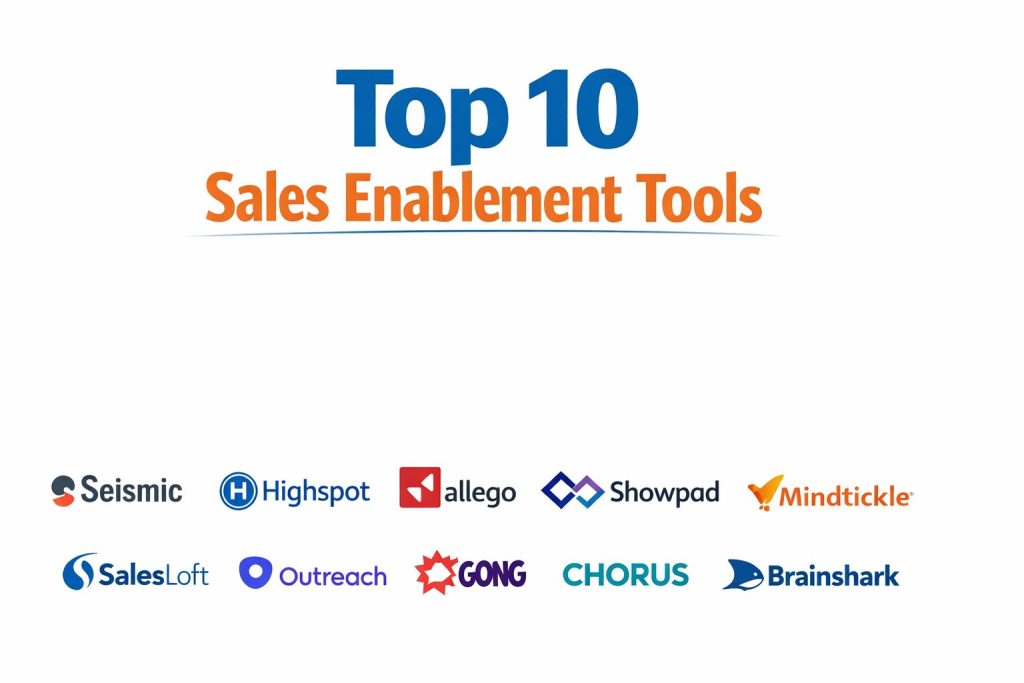
Top 10 Sales Enablement Tools
1) Seismic
A robust sales enablement platform focused on content, personalization, and analytics for large revenue teams. It suits organizations that want strong governance and clear insight into content usage and outcomes.
Key Features
- Centralized content library with controls and publishing workflows
- Content personalization and assembly for role and segment needs
- Strong analytics on usage and content impact across teams
- Enablement workflows that support consistent messaging execution
- Sales playbooks and guidance tied to sales motions
- Support for large org structures, regions, and permissions
- Integration patterns that connect enablement activity to selling systems
Pros
- Strong governance and analytics for enterprise-scale content operations
- Helps standardize messaging while allowing controlled personalization
Cons
- Implementation can be heavier for smaller teams
- Full value often requires disciplined content operations
Platforms / Deployment
- Web
- Cloud
Security & Compliance
- SSO/SAML, MFA, encryption, audit logs, RBAC: Not publicly stated
- SOC 2, ISO 27001, GDPR, HIPAA: Not publicly stated
Integrations & Ecosystem
Seismic typically connects to CRM, email, and collaboration workflows so reps can find, use, and track content in context.
- CRM integration patterns: Varies / N/A
- Email and calendar workflow integrations: Varies / N/A
- Content and file system connectors: Varies / N/A
- APIs and extensibility: Varies / N/A
- Analytics and reporting exports: Varies / N/A
Support & Community
Enterprise support expectations are common, with onboarding and training options that vary by contract and plan.
2) Highspot
A sales enablement platform combining content management, guidance, and training. Often chosen for strong user experience and features that help reps execute playbooks consistently.
Key Features
- Content organization with search and recommendations
- Guided selling and playbooks aligned to deal stages
- Training and coaching features for onboarding and reinforcement
- Analytics on content adoption and sales usage patterns
- Content governance and lifecycle management
- Enablement programs for role-based learning paths
- Reporting that helps leaders see what is working
Pros
- Strong rep experience that supports adoption
- Good balance of content, training, and guidance in one platform
Cons
- Setup and ongoing enablement ownership are required for success
- Advanced governance may need careful configuration
Platforms / Deployment
- Web
- Cloud
Security & Compliance
- SSO/SAML, MFA, encryption, audit logs, RBAC: Not publicly stated
- SOC 2, ISO 27001, GDPR, HIPAA: Not publicly stated
Integrations & Ecosystem
Highspot usually integrates with CRM and communication tools to keep enablement in the rep workflow.
- CRM integration patterns: Varies / N/A
- Collaboration and meeting workflow connections: Varies / N/A
- Content storage connectors: Varies / N/A
- APIs and extensions: Varies / N/A
- Learning and coaching integrations: Varies / N/A
Support & Community
Known for structured onboarding and enablement-focused rollouts; support experience varies by plan.
3) Allego
A sales learning and coaching platform with strong video-based enablement and content sharing. It is often used when teams want better onboarding, peer learning, and coaching at scale.
Key Features
- Video-based coaching and learning workflows for sales teams
- Mobile-friendly content delivery and micro-learning patterns
- Role-based onboarding paths and reinforcement programs
- Content distribution and controlled sharing to reps
- Coaching workflows for managers and enablement leaders
- Analytics on learning progress and engagement
- Support for distributed teams and field sales use cases
Pros
- Strong for onboarding and continuous learning in sales teams
- Video workflows help reinforce messaging and skills
Cons
- Best results require strong coaching discipline from managers
- Some teams may still need a broader content governance layer
Platforms / Deployment
- Web / iOS / Android
- Cloud
Security & Compliance
- SSO/SAML, MFA, encryption, audit logs, RBAC: Not publicly stated
- SOC 2, ISO 27001, GDPR, HIPAA: Not publicly stated
Integrations & Ecosystem
Allego typically integrates with sales systems to connect training outcomes to performance signals.
- CRM workflow connections: Varies / N/A
- Communication tools for sharing and coaching: Varies / N/A
- Content storage and management integrations: Varies / N/A
- APIs and reporting exports: Varies / N/A
- Learning ecosystem connectors: Varies / N/A
Support & Community
Enablement teams often get structured rollout guidance; support tiers vary by plan.
4) Showpad
A sales enablement platform focused on content, training, and coaching to drive consistent sales execution. It is commonly used by teams that want one system for content and readiness.
Key Features
- Content library with governance and version control workflows
- Training and coaching programs for sales readiness
- Guided selling content organized by persona and stage
- Analytics on content usage and engagement
- Sales playbooks and messaging frameworks
- Offline content access patterns (workflow dependent)
- Scalable structure for regions, business units, and roles
Pros
- Combines content and readiness for a unified enablement approach
- Works well for organizations that need consistent sales messaging
Cons
- Requires ongoing content and training ownership to stay effective
- Setup complexity can increase with large org structures
Platforms / Deployment
- Web / iOS / Android
- Cloud
Security & Compliance
- SSO/SAML, MFA, encryption, audit logs, RBAC: Not publicly stated
- SOC 2, ISO 27001, GDPR, HIPAA: Not publicly stated
Integrations & Ecosystem
Showpad is typically used alongside CRM and collaboration tools so reps can access content and learning during selling.
- CRM integration patterns: Varies / N/A
- Storage and content connector workflows: Varies / N/A
- Communication and meeting integrations: Varies / N/A
- APIs and extensibility: Varies / N/A
- Reporting and analytics exports: Varies / N/A
Support & Community
Offers enablement-focused onboarding and support programs that vary by plan and region.
5) Mindtickle
A sales readiness platform built around training, coaching, and measuring competency. Best for teams that treat enablement as an ongoing performance system, not just content storage.
Key Features
- Structured onboarding and readiness programs by role
- Coaching workflows for managers and reps
- Certifications and assessments for measuring competency
- Content and learning paths for continuous skill reinforcement
- Analytics focused on readiness, participation, and outcomes
- Sales playbooks and reinforcement scheduling patterns
- Supports large teams and global rollout programs
Pros
- Strong for measurable sales readiness and onboarding at scale
- Helps leaders identify skills gaps and coach consistently
Cons
- Not a full content governance system for all enablement needs
- Success depends on strong program ownership and participation
Platforms / Deployment
- Web
- Cloud
Security & Compliance
- SSO/SAML, MFA, encryption, audit logs, RBAC: Not publicly stated
- SOC 2, ISO 27001, GDPR, HIPAA: Not publicly stated
Integrations & Ecosystem
Mindtickle typically integrates with CRM and learning ecosystems to connect readiness to performance signals.
- CRM integrations: Varies / N/A
- Learning tool connections: Varies / N/A
- Reporting exports and analytics workflows: Varies / N/A
- API availability: Varies / N/A
- Collaboration integrations: Varies / N/A
Support & Community
Often used with structured enablement programs; support and onboarding vary by plan.
6) Salesloft
A sales engagement platform often used for outbound and deal execution, with enablement value through cadences, templates, and repeatable workflows. Best for teams that want enablement embedded into daily rep actions.
Key Features
- Cadences that standardize outreach and follow-up sequences
- Messaging templates and best-practice play patterns
- Coaching signals from activity and performance tracking
- Workflow alignment across SDR and AE motions
- Reporting on activity and engagement signals
- Team governance for consistent execution standards
- Integrations that align outreach with CRM and pipeline stages
Pros
- Great for operational enablement through repeatable selling actions
- Strong fit when outreach consistency is a major goal
Cons
- Not a full content management and enablement platform by itself
- Analytics focus is often activity-centric rather than content-centric
Platforms / Deployment
- Web
- Cloud
Security & Compliance
- SSO/SAML, MFA, encryption, audit logs, RBAC: Not publicly stated
- SOC 2, ISO 27001, GDPR, HIPAA: Not publicly stated
Integrations & Ecosystem
Salesloft commonly integrates tightly with CRM and email systems to run enablement inside outreach workflows.
- CRM integrations: Varies / N/A
- Email and calendar integrations: Varies / N/A
- Workflow automations: Varies / N/A
- API and partner ecosystem: Varies / N/A
- Analytics exports: Varies / N/A
Support & Community
Strong enablement-style onboarding for sales teams; support tiers vary by plan.
7) Outreach
A sales engagement platform focused on systemizing outreach and execution. It supports enablement by embedding playbooks, templates, and process discipline into the selling workflow.
Key Features
- Sequenced outreach workflows for consistent execution
- Messaging templates and standardized plays by segment
- Activity and engagement analytics for coaching
- Team governance and rules to reduce inconsistent behavior
- Integration patterns that connect activity to pipeline tracking
- Automation that reduces manual rep workload
- Supports complex sales org structures and role separation
Pros
- Strong for scaling outbound and consistent sales execution
- Helps standardize process across large sales teams
Cons
- Not a full enablement content platform by itself
- Requires careful configuration to avoid workflow friction
Platforms / Deployment
- Web
- Cloud
Security & Compliance
- SSO/SAML, MFA, encryption, audit logs, RBAC: Not publicly stated
- SOC 2, ISO 27001, GDPR, HIPAA: Not publicly stated
Integrations & Ecosystem
Outreach typically integrates with CRM and communication tools to make enablement practical during daily selling.
- CRM connections: Varies / N/A
- Email and calendar workflow integrations: Varies / N/A
- Automation and partner ecosystem: Varies / N/A
- API availability: Varies / N/A
- Reporting exports: Varies / N/A
Support & Community
Support and onboarding vary by plan; adoption improves when enablement and ops teams co-own rollout.
8) Gong
A conversation intelligence platform that helps enablement by analyzing sales calls and surfacing coaching insights. Best for organizations that want to improve rep performance through call quality and deal reality checks.
Key Features
- Call recording and analysis for coaching and review workflows
- Insights on talk tracks, objections, and deal signals (results vary)
- Enablement feedback loop for what messaging lands in real calls
- Coaching workflows for managers and enablement teams
- Searchable call libraries for learning by example
- Deal trend and risk signals to support pipeline hygiene
- Team enablement through shared best-practice conversations
Pros
- Turns real sales conversations into coaching and enablement material
- Strong for improving messaging consistency and objection handling
Cons
- Needs careful governance for privacy and adoption
- Value depends on manager coaching habits and enablement action
Platforms / Deployment
- Web
- Cloud
Security & Compliance
- SSO/SAML, MFA, encryption, audit logs, RBAC: Not publicly stated
- SOC 2, ISO 27001, GDPR, HIPAA: Not publicly stated
Integrations & Ecosystem
Gong typically integrates with CRM and meeting platforms to connect conversations to pipeline and coaching workflows.
- CRM integrations: Varies / N/A
- Meeting platform connections: Varies / N/A
- Coaching and enablement workflows: Varies / N/A
- APIs and reporting exports: Varies / N/A
- Collaboration tool integrations: Varies / N/A
Support & Community
Enablement-led rollouts work best; onboarding and support tiers vary by plan.
9) Chorus
A conversation intelligence tool that supports enablement through call insights, coaching, and searchable libraries of real sales conversations. Useful for improving onboarding and consistent messaging.
Key Features
- Conversation recording and analysis for coaching workflows
- Libraries of calls that reps can learn from quickly
- Insights on objections and messaging patterns (results vary)
- Coaching tools for managers to provide targeted feedback
- Team enablement through best-practice examples
- Integrations connecting conversations to pipeline context
- Reporting on call trends and engagement signals
Pros
- Practical learning from real calls improves onboarding and ramp time
- Helps standardize talk tracks through evidence-based coaching
Cons
- Requires governance and adoption discipline to stay valuable
- Insights depend on data quality and consistent usage
Platforms / Deployment
- Web
- Cloud
Security & Compliance
- SSO/SAML, MFA, encryption, audit logs, RBAC: Not publicly stated
- SOC 2, ISO 27001, GDPR, HIPAA: Not publicly stated
Integrations & Ecosystem
Chorus typically integrates with CRM and meeting tools to associate conversations with accounts and deals.
- CRM integrations: Varies / N/A
- Meeting platform connections: Varies / N/A
- Coaching workflow connections: Varies / N/A
- Analytics exports: Varies / N/A
- Collaboration integrations: Varies / N/A
Support & Community
Support experience varies by plan; teams benefit most when enablement turns insights into repeatable coaching.
10) Brainshark
A sales readiness platform focused on training delivery, coaching, and content-based learning. Best for teams that need structured onboarding, practice, and measurable readiness programs.
Key Features
- Training modules for onboarding and continuous learning
- Coaching workflows and practice sessions for reps
- Content-based learning delivery and management
- Assessments to evaluate knowledge and progress
- Reporting on completion and engagement signals
- Supports distributed teams and consistent delivery at scale
- Helps standardize messaging through training programs
Pros
- Strong for structured onboarding and readiness programs
- Helps ensure consistent delivery of approved messaging
Cons
- May need a separate content governance platform for full enablement needs
- Success depends on continuous program ownership and participation
Platforms / Deployment
- Web
- Cloud
Security & Compliance
- SSO/SAML, MFA, encryption, audit logs, RBAC: Not publicly stated
- SOC 2, ISO 27001, GDPR, HIPAA: Not publicly stated
Integrations & Ecosystem
Brainshark typically integrates with sales systems to connect readiness activity to sales execution.
- CRM connections: Varies / N/A
- Learning ecosystem integrations: Varies / N/A
- Reporting exports: Varies / N/A
- API availability: Varies / N/A
- Collaboration tool integrations: Varies / N/A
Support & Community
Support tiers vary by plan; adoption improves when managers actively coach and reinforce training.
Comparison Table (Top 10)
| Tool Name | Best For | Platform(s) Supported | Deployment | Standout Feature | Public Rating |
|---|---|---|---|---|---|
| Seismic | Enterprise content enablement and governance | Web | Cloud | Content personalization and analytics | N/A |
| Highspot | Balanced content, guidance, and training | Web | Cloud | Guided selling with strong usability | N/A |
| Allego | Video-based learning and coaching | Web, iOS, Android | Cloud | Mobile-first coaching and micro-learning | N/A |
| Showpad | Unified content and readiness | Web, iOS, Android | Cloud | Combined content and training workflows | N/A |
| Mindtickle | Sales readiness and competency measurement | Web | Cloud | Assessments and readiness analytics | N/A |
| Salesloft | Embedded enablement through outreach execution | Web | Cloud | Cadences and standardized selling plays | N/A |
| Outreach | Scaled sales execution and outreach governance | Web | Cloud | Process discipline for outbound workflows | N/A |
| Gong | Coaching via conversation intelligence | Web | Cloud | Call insights for coaching loops | N/A |
| Chorus | Call libraries for onboarding and messaging | Web | Cloud | Searchable conversations for learning | N/A |
| Brainshark | Structured training and readiness | Web | Cloud | Training delivery and rep practice | N/A |
Evaluation & Scoring of Sales Enablement Tools
Weights: Core features 25%, Ease 15%, Integrations 15%, Security 10%, Performance 10%, Support 10%, Value 15%.
| Tool Name | Core (25%) | Ease (15%) | Integrations (15%) | Security (10%) | Performance (10%) | Support (10%) | Value (15%) | Weighted Total (0–10) |
|---|---|---|---|---|---|---|---|---|
| Seismic | 9.5 | 7.5 | 9.0 | 6.5 | 8.5 | 8.0 | 6.5 | 8.03 |
| Highspot | 9.0 | 8.5 | 8.5 | 6.5 | 8.5 | 8.0 | 7.0 | 8.20 |
| Allego | 8.0 | 8.5 | 7.5 | 6.0 | 8.0 | 7.5 | 7.5 | 7.78 |
| Showpad | 8.5 | 8.0 | 8.0 | 6.5 | 8.0 | 7.5 | 7.0 | 7.83 |
| Mindtickle | 8.5 | 7.5 | 7.5 | 6.5 | 8.0 | 7.5 | 7.5 | 7.78 |
| Salesloft | 8.0 | 8.0 | 8.5 | 6.5 | 8.0 | 7.5 | 7.0 | 7.78 |
| Outreach | 8.0 | 7.5 | 8.5 | 6.5 | 8.5 | 7.5 | 7.0 | 7.80 |
| Gong | 8.5 | 8.0 | 8.0 | 6.5 | 8.5 | 8.0 | 7.0 | 7.95 |
| Chorus | 8.0 | 7.5 | 7.5 | 6.0 | 8.0 | 7.5 | 7.0 | 7.50 |
| Brainshark | 7.5 | 7.5 | 7.0 | 6.0 | 7.5 | 7.0 | 7.5 | 7.25 |
How to interpret the scores:
- These scores compare tools within this list, not the entire market.
- Higher totals suggest broader strength across many enablement needs, not automatic best-fit.
- Some teams should prioritize adoption and ease over feature depth.
- Security scoring is limited because detailed public disclosures vary by vendor.
- A short pilot with your real workflow is the safest way to confirm fit.
Which Sales Enablement Tool Is Right for You?
Solo / Freelancer
If you are a small sales team or founder-led sales motion, prioritize simplicity and rep workflow support. Salesloft or Outreach can help standardize outreach when you sell through sequences and repeatable steps. If coaching is the biggest need, start with call insights from Gong or Chorus to quickly improve messaging and objection handling.
SMB
SMBs typically benefit from one platform that is easy to adopt and improves daily selling fast. Highspot and Showpad work well when you need content + guidance + readiness without building heavy operations. If training and onboarding are your main pain points, Mindtickle or Brainshark can provide structured readiness programs.
Mid-Market
Mid-market teams often need strong analytics and governance without slowing reps down. Highspot and Seismic can help connect content usage to pipeline impact, while Gong helps build a coaching loop from real calls. If you scale outbound, Salesloft or Outreach can enforce process discipline across SDR and AE teams.
Enterprise
Enterprises usually need governance, permissions, consistent messaging, and measurable impact across regions. Seismic is often considered when content operations and approvals are complex. Highspot and Showpad can also fit enterprise needs depending on how you structure enablement and training. Gong adds value by turning call insights into scalable coaching programs.
Budget vs Premium
If budget is limited, start with the problem closest to revenue. For outbound consistency, prioritize Salesloft or Outreach. For coaching and ramp time, prioritize Gong or Chorus. For a premium unified approach, Seismic or Highspot can provide broader capability, but you must invest in enablement ownership.
Feature Depth vs Ease of Use
If adoption is your biggest risk, choose the tool that reps will actually use daily, even if it has fewer advanced features. If your org has mature enablement operations, deeper platforms like Seismic can deliver stronger governance and analytics.
Integrations & Scalability
Teams that live inside CRM should prioritize strong alignment between enablement activity and pipeline. Also confirm integrations with email, calendar, meeting tools, and content storage so reps do not jump between systems.
Security & Compliance Needs
If you have strict requirements, validate identity controls, access permissions, audit logs, and data retention options during procurement. Where public certification details are not clear, treat them as not publicly stated and request confirmation through formal channels.
Frequently Asked Questions (FAQs)
1. What is the main goal of a sales enablement tool?
The goal is to help reps sell consistently by providing the right content, training, and guidance at the right moment. It also helps leaders measure what actually influences pipeline and revenue.
2. How long does implementation usually take?
It varies based on team size, content volume, and integrations. A simple rollout can be faster, but full governance and analytics typically take more planning and ownership.
3. What content should we upload first?
Start with the assets most tied to revenue: pitch deck, product overview, pricing talk track, core case studies, objection handling, and competitive positioning. Then expand based on usage data.
4. How do we drive adoption among sales reps?
Make it part of the workflow, not an extra task. Build clear playbooks, keep the library clean, train managers to coach with the tool, and remove outdated content quickly.
5. Are conversation intelligence tools also sales enablement tools?
They support enablement by improving coaching and messaging using real call data. They usually complement content enablement platforms rather than fully replacing them.
6. What is the biggest risk after buying an enablement platform?
The biggest risk is poor content hygiene and weak ownership. If content is outdated or hard to find, reps will abandon the system even if the product is strong.
7. Can these tools work without a CRM?
Some features can, but the real value increases when enablement activity connects to pipeline and deal stages. If you do not integrate with CRM, measuring impact becomes harder.
8. How do we measure success?
Track rep adoption, content usage, onboarding speed, call quality improvements, and impact on pipeline progression. Use a mix of leading indicators and sales outcomes.
9. When should we choose a readiness platform instead of a content platform?
Choose readiness first when onboarding, product knowledge, and coaching consistency are your biggest problems. If reps cannot explain value clearly, more content will not fix performance.
10. How do we choose between Seismic and Highspot?
Both can support large teams, but the best choice depends on your priorities: governance depth, analytics needs, rep workflow preferences, and the complexity of your content operations.
Conclusion
Sales enablement tools work best when they reduce friction for reps and create repeatable habits across the team. The right platform depends on whether your biggest gap is content governance, rep readiness, outbound execution, or coaching quality. Seismic and Highspot are often chosen when teams want structured content and measurable impact, while Showpad and Allego can bring content and learning together for faster readiness. If your main improvement lever is better conversations, Gong and Chorus can turn real calls into coaching assets that raise team performance. A practical next step is to shortlist two or three tools, map them to your sales motion, validate integrations with your daily workflow, and run a small pilot with real deals and real content before making a full rollout decision.